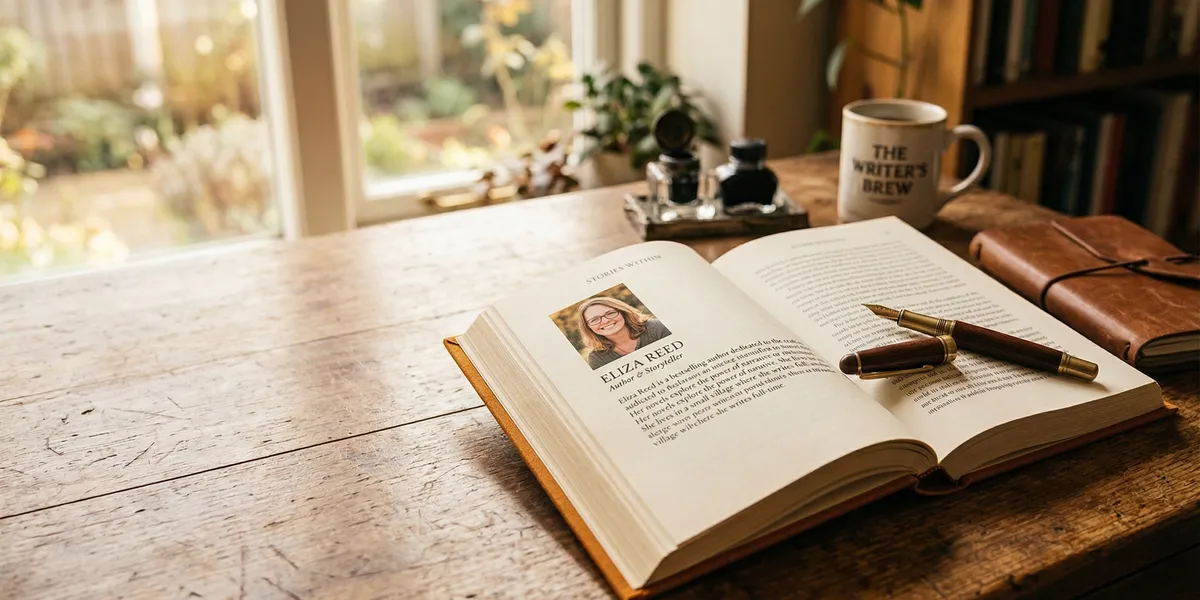
Your about the author section is doing one job: convincing a stranger to trust you. Readers check it after your cover hooks them and your description interests them. If your bio falls flat, so does the sale.
This guide walks you through writing an about the author section that builds credibility, creates connection, and works across every platform where readers find you.
What an about the author section actually does
The about the author section is a short biography — usually 50 to 200 words — that appears in the back matter of your book, on retail sites like Amazon, and on your author website. Its purpose is simple: prove you are worth reading.
For nonfiction, that means showing you have the credentials or experience to write about your topic. A diet book from a certified nutritionist carries more weight than one from someone with no stated background. For fiction, it means giving readers a sense of your personality and writing world — what you write, why you write it, and enough humanity to make you memorable.
According to AuthorHouse, an effective author bio should be around 100 to 150 words and written in third person. Amazon’s KDP guidelines recommend keeping your Author Central bio under 1,000 characters for the short version.
Most readers spend under ten seconds on your bio. That is not much time to establish trust — which is why every word needs to earn its place.
The five elements every about the author needs
Whether your bio is 50 words or 500, it needs to answer the same core questions. Miss one, and readers notice — even if they cannot articulate what feels off.
1. The hook — who you are as a writer
Open with one to two sentences that define you in relation to the book they are about to read (or just read). This is not your life story. It is the single most relevant fact about you.
Nonfiction example: “Dr. Sarah Chen is a behavioral psychologist at Columbia University whose research on habit formation has been cited in The New York Times.”
Fiction example: “Marcus Wilder writes suspense novels set in small Southern towns where everyone has secrets and nobody locks their doors.”
The hook answers the reader’s first question: Should I care what this person has to say?
2. Credentials that connect to the book
Scribe Media calls this the single most important part of a nonfiction author bio. Your credentials need to be relevant to this specific book — not your entire resume.
- Writing a business book? Mention the companies you have built or led.
- Writing a memoir about addiction recovery? Your lived experience IS the credential.
- Writing genre fiction? Previous publications, awards, and writing community involvement matter here.
A common mistake is listing credentials that have nothing to do with your topic. Your MBA does not add credibility to your poetry collection. Your nursing degree does not make readers trust your fantasy novel. Match credentials to content.
3. Social proof
Numbers and names are more persuasive than adjectives. Instead of calling yourself a “bestselling author,” state the specific achievement.
| Weak | Strong |
|---|---|
| ”Bestselling author" | "Author of three Amazon #1 bestsellers in business strategy" |
| "Popular blogger" | "Her newsletter reaches 45,000 subscribers weekly" |
| "Well-known speaker" | "Keynote speaker at TEDx, SXSW, and the World Economic Forum” |
Social proof also includes media mentions, awards, endorsements, and sales figures. If USA Today or the New York Times covered your work, say so. IngramSpark’s guide emphasizes that concrete achievements build more trust than vague superlatives.
4. A human detail
One personal fact makes you memorable. Two is fine. Five and you have lost the reader.
Good personal details feel intentional, not random. They hint at personality or connect to your writing life:
- “She lives in Portland with two rescue dogs and an unreasonable collection of vintage typewriters.”
- “When he is not writing, he coaches his daughter’s little league team — badly.”
These details work because they reveal character in a single line. They make you a person, not just a name on a cover.
5. A call to action
Tell the reader where to find more of your work. This is especially important in the back-of-book bio where you have a captive audience — someone who just finished reading your book and might want more.
Effective calls to action for an about the author section:
- Link to your website or newsletter
- Mention your next upcoming book
- Direct readers to your social media
- Point them to your full catalog
Keep it to one or two links. A bio that reads like a link directory defeats its own purpose.
How to write your about the author (step by step)
Step 1: Start with your longest version
Write your website bio first — 200 to 400 words. This is your most complete version. Include all five elements above, and write in a voice that matches your books.
According to Reedsy’s author bio guide, writing the long version first and then trimming it down is far easier than trying to build up from a short version.
Step 2: Write in third person
Use “she” or “he” or “they” — not “I.” Third person is the standard for about the author sections in books, on Amazon, and in press materials. It reads as more professional and is easier for others to quote directly.
The one exception: your personal website About page can use first person if it fits your brand. Everywhere else, third person.
Step 3: Cut it down for each platform
Your about the author section needs to work in multiple places, each with different length requirements:
| Platform | Ideal length | Focus |
|---|---|---|
| Back of book | 50-75 words | Credentials + one human detail |
| Amazon Author Central | Under 1,000 characters | Credentials + social proof + CTA |
| Website About page | 200-400 words | Full story + personality + CTA |
| Social media bios | 150 characters | One punchy line + genre |
| Press kit / speaking intro | 100-200 words | Credentials + achievements |
Start with the long version and delete until you reach the target length for each platform. Prioritize differently for each: Amazon gets more social proof, the book gets more personality, social media gets your sharpest line.
Step 4: Read it out loud
If your bio sounds stiff, robotic, or like it was written by a committee, rewrite it. Your about the author section should sound like a confident introduction at a dinner party — not a LinkedIn summary.
Step 5: Get feedback from someone who does not know you
Hand your bio to a reader in your target audience — not your spouse, not your writing group, not your mom. Ask them two questions:
- After reading this, would you trust this person to write about [your topic]?
- What is the one thing you remember?
If they cannot answer both questions clearly, revise.
About the author templates you can use today
Nonfiction author template
[Name] is a [relevant credential] who has [specific achievement]. [He/She/They] [additional proof point or experience that connects to the book’s topic]. [Name]‘s work has been featured in [publications or media]. [Personal detail]. Learn more at [website].
Fiction author template
[Name] writes [genre] novels that [one-sentence description of your style or themes]. [He/She/They] is the author of [previous works or series], which [achievement — award, sales, reader response]. [Personal detail]. [He/She/They] lives in [location]. Find more at [website].
First-time author template
[Name] is a [profession or background] who spent [time period] [doing something relevant to the book]. [Book Title] is [his/her/their] first book. [One sentence connecting your experience to why you wrote this book]. [Personal detail].
The first-time author template is important because, as Kindlepreneur notes, debut authors often freeze up trying to list credentials they do not have yet. Your experience IS the credential. Lead with it.
Where to put your about the author section
Your bio should appear in every place a reader might look for it:
In your book: Place the about the author section in the back matter — after the last chapter and before the acknowledgments or index. Some authors also include a brief version on the back cover or inside the dust jacket. The Chicago Manual of Style recommends placing the author bio either on the back cover or in the back matter.
On Amazon: Fill out your Author Central profile completely. This is the page readers land on when they click your author name from any book listing. Upload a professional photo, write your full bio, and list all your books. According to Kindlepreneur, an optimized Author Central page can significantly increase discoverability and sales.
On your website: Your About page is often the second most-visited page on any website. Make it personal, include a photo, and link to your books.
In your book proposal or query letter: Agents and publishers read your bio before they read your manuscript. Make it count.
If you are self-publishing through a platform like Chapter, your formatted manuscript can include the about the author section in the back matter before you export to PDF or upload to distributors.
Common mistakes to avoid
- Writing in first person for your book bio. Save “I” for your website. Books and Amazon use third person.
- Listing irrelevant credentials. Only include experience that connects to THIS book.
- Being too humble. “Just a mom who likes to write” does not sell books. State your accomplishments plainly.
- Being too boastful. Calling yourself “the world’s foremost expert” without evidence undermines trust.
- Forgetting the call to action. If readers finish your bio and have no idea where to find more, you missed an opportunity.
- Never updating it. Your bio should evolve with each book. Add new achievements, remove outdated details, and keep it fresh. Scottish Book Trust recommends reviewing your bio with every new publication.
FAQ
How long should an about the author section be?
For the back of a book, aim for 50 to 75 words. For Amazon Author Central, stay under 1,000 characters. For your website, 200 to 400 words gives you room to be both professional and personal.
Should I write my about the author in first or third person?
Third person for books, Amazon, press kits, and speaking introductions. First person is acceptable on your personal website if it matches your brand voice.
What if I am a first-time author with no credentials?
Lead with the experience that made you write this book. Your career, research, lived experience, or obsessive interest in the topic IS the credential. Many successful debut authors focus on why they wrote the book rather than traditional publishing credentials.
Can I use the same about the author section everywhere?
No. Write your longest version first, then create shorter versions tailored to each platform. Your Amazon bio emphasizes social proof and discoverability. Your book bio emphasizes personality and connection. Your social media bio distills everything into one punchy line.
How often should I update my about the author?
Review it with every new book publication, major media appearance, or significant achievement. At minimum, update it once a year to keep it current.
Need help writing your book — not just the bio? Chapter helps nonfiction authors go from idea to finished manuscript using AI-assisted writing tools. Over 2,147 authors have used it to create more than 5,000 books.