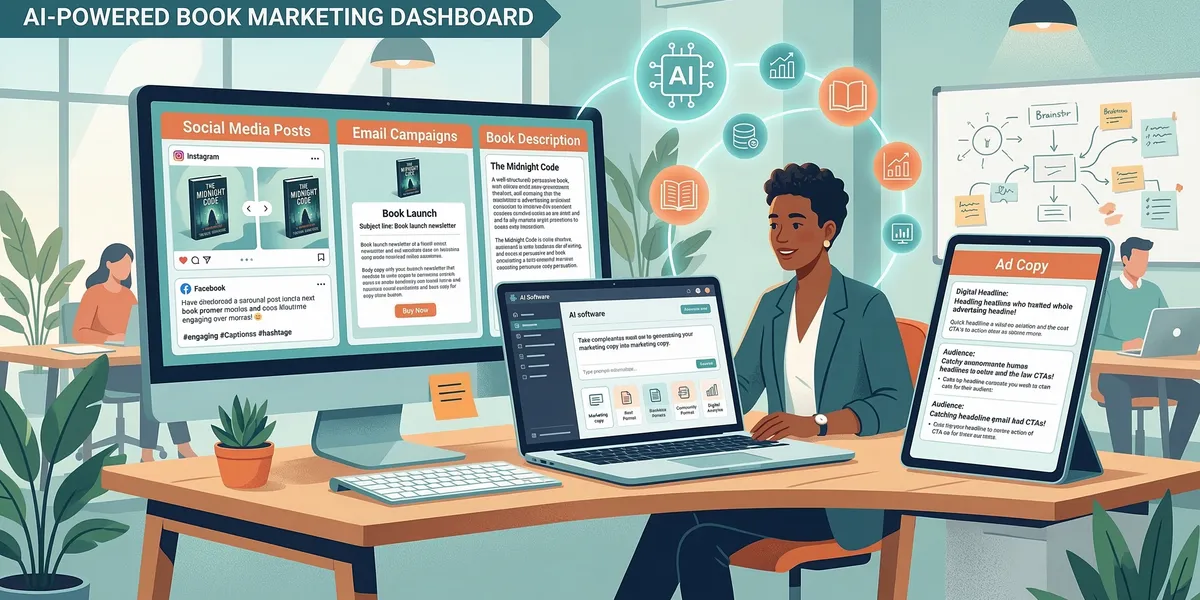
Writing the book is half the job. Marketing it is the other half, and most authors would rather write a second book than figure out Facebook ads, email sequences, and Amazon metadata.
AI does not eliminate the marketing work, but it compresses it. Tasks that used to take days — writing 30 social media posts, drafting a launch email sequence, optimizing your book description — now take hours. The authors who use AI for marketing effectively treat it as a production tool, not a strategy tool. You still need to know who your reader is and what they care about. AI handles the output once you have the direction.
Here is what works, what does not, and how to do it.
Book descriptions
Your book description is the single highest-leverage piece of marketing copy you will write. On Amazon, it is the primary factor (after cover and title) that converts a browser into a buyer.
How to use AI:
Paste your book’s premise, target audience, key themes, and 2-3 comparable titles into ChatGPT or Claude. Ask for 5 variations of a book description under 200 words.
Prompt template:
Write a book description for Amazon. My book is [title] about [topic/premise] for [target reader]. Comparable titles: [2-3 comps]. Key themes: [themes]. Tone: [casual/authoritative/suspenseful]. Write 5 variations, each under 200 words. Lead with the reader’s problem or the story hook. End with a reason to buy now.
What works: AI produces solid structural templates for book descriptions. It handles the format well — hook, premise, stakes, CTA.
What does not work: AI book descriptions sound like every other AI book description. The phrases “In a world where…” and “What follows is a journey…” appear in thousands of AI-generated descriptions. You need to edit for specificity and voice. Replace generic language with concrete details from your book.
Pro tip: Write your own book description first, even if it is rough. Then ask AI to improve it. Starting from your words preserves your voice better than generating from scratch.
Social media content
Most authors need 3-5 social media posts per week to maintain visibility during a book launch. That is 60-100 posts over a launch period. Writing them manually is a full-time job. AI makes it manageable.
How to use AI:
Feed AI your book’s key messages, target audience, and the platforms you use. Generate posts in batches, then schedule them.
Prompt template:
Create 10 social media posts promoting my book [title] about [topic]. My audience is [description] on [platform]. Include: 3 posts sharing a key insight from the book, 2 posts with a compelling question related to the topic, 2 posts with a brief tip or technique from the book, 2 posts with social proof or behind-the-scenes content, 1 direct call-to-action post. Keep each under [character limit for platform]. Do not use hashtags unless I ask for them.
What works: AI generates volume quickly and provides variety in post types. It is particularly good at repurposing book content into standalone insights.
What does not work: AI social posts feel generic without personalization. Add your own anecdotes, reference current events, and include photos from your writing process. The posts that perform best are the ones that feel human, not produced.
Platform-specific tips:
- Instagram/Threads: Shorter, more personal. AI handles caption drafts; you add the visual element.
- LinkedIn: Longer, more authoritative. AI excels here because the format rewards structured thinking.
- X/Twitter: Punchy and opinionated. AI tends to be too balanced — push it toward a stronger point of view.
- TikTok/Reels scripts: AI can draft scripts, but delivery matters more than words. Use AI for the talking points, not the script verbatim.
Email sequences
Email converts better than any other channel for book launches. A well-structured 5-7 email sequence to your list can drive more sales than all social media combined.
How to use AI:
Map out your email sequence structure first: what each email does and when it sends. Then generate the copy for each email.
Sequence structure:
- Announcement (1 week before): The book exists, here is why it matters
- Value preview (3 days before): Share a key insight or chapter excerpt
- Launch day: The book is live, here is how to get it
- Social proof (2 days after): Early reviews, reader reactions, results
- Last chance (1 week after): Final reminder, bonus or urgency element
Prompt template:
Write email [number] of my book launch sequence. The email goal is [goal]. My book [title] is about [topic] for [audience]. My relationship with this list is [how they know you]. Tone: [conversational/professional]. Keep the email under 200 words. Subject line options: give me 5. The CTA is [specific action].
What works: AI writes competent email copy quickly. The structure and flow of launch sequences are predictable enough that AI handles them well.
What does not work: AI email copy lacks the personal connection that makes email marketing effective. The best emails feel like a message from a friend, not a marketing campaign. Add personal anecdotes, reference shared experiences with your audience, and write subject lines in your own voice.
Ad copy
Paid advertising — Amazon Ads, Facebook/Instagram Ads, BookBub — requires concise, persuasive copy that fits strict format constraints. AI is well-suited to this because ad copy has clear rules: character limits, required elements, and measurable results.
How to use AI:
Generate multiple ad variations and test them. The advantage of AI is speed of iteration — you can create 20 ad variations in the time it would take to write 3 manually.
Prompt template:
Write 10 ad copy variations for my book [title] on [platform]. Target audience: [description]. Ad format: [headline + description / single text / image caption]. Character limit: [limit]. Each variation should take a different angle: benefit-focused, curiosity-driven, social proof, problem-agitation, and direct offer. Include a clear CTA in each.
What works: AI generates high volume of test variations. Run 5-10 variations, see which ones perform, then iterate on the winners.
What does not work: AI cannot predict which angle will resonate with your specific audience. That requires testing. Use AI for volume, human judgment for strategy.
Blog content from your book
Your book is a content goldmine. Each chapter can generate 3-5 blog posts, creating a content marketing engine that drives traffic to your book for months or years after launch.
How to use AI:
Feed AI a chapter and ask it to extract standalone blog post ideas.
Prompt template:
Here is a chapter from my book: [paste chapter]. Extract 5 blog post ideas from this content. For each, give me: a SEO-friendly title, a 2-sentence summary, the target keyword, and how it connects back to the book as a CTA. Each post should stand alone as valuable content even if the reader never buys the book.
What works: AI is excellent at identifying standalone ideas within longer content. This repurposing workflow produces months of content from a single book.
What does not work: AI-generated blog posts need the same editing as any AI content. Do not publish raw output. Apply the editing process for AI-generated text to maintain quality.
Metadata optimization
Amazon metadata — title, subtitle, categories, keywords, and description — directly determines whether readers find your book. AI helps optimize these elements using data-driven approaches.
How to use AI:
Use ChatGPT to brainstorm keywords and category options. Then verify them against actual Amazon search data using tools like Publisher Rocket or the Amazon search bar autocomplete.
Prompt template:
My book is [title] about [topic] in [genre]. My target reader searches Amazon for [general terms]. Generate: 7 backend keywords (phrases readers use to find books like mine), 5 subtitle options that include key search terms, 3 Amazon category suggestions with the full category path, and 5 alternative titles optimized for discoverability.
What works: AI generates creative keyword combinations you might not think of. It is also good at writing subtitles that balance SEO with reader appeal.
What does not work: AI does not have access to real Amazon search volume data. Verify every keyword suggestion against actual search behavior before committing.
Reader persona development
Understanding who your reader is drives every marketing decision. AI accelerates persona development by drawing on patterns from its training data.
Prompt template:
Create 3 detailed reader personas for a book about [topic] in [genre]. For each persona: demographics, psychographics, where they hang out online, what podcasts they listen to, what other books they have bought, what problem drives them to search for a book like mine, and what would make them recommend my book to a friend.
What works: AI personas are surprisingly useful as starting points. They surface reader motivations and media habits that inform your marketing channel selection.
What does not work: These are hypothetical profiles, not real data. Validate personas against your actual audience — email list surveys, social media analytics, and reader reviews of comparable books.
What does not work with AI marketing
Honesty about limitations matters:
- AI cannot replace strategy. It generates copy, not marketing plans. You still need to decide which channels to focus on, what your positioning is, and how much to spend.
- AI does not know your audience. It knows generic audience patterns. Your specific readers have specific preferences that only data from your actual audience reveals.
- AI copy needs editing. Every piece of AI marketing copy should be reviewed for voice, accuracy, and brand consistency before publishing.
- AI cannot build relationships. The highest-converting marketing activities — genuine engagement, community building, personal emails — require a real person. AI handles the production tasks that free you up for relationship building.
The marketing stack
For authors who want to streamline the full process from book to marketing:
Chapter generates your complete manuscript and includes book descriptions and marketing copy in the output. Over 2,147 authors have used it to create 5,000+ books, and the platform was designed to get authors from concept to published — including the marketing materials that help the book sell.
Arek Z. generated $60,000 in 48 hours from his book launch. Jim T. landed a $13,200 consulting client from a single reader. These results came from combining quality content with effective marketing — exactly the workflow AI makes possible.
For more on book marketing, read our guides on how to market a self-published book, how to write a book description that sells, and how to build an author platform.
FAQ
Which AI tool is best for book marketing?
ChatGPT is the most versatile for marketing copy generation. Claude is better for longer-form content like blog posts and email sequences. Perplexity is useful for market research and competitive analysis. Most authors benefit from using 2-3 tools depending on the task.
How much time does AI save on book marketing?
Authors report saving 50-70% of marketing content creation time when using AI. A book launch email sequence that takes 8-10 hours manually can be drafted in 2-3 hours with AI (including editing). Social media content batching drops from 20+ hours per month to 5-8 hours.
Should I use AI-generated marketing copy without editing?
No. AI marketing copy is a first draft that needs your voice, your specifics, and your audience knowledge layered in. Publishing unedited AI marketing copy is how you end up sounding identical to every other author using the same tools. The editing pass is where your marketing becomes effective rather than generic.
Can AI help with Amazon ads specifically?
Yes. AI is particularly strong at generating ad copy variations for A/B testing on Amazon Ads. Generate 15-20 headline and description combinations, test 5-10, and iterate on the winners. The volume advantage AI provides is most valuable in paid advertising where testing multiple variations is the path to optimization.