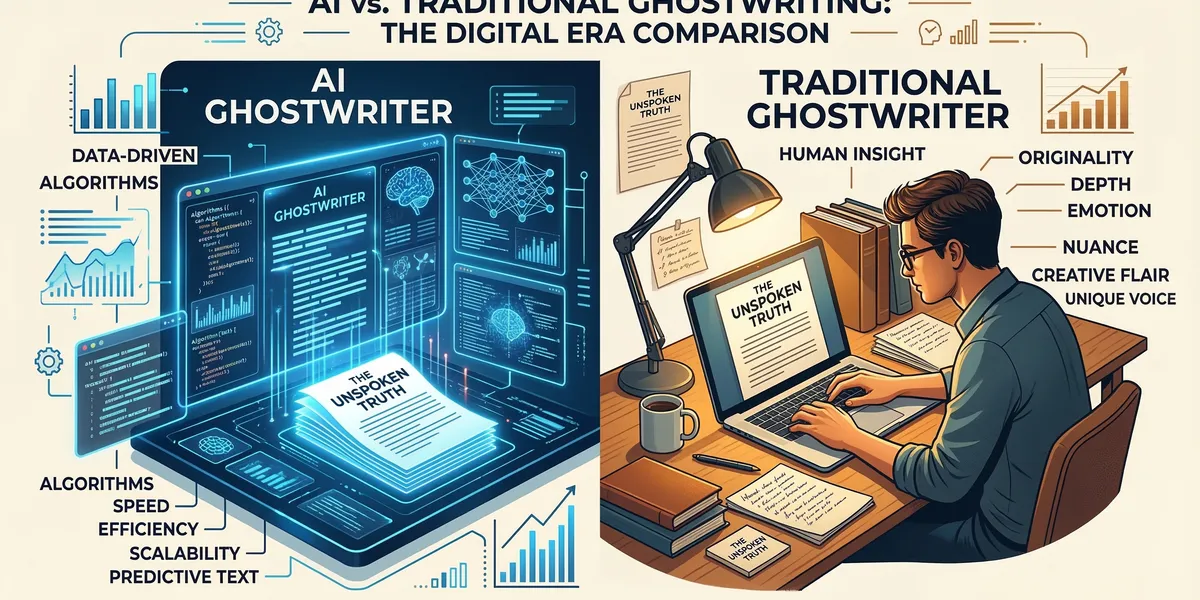
An AI ghostwriter costs $97 and delivers a manuscript in days. A traditional ghostwriter costs $10,000 to $50,000+ and takes three to twelve months. For authority books, lead magnets, and structured nonfiction, AI delivers comparable results. For deeply personal memoirs and complex literary works, human ghostwriters still hold the edge.
Here is a full side-by-side comparison so you can decide which path fits your book, your budget, and your timeline.
Quick Verdict: AI Ghostwriter vs Traditional Ghostwriter
| Factor | AI Ghostwriter (Chapter) | Traditional Ghostwriter |
|---|---|---|
| Cost | $97 one-time | $10,000–$50,000+ |
| Timeline | Days to 2 weeks | 3–12 months |
| Quality | Strong for structured nonfiction | Excellent across genres |
| Voice matching | Based on your input and direction | Developed through interviews |
| Revisions | Unlimited regeneration | 2–3 rounds included |
| Creative input needed | You provide expertise and structure | Collaborative throughout |
| Best for | Business books, authority books, lead magnets | Memoirs, literary works, celebrity books |
For most nonfiction authors writing a business book, coaching framework, or thought leadership piece, AI ghostwriting delivers 90% of the result at roughly 1% of the cost. The rest of this article explains why.
What an AI Ghostwriter Actually Does
An AI ghostwriter takes your expertise, topic, and preferred structure and generates a full manuscript from that input. You are not handing off the project and walking away. You provide the direction — your ideas, your framework, your knowledge — and the AI produces the written output.
With a platform like Chapter, the process works like this: you describe your book’s topic, define the audience, outline the chapters or let the AI suggest a structure, and then generate the manuscript section by section. You review each chapter, make edits, adjust the tone, and reshape sections that don’t land the way you want.
This is not a magic button that writes a bestseller while you sleep. It is a tool that eliminates the blank-page problem and compresses months of writing into days. You still need to bring the substance. The AI handles the drafting.
The output quality depends heavily on how much expertise you feed into the process. Authors who provide detailed outlines, strong opinions, and specific examples get manuscripts that read like they wrote them. Authors who provide vague prompts get vague books.
What a Traditional Ghostwriter Does
A traditional ghostwriter is a professional writer you hire to produce your book. The process is deeply collaborative. It typically starts with a series of interviews — sometimes ten to twenty hours of recorded conversation — where the ghostwriter extracts your ideas, stories, voice patterns, and expertise.
From those interviews, the ghostwriter creates an outline, writes a sample chapter for your approval, and then drafts the full manuscript over several months. You review each section. They revise based on your feedback. Most contracts include two to three revision rounds.
Good ghostwriters study how you speak, the phrases you use, the rhythm of your sentences. The goal is a finished book that sounds like you wrote it, even though someone else did the typing. This voice-matching process is the core value of traditional ghostwriting, and it requires real human skill.
The experience is closer to having a co-author than hiring a service. You are working with a person who becomes an expert in your ideas and translates them to the page. For the right project, this collaboration produces exceptional results.
For a detailed breakdown of traditional ghostwriter pricing, see our guide on how much ghostwriters cost.
Where AI Ghostwriting Wins
Speed
A traditional ghostwriter takes three to six months on the fast end, and up to twelve months for complex projects. An AI ghostwriter produces a full manuscript draft in days. If you need a book for an upcoming speaking engagement, a product launch, or a business milestone, AI closes the gap between “I should write a book” and “here is my book” from months to a weekend.
Cost
This is the most obvious advantage. Traditional ghostwriting is a premium service. You are paying for a skilled professional’s time over several months, and that costs $10,000 to $50,000+ depending on the ghostwriter’s experience and the project scope.
An AI ghostwriting platform like Chapter costs $97. That is not a monthly subscription. It is a one-time payment. The math is not subtle.
Iteration
With a human ghostwriter, every revision round is a negotiation. You are asking a person to rewrite their work, and most contracts limit you to two or three rounds. With AI, you can regenerate sections endlessly. Don’t like the tone of chapter three? Regenerate it. Want to try a different structure? Rebuild the outline and generate a new draft. The cost of experimentation is effectively zero.
Availability
Traditional ghostwriters are booked months in advance. Finding one who is available, affordable, and experienced in your niche can take weeks of searching alone. AI ghostwriting is available the moment you decide to start. No scheduling, no waitlists, no compatibility interviews.
Where Traditional Ghostwriters Win
Voice Nuance
A skilled human ghostwriter captures subtle voice patterns that AI cannot fully replicate — the way you trail off before making a point, the specific metaphors you reach for, the cadence of your humor. For books where voice is the product (comedic memoirs, personal essays, literary nonfiction), a human ghostwriter delivers something AI currently does not match.
Emotional Depth
Books that depend on emotional storytelling — addiction recovery memoirs, grief narratives, deeply personal origin stories — benefit from a writer who can feel the weight of the material and shape it with intention. AI can structure a narrative, but it does not grieve, celebrate, or wrestle with meaning. A human ghostwriter brings interpretive judgment to sensitive material.
Complex Research
Some books require original research: interviewing sources, synthesizing contradictory data, navigating technical or regulated subject matter. A ghostwriter with domain expertise (medical, legal, scientific) brings knowledge that AI models may not have or may not apply accurately. For books where factual precision is non-negotiable, human oversight matters.
Celebrity and High-Profile Projects
Celebrity memoirs, political books, and high-profile business narratives involve layers of sensitivity — NDAs, legal review, reputation management, media coordination. These projects require a ghostwriter who can navigate the human complexity surrounding the book, not just the writing itself.
”The Book Was Totally Perfect”
Adam W. is a professional copywriter who writes for 8-figure brands. He knows what good writing looks like. He has spent years crafting copy that moves audiences and drives revenue. When he decided to write a book, he initially planned to hire a ghostwriter — a decision that would have cost him roughly $25,000.
Instead, he used Chapter’s AI book writer.
His reaction:
“The book was totally perfect. It was almost like exactly what I would have written myself. Saved me $25K on a ghostwriter.”
This is not a casual reader who can’t tell the difference between good and bad writing. This is a professional whose entire career depends on knowing what strong copy looks like. And he said the AI output matched what he would have written himself.
Adam’s experience illustrates the core argument for AI ghostwriting: for structured, expertise-driven nonfiction, the quality gap between AI and human ghostwriters has narrowed to the point where the price difference is no longer justified for most authors.
The Hybrid Approach: Best of Both Worlds
If you want the speed and cost savings of AI with the polish of human editing, consider a hybrid approach:
-
Use AI for the first draft. Generate your manuscript with Chapter for $97. Get the structure, arguments, and flow down in days instead of months.
-
Hire a human editor to polish. A professional developmental editor costs $1,500 to $4,000 — a fraction of a ghostwriter’s fee. They refine voice, tighten prose, and catch anything the AI missed.
-
Add your personal touch. Review the edited manuscript and layer in personal stories, client examples, and specific details that only you know. This is where your book becomes unmistakably yours.
Total cost: roughly $1,600 to $4,100. Total time: two to four weeks. Compare that to $25,000+ and six to twelve months with a traditional ghostwriter. You get a professionally polished manuscript at a fraction of the price and timeline.
This approach works especially well for coaches, consultants, and business owners who have deep expertise but limited time to write. The AI captures your knowledge. The editor makes it shine. You add the human details that make it personal.
How to Write a Book With AI (Step by Step)
If you are leaning toward the AI route, here is how to get a strong result:
Start with a clear outline. The better your structure going in, the better your manuscript coming out. Define your chapters, the key points in each, and the audience you are writing for. Chapter’s platform helps you build this outline before generating any content.
Bring your expertise. AI ghostwriting works best when you feed it specific knowledge — your frameworks, your client stories (with permission), your contrarian takes, your hard-won lessons. Generic input produces generic output.
Review and edit aggressively. Treat the AI draft as a very strong first draft, not a finished product. Read every chapter. Cut what does not sound like you. Add details the AI could not know. This editing pass is what separates a forgettable AI book from a genuinely useful one.
Get outside feedback. Send the manuscript to a few trusted readers or a professional editor before publishing. Fresh eyes catch blind spots that you and the AI both miss.
For a more detailed walkthrough, see our guide on how to write a book with AI.
Bottom Line
For most business books, authority books, coaching frameworks, and structured nonfiction, AI ghostwriting delivers 90% of the result at 1% of the cost. The technology is not perfect for every project — deeply personal memoirs, complex literary works, and celebrity narratives still benefit from human ghostwriters. But for the vast majority of authors who want a professional book that establishes expertise and generates leads, AI has made traditional ghostwriting a hard sell.
The $25K question has a $97 answer.
Try Chapter’s AI book writer and see for yourself why professionals like Adam — who writes for 8-figure brands — called the output “totally perfect.”
Further Reading
- How Much Does a Ghostwriter Cost? — Full pricing breakdown for traditional ghostwriters
- AI Book Writer: The Complete Guide — How AI book writing platforms work
- How to Write a Book With AI — Step-by-step walkthrough
- Chapter Review — Detailed review of the Chapter platform