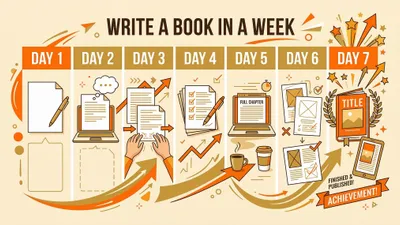
You can go from a raw book idea to a polished, publish-ready manuscript in 30 days or less — if you follow the right AI writing workflow.
In this guide, you’ll learn:
- The five-stage AI writing workflow that 2,147+ authors use to produce books faster
- How to set up your AI tools for each phase of the writing process
- The “selective deployment” approach that keeps your voice authentic while using AI for heavy lifting
- How to write 5,000+ words a day without burning out or sacrificing quality
Here’s the complete workflow, stage by stage.
What Is an AI Writing Workflow?
AI writing workflow — A structured, repeatable process where you use artificial intelligence tools at specific stages of book creation — outlining, drafting, editing, and publishing — while maintaining creative control over the final product.
Think of it like a production line for your book. You’re the creative director. AI handles the labor-intensive parts — generating raw material, checking consistency, catching errors — while you make every decision about story, voice, and structure.
The key distinction: you’re not handing your book to a robot. You’re integrating AI into a process you control. Research from arXiv on creative writers and AI found that successful authors treat AI instrumentally — as one resource among many — rather than as a replacement for their creative judgment.
Why You Need a Structured Workflow (Not Just a Chatbot)
Most authors who try AI writing fail at the same point: they open ChatGPT, type “write me a book about leadership,” get 500 generic words, and give up.
That’s not a workflow. That’s a coin toss.
A structured AI writing workflow solves three problems:
- Consistency — Every chapter follows the same quality standard because you use the same process for each one
- Speed — You eliminate the blank-page problem entirely, because AI gives you raw material to shape rather than an empty screen to fill
- Voice preservation — By defining your voice upfront and editing AI output through your creative lens, the finished book sounds like you wrote it
Authors using a structured AI book writing workflow report 30-50% faster time to market, according to Written Word Media’s 2025 indie author survey. That’s not because they skip steps — it’s because they eliminate friction at every stage.
Stage 1: Concept and Research (Day 1-2)
Every book starts with a clear concept. AI can help you refine it, but you need to bring the spark.
Start by writing one sentence that answers: What will the reader gain from this book? This is your premise. Without it, AI will generate aimless content that goes nowhere.
Define Your Reader
Before you touch any AI tool, write a one-paragraph reader profile. Include their age range, experience level, biggest pain point, and what they want to achieve. This becomes the foundation for every AI prompt you write.
For example: “My reader is a 35-55 year old professional who wants to write a business book to establish authority in their field. They have expertise but no writing experience. Their biggest fear is that the book will sound amateurish.”
Use AI for Research Acceleration
Once your concept is locked, use AI to accelerate your research phase:
- Feed your premise into ChatGPT or Claude and ask for the top 20 questions your target reader would have about this topic
- Use AI to summarize competing books in your space — what do they cover and what do they miss?
- Ask AI to identify data points, statistics, and studies relevant to your book’s argument
This isn’t about having AI write your research. It’s about having AI surface the material you’ll then evaluate, verify, and integrate with your own expertise.
Our Pick — Chapter
Chapter handles concept development and research in a single guided flow — you describe your book idea, define your audience, and the AI generates a structured research brief with key questions, competing angles, and a chapter framework. Over 5,000 books have been created on the platform using this exact process.
Best for: Authors who want a guided, all-in-one workflow from concept to published book Pricing: $97 one-time (nonfiction) Why we built it: Most AI tools treat book writing as a text generation problem. Chapter treats it as a project management problem — because that’s what finishing a book actually requires.
Stage 2: Outline and Structure (Day 3-5)
The outline is the most important deliverable in your entire workflow. A strong outline means every chapter has purpose, flow, and a clear reader payoff. A weak outline means you’ll spend weeks rewriting.
Build Your Chapter Skeleton
Use AI to generate a first-draft outline based on your premise and reader profile. Ask for:
- 10-15 chapter titles with one-sentence descriptions
- The key takeaway for each chapter
- A logical progression from problem to solution (nonfiction) or from setup to resolution (fiction)
Then — and this is critical — rewrite the outline yourself. Move chapters around. Cut the ones that feel like filler. Add the ones only you would think of, because you know your subject or story better than any AI does.
Your personal expertise is your information gain edge. AI gives you a skeleton. You add the muscle, skin, and personality.
Create Chapter-Level Briefs
For each chapter, write a 3-5 bullet brief:
- What question does this chapter answer?
- What story, example, or data point anchors it?
- What does the reader believe before reading this chapter vs. after?
These briefs become your prompts for Stage 3. The more specific they are, the better your AI drafts will be. You can create your book outline manually or use an AI book outline generator to get started faster.
Stage 3: Drafting With AI (Day 6-20)
This is where AI saves you the most time — and where most authors make the biggest mistakes.
The Chapter-by-Chapter Method
Never ask AI to draft your entire book at once. Generate one chapter at a time, feeding your chapter brief as the prompt. This gives you:
- Better continuity between chapters
- More control over pacing and tone
- Shorter, more focused AI outputs that are easier to edit
For each chapter, provide the AI with:
- Your chapter brief (from Stage 2)
- A style reference — 2-3 paragraphs of your own writing that represent your voice
- The previous chapter’s ending paragraph (for continuity)
- Specific instructions on tone, length, and key points to include
How to Write 5,000 Words a Day With AI
The secret to high daily word counts isn’t typing faster — it’s eliminating the blank-page problem. Here’s the actual math:
- Morning session (2 hours): Generate 3 chapter drafts using your briefs. Raw AI output: ~6,000-9,000 words.
- Afternoon session (3 hours): Edit, rewrite, and humanize those 3 chapters. Final polished output: ~4,500-6,000 words.
- Net production: 4,500-6,000 finished words per day, 5 days a week.
At that pace, a 50,000-word nonfiction book takes 8-11 working days. A 75,000-word novel takes 12-17 days. This is how authors on Chapter and similar platforms write books with AI in under a month.
The key is that you’re not writing from scratch — you’re editing and shaping raw material. That’s a fundamentally different cognitive task, and it’s one most people can sustain for longer stretches.
Value-Driven Boundaries: Deciding What AI Touches
Research on creative writers and AI integration reveals an important pattern: the most successful authors set clear boundaries on what AI handles and what stays human.
Here’s a practical framework:
| Writing Task | Let AI Handle | Keep Human |
|---|---|---|
| Research | Summarizing sources, finding data | Evaluating relevance, forming arguments |
| Outlining | First-draft structure, chapter suggestions | Final structure, creative choices |
| Drafting | Raw paragraph generation, scene blocking | Voice, emotional beats, key scenes |
| Dialogue | Initial exchanges, background conversations | Character-defining moments, subtext |
| Editing | Grammar, consistency checks, pacing analysis | Style choices, tone refinement, cuts |
This “selective deployment” approach — using AI for specific tasks while maintaining direct control over core creative elements — produces better books than either full-AI or no-AI approaches. Your readers can tell the difference between a book that was generated and one that was crafted with AI assistance.
Stage 4: Editing and Revision (Day 21-27)
Drafting is where AI saves time. Editing is where you earn quality. Every minute you invest in revision pays dividends in reader satisfaction, reviews, and sales.
The Three-Pass Editing System
Pass 1: Structural Edit (You + AI)
Read the full manuscript and evaluate whether the overall arc works. Ask AI to analyze your manuscript for:
- Pacing issues — chapters that drag or rush
- Logical gaps — arguments that skip steps or plot holes
- Repetition — points made twice that should be consolidated
Then make the structural changes yourself. Move chapters, cut sections, expand thin areas. AI identifies the problems; you decide the solutions. This is essentially developmental editing with an AI assist.
Pass 2: Line Edit (You)
This pass is about voice. Read every sentence and ask: does this sound like me? Would I say it this way?
AI-generated prose tends toward a particular blandness — correct but characterless. Your job in the line edit is to inject your personality, your metaphors, your rhythm. Cut any sentence that could have been written by anyone. Replace it with something only you would write.
Pass 3: Copy Edit (AI + You)
Now let AI handle the mechanical work. Use AI to catch:
- Grammar and punctuation errors
- Inconsistent spelling or formatting
- Fact-checking flagged claims
- Copy editing issues like style consistency
Review every AI suggestion before accepting. AI copy editors are good but not perfect — they occasionally “fix” intentional stylistic choices.
AI for Overcoming Writer’s Block During Revision
Writer’s block doesn’t just hit during drafting. Many authors stall during revision because they can’t see how to fix a chapter that isn’t working.
AI writing workflow for overcoming writer’s block — Use AI as a brainstorming partner when you’re stuck. Feed it the problematic section and ask for three alternative approaches. You don’t have to use any of them — but seeing alternatives often unlocks your own solution.
Other AI-powered unblocking techniques:
- Scene reframing: Ask AI to rewrite a scene from a different character’s perspective. Even if you don’t use it, it reveals what’s missing from the original.
- Constraint writing: Ask AI to compress a 2,000-word section into 500 words. The compression forces you to identify what actually matters.
- Question storming: Ask AI to generate 10 questions a reader would have after reading your stuck chapter. The answers often become the content you need.
A Gotham Ghostwriters study of 1,481 writers reported that authors using AI tools see an average 31% productivity boost — and most of that gain comes from eliminating blocks and dead-end revision cycles.
Stage 5: Publishing and Launch (Day 28-30)
Your manuscript is polished. Now it’s time to get it into readers’ hands.
Format Your Manuscript
AI can help generate the supporting materials that turn a manuscript into a published book:
- Book blurb — Ask AI to draft 3-5 versions of your back-cover copy. Pick the best one and rewrite it in your voice.
- Author bio — Generate a starting point, then edit for personality.
- Chapter titles — If your working titles feel flat, ask AI for 10 alternatives for each. Choose the ones that create curiosity.
- Table of contents — AI can format and organize your TOC for different platforms.
For formatting and export, platforms like Chapter handle conversion to PDF, EPUB, and print-ready files automatically. If you’re using a different workflow, tools like Atticus or Vellum handle the formatting stage. Check our guide to AI book publishing for the full process.
Choose Your Publishing Path
You have three main options:
- Self-publish on Amazon KDP — Fastest path to market. You keep 35-70% royalties. See our Amazon KDP self-publishing guide for step-by-step instructions.
- Wide distribution — Publish across Amazon, Apple Books, Kobo, Barnes & Noble, and more. Platforms like Draft2Digital or self-publishing platforms handle multi-channel distribution.
- Traditional publishing — Use your AI-assisted manuscript as a polished proposal for literary agents. Some authors on Chapter have used their AI-drafted books to land traditional deals.
Common Mistakes to Avoid
- Skipping the outline. Authors who jump straight to AI drafting produce fragmented, directionless books. The outline is your map — never skip it.
- Using a single AI tool for everything. Different stages need different strengths. A chatbot that’s great for brainstorming may produce flat prose for drafting. Match your tools to the task.
- Not editing enough. AI drafts are raw material, not finished writing. Plan to spend 40-50% of your total project time on editing.
- Losing your voice. If every sentence sounds like it could appear on any website, you’ve let AI overwrite your personality. Read your draft aloud — if it doesn’t sound like you, rewrite it.
- Trying to hide AI usage. Readers and publishers can detect fully AI-generated text. The goal isn’t to fool anyone — it’s to use AI as a tool that helps you produce a better book faster.
What Tools Do You Need for an AI Writing Workflow?
You don’t need a dozen subscriptions. Here’s the minimum viable toolkit:
| Tool Type | What It Does | Recommended Option |
|---|---|---|
| AI Writing Platform | Guided workflow from idea to book | Chapter (all-in-one) |
| General AI Assistant | Research, brainstorming, Q&A | ChatGPT or Claude |
| Grammar Checker | Copy editing, style consistency | Grammarly or ProWritingAid |
| Formatting Tool | Export to EPUB, PDF, print | Built into Chapter, or Atticus |
| Publishing Platform | Distribution to retailers | Amazon KDP, Draft2Digital |
If you want a deeper comparison of AI options, check our best AI tools for writing a book roundup.
How Long Does It Take to Write a Book With AI?
How long it takes to write a book with AI depends on your book’s length, your editing standards, and how much time you can dedicate daily. Here’s a realistic breakdown:
| Book Type | Word Count | AI-Assisted Timeline | Traditional Timeline |
|---|---|---|---|
| Short nonfiction | 20,000-30,000 | 2-3 weeks | 3-6 months |
| Full nonfiction | 40,000-60,000 | 3-5 weeks | 6-12 months |
| Novel | 60,000-90,000 | 4-8 weeks | 6-18 months |
| Memoir | 50,000-70,000 | 4-6 weeks | 8-18 months |
These timelines assume you’re working 3-5 hours per day. The biggest time savings come from the drafting stage, where AI cuts the work by 60-70%. Editing takes roughly the same amount of time whether you use AI or not — because quality editing requires human judgment.
Can This Workflow Work for Fiction?
Yes, but fiction requires adjustments. The five-stage workflow applies, but the drafting stage changes significantly:
- Voice matters more. Fiction readers are attuned to voice in a way nonfiction readers aren’t. You’ll spend more time in the line-edit pass ensuring the prose sounds like your narrator, not an AI.
- Scene-level prompting. Instead of chapter briefs, create scene cards — one card per scene with the POV character, goal, conflict, and outcome. Use these as your AI prompts.
- Dialogue needs heavy editing. AI dialogue tends toward exposition. Every conversation should sound like real people talking, not characters explaining the plot to each other.
For fiction-specific tools and techniques, check our guide to best AI novel writing tools and the best AI for writing a book with fiction-specific ratings.
Is AI Writing Ethical?
Is AI writing ethical? Yes — when you use AI as a tool rather than a replacement for your creative work. The ethical line is between AI-assisted writing (you direct, edit, and own the creative vision) and AI-generated writing (you press a button and publish whatever comes out).
Consider these principles:
- Transparency — Many authors disclose AI assistance in their acknowledgments. This is increasingly common and builds reader trust.
- Originality — Your ideas, expertise, and perspective are what make your book valuable. AI helps you express them faster, but the intellectual contribution is yours.
- Quality responsibility — You’re responsible for every word in the final manuscript. Fact-check AI claims. Edit AI prose. Make it yours.
The Alliance of Independent Authors and most major publishing platforms accept AI-assisted books as long as the author takes responsibility for the content. Amazon KDP’s AI policy requires disclosure but doesn’t prohibit AI-assisted work.
FAQ
What is the best AI writing workflow for beginners?
The best AI writing workflow for beginners is a five-stage process: concept, outline, draft, edit, publish. Start with a clear premise and reader profile. Use AI to generate a chapter outline, then draft one chapter at a time. Edit in three passes — structural, line, and copy — before formatting and publishing. Chapter guides beginners through this entire workflow in a single platform.
How many words can you write per day using AI?
You can write 4,500-6,000 polished words per day using an AI writing workflow. The process involves generating raw AI drafts in the morning (6,000-9,000 words) and editing them down in the afternoon (3-5 hours). At this pace, a 50,000-word book takes approximately 8-11 working days to draft.
Does AI writing still sound robotic in 2026?
AI writing in 2026 does not have to sound robotic if you edit properly. Raw AI output from tools like GPT-4 and Claude produces grammatically correct but characterless prose. The key is the line-editing pass where you inject your voice, replace generic phrasing with your own metaphors, and cut anything that sounds like it could appear on any website.
Can you use AI to write fiction and nonfiction?
You can use AI to write both fiction and nonfiction, but the workflow differs. Nonfiction benefits from AI’s research and structuring capabilities. Fiction requires heavier editing for voice, dialogue, and emotional depth. Over 5,000 books — spanning both fiction and nonfiction — have been created using Chapter’s guided workflow.
Is it legal to publish a book written with AI?
It is legal to publish a book written with AI assistance in most jurisdictions. You own the copyright to AI-assisted work as long as you provided substantial creative direction and editing. Amazon KDP, Apple Books, and other major platforms accept AI-assisted books with proper disclosure. The U.S. Copyright Office requires meaningful human authorship for copyright protection.