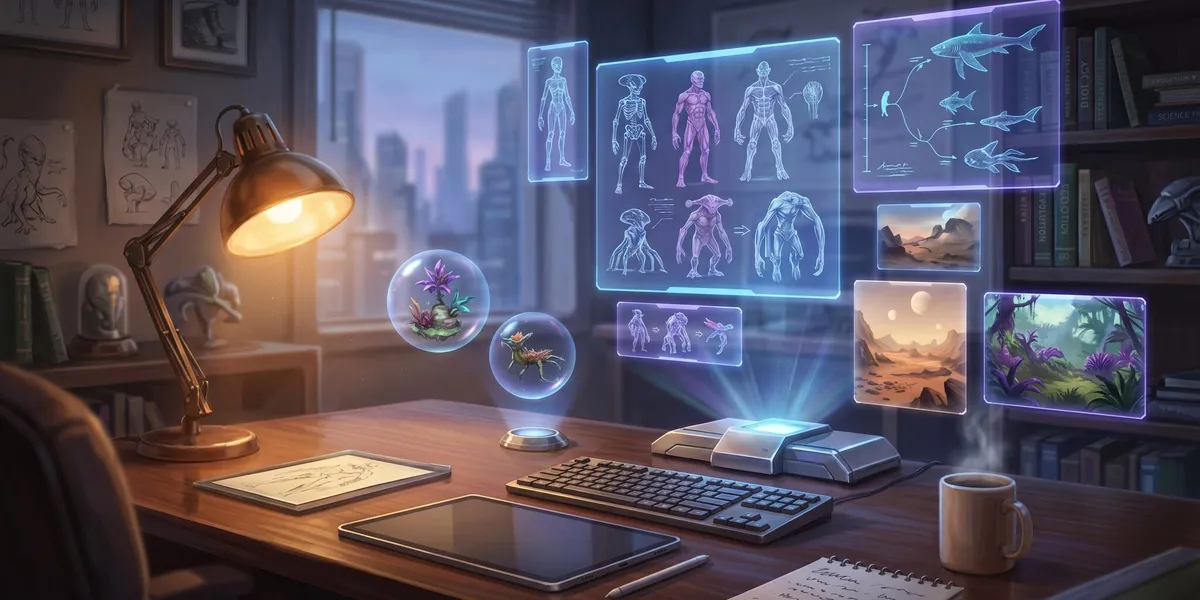
You create a believable alien species by starting with their environment, building outward through biology, then layering culture, language, and psychology on top. The species that feel real in fiction are the ones where every trait traces back to a survival reason.
In this guide, you’ll learn:
- How to design alien biology that follows real evolutionary logic
- The framework for building alien culture, religion, and social structure
- How to create alien languages and communication systems that feel authentic
- Common mistakes that make alien species feel like humans in rubber masks
Here’s how to build aliens your readers will believe in.
What This Guide Covers
- Start with the home planet
- Design alien biology from the environment up
- Build alien psychology and cognition
- Create alien culture and social structure
- Design alien language and communication
- Give your aliens believable technology
- Write alien characters, not alien props
- Use AI to accelerate your species design
- Common mistakes to avoid
- FAQ
Start with the Home Planet
Every believable alien species begins with one question: what world shaped them? The planet comes first because environment drives evolution. You can’t design a creature without knowing what it adapted to survive.
Consider these environmental variables before you sketch a single tentacle:
| Factor | Effect on Species | Example |
|---|---|---|
| Gravity | Higher gravity = shorter, denser bodies. Lower gravity = taller, lighter frames | A 2x Earth gravity species would have thick limbs and a low center of gravity |
| Atmosphere | Determines respiratory system, vocal capability, and sensory organs | A methane atmosphere species wouldn’t have lungs — they might absorb gas through skin |
| Light level | Affects vision, skin pigmentation, and circadian rhythms | A species from a dim red dwarf system might see in infrared and have enormous eyes |
| Temperature | Influences metabolism, body covering, and activity patterns | A species from a tidally locked planet might be nocturnal on the hot side, diurnal on the cold |
| Water availability | Shapes diet, migration patterns, and settlement density | Desert world species might store water internally like camels — or extract it from prey |
| Predator density | Determines fight/flight adaptations, social behavior, and intelligence development | A high-predator world produces species with 360-degree vision, armor plating, or herd behavior |
The key principle: every trait should trace back to a survival advantage. If your alien has six arms, there should be an environmental reason. Maybe they evolved on a world with dense vertical forests where climbing while carrying food was a survival advantage. Maybe their primary predator attacked from multiple angles simultaneously.
This is the approach the Science Fiction & Fantasy Writers Association recommends — start with the habitat, and let the species emerge from it.
Don’t worry about designing the entire planet in exhaustive detail. You need enough to justify your species’ key traits. A paragraph or two of planetary description is usually sufficient. If you want to go deeper on worldbuilding for your sci-fi setting, you can expand later.
Design Alien Biology from the Environment Up
Once you have your planet, you can start building the body. The best approach is working through biological systems one at a time, asking how each one adapted to the environment you’ve established.
Locomotion and Body Plan
How does your species move through its environment? This determines the overall body plan more than any other factor.
A species that evolved in open plains might be bipedal or quadrupedal runners. An aquatic species needs hydrodynamic shaping. A species from a world of floating gas islands might have evolved lighter-than-air bladders or wing membranes.
Don’t default to humanoid. The humanoid body plan (two arms, two legs, upright posture) evolved on Earth under very specific conditions. An alien world with different gravity, terrain, and predator dynamics would produce something different. The “rubber forehead alien” — a human with minor cosmetic changes — is the fastest way to break reader immersion.
Sensory Systems
Your species needs to perceive its environment to survive. But perception doesn’t have to mean sight, sound, smell, taste, and touch — those are Earth’s solutions.
Consider alternatives:
- Echolocation for species in dark or murky environments
- Electroreception for aquatic or underground species (sharks use this on Earth)
- Magnetoreception for migratory species on worlds with strong magnetic fields
- Infrared or ultraviolet vision for species under different stellar spectra
- Chemical sensing through skin contact rather than airborne smell
- Vibration sensing through substrate (like spiders sensing web trembles)
The senses your species has will shape everything about how they experience the world — and how you write from their perspective. A species that perceives primarily through echolocation would describe environments in terms of texture, density, and distance rather than color. This is a goldmine for distinctive prose.
Reproduction and Life Cycle
How your species reproduces affects their social structure, parental bonds, and population dynamics. Earth alone offers dozens of models beyond the mammalian default:
- Egg-laying with external incubation (reptilian)
- Spore-based reproduction (fungal)
- Budding or fission (asexual, like some invertebrates)
- Metamorphosis through distinct life stages (insect-like)
- Symbiotic reproduction requiring a third organism
- Seasonal mass spawning (many marine species)
A species that reproduces through mass spawning with no parental care would develop very different family structures than one where offspring require decades of nurturing. This single biological choice cascades into psychology, culture, and politics.
Diet and Metabolism
What your alien eats determines its teeth (or equivalent), digestive system, hunting/gathering behavior, and relationship with other species.
Think beyond carnivore, herbivore, and omnivore. A species might be a chemosynthesizer, drawing energy from volcanic vents. It might be a photosynthesizer with chloroplast-like structures in its skin. It might consume minerals, radiation, or even information (in a sufficiently speculative setting).
Diet also drives social behavior. Cooperative hunting species tend toward social intelligence. Solitary ambush predators tend toward territorial aggression. Filter feeders tend toward passive, sessile lifestyles. Choose a diet that supports the kind of character dynamics your story needs.
Build Alien Psychology and Cognition
This is where most alien species guides stop — and where yours can go deeper. Biology shapes the body. Psychology shapes the person. And alien psychology should be genuinely alien.
The Maslow Framework for Aliens
One useful tool is adapting Maslow’s Hierarchy of Needs for your species. Every sentient being has needs, but the hierarchy might be radically different:
For humans: Physiological → Safety → Belonging → Esteem → Self-actualization
For a hive-mind species: Colony survival → Role fulfillment → Efficiency optimization → Expansion → Integration of new knowledge
For an immortal species: Sensory stimulation → Novelty → Legacy creation → Connection → Transcendence
Rearranging the hierarchy of needs gives your species fundamentally different motivations — and motivation is what drives every scene in your novel. A species that prioritizes belonging above safety would willingly die rather than be isolated. That’s not a human reaction, and it makes for compelling alien characters.
Cognitive Differences
Consider how your alien thinks, not just what it wants:
- Time perception. A species with a 500-year lifespan might perceive decades the way you perceive months. Patience wouldn’t be a virtue — it would be the default state.
- Self-concept. A hive species might have no concept of individual identity. The word “I” might not exist in their language.
- Emotional range. Your species might lack human emotions entirely and have others instead. A crystalline species might feel “resonance” (harmony with environment) and “dissonance” (conflict) instead of happy and sad.
- Memory structure. A species might experience time non-linearly, remembering future and past with equal clarity. Or it might have no long-term memory at all, living perpetually in the present.
The goal is to create a mind that works differently from a human mind — not just a human mind wearing an alien costume. This is the difference between the truly memorable aliens in fiction (the Heptapods in Arrival, the Pierson’s Puppeteers in Ringworld) and forgettable ones.
Create Alien Culture and Social Structure
Culture emerges from biology and environment. A species that reproduces through mass spawning will develop different family structures than one with decades-long gestations. A species with natural armor will develop different attitudes toward violence than one that’s physically fragile.
Social Organization
Start with the biological constraints, then build the society:
- Pack/herd species tend toward hierarchical societies with clear leadership structures
- Solitary species might form loose alliances of convenience rather than permanent communities
- Hive species might have rigid caste systems determined biologically at birth
- Long-lived species might govern through gerontocracy (rule by the eldest)
- Short-lived species might prioritize rapid knowledge transfer and value youth over experience
Religion and Belief Systems
Every intelligent species grapples with existential questions. But their answers will be shaped by their biology and experience.
A species that can perceive electromagnetic fields might worship the planet’s magnetic core as a living deity. A species that reproduces through metamorphosis might view death as just another transformation — making them eerily calm about mortality. A photosynthetic species might literally worship their star, and that worship would be grounded in biological reality, not metaphor.
The SFWA guide on creating aliens emphasizes that constructing a belief system — whether it’s religious worship of cosmic phenomena or a strict philosophical code based on logic — gives your species depth that readers can feel even when it’s not directly explained.
Art, Ritual, and Expression
What does your species create? Art reveals values. A predator species’ art might celebrate the hunt. A long-lived species might create works that take centuries to complete. A species that communicates through bioluminescence might create “light symphonies” that are simultaneously art and conversation.
Think about what they celebrate, what they mourn, and how they mark transitions in life. These cultural details make aliens feel like a civilization rather than a collection of biological traits.
Design Alien Language and Communication
Language is where alien species either become truly convincing or fall flat. A species with no vocal cords shouldn’t speak English. A species that communicates through pheromones experiences conversation fundamentally differently than one that uses sound.
Communication Modality
Choose a primary communication method based on your species’ biology:
| Method | Biology Required | Strengths | Limitations |
|---|---|---|---|
| Vocal speech | Vocal cords or equivalent, atmosphere that carries sound | Fast, precise, works in darkness | Doesn’t work in vacuum or underwater |
| Bioluminescence | Light-producing organs | Visual communication, can convey emotion through color | Requires line of sight, useless in bright environments |
| Pheromones | Chemical production glands, chemical receptors | Conveys emotional states automatically, persistent | Slow, imprecise, directionally limited |
| Telepathy | Neural electromagnetic fields | Instant, nuanced, language-barrier-free | Range limitations, privacy concerns |
| Gesture/sign | Flexible appendages, good visual acuity | Silent, can be highly complex | Requires visual contact |
| Vibration | Ability to generate substrate vibrations | Works through solid materials, in darkness | Limited range, requires contact with medium |
Language Structure
If your species uses a structured language, consider how it might differ from human language patterns:
A warrior culture might use short, direct constructions with no conditional tense — everything is certain. A philosophical species might have dozens of tenses for degrees of possibility. A hive-mind species might have no first-person pronouns at all.
You don’t need to build an entire conlang (constructed language). A few key features — greeting structures, how they express certainty vs. doubt, what concepts they have no words for — give readers enough to feel the alienness. The concepts a language lacks tell you as much about a species as the concepts it has.
Translation and Miscommunication
If your story involves contact between species, language barriers create natural tension. Consider how your human characters would attempt to bridge the communication gap — and where miscommunication would create conflict.
Arrival by Ted Chiang is the gold standard here. The Heptapod language isn’t just different words for the same concepts — it’s a fundamentally different way of perceiving time, encoded in circular logograms. Learning the language literally changes how the human protagonist thinks.
Give Your Aliens Believable Technology
Technology follows from biology and environment. A species with natural echolocation might never develop visual displays. An aquatic species wouldn’t develop fire-based metallurgy — they might work with coral cultivation, biological engineering, or pressure-based manufacturing instead.
Technology Level
Decide where your species falls on the technological spectrum:
- Pre-technological: Tool use, but no manufactured goods. Their biology might be so capable they don’t need technology.
- Early technological: Agriculture, basic construction, simple tools. They’ve started shaping their environment.
- Industrial: Manufacturing, energy harnessing, early science. They’re transforming their world.
- Spacefaring: They’ve escaped their planet’s gravity well. This is where most sci-fi contact scenarios begin.
- Post-technological: Technology is so integrated it’s invisible. Biological engineering has replaced mechanical engineering.
Technological Philosophy
How a species approaches technology reveals their values. Humans tend toward tool-making that extends physical capability (telescopes extend sight, vehicles extend speed). A species that values harmony might develop technology that integrates with ecosystems rather than dominating them. A species with a collective consciousness might develop technology that enhances mental connection rather than physical ability.
This is one area where your worldbuilding choices compound. The technology level affects what kind of space opera or sci-fi novel you can write. A species with FTL travel creates a very different story than one limited to generation ships.
Write Alien Characters, Not Alien Props
The most common failure in alien fiction isn’t bad biology — it’s writing aliens as scenery instead of characters. Your alien species needs individuals with distinct personalities, internal conflicts, and arcs.
The Individual Within the Species
Not every human is the same, and not every member of your alien species should be the same. Even within strong cultural norms, individuals vary. A hive-minded species might have workers who question their role. A warrior species might produce an individual who values peace.
The tension between individual personality and species norms is one of the richest sources of character conflict in sci-fi. Spock’s half-human, half-Vulcan struggle in Star Trek works because it’s a character caught between two species’ expectations.
Point of View Considerations
If you’re writing from an alien’s perspective, commit to the alienness. Don’t describe colors if your species can’t see them. Don’t reference human emotional concepts if your species processes feelings differently.
Some techniques for alien POV:
- Describe environments through alien senses. If your species uses echolocation, describe rooms in terms of echoes, textures, and distances — not colors and shapes.
- Use alien metaphors. A desert species wouldn’t say “smooth as silk.” They might say “smooth as wind-polished stone.”
- Show alien priorities. When entering a room, what does your alien notice first? A predator species might assess threats. A social species might count individuals. A scientist species might measure the room’s dimensions.
Writing convincing alien POV is one of the hardest things in fiction writing, but it’s also one of the most rewarding. When readers feel genuinely inside an alien mind, that’s when your species becomes unforgettable.
Use AI to Accelerate Your Species Design
Building a detailed alien species from scratch takes time — especially when you’re working through biology, culture, language, and technology simultaneously. AI tools can help you iterate faster without sacrificing depth.
Our Pick — Chapter
Chapter’s AI writing assistant helps you develop alien species directly within your manuscript. Describe your planet’s conditions and Chapter generates biologically consistent species traits, cultural frameworks, and even sample dialogue in alien speech patterns — all integrated into your draft rather than in a separate worldbuilding document.
Best for: Fiction writers who want species design woven into their actual manuscript Pricing: $97 one-time (fiction) Why we built it: Over, including dozens of sci-fi novels with original alien species. Writers told us they wanted worldbuilding that feeds directly into prose, not a separate wiki.
You can also use AI tools for specific parts of the process:
- Brainstorm environmental variables by describing your planet’s star type, orbital mechanics, and atmosphere
- Generate biological trait chains — give AI a starting environment and ask it to extrapolate what adaptations would emerge
- Test cultural consistency by asking AI to identify contradictions in your species’ society
- Develop naming conventions for alien characters, places, and concepts
The key is using AI as a brainstorming partner, not a replacement for your creative decisions. The best alien species come from a writer’s specific vision. AI just helps you explore the implications of that vision faster. If you want to try AI-powered worldbuilding prompts, we have 60+ templates that work well for species design.
Common Mistakes to Avoid
After reviewing hundreds of sci-fi manuscripts and studying what works in published alien fiction, these are the pitfalls that trip up writers most often:
-
The rubber forehead problem. Your alien looks different but thinks, feels, and acts exactly like a human. If you can replace your alien character with a human from a different country and nothing changes, your alien isn’t alien enough.
-
Planet of hats. Every member of the species shares one personality trait — all warriors, all scholars, all tricksters. Real species have variation. Give your aliens internal diversity and disagreement.
-
Inconsistent biology. Your cold-blooded desert species sweats when nervous. Your telepathic species uses a phone. Track your biological rules and check for contradictions.
-
All-knowing author syndrome. You dump every detail of your species’ 10,000-year history into Chapter 1. Reveal alien culture the way you experience a foreign country — gradually, through observation and interaction, not through a textbook.
-
Neglecting the uncanny. The most effective aliens aren’t the most bizarre — they’re the ones that are almost relatable but wrong in specific ways. A species that smiles when grieving is more unsettling than a species with seventeen tentacles.
How Long Does It Take to Design an Alien Species?
Designing an alien species takes anywhere from a few hours to several weeks, depending on how central the species is to your story. A background species that appears in one scene needs a paragraph of notes. A species that serves as your protagonist’s people needs the full treatment — biology, culture, language, and psychology.
For most sci-fi novels, plan to spend 3-5 focused sessions on your primary alien species. One session for environment and biology, one for psychology and culture, one for language and technology, and one or two for refining and checking consistency.
Can You Use Real Earth Animals as Alien Inspiration?
You can absolutely use Earth animals as starting points for alien species. In fact, the SFWA recommends it as one of the most effective approaches. The trick is to extrapolate, not copy.
Start with an Earth organism’s most interesting adaptation — the octopus’s distributed nervous system, the mantis shrimp’s ability to see polarized light, the tardigrade’s near-indestructibility — and ask what a sentient species built around that adaptation would look like.
The danger is stopping at the surface. “Cat aliens” that are just cats standing upright are lazy. But a species that evolved from solitary ambush predators, with the resulting psychology of extreme territorial independence, distrust of groups, and explosive short-range aggression? That’s a species with depth.
What Makes Alien Species Feel Realistic in Fiction?
Alien species feel realistic in fiction when every trait connects to a survival reason and every cultural practice connects to biology. Readers don’t need to see the evolutionary logic spelled out — they feel it instinctively when a species is internally consistent.
The most convincing alien species in published sci-fi share three qualities:
-
They want things humans don’t. The Trisolarans in The Three-Body Problem want survival so desperately that deception is their entire culture. That motivation is comprehensible but alien in its extremity.
-
They perceive differently. The Heptapods in Arrival perceive time non-linearly, which changes everything about how they communicate and plan.
-
They surprise you. The best alien moments are when a species does something logical by their standards but shocking by ours. That’s where the “alien” really lands.
If you’re writing a fantasy novel rather than sci-fi, many of these same principles apply to designing magic systems and fantastical races. The logic is the same: start with the environment, build the biology, and let culture emerge.
FAQ
What Is an Alien Species Creation Guide?
An alien species creation guide is a framework for designing fictional extraterrestrial species with consistent biology, culture, language, and psychology. It walks you through building aliens from the environment up, so every trait has an evolutionary justification and your species feels believable to readers.
How Do You Make Aliens Feel Different from Humans?
You make aliens feel different from humans by giving them non-human psychology, senses, and motivations — not just non-human bodies. Change how they perceive time, what they value most, and what emotions they experience. A species that looks bizarre but thinks like a human isn’t truly alien.
Do You Need to Create an Entire Alien Language?
You do not need to create an entire alien language. A few key linguistic features — how they greet, how they express certainty, what concepts they lack words for — give readers enough to feel the alienness. Full constructed languages (like Klingon or Na’vi) are optional and usually only necessary for media franchises.
How Many Alien Species Should a Sci-Fi Novel Have?
Most successful sci-fi novels feature one to three fully developed alien species and reference others in passing. Each fully realized species requires significant development time. It’s better to have one deeply convincing alien species than five shallow ones. Focus your development energy where it matters most to your plot.
Can AI Help You Design Alien Species?
AI can help you design alien species by brainstorming evolutionary traits, checking biological consistency, and generating cultural frameworks based on environmental parameters you define. Tools like Chapter integrate species design directly into your manuscript, so your worldbuilding feeds into your actual prose rather than sitting in a separate document.