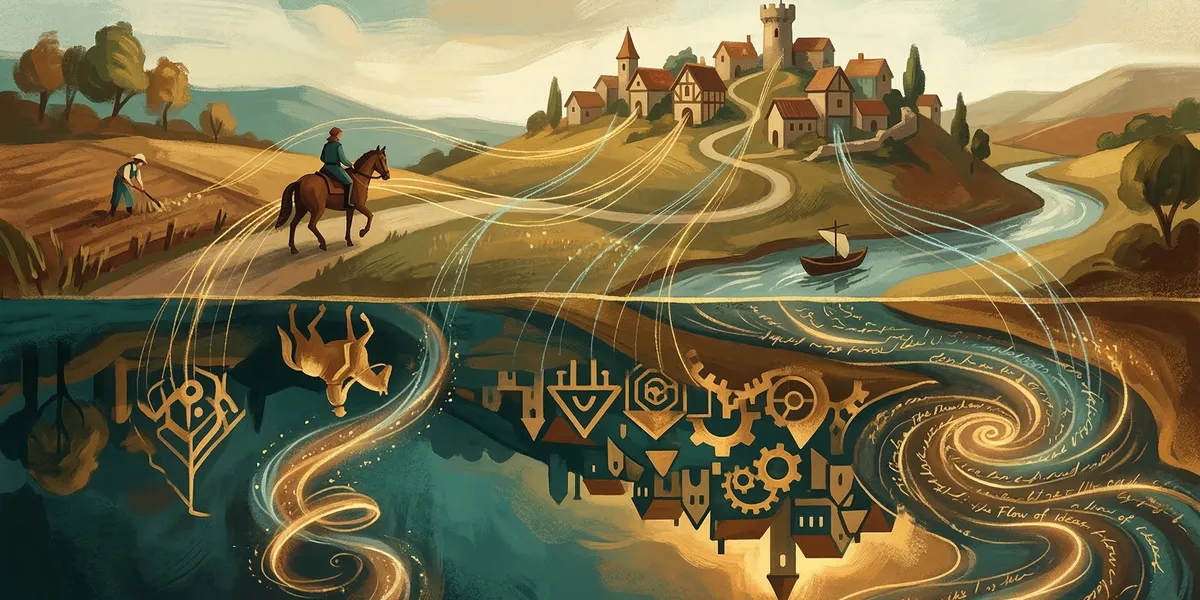
Allegory is a narrative in which characters, events, and settings systematically represent abstract ideas or real-world parallels. Unlike a symbol, which is a single element carrying deeper meaning, an allegory is sustained — the entire story operates on two levels simultaneously.
On the surface, you read about animals on a farm. Beneath the surface, you read about the Russian Revolution. Both levels work at the same time. That duality is what makes allegory one of the most ambitious forms of fiction.
Allegory vs. symbolism
This distinction matters because the two are frequently confused.
Symbolism uses individual elements — an object, a color, an image — to represent something abstract. The green light in The Great Gatsby is a symbol. It represents longing and the American Dream. But The Great Gatsby is not an allegory because the entire story does not map onto a parallel meaning.
Allegory is sustained symbolism across the entire narrative. Every major character, event, and setting corresponds to something in the parallel meaning. It is not one element carrying extra weight — it is the whole structure.
| Symbolism | Allegory | |
|---|---|---|
| Scope | Individual elements | Entire narrative |
| Mapping | One object = one idea | Every character/event = a parallel |
| Reader awareness | Can be subtle or missed | Usually intended to be recognized |
| Example | Mockingbird = innocence | Animal Farm = Russian Revolution |
A story can contain symbols without being an allegory. But an allegory, by definition, is built entirely from symbolic correspondences.
Famous examples of allegory
Animal Farm — George Orwell
The most recognizable allegory in English-language fiction. The animals of Manor Farm overthrow their human farmer and establish a society based on equality. Gradually, the pigs consolidate power. By the end, the pigs are indistinguishable from the humans they replaced.
The correspondences are precise:
- Old Major = Marx/Lenin (the revolutionary thinker who dies before the revolution is corrupted)
- Napoleon = Stalin (the leader who consolidates power through force)
- Snowball = Trotsky (the idealist expelled and demonized)
- Boxer = The working class (loyal, exploited, and ultimately discarded)
- The commandments = Revolutionary ideals (gradually rewritten to serve those in power)
Orwell’s genius is that Animal Farm works on both levels. A reader who knows nothing about Soviet history can still read it as a story about power and corruption. The allegory adds depth but does not require decoding to be understood.
Lord of the Flies — William Golding
A group of boys stranded on an island without adults descend from civilization into savagery. The island is a microcosm of human society, and the boys’ failure to maintain order is an allegory for the fragility of civilization itself.
- Ralph = Democratic leadership and rational order
- Jack = Authoritarian power and primal instinct
- Piggy = Intellect and scientific rationality
- Simon = Spiritual insight and moral clarity
- The conch = Democratic authority (shattered when democracy fails)
- The beast = The darkness within every person
Golding argued that the defect in human society is not in the system but in human nature. The allegory is his proof.
The Crucible — Arthur Miller
Miller wrote his play about the Salem witch trials, but it is an allegory for McCarthyism and the anti-communist hearings of the 1950s. The witch hunt in Salem mirrors the political witch hunt in Washington.
- The accused witches = Americans accused of communism
- The court = The House Un-American Activities Committee
- Abigail Williams = The accusers who benefited from the hysteria
- John Proctor = Those who refused to name names and paid the price
Miller could not write directly about McCarthyism without being blacklisted. Allegory gave him a vehicle to critique the present through the past — which is one of allegory’s most important functions.
The Chronicles of Narnia — C.S. Lewis
Lewis’s fantasy series is a Christian allegory. Aslan the lion represents Christ. His sacrifice on the Stone Table and subsequent resurrection parallel the crucifixion and resurrection. The White Witch represents evil and temptation. The children’s journeys represent the spiritual journey toward faith.
Lewis himself sometimes resisted the label “allegory,” preferring “supposal” — as in, suppose Christ appeared in a world of talking animals. The distinction matters to Lewis because allegory implies a one-to-one mapping, while his intent was more exploratory.
This raises an important point: not all authors agree on whether their work is allegorical. Tolkien explicitly denied that The Lord of the Rings was an allegory for World War II, despite readers’ persistent interpretation. The author’s intent does not always control the reader’s experience.
Pilgrim’s Progress — John Bunyan
The most famous allegory in English literature. A man named Christian journeys from the City of Destruction to the Celestial City. Every location and character he encounters represents a stage in the Christian spiritual journey.
The names are explicit: the Slough of Despond, Vanity Fair, the Giant Despair. Bunyan does not disguise his allegory. The transparency is the point — this is a teaching text that uses narrative to make doctrine accessible.
How to write allegory without being heavy-handed
The greatest risk in writing allegory is that the parallel meaning overwhelms the surface story. If the reader can see the gears turning — if the characters feel like chess pieces moved to illustrate a point — the allegory fails as fiction.
Make the surface story work on its own. Animal Farm is a compelling story about animals even if you strip away the Soviet parallel. Lord of the Flies is a gripping survival narrative. The allegory should be the second layer, not the only one.
Give characters agency beyond their allegorical role. If Napoleon in Animal Farm only did things that Stalin did, he would feel like a puppet. Orwell gives Napoleon specific behaviors — hoarding milk, training dogs in secret — that make him feel like a character, not a symbol wearing a pig costume.
Do not explain the parallel. Orwell never writes, “And Napoleon, who represented Stalin…” The reader makes the connection. If you have to explain it, the allegory is not embedded deeply enough in the story.
Allow imperfect mapping. Real allegories are not ciphers. Not every detail needs a one-to-one correspondence. Leave room for the story to breathe. The places where the allegory is imprecise are often the places where the fiction comes alive.
Choose your vehicle carefully. The surface story should have a natural resonance with the deeper meaning. Animals organizing a society naturally raises questions about power and equality. Boys on an island naturally raises questions about civilization versus nature. The vehicle should make the tenor feel inevitable.
Test it: Can someone who does not know the parallel meaning still enjoy the story? If the answer is no, the allegory has consumed the fiction. Go back and strengthen the surface narrative.
For more on how individual elements carry meaning within a story, see symbolism in literature. For the broader ideas that allegories express, see theme in fiction.