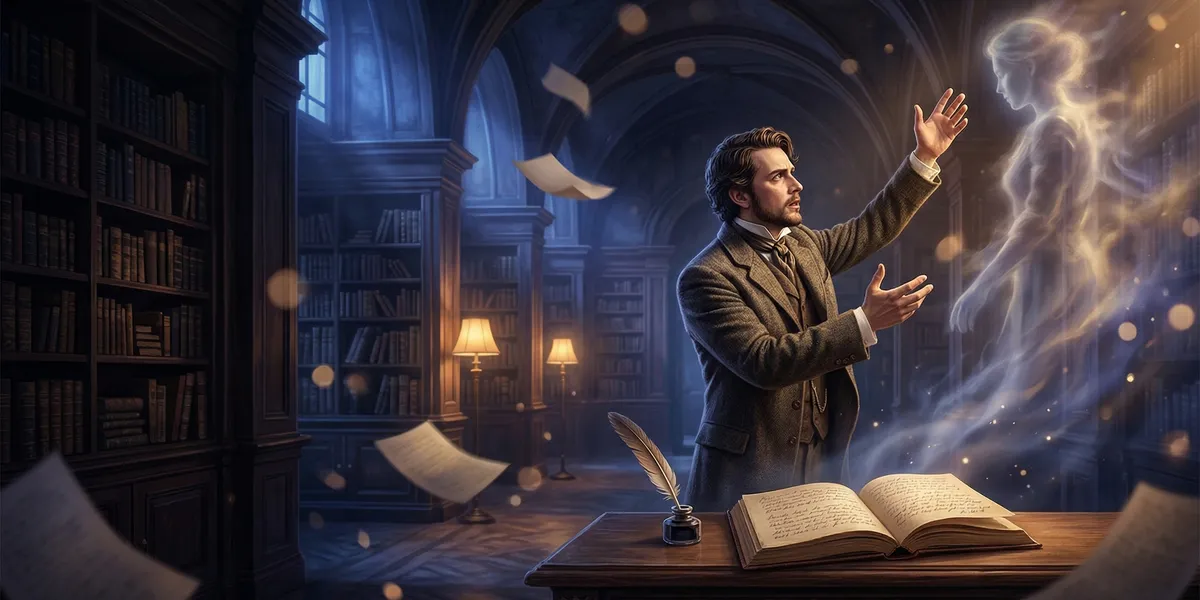
The apostrophe figure of speech is when a writer or speaker directly addresses someone or something that cannot respond — an absent person, a dead figure, an abstract idea, or an inanimate object. It has nothing to do with the punctuation mark. This guide covers what apostrophe means as a literary device, how it works, and how to use it in your own writing.
What Is Apostrophe as a Figure of Speech
Apostrophe is a figure of speech in which a speaker turns away from their audience to address an entity that is not present or not capable of responding. That entity might be a person who is absent or dead, an abstract concept like love or death, or a physical object like a dagger or the sun.
The term comes from the Greek word apostrophein, meaning “to turn away.” In ancient Greek theater, an actor performing apostrophe would literally turn away from the other characters on stage to speak to someone or something that was not there. That physical turn is where the name originates.
Apostrophe is most common in poetry and dramatic works. You will find it throughout Shakespeare’s plays, Romantic poetry, elegies, and odes. It also appears in prose, speeches, and song lyrics — anywhere a writer wants to create a sense of direct, emotional address.
The key feature that separates apostrophe from other devices is the direct address. The speaker is not merely describing or mentioning the absent entity. They are talking to it, as if it could hear and respond.
Famous Examples of Apostrophe in Literature
Shakespeare
Shakespeare used apostrophe constantly. His characters address weapons, body parts, abstract concepts, and absent people in moments of high emotion.
In Romeo and Juliet, Juliet addresses Romeo’s name as if it were a separate entity she could reason with: “O Romeo, Romeo, wherefore art thou Romeo?” She is not asking where Romeo is physically. She is addressing his identity — his name and family — and asking why it must be what it is.
Later in the same play, Juliet addresses a dagger directly before taking her own life: “O happy dagger! This is thy sheath; there rust, and let me die.” The dagger cannot hear her. That is exactly the point — the emotional intensity of the moment demands she speak to it anyway.
In Macbeth, the title character addresses a hallucinated dagger: “Is this a dagger which I see before me, the handle toward my hand?” He speaks to an object that may not even exist, revealing his fractured mental state through the act of addressing it.
John Keats
The Romantic poets were especially drawn to apostrophe. Keats built entire poems around it.
In “Ode on a Grecian Urn,” Keats speaks directly to an ancient vase throughout the poem, calling it a “still unravished bride of quietness” and a “foster-child of silence and slow time.” The urn cannot respond. But by addressing it directly, Keats transforms a museum piece into a conversation partner and a vehicle for meditating on art, beauty, and permanence.
In “Ode to a Nightingale,” Keats addresses the bird directly: “Thou wast not born for death, immortal Bird!” The nightingale is not immortal in any literal sense. But through apostrophe, Keats elevates the bird into a symbol of timeless natural beauty, contrasting it with human mortality.
Walt Whitman
Whitman’s elegy for Abraham Lincoln, “O Captain! My Captain!,” is one of the most recognizable examples of apostrophe in American poetry. Whitman addresses the dead president as if he were the captain of a ship: “O Captain! my Captain! our fearful trip is done.” Lincoln cannot hear the poem. But the direct address transforms grief into something active — a plea, not just a lament.
The Bible
One of the oldest and most quoted examples of apostrophe appears in 1 Corinthians 15:55: “O death, where is thy sting? O grave, where is thy victory?” The speaker addresses death and the grave directly, challenging them as if they were opponents who have lost their power.
Mary Shelley
In Frankenstein, Victor Frankenstein addresses his absent creation in a moment of anguish: “Oh! Stars and clouds and winds, ye are all about to mock me; if ye really pity me, crush sensation and memory; let me become as nought.” Shelley layers apostrophe with emotional desperation, having Frankenstein speak to natural forces as if they are conscious beings choosing to torment him.
John Donne
Donne’s “Death, be not proud” is one of the most studied examples of apostrophe in English literature. The entire poem is addressed to Death as if it were a person who has been overestimating its own importance. The opening line — “Death, be not proud, though some have called thee mighty and dreadful” — directly challenges Death’s authority. By speaking to death rather than about it, Donne diminishes its power.
How Apostrophe Works (and Why Writers Use It)
Apostrophe does several things at once when deployed well.
It externalizes emotion. When a character addresses death, or fate, or a lost loved one, the internal feeling becomes a spoken act. Grief becomes a conversation. Fear becomes a confrontation. This makes abstract emotions concrete and dramatic.
It raises the rhetorical stakes. Addressing an entity that cannot respond creates inherent tension. The audience knows the speaker will not get an answer. That gap between the address and the silence is where the emotional power lives.
It reveals character. What a person chooses to address — and how they address it — tells you about their psychological state. Macbeth speaking to a dagger he may be hallucinating is very different from Keats speaking to an urn in a museum. Both use apostrophe, but they reveal completely different states of mind.
It creates intimacy. By speaking directly to something, the writer invites the reader into a private moment. Apostrophe often feels like overhearing something the speaker would not say to another person — a confession, a plea, a challenge directed at the universe itself.
Apostrophe vs. Personification
These two devices are commonly confused because they often appear together, but they are not the same thing.
Personification gives human qualities to non-human things. “The wind whispered through the trees” is personification — the wind is described as if it can whisper.
Apostrophe is the act of directly addressing something. “O Wind, tell me your secrets!” is apostrophe — the speaker is talking to the wind.
The distinction matters because apostrophe does not require personification. You can address an absent person (who is already human) using apostrophe without personifying anything. Whitman’s “O Captain! My Captain!” addresses Lincoln — a real person — not an abstract concept.
However, when a writer addresses an inanimate object or abstract idea, they often use both devices simultaneously. Keats personifies the Grecian urn by calling it a “bride” (personification) and also speaks directly to it (apostrophe). The two devices overlap but are not identical.
Here is the simplest test: if the writer is describing a non-human thing with human qualities, that is personification. If the writer is talking to something that cannot respond, that is apostrophe.
How to Use Apostrophe in Your Writing
Match it to emotional intensity
Apostrophe works best in moments of genuine emotional weight. A character addressing death at a funeral, a speaker challenging fate during a crisis, a poet mourning a lost love — these are contexts where the device feels natural.
It falls flat when used for low-stakes moments. A character addressing their coffee mug with the same rhetorical weight as Hamlet addressing a skull will read as unintentional comedy.
Use the vocative “O” sparingly
Classical apostrophe often begins with “O” — “O death,” “O Captain,” “O happy dagger.” This convention signals to the reader that a direct address is happening. But in contemporary writing, the “O” can sound archaic if overused. Use it when you want a deliberately formal or elevated tone. Drop it when you want the address to feel more natural and modern.
Let the silence do the work
The power of apostrophe comes partly from the fact that the addressed entity cannot respond. Do not rush to fill that silence with the speaker’s own answers. Let the question or plea hang in the air. “Where are you now?” addressed to a lost person is more powerful without an immediate follow-up explanation.
Combine it with other devices
Apostrophe pairs naturally with metaphor, personification, and rhetorical questions. Keats’s odes are masterclasses in layering apostrophe with imagery and metaphor. When you address an object or idea, you have license to describe it in heightened language that would feel out of place in ordinary narration.
Keep it brief in prose
In poetry and drama, sustained apostrophe can carry an entire scene or stanza. In prose fiction, it works better as a brief, intense moment — a character speaking a line or two to an absent person or a meaningful object before returning to the narrative flow. Extended apostrophe in a novel risks pulling the reader out of the story.
Apostrophe in Modern Writing and Everyday Speech
Apostrophe is not confined to classical poetry. It shows up regularly in modern fiction, screenwriting, music, and even daily conversation.
In film, characters frequently address absent people in emotional moments — speaking to a gravestone, looking at a photograph and saying something to the person in it, or yelling at the sky during a moment of crisis. These are all forms of apostrophe adapted for visual storytelling.
Songwriters use the device constantly. A love song addressed to an ex-partner who will never hear it is apostrophe. A protest song addressed to a political figure or institution is apostrophe. The directness of the address is what gives these songs their emotional punch.
In everyday language, apostrophe is more common than most people realize. Talking to your computer when it freezes. Addressing your car when it will not start. Telling the rain to stop. These are casual, low-stakes forms of the same rhetorical move that Shakespeare and Keats deployed in their most intense passages.
The difference between casual apostrophe and literary apostrophe is not the mechanism — it is the intentionality. In literature, apostrophe is a deliberate choice to create a specific emotional or rhetorical effect. In everyday life, it is an instinctive response to frustration, grief, or excitement. Understanding the device helps you deploy it with intention rather than accident.
Common Mistakes to Avoid
-
Using apostrophe without emotional justification. The device requires genuine feeling behind it. If the moment does not warrant speaking to an absent entity, the apostrophe will feel forced or theatrical in the wrong way.
-
Confusing it with the punctuation mark. The apostrophe figure of speech has no connection to the possessive or contraction punctuation mark. They share a name because the Greek root word has multiple English descendants, but they are entirely different concepts.
-
Overusing it. A poem or scene with too many instances of apostrophe loses the device’s impact. If every stanza addresses a different absent entity, the reader becomes numb to the technique.
-
Forgetting the audience is listening. Apostrophe is technically directed at something other than the audience, but the audience is always the real recipient. The emotional payload is meant for the reader or viewer, not the wind or the dead person. Write with that double audience in mind.
-
Using “O” when “oh” is appropriate. In formal apostrophe, “O” (capitalized, no comma) directly precedes the entity being addressed: “O Death.” The interjection “oh” (lowercase, often followed by a comma) expresses surprise or emotion but is not the same convention: “Oh, I did not see you there.” Mixing them up is a subtle but noticeable error in formal poetry.
FAQ
Is apostrophe only used in poetry?
No. Apostrophe appears in plays, novels, speeches, song lyrics, and even everyday language. When someone says “Come on, car, start!” on a cold morning, that is technically apostrophe — they are directly addressing an inanimate object. But the device is most commonly studied and most effective in poetry and drama, where the elevated emotional register supports it.
What is the difference between apostrophe and soliloquy?
A soliloquy is a speech a character delivers while alone on stage, revealing their inner thoughts to the audience. Apostrophe is the act of addressing an absent or non-responsive entity. A soliloquy can contain apostrophe — Hamlet speaking to the skull of Yorick is both a soliloquy and an apostrophe — but they are separate devices. A soliloquy can exist without apostrophe, and apostrophe can appear outside of soliloquies.
Can apostrophe be used in modern fiction?
Yes, and it is used more often than most readers realize. Contemporary fiction uses apostrophe in moments of intense emotion — a character speaking to a photograph of a dead parent, a narrator addressing the reader directly, or a grieving person talking to someone who is no longer alive. The key is tonal control. Modern apostrophe tends to be quieter and more restrained than classical examples, but the underlying mechanism is the same.
Why is it called “apostrophe” like the punctuation mark?
Both words come from the Greek apostrophos, but they evolved along different paths. The rhetorical apostrophe means “turning away” — the speaker turns away from their audience to address someone or something else. The punctuation apostrophe originally indicated letters that had been “turned away” or removed from a word (like the missing letters in a contraction). The shared etymology is coincidental in modern usage. They are completely different concepts that happen to share a name.