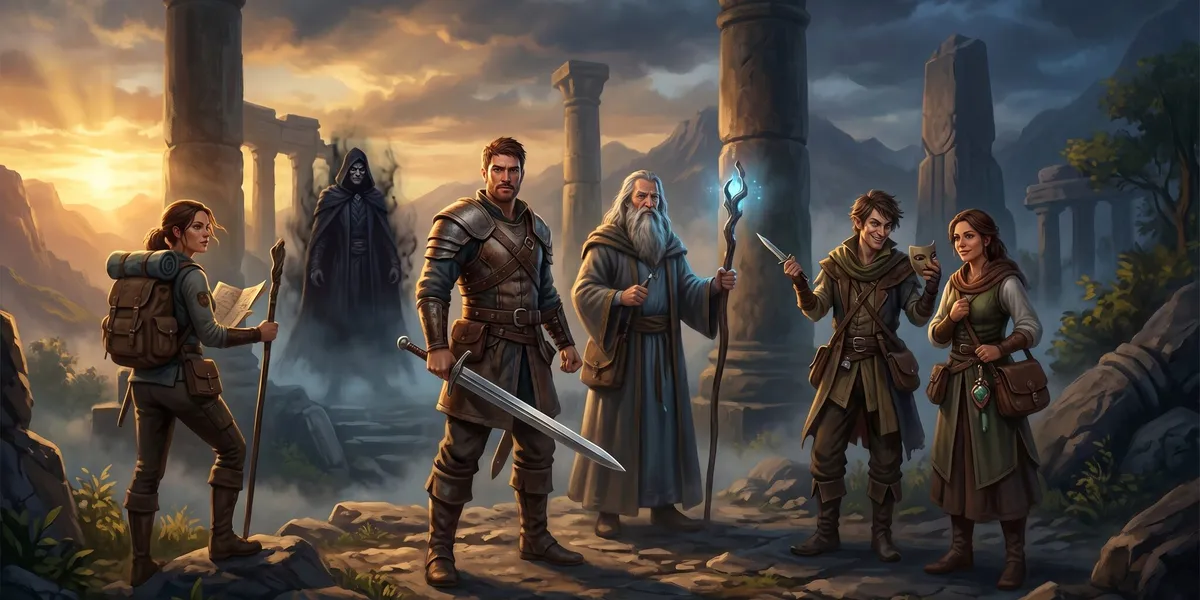
Every memorable character you’ve ever loved — or loved to hate — follows an archetype. These universal character patterns show up across myths, novels, films, and TV because they tap into something deeply human.
In this guide, you’ll find:
- All 12 core character archetypes with famous examples from literature, film, and TV
- The psychology behind why each archetype resonates with audiences
- Practical tips for using archetypes without falling into cliches
Here are the 12 archetypes every writer should know, with examples that bring each one to life.
What Is a Character Archetype?
A character archetype is a universal pattern of behavior, motivation, and personality that recurs across stories, cultures, and time periods. The concept comes from Carl Jung’s theory of the collective unconscious — the idea that certain symbolic figures are hardwired into human psychology.
Think of archetypes as character blueprints. They aren’t rigid molds — they’re starting points that give you a character’s core motivation and fear. The best characters take an archetype as a foundation, then layer on unique traits, flaws, and contradictions.
Archetypes are not stereotypes. A stereotype flattens a character into a shallow cliche. An archetype gives you deep psychological roots to build something original on top of.
The 12 Character Archetypes With Examples
1. The Hero
Core motivation: Prove their worth through courageous action Greatest fear: Weakness or vulnerability
The Hero is the character who rises to meet a challenge, sacrificing personal comfort for a greater cause. They don’t start out as champions — the journey transforms them.
Famous examples:
- Katniss Everdeen (The Hunger Games) — Volunteers as tribute to save her sister, then becomes the reluctant face of a revolution
- Harry Potter (Harry Potter series) — An ordinary boy who discovers he’s destined to face the greatest dark wizard of all time
- Luke Skywalker (Star Wars) — A farm boy who answers the call to adventure and becomes a Jedi knight
- Frodo Baggins (The Lord of the Rings) — Carries a burden no one else can bear, proving heroism doesn’t require physical strength
What makes it work: The Hero archetype resonates because you see yourself in their doubt. The best heroes don’t feel ready for the challenge — that’s what makes their courage meaningful.
Writing tip: Give your hero a specific flaw that directly conflicts with their goal. Harry’s impulsiveness nearly gets him killed multiple times. Katniss struggles with trust. The flaw creates tension and makes the eventual triumph feel earned.
2. The Mentor
Core motivation: Guide others using hard-won wisdom Greatest fear: Leading someone astray
The Mentor is the wise figure who equips the hero for their journey. They provide knowledge, tools, or training — but they can’t fight the hero’s battle for them.
Famous examples:
- Gandalf (The Lord of the Rings) — Guides the Fellowship but deliberately steps back so Frodo can grow
- Dumbledore (Harry Potter) — Provides cryptic guidance and lets Harry learn through experience rather than giving answers
- Haymitch Abernathy (The Hunger Games) — A damaged, alcoholic mentor who uses dark humor and harsh truths to keep Katniss alive
- Mr. Miyagi (The Karate Kid) — Teaches through unconventional methods that only make sense later
What makes it work: The Mentor archetype works because you recognize the teachers and guides who shaped your own life. Their wisdom feels authentic when it comes with scars.
Writing tip: The best mentors have failed before. Haymitch won the Hunger Games but lost everything. Dumbledore carries the guilt of his sister’s death. Past failure gives a mentor’s advice weight and makes their protectiveness feel personal.
3. The Shadow (Villain)
Core motivation: Power, control, or imposing their worldview Greatest fear: Powerlessness
The Shadow is the primary antagonist — the dark mirror of the hero. They often share the hero’s abilities or background but made a different choice at a critical moment.
Famous examples:
- Voldemort (Harry Potter) — An orphan with extraordinary power who chose domination where Harry chose love
- Sauron (The Lord of the Rings) — Pure, consuming desire for control over all living things
- President Snow (The Hunger Games) — Maintains power through fear, spectacle, and calculated cruelty
- Darth Vader (Star Wars) — A fallen hero, showing what Luke could become if he surrenders to darkness
What makes it work: The best villains aren’t evil for evil’s sake. They believe they’re right. Thanos genuinely thinks wiping out half the universe is mercy. That conviction makes them terrifying.
Writing tip: Write your villain as the hero of their own story. Give them a logical reason — from their perspective — for everything they do. A villain who thinks they’re saving the world is far more compelling than one who’s just “bad.”
4. The Trickster
Core motivation: Freedom, fun, and challenging the status quo Greatest fear: Boredom or being trapped
The Trickster uses wit, humor, and cunning to navigate the world. They break rules, question authority, and force other characters to see things differently.
Famous examples:
- Loki (Norse mythology / Marvel) — The god of mischief who operates by his own moral code and shifts allegiances based on self-interest
- Fred and George Weasley (Harry Potter) — Use humor and invention to resist Umbridge’s authoritarian rule
- Jack Sparrow (Pirates of the Caribbean) — Appears foolish but is always three moves ahead
- Puck (A Midsummer Night’s Dream) — Creates chaos for amusement, revealing truths about the other characters in the process
What makes it work: Tricksters are magnetic because they say what you’re thinking but are too polite to say. They puncture pretension and expose hypocrisy.
Writing tip: A Trickster’s humor should serve a purpose. Use them to reveal uncomfortable truths, break tension at critical moments, or challenge the hero’s assumptions. Comedy without consequence makes a Trickster feel shallow.
5. The Caregiver
Core motivation: Protect and nurture others Greatest fear: Selfishness or harm coming to those they love
The Caregiver puts others first, often sacrificing their own needs. Their strength is emotional — they hold communities and families together through compassion.
Famous examples:
- Samwise Gamgee (The Lord of the Rings) — Carries Frodo up Mount Doom, embodying loyalty pushed to its absolute limit
- Molly Weasley (Harry Potter) — A fierce protector whose greatest moment comes when her family is threatened
- Beth March (Little Women) — Quiet, selfless devotion to family that inspires everyone around her
- Peeta Mellark (The Hunger Games) — Protects Katniss even at the cost of his own survival
What makes it work: The Caregiver resonates because you recognize the people in your life who gave without expecting anything in return. Their sacrifice highlights what’s truly worth fighting for.
Writing tip: Don’t make your Caregiver a doormat. The most powerful Caregivers have a line — when it’s crossed, their transformation is devastating. Molly Weasley’s “Not my daughter” moment works because she’s been gentle for seven books.
6. The Explorer
Core motivation: Freedom, discovery, and self-knowledge Greatest fear: Confinement or settling for an ordinary life
The Explorer craves new experiences and resists anything that feels like a cage. They’re driven by curiosity and the conviction that the answer is always somewhere over the next horizon.
Famous examples:
- Bilbo Baggins (The Hobbit) — A homebody who discovers an insatiable appetite for adventure
- Huckleberry Finn (Adventures of Huckleberry Finn) — Lights out for new territory rather than being “civilized”
- Arya Stark (Game of Thrones) — Refuses every traditional role assigned to her and forges her own path
- Moana (Moana) — Defies her father’s boundaries to cross the ocean and find her identity
What makes it work: You feel the Explorer’s restlessness because you’ve felt it too — that pull toward something bigger, even when staying put is safer.
Writing tip: Give your Explorer a genuine reason to leave, not just wanderlust. Bilbo’s Took ancestry creates an internal conflict — comfort vs. curiosity — that drives the entire story. The best Explorers are running toward something, not just away.
7. The Rebel (Outlaw)
Core motivation: Overturn what isn’t working, tear down corruption Greatest fear: Powerlessness or conformity
The Rebel fights against broken systems. They aren’t villains — they’re characters who see injustice and refuse to accept it, even when the cost is enormous.
Famous examples:
- Robin Hood (English folklore) — Steals from the corrupt to feed the oppressed
- Katniss Everdeen (The Hunger Games) — Also fits here: she becomes the symbol of rebellion against a totalitarian state
- Ferris Bueller (Ferris Bueller’s Day Off) — A lighter Rebel who challenges the rigid structures of school and adulthood
- V (V for Vendetta) — Wages a one-person war against fascist government
What makes it work: The Rebel gives voice to frustration with unjust authority. You cheer for them because they do what you wish you could.
Writing tip: Rebels need something to fight for, not just against. Pure destruction isn’t compelling. Show what your Rebel’s ideal world looks like — even if they never achieve it.
8. The Lover
Core motivation: Intimacy, connection, and passion Greatest fear: Being alone or unloved
The Lover seeks deep emotional bonds and is driven by the heart. This isn’t limited to romance — the Lover archetype includes anyone whose primary motivation is connection, beauty, or devotion.
Famous examples:
- Romeo and Juliet (Romeo and Juliet) — Love so consuming it defies family, society, and even death
- Jay Gatsby (The Great Gatsby) — Builds an entire empire of wealth and spectacle to win back one woman
- Elizabeth Bennet (Pride and Prejudice) — Refuses to settle for anything less than genuine respect and intellectual partnership
- Westley (The Princess Bride) — “As you wish” — devotion so complete it transcends death itself
What makes it work: The Lover resonates because connection is a universal need. Their willingness to be vulnerable in pursuit of love makes them deeply relatable.
Writing tip: The Lover’s greatest weakness is obsession. Gatsby destroys himself chasing an idealized past. Use the gap between what the Lover desires and what they actually need to create tension.
9. The Ruler
Core motivation: Control, order, and stability Greatest fear: Chaos or being overthrown
The Ruler craves authority and uses power to create (or impose) order. They can be benevolent leaders or tyrants — the difference lies in whether they serve themselves or their people.
Famous examples:
- Cersei Lannister (Game of Thrones) — Pursues the Iron Throne with ruthless pragmatism, viewing power as the only safety
- King T’Challa (Black Panther) — A ruler who must balance tradition with the responsibility to the wider world
- Miranda Priestly (The Devil Wears Prada) — Rules the fashion world with exacting standards and ice-cold authority
- Mufasa (The Lion King) — A wise king whose leadership philosophy shapes his son’s entire journey
What makes it work: The Ruler archetype fascinates because power reveals character. Give someone a crown and you see who they really are.
Writing tip: The most interesting Rulers face a dilemma where doing the right thing threatens their power. T’Challa must choose between Wakanda’s isolation and global responsibility. That tension between power and principle is where the best Ruler stories live.
10. The Creator
Core motivation: Build something of lasting value Greatest fear: Mediocrity or failing to create
The Creator is driven to bring new things into existence — art, inventions, ideas, worlds. Their identity is bound to their work, and they measure themselves by what they produce.
Famous examples:
- Victor Frankenstein (Frankenstein) — A Creator whose ambition outpaces his ethics, with devastating consequences
- Willy Wonka (Charlie and the Chocolate Factory) — An eccentric genius who builds a fantastical world inside a candy factory
- Tony Stark (Iron Man) — An inventor who literally builds his way out of every problem
- Jo March (Little Women) — A writer who refuses to compromise her creative vision for commercial success
What makes it work: The Creator resonates because the drive to make something meaningful is deeply human. Their stories often explore the cost of that drive.
Writing tip: Give your Creator a tension between vision and consequence. Frankenstein wanted to conquer death but created a monster. The gap between intention and result is where Creator stories become powerful.
11. The Innocent
Core motivation: Happiness, safety, and doing the right thing Greatest fear: Punishment or corruption
The Innocent sees the world with optimism and trust. They believe in goodness, and their faith — though sometimes naive — often inspires the characters around them to be better.
Famous examples:
- Forrest Gump (Forrest Gump) — Simple goodness that stumbles through history and touches everyone he meets
- Dorothy (The Wizard of Oz) — A girl who believes in the power of home and kindness in a strange, dangerous world
- Scout Finch (To Kill a Mockingbird) — A child whose innocent perspective exposes the moral failures of the adults around her
- Neville Longbottom (early Harry Potter) — Begins as a timid, guileless boy whose quiet courage slowly reveals itself
What makes it work: The Innocent holds up a mirror to the world’s cynicism. Their goodness feels radical in dark settings, and their eventual loss of innocence hits hard.
Writing tip: The Innocent is most powerful when the story forces them to confront harsh reality. Scout learns about racism. Dorothy discovers there’s no wizard behind the curtain. That collision between innocence and truth creates some of the most memorable moments in fiction.
12. The Sage
Core motivation: Understanding, truth, and wisdom Greatest fear: Ignorance or being misled
The Sage seeks knowledge above all else. They analyze, investigate, and reflect — serving as the intellectual anchor of a story.
Famous examples:
- Sherlock Holmes (Sherlock Holmes series) — Observation and deductive reasoning elevated to an art form
- Hermione Granger (Harry Potter) — The friend who always has the answer, whose intelligence saves the group repeatedly
- Atticus Finch (To Kill a Mockingbird) — Moral and intellectual wisdom applied to the pursuit of justice
- Yoda (Star Wars) — Centuries of experience distilled into cryptic but profound teachings
What makes it work: The Sage satisfies your desire to understand how the world works. Their knowledge feels like power — the kind that comes from paying attention.
Writing tip: Give your Sage a blind spot. Sherlock Holmes is brilliant but emotionally stunted. Hermione’s reliance on books fails when she needs intuition. A Sage who knows everything with no gap is a walking encyclopedia, not a character.
How Archetypes Work Together
Archetypes don’t exist in isolation. The most compelling stories create dynamic tension by pairing archetypes that challenge each other.
Classic pairings that create conflict:
- Hero + Shadow — The core conflict of most stories (Harry vs. Voldemort)
- Hero + Mentor — The student must eventually surpass or lose the teacher (Luke and Obi-Wan)
- Rebel + Ruler — Order vs. freedom (Katniss vs. President Snow)
- Trickster + Sage — Instinct vs. intellect (Fred and George vs. Hermione)
- Lover + Explorer — Connection vs. freedom (Elizabeth Bennet’s internal conflict)
One character can embody multiple archetypes. Katniss is both Hero and Rebel. Dumbledore is Mentor, Sage, and carries a Ruler’s burden. Real characters — like real people — don’t fit neatly into a single box.
Archetypes vs. Stereotypes: What’s the Difference?
This distinction matters. Get it wrong, and your character falls flat.
| Archetype | Stereotype | |
|---|---|---|
| Based on | Universal psychology | Surface-level assumptions |
| Depth | A foundation to build on | A finished (and shallow) product |
| Feels like | A recognizable pattern with fresh details | A character you’ve seen a hundred times |
| Example | A Mentor with guilt and flaws (Haymitch) | A wise old man who exists only to give advice |
An archetype gives you the skeleton. Your job is to add the muscle, skin, and scars that make it feel alive. If you can describe your character entirely with the archetype label and nothing else, you’ve written a stereotype.
How to Use Archetypes Without Writing Cliches
Knowing the 12 archetypes is the easy part. Using them well takes practice. Here are five strategies that work:
1. Blend two or more archetypes. Give your character a primary archetype and a secondary one that creates internal conflict. A Hero who is also a Lover must choose between saving the world and protecting the person they love.
2. Subvert the expected arc. Take a Mentor and let them fail. Make a Ruler who gives up power willingly. Give an Innocent character a dark secret. Subversion works because you’re playing against the reader’s expectations.
3. Shift archetypes mid-story. Characters can evolve from one archetype to another. Walter White starts as an Innocent/Creator and becomes a Shadow. That transformation is the entire engine of Breaking Bad.
4. Use archetypes for supporting characters too. Your secondary characters need clear roles. Giving each one a distinct archetype ensures they serve a unique function in the story and don’t overlap.
5. Start with the fear, not the motivation. Every archetype has a core fear. Write from that fear first — it generates more interesting choices than writing from motivation alone.
Using AI to Develop Archetypal Characters
If you’re building characters from archetypes, AI writing tools can accelerate the process significantly. You can feed an archetype’s core motivation and fear into a prompt and generate dozens of character variations in minutes.
Our Pick — Chapter
Chapter’s AI character generator lets you build characters from archetypal foundations, generating detailed backstories, motivations, and flaws based on the archetype you select. Over 2,147 authors have used it to develop characters for their novels.
Best for: Fiction and nonfiction authors who want to develop full characters quickly Pricing: $97 one time, 2 books included (fiction or nonfiction), 30-day money-back guarantee Why we built it: Because building deep, multi-dimensional characters is one of the hardest parts of writing a book — and archetypes give AI the right framework to help.
You can also explore our AI character generator guide for more options, or read about character development strategies that work alongside AI tools.
Common Mistakes When Using Archetypes
Avoid these pitfalls:
- Treating archetypes as personality tests. An archetype is a starting point, not a complete character sheet. Layer on specific traits, contradictions, and history.
- Forgetting the fear. Every archetype has a core fear. If your Hero isn’t afraid of failure, they feel invincible and boring.
- Making the Mentor too perfect. Mentors who know everything and never struggle are wish fulfillment, not characters.
- Locking a character into one archetype. Real people shift between roles depending on context. Your characters should too.
- Confusing dark archetypes with villains. The Shadow, the Rebel, and the Trickster can all be protagonists. Don’t default to making them antagonists.
What Archetype Should Your Main Character Be?
The right archetype depends on the story you’re telling.
If your story is about overcoming a challenge: Start with the Hero. Their arc gives you a natural structure — call to adventure, trials, transformation, return.
If your story is about fighting injustice: The Rebel drives stories about broken systems and the courage it takes to dismantle them.
If your story is about self-discovery: The Explorer’s journey outward mirrors an internal search for identity.
If your story is about love and connection: The Lover’s pursuit of intimacy creates emotional stakes that readers feel deeply.
If your story is about power and responsibility: The Ruler archetype lets you explore what happens when someone must choose between their own interests and the greater good.
For more on building your story’s structure around your characters, check out our guides on character arcs, the Hero’s Journey, and plot structure.
FAQ
What Are the 12 Character Archetypes?
The 12 character archetypes are the Hero, the Mentor, the Shadow (Villain), the Trickster, the Caregiver, the Explorer, the Rebel, the Lover, the Ruler, the Creator, the Innocent, and the Sage. These universal patterns come from Carl Jung’s psychological framework and appear across every culture, genre, and era of storytelling.
What Is the Most Common Character Archetype?
The most common character archetype is the Hero. Nearly every story has a protagonist who faces challenges, grows through adversity, and achieves a transformation. However, modern fiction increasingly uses Rebels, Explorers, and even Shadows as main characters, reflecting audiences’ appetite for more complex protagonists.
What Is the Difference Between an Archetype and a Stereotype?
An archetype is a universal psychological pattern that serves as a foundation for building complex characters. A stereotype is a shallow, surface-level assumption about a type of person. Archetypes give you depth to build on — stereotypes give you a flat cliche. The difference is what you add on top of the starting pattern.
Can a Character Be More Than One Archetype?
Yes — and the best characters usually are. Blending multiple archetypes creates internal conflict and complexity. Katniss Everdeen is both a Hero and a Rebel. Dumbledore combines Mentor, Sage, and Ruler. The tension between competing archetypal drives is what makes characters feel three-dimensional and human.
How Do Archetypes Differ From the Hero’s Journey?
Archetypes describe character types — the roles people play in a story. The Hero’s Journey describes a story structure — the sequence of events a protagonist moves through. They work together: the Hero’s Journey is the path, and archetypes are the characters who walk it. A hero meets mentors, faces shadows, and encounters tricksters along the way.