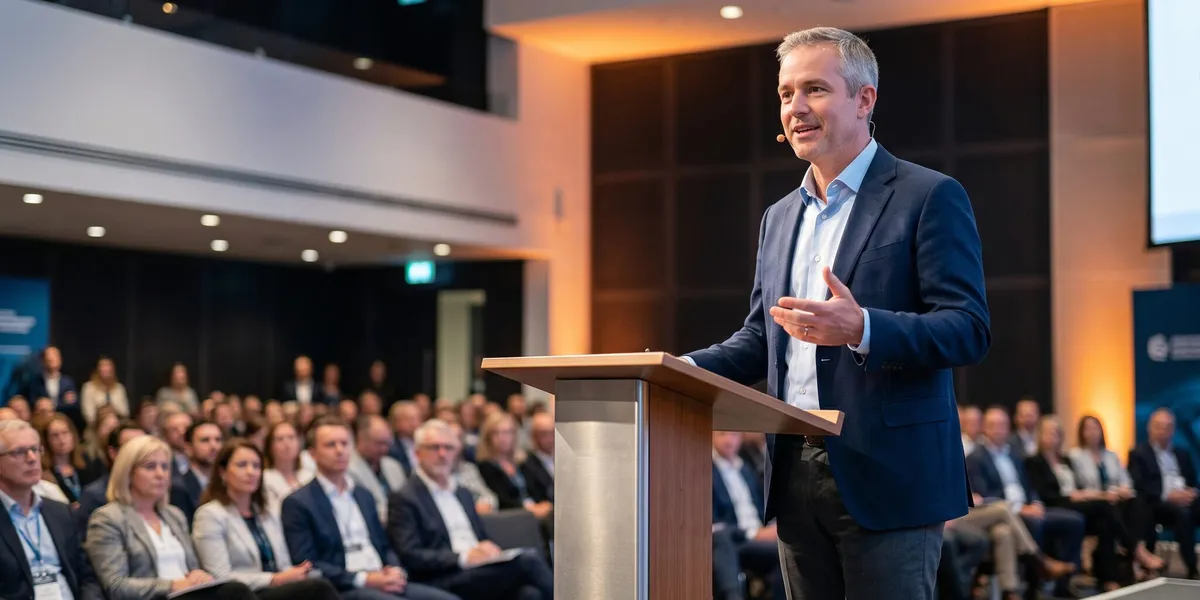
Author speaking fees range from free to $50,000+ per engagement depending on your book sales, platform size, and speaking experience. Most published authors start between $1,000 and $5,000 per talk and can reach $10,000-$25,000 within two years of consistent booking.
In this guide, you’ll learn:
- Exact fee ranges for every author tier (with real numbers)
- How to set your first speaking fee without undercharging
- Negotiation tactics that protect your rate
- The back-of-room revenue model that earns you money even at free events
Here’s what to charge — and how to get there faster.
How Much Do Authors Charge for Speaking Engagements?
Author speaking fees depend on five factors: book sales track record, audience size, topic demand, speaking experience, and event type. The table below breaks down typical rates by tier.
| Author Tier | Fee Range | Typical Events | What You Need |
|---|---|---|---|
| First-time speaker | Free – $1,000 | Local meetups, library talks, panels | A published book |
| Emerging author | $1,000 – $5,000 | Industry conferences, corporate lunch-and-learns | Book + 5-10 past talks + testimonials |
| Established author | $5,000 – $15,000 | National conferences, company all-hands, retreats | Strong book sales + speaking reel + media mentions |
| Bestselling author | $15,000 – $50,000 | Keynotes, high-profile summits, corporate events | Bestseller status + significant platform |
| Celebrity author | $50,000 – $200,000+ | Headliner keynotes, galas, private events | Household name recognition |
According to the National Speakers Association, the median speaking fee in North America is $7,500 per engagement. Authors with published books command fees 25-40% above that median — even without bestseller status.
The Self Publishing Formula’s research confirms that a published book is the single most powerful variable in pricing power. Event organizers pay more for speakers with books because the book doubles as proof of expertise and marketing material for the event.
How to Set Your First Author Speaking Fee
Setting your first speaking fee is the hardest pricing decision you’ll make — because you have no market data about yourself yet. Here’s the framework that works.
Start with the “minimum viable fee”
Calculate what your time is actually worth for a single engagement. Factor in:
- Preparation time — 8-20 hours for a new talk (research, slides, rehearsal)
- Travel time — door to door, including airport wait times
- Event time — the actual talk plus networking, Q&A, and book signing
- Recovery time — the day after a travel engagement is usually lost productivity
A “free” 45-minute talk at a conference 200 miles away actually costs you 15-25 hours of total time. If your consulting rate is $150/hour, that “free” talk has an opportunity cost of $2,250-$3,750.
The first-engagement pricing rule
For your first 3-5 paid engagements, charge $1,500-$2,500. This is high enough to signal professionalism but low enough to get booked. Event organizers with real budgets expect to pay at least $1,000 — quoting $200 actually makes you look less credible, not more affordable.
The Nonfiction Authors Association recommends starting slightly higher than you’re comfortable with and leaving room for negotiation. You can always come down. You can never go back up with the same client.
When to speak for free
Free talks make strategic sense in exactly three scenarios:
- Your first 3-5 appearances — to build your reel and collect testimonials
- High-visibility events — where the exposure value exceeds what you’d charge (TEDx, major industry conferences with 1,000+ attendees)
- Events that let you sell books — the back-of-room model can earn you $500-$2,000+ even without a speaking fee
Outside these situations, always quote a fee. If an event has a budget for a venue, catering, and AV equipment, they have a budget for speakers.
Author Speaking Fee Structures: Which Model Fits You?
There’s no single “right” way to structure your speaking fees. The best model depends on your career stage and goals.
Flat fee per engagement
The most common structure. You quote one price that covers your talk, Q&A, and a set time for networking or book signing. Travel expenses are billed separately.
Best for: Most authors at every level. Simple, clean, easy to negotiate.
Example: “$3,500 plus travel expenses for a 45-60 minute keynote with 15-minute Q&A.”
Flat fee plus book sales
You charge a lower flat fee but retain the right to sell books at the event. Some speakers negotiate for the event organizer to purchase a copy for every attendee.
Best for: Authors with a book priced at $15-$30. At a 200-person event, selling to even 30% of the audience generates $900-$1,800 in additional revenue.
Example: “$2,000 flat fee plus a book table at the back of the room.”
Revenue share or percentage of ticket sales
Rare but lucrative for authors with strong personal brands. You earn a percentage (typically 10-20%) of ticket revenue generated by your appearance.
Best for: Authors headlining paid workshops, masterclasses, or events where your name is the primary draw.
All-inclusive package
You quote a single number that includes your fee, travel, hotel, and meals. This simplifies budgeting for the event organizer.
Best for: Remote events requiring flights. Some organizers prefer this because it eliminates expense report surprises.
Example: “$5,000 all-inclusive for any domestic engagement.”
Virtual speaking fees
Virtual keynotes typically command 30-50% less than in-person engagements because they eliminate travel time and logistics. But they’re far more profitable per hour of your time.
A $2,000 virtual talk that takes 2 hours of your day (prep + delivery) is more profitable than a $5,000 in-person talk that takes 20 hours including travel.
What Factors Increase Your Author Speaking Fee?
Not all authors with books command the same fees. These factors create the gap between a $1,500 speaker and a $15,000 speaker.
Book sales and bestseller status
A book that’s sold 10,000+ copies signals market validation. A bestseller — even a category bestseller on Amazon — gives you a title prefix that justifies higher fees. Event organizers can promote you as a “bestselling author,” which sells tickets.
Media mentions and press coverage
Being featured in major publications transforms your perceived value. Authors featured in outlets like USA Today or the New York Times can immediately command 2-3x higher fees than equally knowledgeable authors without press clips. One Chapter.pub author leveraged a press mention into a speaking gig for 20,000 people.
A professional speaker reel
A 2-3 minute video showing you commanding a stage is worth more than any pitch email. Event organizers want visual proof that you can engage an audience. Even clips from webinars or small events work — the key is showing energy, confidence, and audience engagement.
Corporate vs. association vs. nonprofit events
Corporate events pay the most — typically 2-5x what associations or nonprofits budget. A $5,000 fee at an industry association conference might translate to $10,000-$25,000 for the same talk at a corporate sales kickoff or leadership retreat.
Topic demand and specificity
Broad topics (“leadership,” “motivation”) are overcrowded. Specific topics tied to measurable business outcomes command premium fees. “How to use AI to write your company’s thought leadership content” pays more than “the power of storytelling” — because the ROI is tangible.
Audience size
Larger audiences justify higher fees. A keynote for 2,000 people requires more preparation, carries more pressure, and delivers more value than a workshop for 30. Scale your fees accordingly.
How to Negotiate Author Speaking Fees
Negotiation is where most authors leave money on the table. These tactics protect your rate while keeping the relationship positive.
Never quote your fee first in email
When an event organizer asks “What do you charge?”, respond with: “I’d love to help — can you share the event details and your speaker budget range?” This forces them to anchor first. If their budget is $8,000 and you were going to quote $5,000, you just left $3,000 on the table by going first.
Use the “fee plus expenses” structure
Always separate your speaking fee from travel expenses. Quoting “$5,000 plus travel” sounds lower than “$6,500 all-inclusive” even though they might cost the same. The psychological separation makes the fee feel smaller.
Offer tiered packages
Give organizers three options:
| Package | Includes | Fee |
|---|---|---|
| Keynote | 45-60 minute talk + Q&A | $5,000 |
| Keynote + Workshop | Keynote + 90-minute hands-on session | $7,500 |
| Full Day | Keynote + workshop + private dinner with leadership | $12,000 |
Three tiers accomplish two things: the middle option looks reasonable compared to the top tier, and organizers who only budgeted for a keynote sometimes upgrade when they see the value of the full package.
Handle “we don’t have the budget” responses
When an organizer says they can’t afford your fee, don’t immediately discount. Instead, explore alternatives:
- “I understand budget constraints. Would a virtual presentation work? My virtual rate is [$lower amount].”
- “I can offer a shorter format — a 30-minute talk instead of 60 — for [$reduced fee].”
- “If you can purchase [X] copies of my book for attendees, I can reduce my speaking fee by [$amount].”
These preserve your per-hour value while giving the organizer a win.
The “never lower without removing” rule
If you reduce your fee, remove something from the package. A discounted keynote should not include a workshop, Q&A panel, and book signing. Otherwise, you’re training organizers to expect your full service at a discount rate.
How to Raise Your Speaking Fees Over Time
The difference between authors who earn $1,500 per talk for years and those who reach $10,000+ within 18 months usually comes down to a systematic approach to rate increases.
Raise by $500-$1,000 after every 3-5 bookings
If you’re getting booked consistently at your current rate, your fee is too low. The market is telling you there’s room to grow. Raise your rate for new inquiries — you don’t need to renegotiate existing commitments.
Track your booking-to-inquiry ratio
If you’re converting more than 70% of inquiries into bookings, your fee is underpriced. The sweet spot is 40-60% conversion — high enough to stay busy, low enough to indicate you’re priced at market value. Below 30% means you’re either overpriced or targeting the wrong events.
Build proof points between raises
Each rate increase should be supported by new evidence of your value:
- A testimonial from a recent event (“Best speaker we’ve had in 5 years”)
- Updated audience numbers (“Spoke to 3,500 people at [Event Name]”)
- New media mentions or book sales milestones
- Measurable outcomes from your talks (“Attendees implemented [strategy] and saw [result]“)
Use a speaker agent or bureau at $10,000+
Once your fee consistently exceeds $10,000, consider joining a speakers bureau. Bureaus like SpeakInc, BigSpeak, and the National Speakers Bureau take 25-30% but access corporate clients you’d never reach on your own. The net effect is usually higher total income despite the commission.
How a Published Book Multiplies Your Speaking Revenue
A published book doesn’t just open doors to speaking gigs — it directly increases what you can charge. The Global Speakers Federation reports that authors earn 35% more per engagement than non-author speakers with comparable expertise.
Here’s why the math works:
The credibility premium
“Author of [Book Title]” is the most efficient credibility signal in the speaking industry. It tells event organizers you’ve organized your thinking deeply enough to fill a book. An authority book positions you as the definitive expert, not just someone with opinions.
The back-of-room revenue stack
Even at events where your speaking fee is modest, book sales add a second revenue stream. At a 200-person conference:
- 30% buy your $20 book = 60 copies = $1,200
- Event organizer buys copies for all VIP attendees (50 copies) = $1,000
- You earn $2,200 in book revenue on top of your speaking fee
Some authors earn more from back-of-room sales than from the speaking fee itself. The Self Publishing Formula calls this the “hidden revenue layer” of author speaking.
The flywheel effect
Each speaking engagement sells books. More book sales improve your Amazon ranking. Better rankings attract more event organizers. More events generate more testimonials. Better testimonials justify higher fees.
This flywheel is why authors who build multiple income streams around their book — speaking, consulting, courses — earn dramatically more than authors who rely on royalties alone.
Our Pick — Chapter
Chapter.pub helps you write and publish a professional nonfiction book in days instead of months. Over 10,000 authors have used it to create books — many of whom leveraged their books into paid speaking careers. One author landed a speaking gig for 20,000 people just from announcing her book was done.
Best for: Professionals who want a credibility-building book to launch their speaking career Pricing: $97 one-time Why we built it: The faster you publish, the sooner you start earning speaking fees.
How Much Do Bestselling Authors Charge for Speaking?
Bestselling authors charge $20,000 to $200,000+ per speaking engagement depending on their fame level and topic demand. Here’s what the data shows for well-known author speakers.
BigSpeak and the National Speakers Bureau publish fee ranges for their represented speakers. The patterns are consistent:
| Author Category | Typical Fee | Examples |
|---|---|---|
| Business bestseller | $25,000 – $75,000 | Authors of top-selling business, leadership, and productivity books |
| Celebrity memoir author | $50,000 – $150,000 | Politicians, athletes, entertainers with published memoirs |
| Thought leader / TED speaker | $30,000 – $100,000 | Authors with viral TED talks or massive social followings |
| Genre fiction bestseller | $10,000 – $40,000 | Popular novelists at literary festivals and book events |
The gap between a $5,000 speaker and a $50,000 speaker is rarely about the quality of the talk. It’s about perceived demand — how many other events are competing to book the same person.
Common Mistakes Authors Make With Speaking Fees
These pricing errors cost authors thousands in lost revenue every year.
- Undercharging because of imposter syndrome. If you wrote a book and people are inviting you to speak, you’ve earned the right to charge. A published book is a credential that most people never achieve.
- Quoting hourly rates. Never frame your fee as an hourly rate. A $5,000 keynote sounds reasonable. “$5,000 per hour” triggers sticker shock — even though most keynotes are 45-60 minutes. Frame it as a flat engagement fee.
- Forgetting to charge for travel. Travel expenses (flights, hotels, meals, ground transportation) should always be billed separately or baked into a higher all-inclusive rate. Never absorb travel costs into your base fee.
- Saying yes to every opportunity at the same rate. A corporate keynote for a Fortune 500 company and a local Rotary Club lunch should not cost the same. Price based on the event’s budget and audience value, not a one-size-fits-all number.
- Not having a speaker page. Event organizers Google you before making an offer. Without a professional speaker page on your author website, you lose bookings to authors who have one.
- Discounting without removing scope. If you reduce your fee, shorten your talk or remove the workshop add-on. Discounting your full package trains organizers to expect less from you financially while demanding more of your time.
How Long Does It Take to Reach $10,000 Per Speaking Engagement?
Most authors reach the $10,000-per-talk range within 18-24 months of their first paid engagement — if they raise rates consistently and build proof points along the way.
The typical timeline looks like this:
- Months 1-3: Free talks at local events. Build your reel and get 3-5 testimonials.
- Months 3-6: First paid gigs at $1,500-$2,500. Target industry associations and smaller corporate events.
- Months 6-12: Raise to $3,000-$5,000. Refine your signature talk and add a workshop option.
- Months 12-18: Reach $5,000-$7,500. Submit to national conferences. Consider a speakers bureau.
- Months 18-24: Hit $10,000+. Corporate clients and premium events become your primary market.
This timeline accelerates significantly if your book is selling well, you get media coverage, or your topic hits a cultural moment. Authors who build a strong platform alongside their speaking career reach premium rates faster because their brand visibility compounds.
Should You Hire a Speaker Agent or Bureau?
A speaker agent or bureau handles bookings, negotiations, and marketing in exchange for a commission (typically 25-30%). Here’s when it makes sense.
Hire an agent when:
- Your fee consistently exceeds $7,500-$10,000
- You’re turning down more gigs than you accept
- You want access to corporate clients you can’t reach through direct outreach
- Negotiation and admin work is eating into your writing time
Stay independent when:
- Your fee is below $5,000 (most bureaus won’t represent you)
- You enjoy the relationship-building aspect of direct booking
- You’re still building your speaking track record
- Your niche is very specific (bureaus work best with broadly appealing topics)
Top speaker bureaus for authors include SpeakInc, BigSpeak, Washington Speakers Bureau, and Keppler Speakers. Apply with your speaker reel, book, and a list of past engagements with testimonials.
How to Make Speaking a Consistent Income Stream
The authors who earn six figures from speaking don’t treat it as a side hustle. They build a system.
Create 2-3 signature talks
Develop talks that can be adapted to different audiences but share a core structure. A business author might have:
- A 45-minute keynote on the book’s core thesis
- A 90-minute workshop applying the book’s framework
- A 20-minute “lightning talk” for panels and smaller events
Each format targets a different budget level and event type.
Build a speaking page on your author website
Your speaker page should include a professional headshot, your book cover, 2-3 talk descriptions, testimonials, a speaking reel, and a clear booking form. List yourself on platforms like SpeakerHub and eSpeakers.
Book 12-18 months ahead
High-paying events plan a year or more in advance. If you’re only pursuing events 2-3 months out, you’re competing for the scraps. Pitch conferences during their call-for-speakers window, typically 9-15 months before the event date.
Stack revenue per appearance
Every speaking engagement should generate revenue in at least two ways:
- Speaking fee + book sales
- Speaking fee + consulting leads
- Speaking fee + course signups
- Free talk + bulk book purchase by organizer
Authors who diversify their income streams around each engagement earn 2-3x what single-stream speakers earn from the same number of talks.
FAQ
What is a typical speaking fee for a first-time author?
A typical speaking fee for a first-time author is $1,000 to $2,500 per engagement. First-time speakers with a published book can command this range at industry conferences, corporate events, and association meetings. Start with 3-5 free talks to build your reel, then transition to paid gigs at this rate.
How much do bestselling authors charge for keynote speeches?
Bestselling authors charge $20,000 to $75,000 for keynote speeches, with celebrity-level authors commanding $100,000 or more. Business bestseller authors typically fall in the $25,000-$50,000 range, while genre fiction bestsellers charge $10,000-$40,000 for literary festival appearances and special events.
Do self-published authors get speaking gigs?
Yes — self-published authors get speaking gigs at the same rate as traditionally published authors. Event organizers care about your expertise, audience, and book quality — not your publisher. Over 10,000 authors have published through Chapter.pub, and many have leveraged their self-published books into paid speaking careers.
How do authors find speaking opportunities?
Authors find speaking opportunities through direct outreach to event organizers, speaker platforms like SpeakerHub and eSpeakers, conference call-for-speaker submissions, and speaker bureaus. Having a professional author website with a dedicated speaker page is essential — event organizers Google you before making an offer.
Should authors speak for free?
Authors should speak for free only at their first 3-5 events (to build a reel and testimonials), at high-visibility events where exposure exceeds the fee value, or at events that allow book sales. Beyond these situations, always charge. If an event budgets for a venue and catering, they should budget for speakers too.