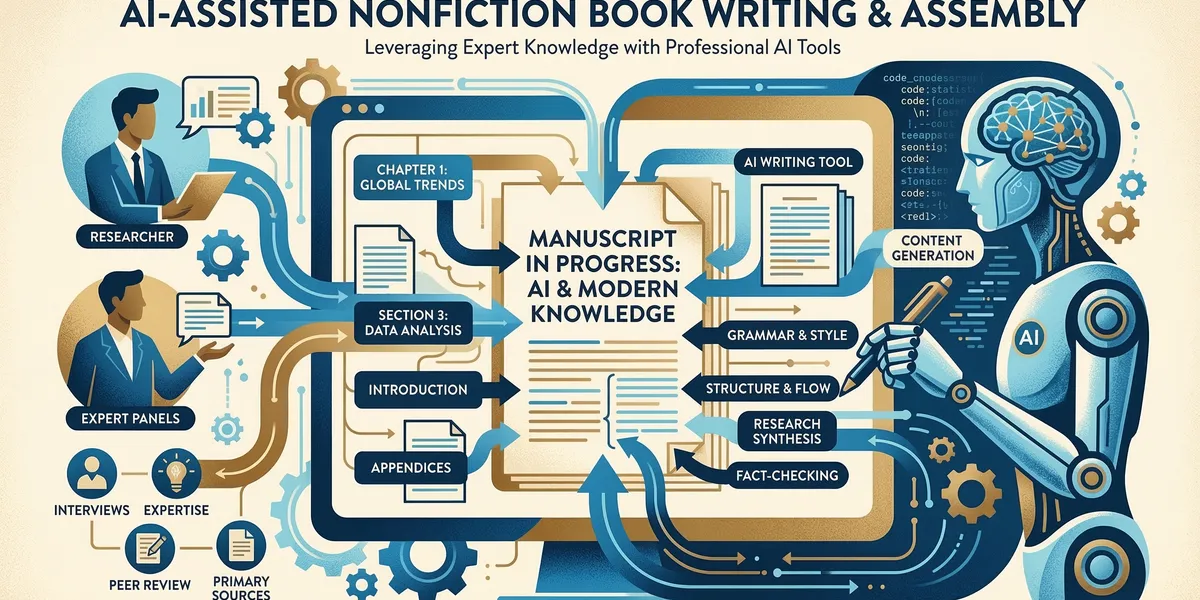
The best AI for writing nonfiction books turns your expertise into a structured, publish-ready manuscript — without months of writing or a $25,000 ghostwriter. Whether you are producing an authority book for your business, a how-to guide, a memoir, or a self-help book, the right tool handles structure, drafting, and formatting while you focus on the knowledge only you can provide.
We compared five AI tools for nonfiction book writing in 2026. Here is how they stack up.
Quick Comparison
| Tool | Best For | Full Manuscript | Nonfiction Strength | Pricing |
|---|---|---|---|---|
| Chapter | Complete nonfiction books | Yes — 80-250 pages in ~60 min | Structure + expertise integration | $97 one-time |
| ChatGPT | Drafting individual chapters | No — chapter by chapter | Flexible, good research synthesis | $20/mo (Plus) |
| Claude | Long-form drafting with context | No — not a book tool | Extended context, nuanced writing | $20/mo (Pro) |
| Jasper | Marketing copy and short content | No — not book-length | Marketing-focused writing | $49-125/mo |
| Scribe | Interview-based business books | Yes — from interviews | Guided extraction process | $20,000+ |
1. Chapter — Best for Complete Nonfiction Books
Our Pick — Chapter
Chapter generates full nonfiction manuscripts of 80 to 250 pages in approximately 60 minutes. You provide your expertise — the AI handles the writing, structure, and publishing-ready output.
Best for: Entrepreneurs, consultants, coaches, and experts who need a professionally structured nonfiction book Pricing: $97 one-time (no monthly fees) Why we built it: Most experts have enough knowledge for ten books. They just do not have six months to sit down and write one. We built Chapter to collapse that timeline from months to hours.
Chapter is the only tool on this list that produces a complete, publish-ready nonfiction manuscript from a single workflow. You define your topic, target audience, key expertise, and desired structure. The AI builds a complete book — table of contents, chapters, sections, conclusions — with your knowledge integrated throughout.
What makes it work for nonfiction:
-
Expertise integration. Nonfiction books are only as valuable as the knowledge behind them. Chapter’s input process captures your specific expertise, frameworks, methodologies, and case studies. The manuscript reflects what you know, not generic information anyone could find online.
-
Professional book structure. The system generates proper nonfiction architecture: introductions that establish authority, chapters that build on each other logically, transitions between ideas, summaries that reinforce key points, and conclusions that drive action.
-
Publishing-ready output. Front matter, back matter, table of contents, proper formatting for KDP and print distribution. No separate formatting step.
-
Authority positioning. For business and professional books, Chapter’s output positions you as the expert — which is the entire point of an authority book. The book reads like a knowledgeable professional sharing hard-won insights, not like AI-generated filler.
The results speak through the authors who have used it:
“A stranger read my book and reached out: ‘I need your help. What does it cost?’ I said $13,200. He started the same day.” — Jim T.
Jim’s book was not a literary endeavor. It was a business asset — a credible demonstration of expertise that converted a cold reader into a five-figure client in a single interaction.
“$60,000 in 48 hours from one lead magnet — and that was a book.” — Arek Z.
Arek used his nonfiction book as a lead magnet for his business. The book attracted qualified buyers who already understood his value before the first sales conversation.
“I figured out I saved about $25,000 in ghostwriting fees.” — Adam W.
Adam compared Chapter’s $97 one-time cost against the ghostwriting quotes he received. Professional ghostwriters for nonfiction business books typically charge $15,000 to $50,000 according to Reedsy’s ghostwriter marketplace.
Limitations: Chapter generates from your inputs, not from live research. You need to bring the expertise — it does not interview you or pull data from external sources during generation. For research-heavy books, you will want to do your research first and feed the key findings into Chapter as inputs. The tool also produces a complete manuscript rather than allowing chapter-by-chapter co-writing.
2. ChatGPT — Best for Drafting Individual Chapters
ChatGPT is the most versatile general-purpose AI and a solid choice for specific nonfiction writing tasks — with significant manual management required for book-length projects.
Best for: Authors who want to draft chapters individually and enjoy hands-on control of the writing process
ChatGPT’s strength for nonfiction is flexibility. Need a chapter explaining compound interest for a personal finance book? Give it your key points, target audience, and desired depth — it produces a solid draft in minutes. Need to synthesize research into readable prose? Paste in your notes and tell it what to write. Need to simplify a technical concept for a lay audience? ChatGPT handles the translation well.
For individual chapters, the quality is genuinely good. Clear explanations, logical structure, appropriate depth. GPT-4 produces nonfiction prose that needs moderate editing — primarily for voice, specific examples, and verifying factual claims.
Pricing: Free tier available. ChatGPT Plus at $20/month for GPT-4 access.
Limitations: The chapter-by-chapter workflow means managing consistency yourself — ensuring chapter eight does not repeat what chapter four covered, maintaining terminology consistency, and building ideas progressively across the book. For a 200-page nonfiction book, expect 20 to 40 hours of active work including prompting, reviewing, and assembling. No publishing formatting — you get raw text.
3. Claude — Best for Long-Form Drafting With Context
Claude (by Anthropic) offers the largest context window of the general-purpose AI assistants, making it the strongest option for nonfiction chapters that reference extensive source material.
Best for: Research-heavy nonfiction where you need the AI to reference multiple sources simultaneously
Claude’s extended context window means you can paste in research notes, previous chapters, your outline, and your style preferences all at once. The AI writes new chapters with awareness of everything you have provided — producing more coherent, contextually appropriate output than tools with smaller context windows.
For nonfiction specifically, Claude tends toward careful, nuanced prose. It handles complexity well — explaining multi-step processes, comparing approaches, presenting balanced arguments. The output reads like a thoughtful professional wrote it, which suits business books, self-help, and academic-adjacent nonfiction.
Pricing: Free tier available. Claude Pro at $20/month.
Limitations: Claude is a conversational AI, not a book production tool. You manage the same manual workflow as ChatGPT — chapter-by-chapter generation, consistency tracking, assembly, and formatting. Better context handling improves the individual chapter quality but does not eliminate the project management overhead. No publishing features.
4. Jasper — Best for Marketing-Focused Content
Jasper built its reputation on marketing copy — blog posts, ad copy, email sequences, social media content. For short-form business writing, it is polished and efficient. For book-length nonfiction, it is a stretch.
Best for: Short business ebooks and marketing-oriented content under 10,000 words
Jasper’s templates are optimized for content that converts — persuasive language, benefit-focused structure, clear calls to action. If you are writing a short ebook as a lead magnet or a content marketing asset, Jasper’s marketing DNA works in your favor. The output sounds professional and sales-aware.
Pricing: $49-125/month depending on features and word limits.
Limitations: Jasper was not designed for book-length projects. There is no manuscript management, no chapter organization, no structural awareness of how a 200-page book flows. The marketing-forward tone can feel pushy in a book that should establish authority through knowledge, not sales tactics. Monthly costs add up quickly — $588 to $1,500 annually versus a $97 one-time tool. For full nonfiction books, Jasper is the wrong tool for the job.
5. Scribe — Best for Interview-Based Business Books
Scribe (formerly Book in a Box) takes the most human-intensive approach. You work with a team that interviews you about your expertise, then professional writers turn those interviews into a book. AI has been integrated into parts of their workflow, but it is fundamentally a service, not a software tool.
Best for: Executives and high-profile professionals who want a fully done-for-you book production experience
Scribe’s process extracts knowledge through structured interviews — you talk, they write. For busy professionals who cannot invest time in even a tool-assisted writing process, this hands-off approach has appeal. The output quality is high because professional writers and editors shape every page.
Pricing: Starting around $20,000 for their guided process. Premium packages significantly higher.
Limitations: The price tag makes Scribe inaccessible for most authors. At $20,000+, it is 200 times more expensive than Chapter’s $97 one-time cost. The timeline is also measured in months, not hours. For executives whose time is worth $1,000+ per hour, the math may work out. For most nonfiction authors, the ROI comparison favors tools you can use yourself.
What Matters Most for Nonfiction AI Tools
Different nonfiction books have different requirements. Here is what to prioritize based on your book type.
Authority books (business, consulting, coaching): Structure and positioning matter most. Your book needs to establish you as the expert. Look for tools that build proper nonfiction architecture — not just generate prose, but organize it to build authority progressively. Chapter and Scribe excel here.
How-to and self-help books: Clear instruction and logical sequencing. Each chapter should build on the previous one. Readers need to follow steps in order. Tools that generate isolated chapters risk repeating information or skipping prerequisites.
Memoirs and personal narrative: Voice matters more than structure. The book needs to sound like you, not like an AI. Any tool you use should allow significant voice customization. Plan for heavier editing regardless of which tool you choose.
Reference and data-driven books: Accuracy is non-negotiable. AI tools can structure and write, but you must verify every fact, statistic, and citation. Claude’s ability to reference extensive source material makes it strongest here, though Chapter handles the full manuscript generation if you provide verified data as inputs.
How We Evaluated
Each tool was tested on the same nonfiction project: a 45,000-word business authority book on digital marketing strategy. We evaluated:
- Manuscript completeness: Could the tool produce a full book?
- Structural quality: Did chapters build logically on each other?
- Expertise integration: Did the output reflect specific knowledge or generic information?
- Publishing readiness: How close was the output to publishable?
- Time investment: Total hours from start to finished manuscript
- Cost: Total cost including subscriptions over the project timeline
Chapter produced a complete, structured manuscript in under two hours of total work (input preparation plus generation). ChatGPT and Claude required 25 to 35 hours of active work for comparable output quality. Jasper was not viable for the full project. Scribe was not tested due to pricing.
FAQ
Can AI write a nonfiction book that establishes authority?
Yes — if you provide genuine expertise as input. An AI-generated authority book filled with generic advice will not position you as an expert. An AI-generated book filled with your specific frameworks, case studies, and hard-won insights will. The AI handles the writing labor. The authority comes from you. Jim T. landed a $13,200 client from his AI-written authority book because the expertise in it was real.
How long does it take to write a nonfiction book with AI?
With Chapter, approximately 60 minutes for the generation plus 2 to 5 hours for review and editing. With ChatGPT or Claude working chapter by chapter, 20 to 40 hours over several weeks. With a traditional ghostwriter or Scribe, 3 to 6 months.
Is a $97 AI tool really comparable to a $25,000 ghostwriter?
The output is different. A premium ghostwriter conducts interviews, researches your field, and crafts prose with a professional writer’s skill. An AI tool generates from your inputs with competent but not literary prose. For authority books where the goal is credibility and lead generation — not winning a writing award — the practical difference in business results is minimal, as Adam W. discovered when he compared the outcomes.
What nonfiction genres work best with AI?
Business and professional books, how-to guides, self-help, and reference works produce the strongest AI-generated results because they follow predictable structures. Memoir and creative nonfiction require more voice-driven writing and benefit from heavier human editing regardless of the tool used.