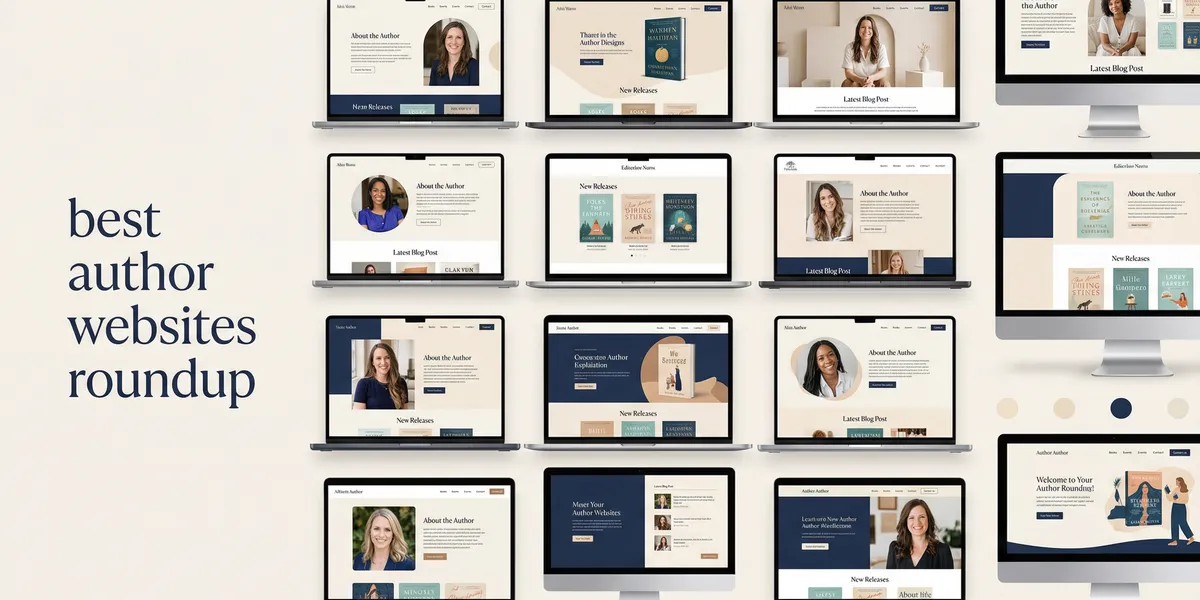
The best author websites do three things: they make visitors want to read your books, they capture email addresses, and they make you look like a professional. These 15 author websites nail all three — and each one teaches a different lesson you can steal for your own site.
Quick Comparison
| Author | Genre | Platform | Standout Feature |
|---|---|---|---|
| Neil Gaiman | Fantasy/Literary | Custom | Blog-driven engagement |
| Rupi Kaur | Poetry | Custom | Visual brand immersion |
| James Patterson | Thriller/Multiple | Custom | Genre-based navigation |
| Austin Kleon | Nonfiction/Art | WordPress | Creative process blog |
| Colleen Hoover | Romance/Contemporary | Squarespace | Reader community focus |
| Brandon Sanderson | Epic Fantasy | Custom | Progress bars and transparency |
| Joanna Penn | Thriller/Nonfiction | WordPress | Content marketing machine |
| Nora Roberts | Romance | Custom | Massive catalog organization |
| John Green | YA/Literary | Squarespace | Multi-platform hub |
| Dani Pettrey | Romantic Suspense | WordPress | Genre-matched design |
| Mark Dawson | Thriller | WordPress | Lead magnet strategy |
| Carissa Broadbent | Fantasy Romance | Custom | Fan community extras |
| Jasmine Guillory | Romance | Squarespace | Clean and accessible |
| V.E. Schwab | Fantasy | Custom | Dark, immersive branding |
| Jeff Goins | Nonfiction | WordPress | Email-first architecture |
1. Neil Gaiman
Best for: Authors who want a blog-driven website that keeps readers coming back
Neil Gaiman’s website proves that consistent content builds an audience bigger than any book launch. His site centers on a long-running blog where he answers reader questions, shares behind-the-scenes updates, and posts about everything from writing process to beekeeping. The navigation is simple — books, events, blog, about — and every page funnels visitors toward his work.
What makes it effective is the personal voice. The blog reads like a conversation, not a marketing pitch. Readers visit between book releases because the content itself is worth reading.
Lesson to steal: A regularly updated blog gives readers a reason to visit your site even when you don’t have a new book out. It also builds massive SEO value over time.
2. Rupi Kaur
Best for: Poets and visual artists who need their website to feel like their work
Rupi Kaur’s website is an extension of her poetry — minimal, emotional, and visually intentional. The homepage uses large whitespace, muted tones, and short phrases that mirror her writing style. You feel her brand the moment the page loads.
Beyond aesthetics, the site is functional. It features her books with purchase links, a merch shop, tour dates, and media appearances. The newsletter signup is prominent without being aggressive.
Lesson to steal: Your website’s visual design should match the emotional tone of your writing. A thriller writer and a poet should not have the same website aesthetic.
3. James Patterson
Best for: Prolific authors with large catalogs spanning multiple genres
James Patterson’s website solves a problem most authors dream of having: too many books. The landing page asks visitors to choose between adult and kids’ content, then each section organizes titles by series and genre. This approach prevents catalog overwhelm and helps readers find exactly what they want.
The site also features a “read next” recommendation engine and integrates reading guides for book clubs.
Lesson to steal: If you write across genres or age groups, let visitors self-select their path. A single long book list loses people. Organized navigation converts them.
4. Austin Kleon
Best for: Nonfiction authors who want to share their creative process
Austin Kleon calls himself “a writer who draws,” and his website embodies that identity. The site showcases his books, but the real draw is his weekly newsletter and blog posts about creativity, art, and the writing life. His “newspaper blackout” poetry series started on his blog and became a bestselling book.
The design is playful and hand-drawn, reflecting his artistic style. The newsletter signup appears on nearly every page with a clear value proposition.
Lesson to steal: Share your creative process publicly. The work-in-progress is often more interesting to readers than the finished product, and it builds anticipation for your next release.
5. Colleen Hoover
Best for: Authors with passionate reader communities
Colleen Hoover’s website succeeds because it focuses on her readers, not just her books. The site features book club guides, a frequently updated events page, and direct links to her social media communities where millions of fans discuss her work.
The book pages include content warnings alongside purchase links — a thoughtful touch that her contemporary romance and literary fiction readers appreciate. The design is clean, modern, and loads quickly on mobile.
Lesson to steal: Build your website around your reader community, not just your catalog. Book club guides, content extras, and community links turn one-time buyers into lifelong fans.
6. Brandon Sanderson
Best for: Authors who value transparency and reader trust
Brandon Sanderson’s website is legendary among fantasy readers for one feature: progress bars. He shows real-time writing progress on current projects, so fans always know exactly where their next book stands. This level of transparency builds extraordinary trust and anticipation.
The site also includes a massive free library of writing lectures from his BYU courses, detailed book annotations, and a reading order guide for his interconnected “Cosmere” universe. His 2022 Kickstarter raised $41 million — proof that transparency and direct reader relationships drive real results.
Lesson to steal: Show your readers what you’re working on. Progress updates, behind-the-scenes content, and honest timelines build the kind of loyalty that translates directly into sales.
7. Joanna Penn
Best for: Author-entrepreneurs who want their website to generate income
Joanna Penn’s website, The Creative Penn, is a masterclass in author content marketing. It functions as a full media company — podcast, blog, courses, books, and affiliate partnerships — all built around helping writers succeed. The site drives traffic through SEO-optimized articles that rank for hundreds of writing-related keywords.
Her email funnel is sophisticated: a free ebook leads to a nurture sequence, which leads to course sales and book purchases. The blog publishes weekly and has built an archive of over a thousand posts.
Lesson to steal: Your author website can be more than a digital business card. Treat it as a content platform, and it becomes a revenue-generating asset that works while you write.
8. Nora Roberts
Best for: Authors with decades of backlist titles to organize
With over 200 published novels, Nora Roberts needs a website that makes her catalog navigable. Her site excels at this with multiple browse options: by series, by title, by publication date, and by her J.D. Robb pen name. A search function handles the rest.
The design is polished but not flashy. New releases get prominent homepage placement, while the “coming soon” section builds anticipation. A detailed FAQ page answers the questions her team receives most often, reducing inbox volume.
Lesson to steal: Invest in catalog organization early. Even if you only have three books now, building a browsable structure scales better than a simple list as your backlist grows.
9. John Green
Best for: Authors with multi-platform brands beyond books
John Green’s Squarespace website serves as a hub connecting his books, YouTube channels (Vlogbrothers and Crash Course with over 18 million combined subscribers), podcast, and public appearances. The site doesn’t try to do everything — it directs visitors to the right platform for what they want.
The design is clean and modern with clear calls to action. Book pages include teacher guides and discussion questions, recognizing that much of his YA audience discovers his work through schools.
Lesson to steal: If you create content across multiple platforms, your website should be the central hub that connects everything — not a siloed book catalog that ignores your other work.
10. Dani Pettrey
Best for: Genre fiction authors who want design to match their brand
Dani Pettrey writes romantic suspense, and her website immediately communicates that. Moody imagery, bold serif typography, and book covers featuring atmospheric settings tell visitors exactly what kind of stories they’ll find here. The color palette is dark and dramatic — appropriate for thrillers with romance.
The homepage prioritizes her latest release with a prominent cover image and purchase links. A newsletter signup offers a free novella as a reader magnet.
Lesson to steal: Choose colors, fonts, and imagery that match your genre. Romance readers expect warmth and elegance. Thriller readers expect tension and darkness. Your website’s visual language should prime visitors for the reading experience.
11. Mark Dawson
Best for: Self-published authors focused on direct-to-reader sales
Mark Dawson’s website is built around one goal: growing his email list. Every page includes a strategic signup offer, and his free “first in series” reader magnet has built a list of over 150,000 subscribers. The site also houses his Self Publishing Formula courses, creating a dual-purpose platform.
His book pages are conversion-optimized with clear buy buttons, series reading order, and review snippets. The design is professional and fast-loading.
Lesson to steal: Treat your email list as your most valuable asset. An engaged list of even 2,000 subscribers can generate 100 to 300 sales per email — far outperforming social media for direct book sales.
12. Carissa Broadbent
Best for: Self-published authors building a passionate fan community
Carissa Broadbent started as a self-published fantasy romance author and built a website that reflects how much she values her readers. The site includes merch, bonus content, character glossaries, series recaps, and extras that reward dedicated fans. Her voice on the site matches her social media presence — warm, personal, and full of personality.
The fan-focused extras serve a strategic purpose too. Glossaries and recaps keep readers engaged between releases and reduce the barrier to starting a new book in a series.
Lesson to steal: Give fans a reason to visit your website beyond buying books. Bonus content, character art, and world-building extras create a destination that deepens reader loyalty.
13. Jasmine Guillory
Best for: Authors who want a clean, accessible site that lets the books speak
Jasmine Guillory’s Squarespace website is proof that simplicity works. The homepage features her book covers prominently, the navigation has four items, and the overall design is bright, warm, and inviting — matching the tone of her contemporary romance novels.
What stands out is the accessibility. The site loads fast, works perfectly on mobile, and doesn’t overwhelm visitors with popups or competing calls to action. The newsletter signup is present but not pushy.
Lesson to steal: You don’t need a complex website to be effective. A clean design with clear navigation and prominent book covers often converts better than a feature-packed site that confuses visitors.
14. V.E. Schwab
Best for: Authors who want an immersive, atmospheric web experience
V.E. Schwab’s website is dark, moody, and immediately draws you into her fantasy worlds. The design uses rich color palettes, custom illustrations, and typography that feels pulled from her book covers. It’s one of the most visually distinctive author websites online.
Beyond the aesthetics, the site is well-organized. Books are grouped by series with clear reading orders, and an FAQ section addresses common reader questions about her interconnected stories.
Lesson to steal: If your books have a strong visual identity, carry that identity through to your website. Consistency between your covers and your online presence reinforces your brand in readers’ minds.
15. Jeff Goins
Best for: Nonfiction authors who want email subscribers above all else
Jeff Goins’ website is an email-capture machine. The homepage is essentially a landing page for his newsletter, with a compelling headline and a simple signup form above the fold. Everything else — books, blog, courses — is secondary to getting that email address.
His content strategy drives thousands of organic visitors monthly through SEO-optimized blog posts about writing and creativity. Each post includes contextual email signup offers related to the topic.
Lesson to steal: If your primary goal is building an email list, design your homepage as a landing page first and a portfolio second. You can always link to your books from the navigation.
How We Evaluated These Websites
Every website on this list was assessed on five criteria:
- Design quality — Does the visual design match the author’s brand and genre?
- User experience — Is the site fast, mobile-friendly, and easy to navigate?
- Conversion strategy — Does the site effectively drive book sales and email signups?
- Content value — Does the site offer reasons to visit beyond buying a book?
- Technical execution — Is the site well-built, accessible, and optimized for search engines?
We prioritized sites that demonstrate specific, actionable strategies you can apply to your own author website, regardless of your budget or technical skill level.
What Every Author Website Needs
Before building your own site, make sure you include these essential elements:
Non-negotiable pages:
- Homepage with your name, genre, and latest book
- Book pages with covers, descriptions, and purchase links
- About page with both a short and long bio
- Contact page (or at minimum, a contact form)
- Newsletter signup with a compelling reason to subscribe
Design fundamentals:
- Mobile-responsive layout (roughly 30% of your traffic will come from phones)
- Fast load times (compress images, choose reliable hosting)
- Colors and fonts that match your genre
- Professional author photo
Growth features:
- A reader magnet (free chapter, novella, or bonus content) to incentivize email signups
- Links to your social media profiles
- A blog or news section for fresh content and SEO value
- Press kit for media and event organizers
Best Platforms for Author Websites
You don’t need to hire a developer. These platforms make it straightforward to build a professional author website:
| Platform | Starting Price | Best For |
|---|---|---|
| Squarespace | $16/month | Beautiful templates, easiest design |
| WordPress | $4/month + hosting | Maximum flexibility, best for blogging |
| Wix | Free / $17/month | Drag-and-drop simplicity |
Squarespace is the most popular choice among the authors on this list, and for good reason. The templates are polished, the editor is intuitive, and the built-in SEO and analytics tools are solid. If design quality matters to you, start here.
WordPress powers over 43% of all websites and offers the most flexibility. It requires slightly more technical setup but gives you full control over every aspect of your site. Best for authors who plan to blog regularly or want advanced customization.
Wix offers a free tier and a drag-and-drop editor that makes it easy to get started quickly. The AI site builder can generate a basic site in minutes.
Start With What You Have
You don’t need a perfect website to launch. Start with a homepage, an about page, a book page, and a newsletter signup. You can always add a blog, merch shop, or fan extras later.
The authors on this list didn’t build their sites overnight. They iterated, tested, and improved over years. The best time to publish your author website was when your first book came out. The second best time is today.
If you’re working on the book that will anchor your website, Chapter helps you go from idea to finished manuscript using AI-assisted writing tools — so you can spend less time drafting and more time building the platform that sells it.