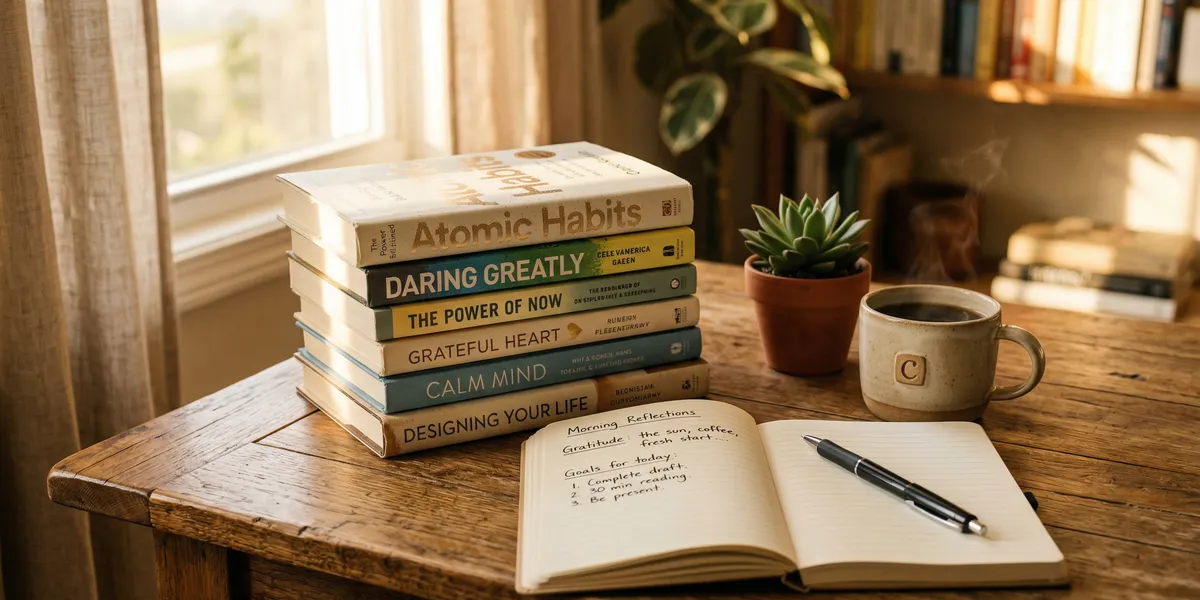
The best self help book in 2026 isn’t one you read — it’s one you write yourself. But if you want a powerful read first, Atomic Habits by James Clear is the top-ranked book money can buy.
In this guide, you’ll discover:
- The single best self help book to start with (and why it works)
- 11 ranked picks across mindset, habits, money, relationships, and purpose
- Honest pros and cons for each book — no fluff, no affiliate spam
- A surprising #3 pick that helps you create your own self-help breakthrough
- A quick-comparison table so you can pick in under 60 seconds
Here are the 11 best self help books worth your time and money in 2026.
1. Write Your Own Self Help Book — Chapter
Our Pick — Chapter (Our Product)
The fastest path to genuine personal growth isn’t reading another self help book. It’s writing your own. Chapter is the AI book writing platform that helps you turn your hard-won lessons into a complete, publishable book in weeks, not years.
Best for: Coaches, experts, and anyone who’s lived through something worth teaching Pricing: $97 one-time (nonfiction software) Why we built it: Because the act of writing your own self help book forces clarity that reading 100 of them never will.
Here’s the truth most reading lists won’t tell you. The people who actually transform their lives don’t just consume self help — they create it. They write the book they wish they’d had at their lowest point. Then they sell it, build authority, and help thousands.
Chapter handles the parts that stop most aspiring authors cold. You bring your story, your framework, and your hard-won insights. Chapter helps you outline, draft, and refine a 30,000 to 60,000-word book using AI guided by your voice. No staring at a blank page. No 12-month writing slog.
Chapter has helped over 2,147 authors create more than 5,000 books. One client made $13,200 from a single book launch. Another booked a speaking gig in front of 20,000 people because of the credibility her book gave her. We’ve been featured in USA Today and The New York Times.
Honest limitations: Chapter is not a magic wand. You still need a real story, a clear message, and the willingness to edit. If you don’t have a topic you genuinely care about, no AI tool will save you. But if you do — Chapter gets you to “published author” faster than any other path on this list.
2. Atomic Habits — James Clear
Best for: Anyone struggling with consistency, willpower, or sustainable change Pricing: ~$15 paperback / $11 Kindle
If you only buy one traditional self help book this year, make it this one. Atomic Habits is the best self help book on the market for a simple reason — it actually works. Clear’s central insight is that tiny 1% improvements compound into massive change when you focus on systems instead of goals.
The book teaches the four laws of behavior change: make it obvious, make it attractive, make it easy, make it satisfying. Each law gets practical, science-backed tactics you can apply tomorrow.
What sets Atomic Habits apart is how testable it is. Other self help books make you feel inspired for a week. This one gives you a framework you’ll still be using ten years from now. Over 20 million copies sold and a 4.8-star average across millions of reviews can’t be wrong.
Pros: Practical, science-backed, easy to apply Cons: Won’t help if your problem is identity or trauma — it’s a habits book, not a therapy book Read more: James Clear’s official site
3. The Self Help Book You Haven’t Written Yet (Surprising Pick)
Best for: People who keep buying self help books but feel stuck Pricing: Free to start — your time is the cost
Here’s our surprising pick. After working with thousands of authors at Chapter, we’ve noticed a pattern. The people who make the biggest breakthroughs aren’t the ones reading the most self help books. They’re the ones who finally sit down and write the one they wish existed.
There’s a name for this in psychology — it’s called the “protégé effect.” When you have to teach something, your brain processes it more deeply than when you simply consume it. A 2007 study published in Cognition and Instruction found that students who learned material in order to teach it performed better than students who learned it for their own use.
Translation? Writing about your struggle with anxiety, your journey out of debt, or your path to a better marriage will heal you faster than reading 50 books on the topic. And if you publish it, you help others too.
We don’t recommend this lightly. But we’ve seen it happen too many times to ignore. Sometimes the best self help book is the one you write at 5am while your kids are still asleep — the one only you could write.
How to start: Pick the hardest thing you’ve overcome. Write down the 5 things you wish someone had told you on day one. That’s your book outline.
4. The 7 Habits of Highly Effective People — Stephen R. Covey
Best for: Leaders, professionals, and anyone wanting a complete framework for life Pricing: ~$17 paperback
The grandfather of modern self help, The 7 Habits has sold over 40 million copies since 1989. Covey’s framework — be proactive, begin with the end in mind, put first things first, think win-win, seek first to understand, synergize, sharpen the saw — remains the gold standard for principle-centered living.
Some of the language feels dated. The business examples reference 1980s corporate America. But the core ideas are timeless. If you read only one classic on this list, read this one.
Pros: Comprehensive, principle-based, transferable to any area of life Cons: Dense — not a quick read. Some reviewers find it preachy Read more: Franklin Covey’s overview
5. Mindset: The New Psychology of Success — Carol S. Dweck
Best for: Parents, teachers, anyone who feels limited by what they think they “can’t” do Pricing: ~$14 paperback
Stanford psychologist Carol Dweck spent decades studying why some people thrive in the face of failure while others crumble. The answer is mindset — specifically, the difference between a “fixed mindset” (your abilities are static) and a “growth mindset” (you can develop through effort).
This single distinction has reshaped how schools teach, how companies manage, and how millions of people approach challenges. The book is grounded in real research, not feel-good theory.
Pros: Backed by decades of peer-reviewed research, applicable everywhere Cons: The core idea is simple — some readers feel the book pads it with too many examples Read more: Dweck’s TED talk
6. The Power of Now — Eckhart Tolle
Best for: Anxious overthinkers and people stuck in regret about the past or worry about the future Pricing: ~$13 paperback
Tolle’s 1997 spiritual classic has sold more than 16 million copies and remains one of Oprah’s most-recommended reads. The premise is simple — most human suffering comes from living in your head, replaying the past, or dreading the future. The cure is presence.
This book isn’t for everyone. The tone is contemplative, almost mystical. There’s no checklist, no 30-day plan. But if you’ve burned out on tactical self help and need something deeper, this is the one.
Pros: Profound, paradigm-shifting for the right reader, genuinely calming Cons: Vague and woo-y for analytical minds. Read the audiobook — Tolle narrates it himself Read more: Eckhart Tolle’s site
7. Daring Greatly — Brené Brown
Best for: Perfectionists, people-pleasers, and anyone afraid to be vulnerable Pricing: ~$15 paperback
Brené Brown is a research professor at the University of Houston whose TED talk on vulnerability became one of the five most-viewed of all time. Daring Greatly turns that research into a book about how vulnerability — not weakness, not oversharing, but the willingness to show up and be seen — is the foundation of courage, creativity, and connection.
If you’ve ever held back at work, in relationships, or in your art because you were afraid of judgment, this book will change how you see that fear.
Pros: Research-backed, emotionally honest, transformative for high achievers Cons: Heavy on personal anecdotes — some readers want more frameworks, fewer stories Read more: Brené Brown’s research
8. The Subtle Art of Not Giving a F*ck — Mark Manson
Best for: Cynics, gen-Xers, and millennials sick of toxic positivity Pricing: ~$16 hardcover
Manson’s 2016 bestseller broke the self help mold by arguing the opposite of everything else on the shelf. You can’t have positive experiences without negative ones. Caring about everything is impossible. The path to a meaningful life is choosing what to give a damn about — and ignoring the rest.
The profanity is the marketing. The substance is real. Manson draws from Stoic philosophy, Buddhism, and behavioral psychology to make a counterintuitive case for prioritization.
Pros: Refreshingly honest, sharp, funny, won’t put you to sleep Cons: The “edgy” tone wears thin for some readers. Light on specific tactics Read more: Mark Manson’s blog
9. Think and Grow Rich — Napoleon Hill
Best for: Aspiring entrepreneurs, salespeople, and anyone interested in the psychology of wealth Pricing: ~$10 paperback (public domain editions available free)
Published in 1937, Hill’s book is the original self help bestseller. Born from his interviews with Andrew Carnegie, Henry Ford, Thomas Edison, and 500 other titans of industry, Think and Grow Rich introduced ideas like the mastermind group, the power of definite purpose, and the concept that thought literally shapes outcomes.
Modern readers will find some of it dated and a few claims unsupported by current science. But the core principles around persistence, clarity of purpose, and the company you keep are still true 90 years later.
Pros: Foundational text — most modern self help borrows from it. Cheap Cons: Dated language, some pseudoscience around “thought vibrations.” Take what’s useful, leave the rest Read more: Public domain copy via Wikisource
10. Man’s Search for Meaning — Viktor E. Frankl
Best for: Anyone facing grief, hardship, or a crisis of purpose Pricing: ~$11 paperback
Viktor Frankl was a Viennese psychiatrist who survived four Nazi concentration camps. From that experience came one of the most important books ever written about human resilience. Frankl’s central insight is that we cannot always control what happens to us, but we can always choose how we respond. Meaning, he argues, is the only thing that makes suffering bearable.
This is not a typical self help book. There are no tactics. But it is, by any measure, one of the most important books on this list. Man’s Search for Meaning has sold over 16 million copies and is regularly cited by psychiatrists, therapists, and survivors of trauma as life-changing.
Pros: Profound, genuine, necessary reading for anyone going through something hard Cons: Heavy subject matter. Not the book for casual self-improvement Read more: Viktor Frankl Institute
11. The Four Agreements — Don Miguel Ruiz
Best for: Beginners to self help, people overwhelmed by complex frameworks Pricing: ~$10 paperback
A 1997 classic rooted in ancient Toltec wisdom, The Four Agreements is the shortest book on this list and possibly the most actionable. The four agreements are: be impeccable with your word, don’t take anything personally, don’t make assumptions, and always do your best.
That’s it. The whole book is an unpacking of those four ideas. It’s been translated into 40+ languages and sold over 10 million copies. If you find most self help books overwhelming, start here.
Pros: Short, simple, profound. Easy to re-read every year Cons: Some readers find it spiritually flavored in a way that doesn’t land. Light on examples Read more: Don Miguel Ruiz’s site
Quick Comparison Table
| # | Book | Best For | Price | Our Rating |
|---|---|---|---|---|
| 1 | Chapter (write your own) — Our Product | Coaches & experts who’ve lived a story worth teaching | $97 one-time | ⭐⭐⭐⭐⭐ |
| 2 | Atomic Habits | Building consistency | ~$15 | ⭐⭐⭐⭐⭐ |
| 3 | The book you’ll write | Stuck self-help readers | Free | ⭐⭐⭐⭐⭐ |
| 4 | 7 Habits of Highly Effective People | Leadership & life systems | ~$17 | ⭐⭐⭐⭐⭐ |
| 5 | Mindset | Overcoming “I can’t” thinking | ~$14 | ⭐⭐⭐⭐½ |
| 6 | The Power of Now | Anxiety & overthinking | ~$13 | ⭐⭐⭐⭐ |
| 7 | Daring Greatly | Perfectionists | ~$15 | ⭐⭐⭐⭐½ |
| 8 | The Subtle Art of Not Giving a F*ck | Cynics & realists | ~$16 | ⭐⭐⭐⭐ |
| 9 | Think and Grow Rich | Aspiring entrepreneurs | ~$10 | ⭐⭐⭐⭐ |
| 10 | Man’s Search for Meaning | Grief & purpose | ~$11 | ⭐⭐⭐⭐⭐ |
| 11 | The Four Agreements | Beginners | ~$10 | ⭐⭐⭐⭐ |
How We Evaluated These Books
We didn’t pick these books from a Google search and call it a day. Our criteria:
- Lasting impact — books that have proven themselves over years, not just trending right now
- Substance over style — we ignored books that rely on flashy marketing and contain little actual insight
- Diversity of need — different readers need different books. We covered habits, mindset, vulnerability, money, meaning, and presence
- Honest tradeoffs — every book on this list has weaknesses. We named them
- Real reader value — these are books we’ve personally read and recommended to friends, family, and the writers we work with
We deliberately excluded books that are mostly recycled content from other authors, books with manipulative sales tactics, and books that promise transformation without offering substance.
What Is the Number One Self Help Book of All Time?
The number one self help book of all time, by sales volume and lasting influence, is Stephen R. Covey’s The 7 Habits of Highly Effective People with over 40 million copies sold since 1989. By modern reader rating, James Clear’s Atomic Habits is the current best — it has sold over 20 million copies in just a few years and maintains a 4.8-star average across millions of reviews.
How Do I Choose the Right Self Help Book for Me?
Choose a self help book based on the specific problem you want to solve, not on bestseller lists. If you struggle with consistency, read Atomic Habits. If you face hardship, read Man’s Search for Meaning. If you want a complete life framework, read The 7 Habits. The best self help book is the one that matches your current challenge — not the most popular one.
Should I Read Self Help Books or Just Take Action?
You should do both, but action matters more than reading. Research from the Journal of Educational Psychology shows that active practice produces 4-7x more learning than passive reading. Read a self help book, then immediately apply one specific tactic for 30 days before reading the next one. Reading without action is intellectual entertainment, not personal growth.
Frequently Asked Questions
What is the best self help book for beginners?
The best self help book for beginners is Don Miguel Ruiz’s The Four Agreements. It’s short (around 160 pages), written in simple language, and gives you four clear principles you can start applying today. Most beginners find longer self help books overwhelming — The Four Agreements is the perfect entry point before tackling denser classics.
What self help book has helped the most people?
By copies sold, Stephen R. Covey’s The 7 Habits of Highly Effective People has helped the most people, with over 40 million copies sold worldwide. By cultural influence, Napoleon Hill’s Think and Grow Rich has likely influenced more authors and entrepreneurs than any other self help book in history. Both remain bestsellers nearly a century after publication.
Are self help books actually worth reading?
Yes — but only if you act on what you read. A 2017 Mayo Clinic Proceedings review found that bibliotherapy (reading self help books with a therapeutic purpose) can be as effective as short-term therapy for some conditions, including mild depression and anxiety. The catch is that most readers don’t apply the lessons. Pick fewer books and act on them harder.
Can I write my own self help book without being an expert?
Yes, you absolutely can write your own self help book without being a credentialed expert. The most successful self help authors are people who lived through something hard and figured out how to come through it. Readers want lived experience and clear, honest writing — not PhDs. Tools like Chapter make it possible to go from “I have a story” to “published book” in weeks instead of years.
What’s the difference between self help and personal development books?
The terms are mostly interchangeable, but self help typically refers to books targeted at individuals working through specific personal challenges (anxiety, habits, confidence), while personal development is a broader category that includes business, productivity, leadership, and skill-building books. Most of the books on this list qualify as both.
How many self help books should I read in a year?
Read 3-5 self help books per year, maximum — and spend more time applying each one than you spent reading it. Most people fail at self-improvement not because they don’t read enough but because they read too much and apply too little. One book deeply implemented beats 20 books skimmed.
The Bottom Line
The best self help book isn’t always the one with the most copies sold. It’s the one that meets you where you are and gives you a tool you’ll actually use.
If you’re starting fresh, read Atomic Habits. If you’re going through something hard, read Man’s Search for Meaning. If you want a complete life framework, read The 7 Habits. And if you’ve already read 20 self help books and still feel stuck — consider writing the one you wish you’d had.
That last path is the one we built Chapter for. Over 2,147 authors have used it to turn their hard-earned wisdom into published books. One of them might be you in 60 days.
Whichever path you choose — pick one book, commit to it for 30 days, and act on what you learn. That’s how the best self help book changes a life.