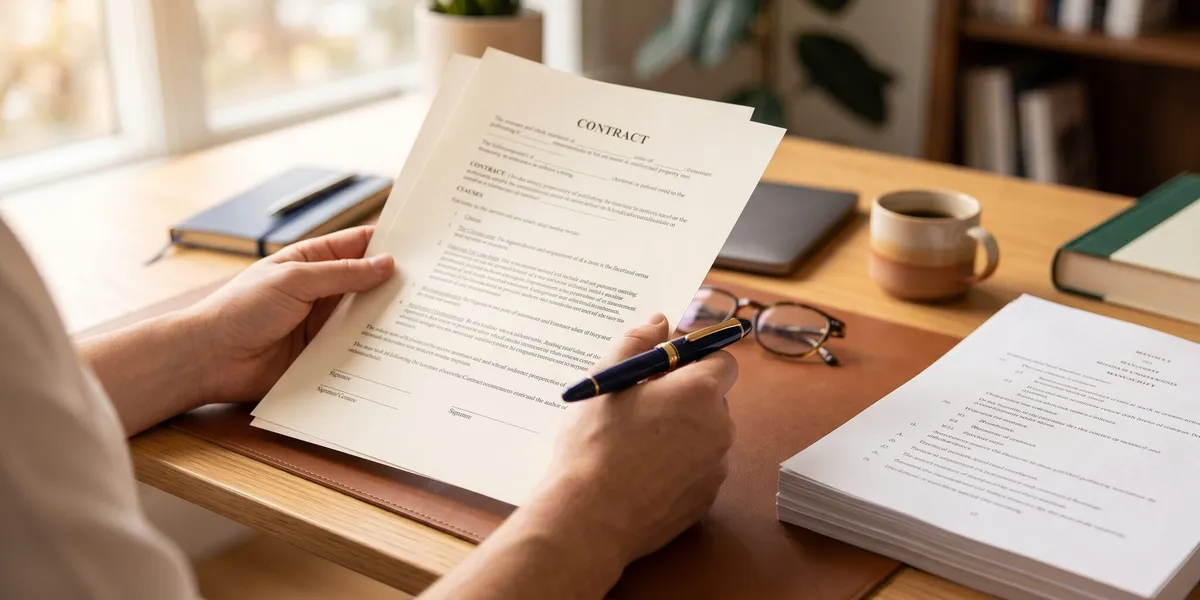
A reversion clause lets you reclaim publishing rights to your book when specific conditions are met — typically when sales drop below a threshold or a set time period expires.
In this guide, you’ll learn:
- What a reversion clause is and how it works in modern publishing contracts
- The key book publishing contract terms that affect your rights
- How to negotiate stronger reversion language before signing
- What non-compete clauses mean for your future books
- How to exercise your reversion rights and self-publish your backlist
Here’s everything you need to know about protecting your intellectual property.
Note: This article is general information for authors, not legal advice. Publishing contracts vary, and rights law differs by country. Consult a qualified publishing attorney before signing, negotiating, or enforcing any contract term.
What Is a Reversion Clause?
Reversion clause — A contract provision that defines when and how rights granted to another party transfer back to the original owner. In publishing, a book contract reversion clause returns publishing rights from the publisher to the author, typically triggered by low sales, out-of-print status, or a fixed time period.
The term appears in other contexts too — property leases and mineral rights use “reversion” the same way, meaning rights revert to the original holder once a condition is met. In book publishing, that condition is almost always commercial performance or elapsed time.
Every traditional publishing contract grants the publisher certain rights to your work. The reversion clause is your exit strategy — it specifies the exact conditions under which those rights come back to you.
Without a strong reversion clause, your publisher could hold your rights indefinitely, even if your book hasn’t sold a copy in years. This is particularly common with ebook-only editions, where a publisher can keep a title technically “in print” forever with zero marketing investment.
The Authors Guild calls reversion clauses one of the most important provisions in any publishing contract — and one of the most frequently overlooked by new authors.
How Reversion Clauses Work in Modern Publishing Contracts
Traditional reversion clauses were straightforward: when a book went out of print (no physical copies available), rights reverted to the author. The publisher would send a letter confirming reversion, and you could shop the book elsewhere.
Digital publishing changed everything. Since ebooks never technically go “out of print,” publishers can hold rights indefinitely on a title generating $12 per year in royalties. Modern contracts need modern reversion language.
Common Reversion Triggers
Your reversion clause should include at least one of these mechanisms:
Sales threshold reversion. Rights revert if the book sells fewer than a specified number of copies (commonly 100-250) within a rolling 12-month period. This is the most author-friendly trigger because it measures actual market performance.
Royalty threshold reversion. Rights revert if royalties earned fall below a specific amount (often $100-$500) in a 12-month period. The Authors Guild recommends this approach because it prevents publishers from dumping copies at steep discounts to stay above a unit-sales threshold.
Time-based reversion. Rights automatically revert after a fixed period — typically 3 to 7 years from publication. This is the cleanest mechanism but the hardest to negotiate with major publishers.
Out-of-print reversion. The traditional trigger — rights revert when no edition is commercially available. In modern contracts, you’ll want this defined as “no edition available through standard retail channels with active marketing support,” not simply “available in any format.”
Essential Book Publishing Contract Terms You Must Understand
Beyond reversion clauses, several other book publishing contract terms directly affect your ability to reclaim and use your rights. Understanding these terms before signing gives you negotiating power.
Grant of Rights
This section defines exactly what you’re giving the publisher. Pay close attention to:
- Territory — World English rights vs. North American only vs. specific countries
- Format — Hardcover, paperback, ebook, audio, or “all formats now known or later invented”
- Duration — Term of copyright (life plus 70 years) vs. a fixed term
- Subsidiary rights — Film rights, translation rights, merchandise, and more
The narrower the grant, the easier it is to reclaim what matters to you. If your publisher only holds North American print rights, you retain everything else from day one.
Option Clause
The option clause gives the publisher first look at your next book. A well-drafted option clause specifies:
- Only your next book in the same genre or series (not everything you ever write)
- A time limit for the publisher’s decision (30-60 days is standard)
- Terms that must match or improve upon your current contract
- A clear release mechanism if you and the publisher can’t agree on terms
A poorly drafted option clause can trap you with a publisher for years — even after you’ve successfully reverted rights on earlier books.
Accounting and Audit Rights
Your contract should specify:
- Payment frequency — Quarterly or semi-annually (never annually)
- Reporting detail — Unit sales by format, returns, reserves against returns
- Audit rights — Your ability to have an accountant inspect the publisher’s books
- Reserve limits — Maximum percentage the publisher can hold back against returns (industry standard is 20-25%)
These provisions matter for reversion because you need accurate sales data to know when your reversion threshold is triggered.
Book Permissions and Rights: What You’re Really Signing Away
Book permissions and rights — The specific legal authorizations an author grants to a publisher, defining what the publisher can and cannot do with the work across formats, territories, and time periods.
When you sign a publishing contract, you’re granting permission to exploit your intellectual property in specific ways. Understanding the full scope of these permissions helps you negotiate better reversion terms from the start.
Primary Rights vs. Subsidiary Rights
Primary rights include the core publishing formats: hardcover, trade paperback, mass market paperback, and ebook. These are the rights most directly affected by your reversion clause.
Subsidiary rights include everything beyond the book itself:
- Audio rights (increasingly valuable — this market grew 25% year-over-year through 2025)
- Film and television adaptation rights
- Foreign translation rights
- Serial rights (excerpts in magazines or newspapers)
- Merchandising rights
- Large print rights
- Book club rights
Each subsidiary right should have its own “use it or lose it” timeline. If your publisher hasn’t sold audio rights within 18 months of publication, those rights should revert automatically. Same with translation rights (typically 18-24 months) and film rights (24 months is standard).
Digital Rights and the Modern Reversion Problem
The biggest rights dispute in modern publishing centers on ebook rights. Before 2008, most contracts didn’t specifically address digital editions. Many publishers now claim ebook rights under broad “all formats” language in older contracts.
If your contract predates the ebook era, you may have grounds to argue that digital rights were never granted. This is a legal question requiring an attorney, but it’s worth exploring if you signed before 2010.
For new contracts, insist that ebook rights are subject to the same reversion triggers as print rights. A book selling 3 ebook copies per month shouldn’t block reversion of all rights.
Non-Compete Clause in Book Contracts: What It Means for Your Career
Non-compete clause book contracts — A contractual restriction preventing an author from publishing competing works that could reduce sales of the contracted book, often limiting the author’s ability to write on similar topics or in similar genres.
Non-compete clauses are one of the most author-unfriendly provisions in publishing contracts. The Authors Guild has actively campaigned to weaken or eliminate these clauses, calling them a threat to authors’ livelihoods.
How Non-Compete Clauses Typically Read
A standard non-compete might state:
“The Author agrees not to publish or authorize publication of any work that directly competes with or is reasonably likely to injure sales of the Work during the term of this Agreement.”
The problems here are obvious: “reasonably likely to injure sales” is subjective, “during the term of this Agreement” could mean decades, and “any work” is dangerously broad.
Red Flags in Non-Compete Language
Watch for these overly broad terms:
- “Similar subject matter” — If you write a cookbook on Italian pasta, does this prevent you from writing any Italian cookbook? Any cookbook at all?
- “During the term of this Agreement” — If the agreement lasts for the life of copyright, this is a career-killing restriction
- “Same genre” — Does writing one romance novel lock you out of the entire romance genre?
- No time limit — A non-compete should expire within 12-24 months of publication at most
- No geographic limit — A non-compete should match the territory of your rights grant
How to Negotiate Better Non-Compete Terms
Push for these author-friendly modifications:
- Limit to the specific text — The non-compete should only prevent you from republishing substantially similar content, not writing on the same topic
- Add a time limit — 12 months from publication date is reasonable; life of copyright is not
- Define “competing” — Require that the competing work must “directly and substantially” reduce sales, not merely cover related topics
- Carve out exceptions — Academic articles, blog posts, shorter works, and works in different formats should be exempt
- Tie to reversion — Once your reversion clause triggers, any non-compete should automatically expire
If you’re a nonfiction author specializing in a topic, a broad non-compete could prevent you from writing in your area of expertise for years. This is especially problematic for academics, subject-matter experts, and series authors.
How to Exercise Your Reversion Rights (Step-by-Step)
Once your reversion conditions are met, you need to follow the proper procedure. Missing a step can delay or void your claim.
Step 1: Verify Your Threshold Is Met
Pull your royalty statements for the relevant period. Calculate whether sales or royalties have fallen below the contractual threshold. If your contract uses a rolling 12-month period, identify the exact dates.
Keep copies of all royalty statements. If numbers seem off, exercise your audit rights before requesting reversion.
Step 2: Send Written Notice
Most contracts require written notice (not email) sent to the publisher’s legal or contracts department. Your letter should:
- Reference the specific contract and ISBN
- Cite the exact reversion clause by section number
- State the factual basis for reversion (e.g., “Royalties for the period [date] to [date] totaled $47, below the $100 threshold specified in Section 14.2”)
- Request written confirmation of reversion within 30 days
Send via certified mail with return receipt. You want proof of delivery.
Step 3: Wait for the Cure Period
Most contracts give the publisher a “cure period” — typically 6 to 12 months — to bring the book back into active publication before reversion takes effect. During this period, the publisher might:
- Launch a new marketing campaign
- Release a new edition
- Reduce the price to stimulate sales
- Sell subsidiary rights they’ve been sitting on
If the publisher successfully meets the threshold during the cure period, reversion doesn’t occur. You’ll need to wait for the next qualifying period.
Step 4: Get Written Confirmation
Once the cure period expires without the publisher meeting the threshold, request written confirmation that rights have reverted. This document is essential when you approach new publishers or self-publish your backlist.
Your confirmation letter should specify:
- All rights that have reverted
- The effective date of reversion
- Confirmation that no further obligations exist (or specification of any that remain, like royalty payouts on existing inventory)
Step 5: Plan Your Next Move
With rights in hand, you have several options:
- Self-publish — The most common choice for reverted books. You keep full control and higher royalties. Platforms like Amazon KDP make this straightforward.
- Republish with a new publisher — If you’ve built a larger platform since the original deal, you may attract better terms
- License specific rights — Sell audio rights to an audiobook publisher, film rights to a production company, or translation rights territory by territory
Many authors who reclaim their rights find that self-publishing reverted backlist titles generates significantly more income than the original publishing deal — especially when they control pricing, marketing, and format decisions.
How to Negotiate Stronger Reversion Terms Before You Sign
The best time to fight for your rights is before you sign. Once a contract is executed, changing terms requires the publisher’s cooperation — which they have no incentive to provide.
Minimum Reversion Standards to Demand
Based on recommendations from the Authors Guild, SFWA, and other author advocacy organizations, your reversion clause should include:
| Element | Author-Friendly Standard | Publisher-Friendly (Avoid) |
|---|---|---|
| Trigger | Royalties below $250/year OR sales below 100 units/year | ”Out of print” (undefined) |
| Timeline | Right to request reversion 2-3 years after publication | ”During the term of copyright” |
| Cure period | 6 months maximum | 12-18 months |
| Notice method | Written notice, publisher must respond in 30 days | No response timeline specified |
| Subsidiary rights | Individual reversion timelines (12-24 months) | Tied to primary rights only |
| Digital definition | Ebooks subject to same thresholds as print | Any digital availability = “in print” |
What to Do If the Publisher Won’t Negotiate
If a publisher refuses to include reasonable reversion terms:
- Walk away — This is always an option. A bad contract is worse than no contract.
- Propose a compromise — Suggest a higher sales threshold or longer cure period rather than accepting no reversion clause at all.
- Hire an agent — Literary agents negotiate these terms daily and know what’s achievable with each publisher.
- Consult a publishing attorney — For deals with advances above $25,000, legal review is worth the cost.
The Self-Publishing Alternative
If traditional publishers won’t offer fair terms, self-publishing eliminates the reversion problem entirely. You retain all rights from day one. With modern tools like Chapter, you can produce professional-quality books without surrendering any rights.
Our Pick — Chapter
Chapter helps you write and publish your book while keeping 100% of your rights. No contracts to sign away your intellectual property, no reversion clauses needed, no non-compete restrictions on your future work.
Best for: Authors who want full creative control and ownership from day one Pricing: $97 one-time (nonfiction) Why we built it: Because your words should always belong to you
The Copyright Act’s 35-Year Termination Right
Even without a contractual reversion clause, U.S. law provides a statutory right to reclaim your work. Under Section 203 of the Copyright Act of 1976, authors can terminate any rights transfer 35 years after the original grant.
This means:
- If you signed a publishing contract in 1991, you can reclaim rights starting in 2026
- The termination window is 5 years (so years 35-40 after the grant)
- You must provide notice 2-10 years before the intended termination date
- Works made for hire are NOT eligible
This statutory right exists regardless of what your contract says. Even if your contract states “rights granted for the full term of copyright,” the 35-year termination right overrides it. Publishers cannot contractually waive this right.
How to Use the 35-Year Termination
- Calculate your eligibility window (35 years from the date of the contract or publication, depending on the grant type)
- File a termination notice with the Copyright Office (required 2-10 years before the intended date)
- Serve notice on the publisher
- Wait for the effective date
This is a complex legal process. Consult a publishing attorney who specializes in copyright termination. The Authors Alliance maintains free resources to guide you through the process.
Common Mistakes When Requesting Rights Reversion
Avoid these errors that can delay or prevent your reversion:
- Not reading your specific contract — Every contract is different. Don’t assume standard terms apply to yours.
- Sending notice to the wrong address — Use the address specified in the “notices” section of your contract, not the editor’s email.
- Forgetting subsidiary rights — Reversion of print rights doesn’t automatically include audio, film, or translation rights. Request reversion of all rights specifically.
- Not waiting for the cure period to expire — Jumping the gun can void your reversion request entirely.
- Accepting verbal confirmation — Always get written confirmation signed by someone with authority at the publishing house.
- Not checking for assignment — Publishers get acquired. Your contract may have been assigned to a new entity. Verify who currently holds your rights.
What Happens After You Get Your Rights Back?
Once reversion is confirmed, you own your work again — but there are practical steps to take:
Update Your Copyright Registration
If you registered copyright when the book was first published, file a supplementary registration with the Copyright Office noting the reversion of rights. This creates a clear public record.
Reclaim Your ISBN
Your original ISBN belongs to the publisher who purchased it. You’ll need a new ISBN for any new edition. You can get ISBNs through Bowker or use free ISBNs from platforms like KDP.
Consider Revisions
Reversion is a perfect opportunity to:
- Update outdated information (especially for nonfiction)
- Fix errors that were never corrected
- Add new material
- Redesign the cover for modern market expectations
- Retitle if the original title underperformed
Build Your Self-Publishing Strategy
Most authors who reclaim rights choose to self-publish their backlist. The combination of existing reader reviews, name recognition, and full royalty rates makes self-publishing reverted titles one of the highest-ROI activities in an author’s career.
Related Resources
- Author contract red flags — the warning signs to catch before you sign
- Publishing contract template — a plain-language reference for standard clauses
- Book royalties explained — how the numbers behind your reversion threshold actually work
- Ghostwriter contract template — rights language for work-for-hire arrangements
- How to find a literary agent — who negotiates reversion terms on your behalf
FAQ
What is a reversion clause?
A reversion clause is a contract provision that specifies when rights granted to another party return to the original owner. In publishing, it returns your book’s publishing rights from the publisher to you — usually when sales fall below a threshold, royalties drop under a minimum, or a fixed term expires.
What is a reversion clause in a book contract?
A reversion clause in a book contract is a provision that specifies when and how publishing rights transfer back from the publisher to the author. Common triggers include sales falling below a specified threshold, royalties dropping below a minimum amount, or a fixed time period expiring after publication.
How long does rights reversion take?
Rights reversion typically takes 6 to 18 months from your initial request. This includes the time to verify threshold conditions, send written notice, wait for the publisher’s cure period (usually 6-12 months), and receive written confirmation. The exact timeline depends on your contract’s specific cure period length.
Can a publisher refuse to revert my rights?
A publisher can only refuse reversion if the contractual conditions haven’t been met. If your contract specifies reversion when sales fall below 100 copies annually and the book sold 101 copies, the publisher can legitimately refuse. However, if conditions are clearly met and the publisher still refuses, you may need legal counsel to enforce the clause.
What is a non-compete clause in a book contract?
A non-compete clause in a book contract prevents you from publishing works that could directly compete with your contracted book. These clauses restrict what topics, genres, or formats you can publish during the agreement’s term. Authors should negotiate time limits (12-24 months maximum) and narrow definitions of “competing” work.
Do I need a lawyer to exercise reversion rights?
You don’t always need a lawyer for straightforward reversion requests where conditions are clearly met. However, legal counsel is advisable when the publisher disputes your claim, the contract language is ambiguous, you’re dealing with a publisher acquisition, or you want to terminate under the Copyright Act’s 35-year provision.