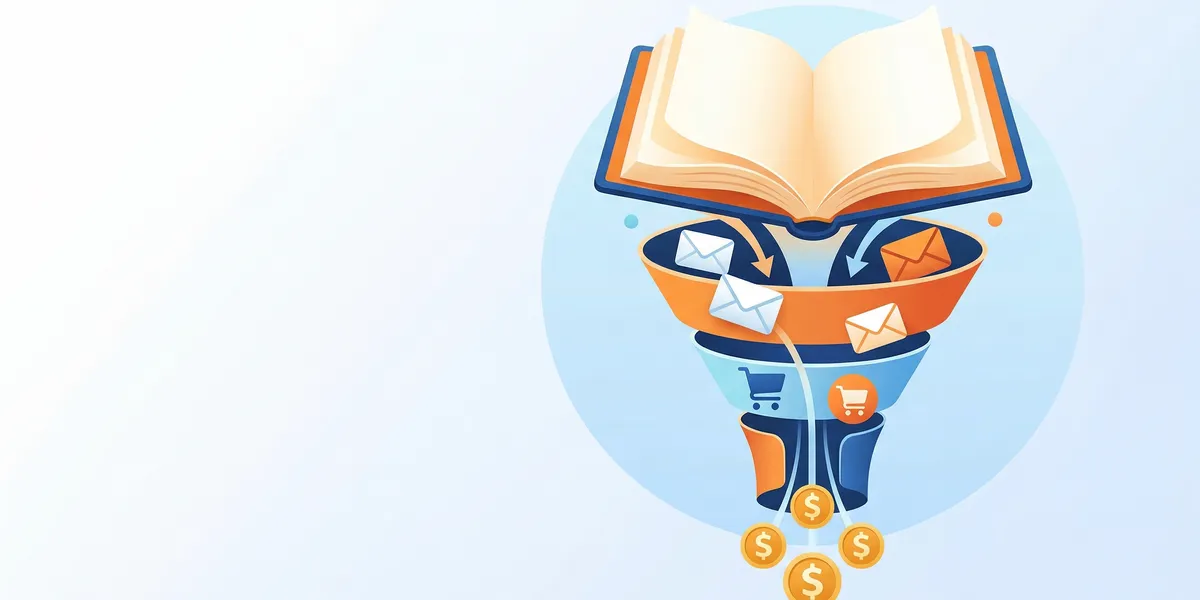
A book funnel is a marketing system that turns your book into a lead-generation machine — converting casual readers into email subscribers, paying customers, and long-term fans.
In this guide, you’ll learn:
- What a book funnel is and why every author needs one
- The 7 steps to building a profitable book funnel from scratch
- How to choose the right funnel model for your goals
- Which tools make the process fast and affordable
Here’s how to set yours up.
What Is a Book Funnel?
A book funnel is a structured sequence of pages, offers, and emails that guides a reader from discovering your book to buying it — and then purchasing your higher-priced products or services.
Think of it like a path. Your book sits at the entrance. A reader picks it up (free, discounted, or full price). Then your funnel gently guides them toward your email list, a course, coaching, or your next book.
The concept comes from traditional sales funnel strategy, but applied specifically to books. Instead of a webinar or free trial at the top, your book is the entry point.
Why Every Author Needs a Book Funnel
Most authors publish a book and hope people find it. A book funnel flips that approach entirely.
You control the reader journey. Instead of relying on Amazon’s algorithm to surface your book, you drive traffic directly to a landing page you own.
You build an email list. Every reader who enters your funnel gives you their email address. That list becomes your most valuable marketing asset — worth far more than any single book sale.
You increase revenue per reader. A book alone might earn you $3-7 per sale. A well-built funnel can generate $50-200+ per reader through upsells, courses, and backend offers.
According to Nonfiction Authors Association, many bestselling authors earn the majority of their income not from book royalties, but from speaking, consulting, and courses that their book funnels feed into.
The 5 Book Funnel Models (Pick the Right One)
Not every book funnel works the same way. Choose the model that matches your goals.
| Funnel Model | Best For | Entry Offer | Backend Revenue |
|---|---|---|---|
| Free + Shipping | Nonfiction authors, coaches | Free book, reader pays $7-10 shipping | Courses, coaching, consulting |
| Lead Magnet | List building, fiction or nonfiction | Free ebook or sample chapters | Email sequences, book sales |
| Discounted Front-End | Fiction authors, series writers | $0.99-2.99 ebook | Full-price sequels, box sets |
| Webinar Bridge | Course creators, experts | Free book + free training | High-ticket course or program |
| Direct Sales | Established authors with audiences | Full-price book on your own site | Signed editions, bundles, merch |
The free + shipping model is the most popular for nonfiction authors who want clients. You offer your physical book for free — the reader just covers shipping (typically $7-10). Your goal is not to profit from the book sale. Your goal is to acquire a customer cheaply and move them toward higher-value offers.
The lead magnet model works best if you want to build a massive email list. You give away a free ebook or sample chapters in exchange for an email address. This is especially effective for fiction authors building a reader base.
Step 1: Write a Book Worth Funneling
Your book is the foundation of your entire funnel. If the book is mediocre, the funnel collapses.
For nonfiction, your book should solve one specific problem for a clearly defined reader. The more focused, the better. A book called “How to Train Your Golden Retriever in 30 Days” converts better in a funnel than “Everything About Dogs.”
For fiction, your book needs to hook readers hard enough that they want more. The first book in a series is the ideal funnel entry point.
Our Pick — Chapter
Chapter’s AI writing assistant helps you draft, outline, and polish a full-length book in weeks instead of months. Over 2,147 authors have used it to create 5,000+ books — including titles featured in USA Today and the New York Times.
Best for: Nonfiction and fiction authors who want a publication-ready book fast Pricing: $97 one-time (nonfiction) | Varies (fiction) Why we built it: Because a great funnel means nothing without a great book behind it
Whether you use AI tools to write your book or draft it yourself, invest in quality. Your funnel audience will judge your expertise by the book they receive.
Step 2: Build Your Landing Page
Your landing page is where the funnel begins. This is the page you drive traffic to — not your Amazon listing, not your blog, not your homepage.
A high-converting book landing page needs:
- A headline that promises a specific outcome — “The Free Book That Shows You How to Train Your Dog in 30 Days”
- A hero image of the book — Physical mockup or 3D cover render
- 3-5 bullet points of benefits — What the reader gets from the book
- Social proof — Testimonials, review count, media mentions
- A clear call-to-action — “Get Your Free Copy” or “Download Now”
- A simple form — Name and email (keep it minimal to reduce friction)
Keep the page focused on one action. No navigation menu. No sidebar. No distractions. One page, one offer, one button.
Tools like Carrd, ConvertKit, and Leadpages make it easy to build landing pages without coding.
Step 3: Set Up Your Email Sequence
Once someone enters your funnel, they need to hear from you. An automated email sequence does the heavy lifting while you sleep.
Your welcome sequence should include 5-7 emails:
- Email 1 (Immediate): Deliver the book or confirm shipping. Thank them.
- Email 2 (Day 1): Share a personal story about why you wrote the book.
- Email 3 (Day 3): Provide a bonus tip or exclusive content related to the book’s topic.
- Email 4 (Day 5): Introduce your next offer (course, coaching, next book) with a soft pitch.
- Email 5 (Day 7): Share a case study or testimonial from someone who used your advice.
- Email 6 (Day 10): Make a direct offer with a deadline or incentive.
- Email 7 (Day 14): Final reminder + recap of what they’ll miss.
The key is value first, pitch second. Every email should give the reader something useful — even the ones that include a sales pitch.
For a deeper dive into email marketing strategies for authors, check our dedicated guide.
Step 4: Create Your Upsell Offers
The real revenue in a book funnel comes from what you sell after the book. Your upsells should naturally extend the value of the book itself.
Effective upsell tiers for authors:
- Low-ticket ($7-47): Audiobook version, workbook/templates, bonus chapter bundle, mini-course
- Mid-ticket ($47-297): Full online course, group coaching program, advanced training
- High-ticket ($297-5,000+): One-on-one coaching, done-for-you services, mastermind group, consulting packages
The upsell page appears immediately after the reader enters their information. This is called a “one-time offer” (OTO) — they see it before they even check their email.
One Chapter.pub client generated $13,200 from a single book by pairing it with a coaching upsell. Another earned $60,000 in 48 hours using a book funnel that fed into a course launch.
The book itself might break even or even lose money. That is fine. You are buying customers at a predictable cost, then profiting on the backend.
Step 5: Drive Traffic to Your Funnel
A funnel without traffic is just a website nobody visits. You need a consistent traffic strategy.
Organic traffic sources:
- Social media content — Share insights from your book on LinkedIn, Instagram, or BookTok
- Podcast guesting — Appear on podcasts in your niche and mention your free book offer
- SEO blog content — Write articles that rank for keywords your ideal readers search for
- YouTube — Create videos around your book’s topic with a funnel link in the description
Paid traffic sources:
- Facebook/Instagram ads — Target readers by interest, behavior, and lookalike audiences
- Amazon ads — Drive traffic from Amazon searches to your own funnel (for physical books on Amazon, use your funnel for the ebook version)
- Google ads — Bid on keywords your readers are searching
Start with one traffic source and master it before adding more. Most authors spread themselves too thin trying to be everywhere. Pick the platform where your readers already spend time and go deep.
For a complete marketing strategy, see our book marketing guide.
Step 6: Add Social Proof and Testimonials
Trust is the currency of book funnels. Readers are giving you their email address (and possibly their money). They need to know you are credible.
Ways to build social proof in your funnel:
- Reader testimonials — Even 3-5 short quotes dramatically increase conversion rates
- Review counts — “4.7 stars from 200+ Amazon reviews”
- Media mentions — If your book has been featured anywhere, display those logos
- Author credentials — Your relevant experience, certifications, or accomplishments
- Specific results — “This book helped me land a speaking gig for 20,000 people” is more powerful than “Great book!”
Place social proof throughout your funnel — on the landing page, in your emails, and on your upsell pages. Every touchpoint should reinforce trust.
Step 7: Track, Test, and Optimize
A book funnel is never “done.” The authors who make the most money are the ones who constantly test and improve.
Key metrics to track:
| Metric | What It Tells You | Good Benchmark |
|---|---|---|
| Landing page conversion rate | How many visitors enter your funnel | 20-40% for free offers, 5-15% for paid |
| Email open rate | How engaged your list is | 30-50% for welcome sequence |
| Email click rate | How compelling your offers are | 3-8% |
| Upsell take rate | How well your offers convert | 5-15% |
| Earnings per lead | Your overall funnel profitability | $5-50+ depending on backend |
A/B test these elements in order of impact:
- Landing page headline (highest leverage)
- Call-to-action button text and color
- Email subject lines
- Upsell offer and pricing
- Traffic targeting and ad creative
Even a 2% improvement in your landing page conversion rate can mean hundreds of additional leads per month. Small changes compound over time.
Book Funnel Examples That Work
Seeing real examples makes the concept click. Here are three proven book funnel structures.
The Authority Funnel (Nonfiction): Free book on leadership → Email sequence with management tips → $497 leadership course → $2,000 executive coaching program. This is the classic expert-to-course pipeline.
The Series Funnel (Fiction): Book 1 at $0.99 → Read-through to Books 2-5 at $4.99 each → Box set offer → Audiobook bundle. Fiction authors use this to maximize lifetime reader value across a series.
The Hybrid Funnel (Nonfiction + Services): Free ebook download → 3-email value sequence → Free webinar → $97 course → $1,500 done-for-you service. This bridges the gap between low-ticket and high-ticket offers using a webinar as the transition.
Common Mistakes to Avoid
- Making the book an afterthought. If your book is thin or low-quality, your entire funnel suffers. Invest in writing a genuinely helpful book.
- Asking for too much information. Your landing page form should ask for name and email — nothing more. Every extra field reduces conversions.
- Skipping the email sequence. Without follow-up emails, you are leaving money on the table. Most sales happen between emails 3 and 7.
- Pricing upsells too high too fast. A reader who just got a free book is not ready for a $2,000 offer. Build trust incrementally with tiered pricing.
- Ignoring mobile. Over 60% of your funnel traffic will come from mobile devices. Test every page on a phone before launching.
How Long Does It Take to Build a Book Funnel?
Building a book funnel takes 2-4 weeks if you already have a published book. The timeline breaks down like this: 2-3 days for your landing page, 3-5 days for your email sequence, 1-2 days for upsell pages, and ongoing time for traffic generation and optimization.
If you still need to write the book, add 2-8 weeks depending on your approach. Using AI writing tools can cut that timeline dramatically — some authors complete full drafts in under 30 days.
Can You Build a Book Funnel for Free?
You can build a basic book funnel for free using free tiers of email marketing tools like Mailchimp or MailerLite, a free landing page from Carrd ($0-19/year), and free traffic from social media or SEO content.
The total minimum cost is close to zero if you are willing to trade time for money. Most authors invest $50-200/month in tools once their funnel starts generating revenue, then reinvest profits into paid advertising to scale.
Is a Book Funnel Worth It for Fiction Authors?
A book funnel is absolutely worth it for fiction authors — especially series writers. Instead of offering a free book for an email address, you offer the first book in your series at a steep discount ($0.99 or free).
Your “upsell” is simply the next book in the series. Fiction funnels rely on read-through rate rather than coaching or courses. A 5-book series with a 70% read-through rate means every $0.99 reader is actually worth $15-20 in total revenue.
Pair this with a book launch strategy for each new release, and your funnel becomes a reliable revenue engine.
FAQ
What is a book funnel?
A book funnel is a marketing system that uses your book as the entry point to attract readers, collect their email addresses, and guide them toward purchasing higher-value products or services. It typically includes a landing page, an email sequence, and tiered upsell offers that increase your revenue per reader.
How much does it cost to create a book funnel?
Creating a book funnel costs between $0 and $200 per month depending on your tools. Free options exist for landing pages, email marketing, and traffic generation. Most authors start free and invest in paid tools like ConvertKit or Leadpages once their funnel generates consistent revenue.
What is the best platform for building a book funnel?
The best platform for building a book funnel depends on your budget and technical skill. ConvertKit handles email and landing pages in one tool. Carrd builds simple landing pages for under $20/year. For all-in-one funnel builders, ClickFunnels and Systeme.io are popular choices among authors.
How do I drive traffic to my book funnel?
Drive traffic to your book funnel through a mix of organic and paid channels. Start with one platform — social media content, podcast guesting, SEO blog posts, or YouTube videos. Once you have a converting funnel, add paid advertising through Facebook, Instagram, or Amazon ads to scale.
Can I use a book funnel if I only have one book?
You can absolutely use a book funnel with just one book. Your upsells do not have to be additional books. Offer related products like workbooks, templates, mini-courses, coaching sessions, or consulting. Many successful authors run profitable funnels built around a single book paired with a passive income strategy.