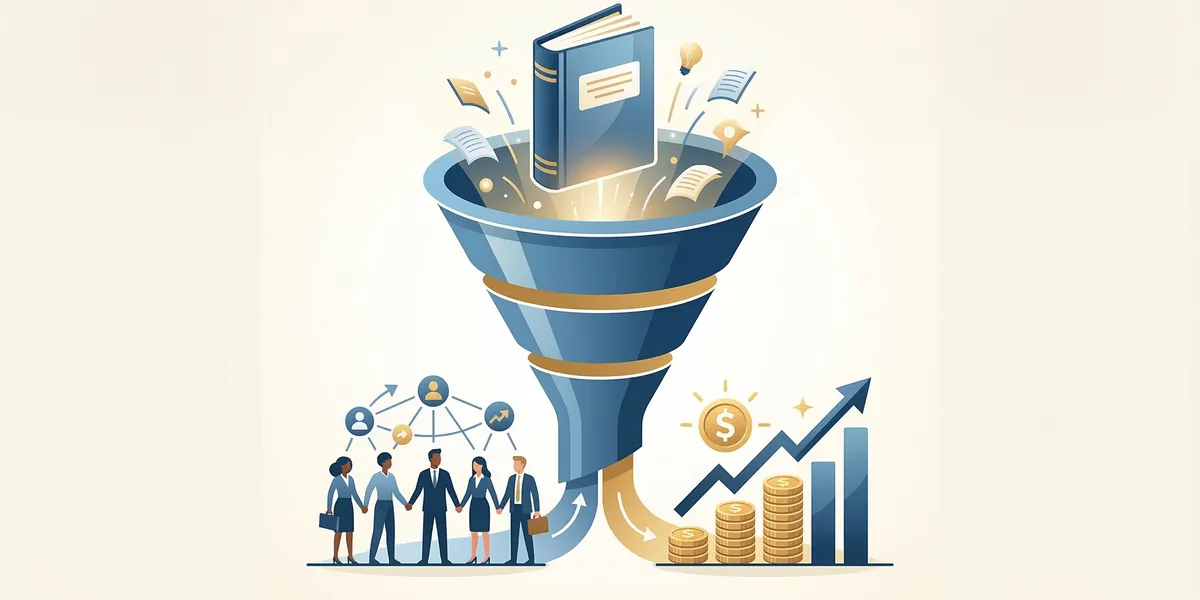
A book funnel is the most underused client acquisition strategy in coaching and consulting. While most authors try to make money from book royalties, the smartest ones use a $10 book to generate five- and six-figure client relationships.
Arek Z. made $60,000 in 48 hours from a single book used as a lead magnet. Jim T. landed a $13,200 client from a stranger who read his book and called him the same day. These are not outliers — they are the predictable result of a well-built book funnel.
This guide breaks down the exact funnel structure, the math behind it, and how to build one yourself.
What is a book funnel
A book funnel uses a published book as the entry point to a client acquisition system. The book is not the product — it is the marketing.
Here is the flow:
Book → Reader → Lead → Client
The reader buys or downloads your book for $0-$15. They read it, recognize your expertise, and take a next step you have designed — joining your email list, booking a call, or attending a webinar. A percentage of those people become high-ticket clients.
The critical shift: you are not trying to make money from book sales. You are trying to acquire clients at the lowest possible cost. The book pays for itself by doing what no ad, cold email, or social media post can do — it builds deep trust over hours of reading.
Book funnel vs traditional publishing
| Traditional publishing | Book funnel | |
|---|---|---|
| Goal | Sell books for royalties | Acquire clients through trust |
| Revenue source | Royalties ($1-5/book) | High-ticket services ($2K-$50K+) |
| Success metric | Units sold | Leads generated |
| Book price | $15-$25 | $0-$10 (low barrier) |
| Content focus | Comprehensive coverage | Demonstrate expertise, create desire |
| Call to action | ”Buy my next book" | "Book a call / Join my program” |
The funnel stages
Every book funnel has five stages. Each one filters readers closer to becoming clients.
Stage 1: The book (entry point)
Your book is cheap or free. Price the ebook at $0.99-$4.99 or offer a free digital copy in exchange for an email address. The goal is maximum distribution, not maximum revenue per copy.
The book itself should do three things:
- Demonstrate expertise — prove you know what you are talking about
- Deliver real value — solve a specific problem for the reader
- Create desire for more — show the reader what is possible, making them want your direct help
The book should NOT try to teach everything. It should teach enough that the reader thinks: “If the free/cheap book is this good, what would working with this person directly be like?”
Stage 2: The lead capture
Every book needs a mechanism to capture the reader’s contact information. The most common approaches:
- In-book resource page: Offer a bonus resource (template, checklist, video training) at a URL that requires an email to access
- Free + shipping model: Offer the physical book free, charge $7-$10 for shipping, and capture their name, email, and mailing address at checkout
- Back-of-book CTA: Direct readers to a specific landing page with an assessment, quiz, or consultation offer
According to HubSpot’s marketing benchmarking data, content-based lead magnets convert 20-30% of page visitors — significantly higher than cold traffic ads.
Stage 3: The nurture sequence
Once someone is in your email system, you nurture them. This is not about hard selling — it is about continuing the trust-building process the book started.
A typical nurture sequence:
- Day 1: Welcome email + bonus resource delivery
- Day 3: Case study or success story from a past client
- Day 5: Teaching email that expands on a book concept
- Day 8: Social proof — testimonials, results, media mentions
- Day 12: Invitation to a free workshop, webinar, or strategy call
- Day 15+: Weekly value emails with periodic offers
Tools like ConvertKit or ActiveCampaign automate this entire sequence.
Stage 4: The conversion event
The conversion event is where a lead becomes a prospect. This is typically:
- Discovery call: A 30-minute conversation where you assess fit and present your offer
- Webinar: A live or recorded training that ends with an offer
- Application: A form that qualifies leads before you speak with them
The key: by the time someone reaches this stage, they have already read your book, received your emails, and consumed your case studies. They are pre-sold. The conversion event is a formality, not a hard sell.
Stage 5: The high-ticket offer
This is where the money is. Your offer might be:
- Coaching program ($2,000-$25,000)
- Consulting engagement ($5,000-$50,000+)
- Online course ($500-$5,000)
- Mastermind group ($5,000-$50,000/year)
- Done-for-you service (varies)
The book funnel works because the sale is easy. The reader already trusts you, understands your framework, and has seen social proof. You are not convincing a stranger — you are closing someone who has been warming up for weeks or months.
The math behind a book funnel
This is where book funnels become irresistible when you see the numbers.
Example: consultant with a $5,000 offer
- 1,000 books distributed per month (free + shipping or ebook)
- 15% opt into email list = 150 leads
- 10% book a call = 15 discovery calls
- 30% close = 4-5 new clients
- Revenue: $20,000-$25,000/month
Your book cost you nothing to produce beyond the initial writing investment. Each copy costs $3-5 to print if you are doing free + shipping. Your customer acquisition cost is roughly $15-25 per client — compared to $500-$2,000+ for paid advertising.
Real results
These are not hypothetical numbers:
- Arek Z. used his book as a lead magnet and generated $60,000 in 48 hours. The book was not the product — it was the entry point to a high-ticket offer.
- Jim T. published a book about his consulting methodology. A stranger read it, called him, and became a $13,200 client the same day.
- Kerri-Anne K. leveraged her book into a speaking gig in front of 20,000 people — the kind of opportunity that does not come from a social media following.
According to Forbes, published authors in the consulting and coaching space command 30-50% higher fees than non-published competitors.
Writing the book for your funnel
A funnel book is not the same as a traditional nonfiction book. Every chapter serves a strategic purpose.
The framework chapter
Early in the book, present your proprietary framework — the unique approach you use with clients. Name it. Give it 3-5 steps. This framework becomes the backbone of your marketing and the reason people hire you specifically.
Example: A business coach might call their framework “The Revenue Clarity Method” with five stages. The book explains the stages. The coaching program implements them with direct support.
The proof chapters
Include 2-3 detailed case studies showing real results. These chapters do more selling than any pitch. Use the format:
- Situation: Where the client started
- Challenge: What was holding them back
- Solution: What you did (using your framework)
- Result: Specific, measurable outcomes
The gap chapter
This is the chapter that creates desire without manipulation. You show readers what is possible — the full transformation — and honestly explain that achieving it requires more than reading a book. It requires implementation, accountability, and guidance.
This is not about withholding information. You give everything away in the book. But you make it clear that having a guide makes the journey faster and more certain.
The call-to-action chapter
The final chapter — or a dedicated section after the conclusion — offers a clear, natural next step.
Do NOT write: “Buy my coaching program for $5,000.”
DO write: “If you have read this far and want help implementing [framework] in your business, I offer a free 30-minute strategy call to see if we are a good fit. Book yours at [URL].”
The tone matters. Invite, do not push.
Building your funnel book fast
The biggest obstacle is not strategy — it is actually writing the book. Most consultants and coaches have the knowledge but not the time to write 40,000 words.
Chapter solves this. You input your expertise, frameworks, case studies, and positioning — the AI helps you produce a polished nonfiction book between 80 and 250 pages. Over 2,147 authors have used it, including coaches and consultants who turned their books into client-generating machines.
At $97 one-time, the ROI is immediate. One client from your book funnel pays for the tool 50-100x over.
The tech stack
You do not need complicated technology. Here is the minimum:
| Tool | Purpose | Cost |
|---|---|---|
| Chapter | Write the book | $97 one-time |
| Amazon KDP | Publish and distribute | Free |
| ConvertKit | Email capture and nurture | Free-$29/month |
| Calendly | Discovery call booking | Free-$12/month |
| Landing page (any) | Lead capture page | $0-$20/month |
Total ongoing cost: under $50/month. Total potential revenue: thousands per month.
Common mistakes to avoid
- Trying to make money from the book itself. The book is marketing, not a product. Price it low and distribute widely.
- Writing a book that teaches everything. Teach enough to build trust and demonstrate expertise. Leave room for your paid offer to add value.
- Skipping the email capture. Without a lead capture mechanism, your book is a dead end. Every reader should have a path to your email list.
- Having no nurture sequence. A lead without follow-up is a wasted opportunity. Build at least a 5-email automated sequence.
- Making the CTA aggressive. Readers who feel sold to stop trusting you. Invite them to a next step — do not pressure them.
FAQ
How long should a book funnel book be?
Between 80 and 200 pages (20,000-50,000 words). Long enough to demonstrate expertise and build trust, short enough that people actually finish it. A 120-page book with a clear framework and strong case studies outperforms a 400-page textbook.
Does the book need to be on Amazon?
Amazon helps with credibility and discovery, but the book funnel itself often runs through your own website. Publish on Amazon for the “published author” credential and organic discovery. Use your website for the free + shipping model and direct lead capture.
What if I do not have case studies yet?
Use your own transformation story, hypothetical scenarios based on real patterns, or results from informal advice you have given. As you get client results, update the book with real case studies. Amazon KDP makes updates easy.
How do I price the ebook for maximum funnel performance?
Price at $0.99-$2.99 for maximum distribution. Some consultants offer the ebook free on their website and charge full price on Amazon. The revenue per copy does not matter — the lead value does.
Can a book funnel work for service businesses beyond coaching?
Yes. Accountants, financial advisors, real estate agents, lawyers, dentists, and any professional who sells expertise can use a book funnel. The structure is the same: demonstrate expertise through a book, capture leads, and convert through a consultation.