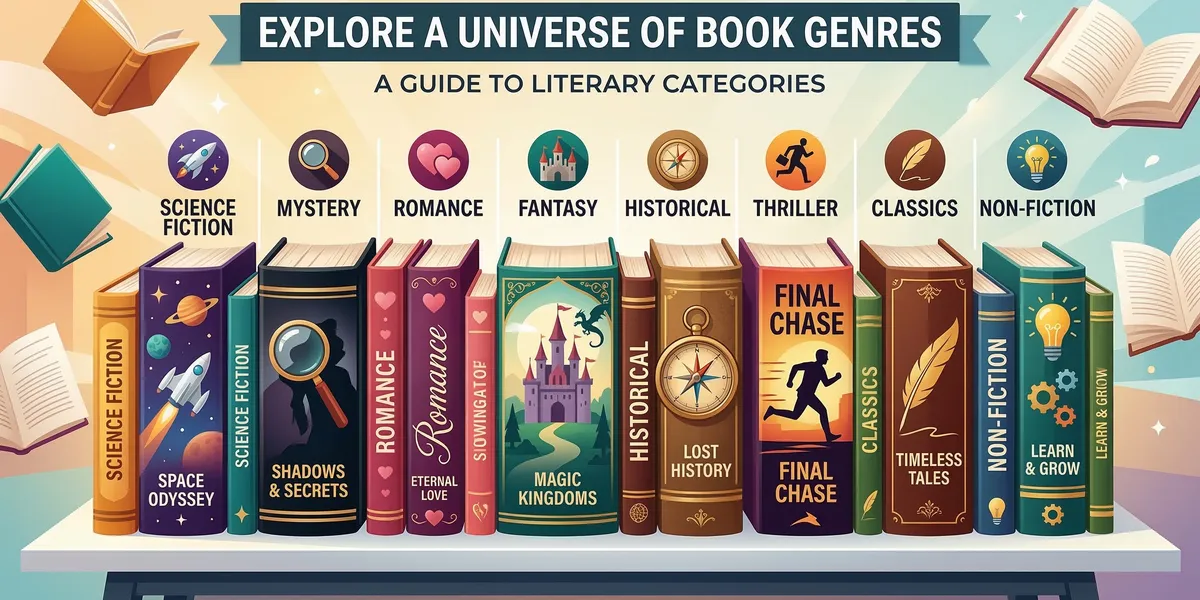
Book genres are categories that classify books by shared themes, conventions, and reader expectations. Knowing your genre shapes every decision you make as a writer — from plot structure to cover design to where your book sits on the shelf.
This is the complete reference of every major book genre and sub-genre, organized for quick scanning.
Fiction genres overview
Fiction genres are defined by their narrative conventions, settings, and the emotional experience they promise the reader. Most novels blend elements from multiple genres, but every book has a primary genre that drives its marketing and readership.
| Genre | Core Appeal | Typical Length |
|---|---|---|
| Literary Fiction | Language, theme, character depth | 70K–100K words |
| Mystery/Thriller | Suspense, puzzle-solving | 70K–90K words |
| Romance | Emotional arc, guaranteed HEA | 50K–90K words |
| Science Fiction | Speculative ideas, future worlds | 80K–120K words |
| Fantasy | Imagined worlds, magic systems | 90K–150K words |
| Horror | Fear, dread, the uncanny | 60K–90K words |
| Historical Fiction | Past eras brought to life | 80K–120K words |
| Thriller/Suspense | Tension, stakes, pacing | 70K–100K words |
| Western | Frontier life, moral codes | 50K–80K words |
| Women’s Fiction | Female experience, growth | 70K–90K words |
Literary fiction
Literary fiction prioritizes prose style, thematic depth, and complex characterization over plot-driven storytelling. These books often explore the human condition and resist easy categorization.
Common elements: Unreliable narrators, nonlinear timelines, internal conflict, ambiguous endings, social commentary.
Example books: The Great Gatsby (F. Scott Fitzgerald), Beloved (Toni Morrison), A Little Life (Hanya Yanagihara), The Goldfinch (Donna Tartt).
Mystery and thriller
Mystery and thriller fiction centers on crime, investigation, and suspense. The reader follows a protagonist working to uncover the truth — often against a ticking clock.
Mystery and thriller sub-genres
| Sub-Genre | Description | Example |
|---|---|---|
| Cozy Mystery | Amateur sleuth, no graphic violence, small-town setting | The Thursday Murder Club (Richard Osman) |
| Police Procedural | Realistic law enforcement investigation | The Girl with the Dragon Tattoo (Stieg Larsson) |
| Noir/Hardboiled | Cynical protagonist, moral ambiguity, dark tone | The Big Sleep (Raymond Chandler) |
| Legal Thriller | Courtroom drama, legal system stakes | A Time to Kill (John Grisham) |
| Psychological Thriller | Mind games, unreliable perspectives, paranoia | Gone Girl (Gillian Flynn) |
| Spy/Espionage | Intelligence agencies, geopolitical stakes | Tinker Tailor Soldier Spy (John le Carré) |
| Domestic Thriller | Danger within families and relationships | Behind Closed Doors (B.A. Paris) |
| Medical Thriller | Healthcare settings, biological threats | Coma (Robin Cook) |
| Whodunit | Classic puzzle mystery with clues for the reader | And Then There Were None (Agatha Christie) |
Romance
Romance fiction follows two characters developing a romantic relationship, ending in a happily ever after (HEA) or happy for now (HFN). It is the highest-selling fiction genre in the U.S.
For a deep dive into the story patterns that drive romance fiction, see our guide to romance tropes.
Romance sub-genres
| Sub-Genre | Description | Example |
|---|---|---|
| Contemporary Romance | Modern-day settings, realistic situations | Beach Read (Emily Henry) |
| Historical Romance | Set before 1950, period-accurate details | The Duchess Deal (Tessa Dare) |
| Romantic Suspense | Romance + thriller elements | The Witness (Nora Roberts) |
| Paranormal Romance | Vampires, shifters, supernatural beings | Twilight (Stephenie Meyer) |
| Romantasy | Romance-centered fantasy | A Court of Thorns and Roses (Sarah J. Maas) |
| Romantic Comedy (RomCom) | Humor-driven, lighthearted tone | The Flatshare (Beth O’Leary) |
| Dark Romance | Morally gray characters, intense themes | Haunting Adeline (H.D. Carlton) |
| Sports Romance | Athletes, competition settings | The Deal (Elle Kennedy) |
| Small-Town Romance | Community-focused, charming settings | Virgin River (Robyn Carr) |
| Second-Chance Romance | Former lovers reuniting | People We Meet on Vacation (Emily Henry) |
Science fiction
Science fiction explores speculative technology, space, time, and their impact on society. The genre ranges from hard science to social commentary.
Science fiction sub-genres
| Sub-Genre | Description | Example |
|---|---|---|
| Hard Sci-Fi | Scientifically rigorous, technology-focused | The Martian (Andy Weir) |
| Space Opera | Galactic-scale adventure, epic scope | Dune (Frank Herbert) |
| Cyberpunk | Near-future, high tech, low life, corporate dystopias | Neuromancer (William Gibson) |
| Dystopian | Oppressive societies, societal collapse | 1984 (George Orwell) |
| Post-Apocalyptic | Survival after global catastrophe | The Road (Cormac McCarthy) |
| Military Sci-Fi | Interstellar warfare, military culture | Ender’s Game (Orson Scott Card) |
| Time Travel | Paradoxes, alternate timelines | The Time Traveler’s Wife (Audrey Niffenegger) |
| First Contact | Humanity encountering alien civilizations | Arrival (Ted Chiang) |
| Climate Fiction (Cli-Fi) | Climate change as central premise | The Ministry for the Future (Kim Stanley Robinson) |
| Solarpunk | Optimistic futures, sustainability | A Psalm for the Wild-Built (Becky Chambers) |
Fantasy
Fantasy fiction features magical systems, invented worlds, and mythological elements. It is one of the broadest genres, spanning everything from epic quests to contemporary urban settings.
Fantasy sub-genres
| Sub-Genre | Description | Example |
|---|---|---|
| Epic/High Fantasy | Grand quests, fully built worlds, good vs. evil | The Lord of the Rings (J.R.R. Tolkien) |
| Urban Fantasy | Magic in modern city settings | Storm Front (Jim Butcher) |
| Dark Fantasy | Fantasy with horror elements, grim tone | The Poppy War (R.F. Kuang) |
| Grimdark | Morally ambiguous, brutal, anti-heroes | The Blade Itself (Joe Abercrombie) |
| Portal Fantasy | Characters transported to another world | The Chronicles of Narnia (C.S. Lewis) |
| Sword and Sorcery | Action-heavy, individual heroes | Conan the Barbarian (Robert E. Howard) |
| Mythic Fantasy | Rooted in real-world mythology | Circe (Madeline Miller) |
| Gaslamp Fantasy | Victorian-era settings with magic | Soulless (Gail Carriger) |
| Cozy Fantasy | Low stakes, comfort-focused, gentle pacing | Legends & Lattes (Travis Baldree) |
| LitRPG | Game mechanics and leveling systems as plot elements | Ready Player One (Ernest Cline) |
Horror
Horror fiction aims to frighten, disturb, or unsettle the reader through supernatural threats, psychological dread, or visceral terror.
Horror sub-genres
| Sub-Genre | Description | Example |
|---|---|---|
| Gothic Horror | Decaying settings, atmosphere, family secrets | Mexican Gothic (Silvia Moreno-Garcia) |
| Psychological Horror | Dread from the mind, paranoia, unreliable reality | The Haunting of Hill House (Shirley Jackson) |
| Cosmic Horror | Incomprehensible entities, existential dread | The Call of Cthulhu (H.P. Lovecraft) |
| Supernatural Horror | Ghosts, demons, haunted places | The Shining (Stephen King) |
| Slasher/Splatter | Graphic violence, survival | Final Girls (Riley Sager) |
| Folk Horror | Rural settings, ancient rituals, pagan traditions | The Wicker Man (Robin Hardy) |
| Body Horror | Transformation, mutation, bodily violation | The Troop (Nick Cutter) |
| Quiet Horror | Slow-building unease, subtle dread | The Little Stranger (Sarah Waters) |
Historical fiction
Historical fiction is set in a past time period and uses that era’s social norms, events, and details as central elements of the story.
Historical fiction sub-genres
| Sub-Genre | Description | Example |
|---|---|---|
| War Fiction | Armed conflict as backdrop or focus | All the Light We Cannot See (Anthony Doerr) |
| Biographical Fiction | Fictionalized account of real people | The Paris Wife (Paula McLain) |
| Ancient World | Set in antiquity (Egypt, Rome, Greece) | The Song of Achilles (Madeline Miller) |
| Medieval | Castles, feudal systems, early warfare | The Pillars of the Earth (Ken Follett) |
| Regency | Early 19th-century England, social manners | Jonathan Strange & Mr Norrell (Susanna Clarke) |
| Dual Timeline | Alternates between past and present | The Nightingale (Kristin Hannah) |
Additional fiction genres
| Genre | Description | Example |
|---|---|---|
| Adventure | Quest-driven, exotic locations, physical challenges | Jurassic Park (Michael Crichton) |
| Satire | Uses humor and irony to critique society | Catch-22 (Joseph Heller) |
| Magical Realism | Magical elements treated as mundane in realistic settings | One Hundred Years of Solitude (Gabriel García Márquez) |
| Upmarket/Book Club Fiction | Commercial appeal with literary prose | Where the Crawdads Sing (Delia Owens) |
| New Adult | Protagonists 18–25, coming-of-age themes | Normal People (Sally Rooney) |
| Absurdist Fiction | Illogical events, existential themes | The Metamorphosis (Franz Kafka) |
| Epistolary | Told through letters, emails, documents | The Perks of Being a Wallflower (Stephen Chbosky) |
| Speculative Fiction | Umbrella term for sci-fi, fantasy, and alt-history | The Handmaid’s Tale (Margaret Atwood) |
Nonfiction genres overview
Nonfiction genres are defined by their subject matter and the reader’s purpose. Some readers want to learn a skill. Others want a gripping true story. The genre determines the structure, voice, and marketing approach.
| Genre | Core Appeal | Typical Length |
|---|---|---|
| Memoir | Personal story, emotional connection | 60K–90K words |
| Self-Help | Actionable advice, personal growth | 40K–60K words |
| Business | Professional strategies, case studies | 40K–70K words |
| History | Understanding the past | 80K–120K words |
| Science/Nature | Explaining the world | 60K–100K words |
| True Crime | Real criminal cases, investigation | 70K–100K words |
| Biography | Someone else’s life story | 80K–120K words |
| Health/Wellness | Physical and mental wellbeing | 40K–60K words |
| Travel | Place-based narrative, culture | 50K–80K words |
| Humor/Essay | Voice-driven, comedic observations | 40K–70K words |
Memoir and autobiography
Memoir focuses on a specific period, theme, or experience from the author’s life. Autobiography covers a full life chronologically. Both are first-person and demand emotional honesty.
Common elements: Reflective voice, narrative arc applied to real events, thematic focus, vulnerability.
Example books: Educated (Tara Westover), The Glass Castle (Jeannette Walls), Know My Name (Chanel Miller), Born a Crime (Trevor Noah).
Self-help and personal development
Self-help books provide frameworks, strategies, and exercises to help readers improve a specific area of their life. The best self-help books pair actionable advice with research or personal authority.
Common elements: Step-by-step frameworks, exercises, case studies, reader worksheets, motivational tone.
Example books: Atomic Habits (James Clear), The Subtle Art of Not Giving a Fck* (Mark Manson), The 7 Habits of Highly Effective People (Stephen Covey).
Business and entrepreneurship
Business books teach professional strategies, leadership principles, or industry insights. They range from case-study-heavy narratives to tactical playbooks.
Common elements: Case studies, data-backed arguments, actionable frameworks, expert interviews.
Example books: Good to Great (Jim Collins), Zero to One (Peter Thiel), The Lean Startup (Eric Ries), Shoe Dog (Phil Knight).
History
History books reconstruct past events using primary sources, scholarly research, and narrative technique. Popular history makes academic research accessible to general readers.
Common elements: Chronological or thematic structure, source citations, contextual analysis, maps and timelines.
Example books: Sapiens (Yuval Noah Harari), The Wright Brothers (David McCullough), The Warmth of Other Suns (Isabel Wilkerson).
Science and nature
Science books explain natural phenomena, research findings, or scientific concepts for a general audience. Nature writing blends scientific observation with personal reflection.
Common elements: Research translation, analogies and metaphors, expert sourcing, data visualization.
Example books: A Short History of Nearly Everything (Bill Bryson), The Immortal Life of Henrietta Lacks (Rebecca Skloot), Braiding Sweetgrass (Robin Wall Kimmerer).
True crime
True crime recounts real criminal cases — murders, heists, fraud, disappearances — with investigative reporting and narrative storytelling.
Common elements: Investigative structure, victim-centered narratives, evidence reconstruction, interviews.
Example books: In Cold Blood (Truman Capote), I’ll Be Gone in the Dark (Michelle McNamara), The Devil in the White City (Erik Larson).
Biography
Biographies tell the story of a real person’s life, written by someone other than the subject. They require extensive research and often access to the subject or their estate.
Common elements: Chronological structure, archival research, interviews, historical context.
Example books: Steve Jobs (Walter Isaacson), Alexander Hamilton (Ron Chernow), Frida (Hayden Herrera).
Additional nonfiction genres
| Genre | Description | Example |
|---|---|---|
| Cookbook/Food Writing | Recipes, food culture, culinary memoir | Salt, Fat, Acid, Heat (Samin Nosrat) |
| Travel Writing | Place-based narrative, cultural exploration | In a Sunburned Country (Bill Bryson) |
| Humor/Essay Collection | Voice-driven comedic or reflective pieces | Me Talk Pretty One Day (David Sedaris) |
| Philosophy | Ideas, ethics, meaning, existential questions | Meditations (Marcus Aurelius) |
| Religion/Spirituality | Faith, practice, theological exploration | Mere Christianity (C.S. Lewis) |
| Parenting | Child-rearing strategies and research | Hunt, Gather, Parent (Michaeleen Doucleff) |
| Political/Current Affairs | Policy, social issues, political analysis | Caste (Isabel Wilkerson) |
| How-To/Reference | Instructional guides, skill-building | On Writing (Stephen King) |
| Narrative Nonfiction | True stories told with novelistic technique | The Boys in the Boat (Daniel James Brown) |
| Creative Nonfiction | Blends literary techniques with factual reporting | The Year of Magical Thinking (Joan Didion) |
How to choose your genre
Choosing the right genre is a practical decision with direct consequences for your book’s marketability. Here’s what to consider:
- Read widely in your target genre. You need to know its conventions before you can work within — or intentionally break — them.
- Identify your comp titles. Find 3–5 recently published books that your ideal reader would also enjoy. Their genre is likely your genre.
- Check sub-genre expectations. A cozy mystery reader expects zero graphic violence. A grimdark fantasy reader expects plenty. Know the boundaries.
- Consider hybrid genres. Many successful books blend genres — romantic suspense, literary horror, science fantasy. Pick a primary genre for marketing, then layer in secondary elements.
A solid book outline will help you map your genre’s structural conventions before you start drafting.