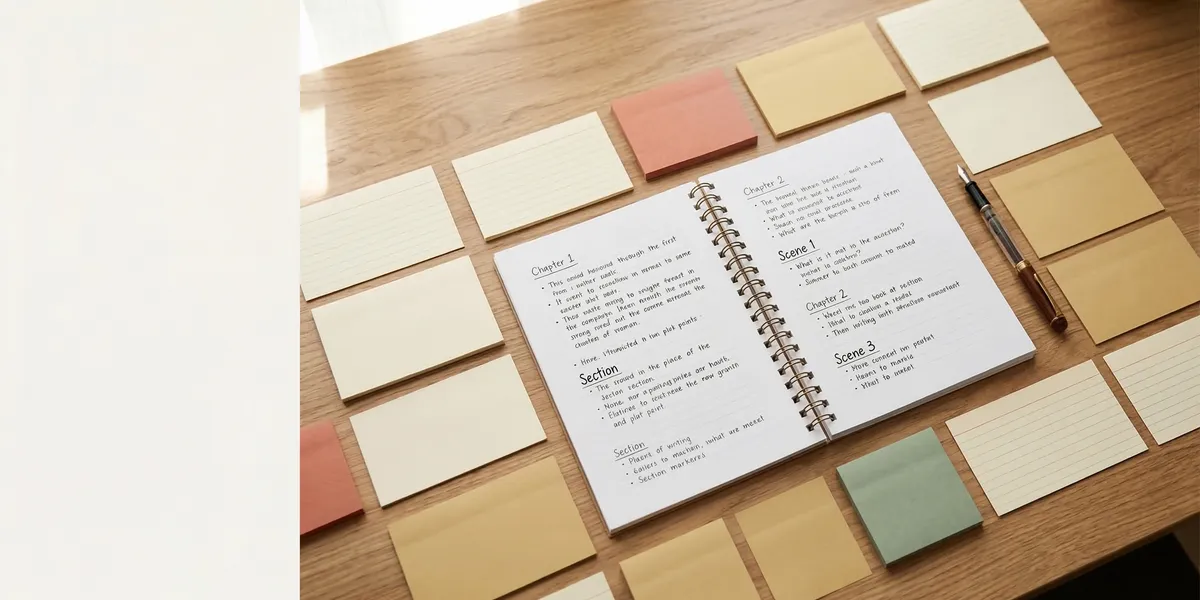
A book outline is a structured plan that maps every chapter, scene, or section of your book before you write a single page. Starting with an outline cuts your writing time in half and prevents the structural rewrites that kill most book projects midway through.
Whether you’re writing a memoir, a business book, or a fantasy novel, the outline is where your book either finds its backbone or falls apart. This guide gives you the exact templates and steps for both fiction and nonfiction.
Why you need a book outline
Most abandoned manuscripts die from structural problems, not lack of motivation. The author hits chapter seven and realizes the book doesn’t hold together. An outline prevents that.
A strong outline does three things:
- Eliminates blank-page paralysis. Every writing session has a clear target.
- Exposes gaps early. You’ll spot missing arguments, plot holes, or thin chapters before you’ve written 30,000 words around them.
- Speeds up drafting. Authors with detailed outlines consistently write 2-3x faster because they’re executing, not deciding.
How to outline a nonfiction book
Nonfiction outlines follow a logical structure. Each chapter solves a specific problem or teaches a specific concept, building toward a transformation for the reader.
Step 1: Define your core promise
Write one sentence that describes what the reader will be able to do after finishing your book. Every chapter must support this promise.
Examples:
- “The reader will know how to launch a profitable consulting business in 90 days.”
- “The reader will understand the science of habit formation and have a system to build any habit.”
Step 2: List your major topics
Brain-dump every topic, idea, and subtopic related to your promise. Don’t organize yet. Aim for 20-40 items. Then group related items together. Each group becomes a potential chapter.
Step 3: Arrange chapters in logical order
Nonfiction books typically follow one of three sequences:
| Sequence type | Best for | Example |
|---|---|---|
| Chronological | Memoirs, how-to processes | Steps 1 through 10 in order |
| Problem-solution | Business books, self-help | Present problem, then solve it |
| Modular | Reference books, skill-based guides | Independent chapters that stand alone |
Step 4: Build out each chapter
For every chapter, define:
- Chapter title — clear and specific
- Key takeaway — the one thing the reader learns
- 3-5 subtopics — the sections within the chapter
- Supporting evidence — stories, data, or examples you’ll include
Nonfiction book outline template
Here’s a complete template you can copy and adapt:
BOOK TITLE: [Your Title]
CORE PROMISE: [One sentence — what the reader gains]

INTRODUCTION
- Hook: [Opening story or statistic]
- Problem: [What the reader is struggling with]
- Promise: [What this book will deliver]
- Roadmap: [Brief chapter overview]

CHAPTER 1: [Foundation concept]
  Key takeaway: [One sentence]
  - Section 1.1: [Define the core concept]
  - Section 1.2: [Why it matters]
  - Section 1.3: [Common mistakes]
  Chapter summary + transition to Chapter 2

CHAPTER 2: [First skill or principle]
  Key takeaway: [One sentence]
  - Section 2.1: [The principle explained]
  - Section 2.2: [Real-world example or case study]
  - Section 2.3: [How to apply it]
  Chapter summary + transition to Chapter 3

[CHAPTERS 3-8: Same structure]

CHAPTER 9: [Putting it all together]
  Key takeaway: [One sentence]
  - Section 9.1: [Step-by-step action plan]
  - Section 9.2: [Common obstacles and fixes]
  - Section 9.3: [Success metrics]

CONCLUSION
- Recap core promise
- Final motivating story
- Clear next step for the reader
This template works for business books, self-help, how-to guides, and educational nonfiction. Adjust the chapter count based on your topic depth — most nonfiction books land between 8 and 15 chapters.
How to outline a fiction book
Fiction outlines need to track story structure, character arcs, and pacing alongside chapter content. The approach differs by genre, but the three-act structure works as a universal starting point.
The three-act structure outline
Act 1 — Setup (roughly 25% of the book)
- Opening scene: Introduce your protagonist in their ordinary world.
- Inciting incident: The event that disrupts everything and forces the protagonist into the story.
- First plot point: The protagonist commits to the journey. No turning back.
Act 2 — Confrontation (roughly 50% of the book)
- Rising action: Obstacles escalate. Allies and enemies appear.
- Midpoint shift: A revelation or reversal that changes the protagonist’s understanding of the conflict.
- Crisis: The protagonist’s lowest point. Everything seems lost.
Act 3 — Resolution (roughly 25% of the book)
- Climax: The final confrontation where the protagonist faces the central conflict head-on.
- Falling action: Immediate aftermath of the climax.
- Resolution: The new normal. Character arcs complete.
Fiction book outline template
BOOK TITLE: [Your Title]
GENRE: [Genre/subgenre]
WORD COUNT TARGET: [e.g., 80,000]
POV: [First person, third limited, etc.]

PROTAGONIST: [Name]
  Want: [External goal]
  Need: [Internal growth]
  Flaw: [What holds them back]

ANTAGONIST: [Name or force]
  Goal: [What they want]
  Why: [Their motivation]

ACT 1 (Chapters 1-6)
  Ch 1: [Ordinary world — show protagonist's life and flaw]
  Ch 2: [Deepen relationships and stakes]
  Ch 3: [Inciting incident — the disruption]
  Ch 4: [Protagonist resists the call]
  Ch 5: [Stakes raised — refusal is no longer an option]
  Ch 6: [First plot point — protagonist commits]

ACT 2A (Chapters 7-12)
  Ch 7: [New world — protagonist is out of their element]
  Ch 8: [Ally introduction — new relationships form]
  Ch 9: [First test — small victory]
  Ch 10: [Escalation — antagonist pushes back]
  Ch 11: [Midpoint — revelation changes everything]
  Ch 12: [Aftermath — protagonist recalibrates]

ACT 2B (Chapters 13-18)
  Ch 13: [Protagonist goes on offense]
  Ch 14: [Antagonist counterattack]
  Ch 15: [Betrayal or major setback]
  Ch 16: [All is lost — lowest point]
  Ch 17: [Dark night of the soul — internal reckoning]
  Ch 18: [Protagonist discovers the key]

ACT 3 (Chapters 19-24)
  Ch 19: [Rally — putting the plan together]
  Ch 20: [Final approach — last preparations]
  Ch 21: [Climax begins — confrontation]
  Ch 22: [Climax peak — the decisive moment]
  Ch 23: [Falling action — immediate aftermath]
  Ch 24: [Resolution — the new normal]
Adjust chapter counts to match your target word count. A 60,000-word novel might use 20 chapters. A 100,000-word epic might use 35+.
Genre-specific adjustments
Romance: Build your outline around the relationship arc. Key beats include the meet-cute, first conflict, vulnerability moment, black moment (breakup), and reunion.
Mystery/Thriller: Outline the crime timeline separately from the investigation timeline. Plant your clues and red herrings in the outline before writing.
Memoir: Use a hybrid approach. Follow the three-act structure for narrative shape, but organize content thematically like nonfiction.
How to outline a book step by step
Regardless of genre, follow this process:
1. Start with the ending. Know where your book lands before you outline the path. For nonfiction, that’s your reader’s transformation. For fiction, it’s your climax and resolution.
2. Identify your major beats. Write 5-8 major milestones. These become your structural pillars.
3. Fill in chapters. Place content between each milestone. Each chapter should accomplish one clear thing.
4. Add detail. Within each chapter, list the scenes (fiction) or subtopics (nonfiction) you’ll cover.
5. Pressure-test the structure. Read through your outline and ask: Does each chapter earn its place? Is there momentum? Are there dead spots?
Tools for book outlining
You can outline with pen and paper, a spreadsheet, or dedicated software. What matters is that you can see the full structure at a glance and rearrange pieces easily.
Chapter generates a complete book outline based on your topic, expertise, and target audience. Over 2,147 authors have used it to outline and draft more than 5,000 books. You provide your ideas and knowledge; the AI builds the structural framework. It’s particularly useful if you know what you want to write but struggle with organizing it into chapters.
Common outlining mistakes
Going too detailed too early. Your first outline should be a skeleton. Add muscle later. If you’re writing paragraph-level detail for chapter one before you’ve mapped chapter ten, you’re drafting, not outlining.
Ignoring pacing. Nonfiction books need variety — alternate between conceptual chapters and practical ones. Fiction needs escalating tension. Check your outline for flat stretches.
Treating the outline as fixed. The outline is a guide, not a contract. When you discover something better while writing, update the outline. Rigid outlines produce rigid books.
Skipping the outline entirely. Some writers call themselves “pantsers” and write by the seat of their pants. This works for a small percentage of experienced authors. For most people, it produces a first draft that requires a complete structural rewrite — which is just outlining after the fact, with far more effort.
Frequently asked questions
How detailed should a book outline be?
Detailed enough that you know what every chapter covers, but not so detailed that you’ve essentially written the book. For nonfiction, define the key takeaway and 3-5 subtopics per chapter. For fiction, summarize each chapter in 2-3 sentences covering the key events and character developments.
How many chapters should a book have?
Nonfiction books typically have 8-15 chapters plus an introduction and conclusion. Novels range from 15-40 chapters depending on genre and length. Short chapters (2,000-3,000 words) create faster pacing. Longer chapters (4,000-6,000 words) suit literary fiction and detailed nonfiction.
Can I outline a book I’ve already started writing?
Yes. Retroactive outlining is one of the most effective revision tools. Summarize each existing chapter in one sentence, lay them out in order, and you’ll immediately see structural issues — missing transitions, redundant chapters, or pacing problems.
What’s the difference between a book outline and a book proposal?
A book outline maps the internal structure of your book for your own writing process. A book proposal is a sales document for publishers that includes the outline alongside market analysis, author credentials, and sample chapters. If you’re self-publishing, you only need the outline.