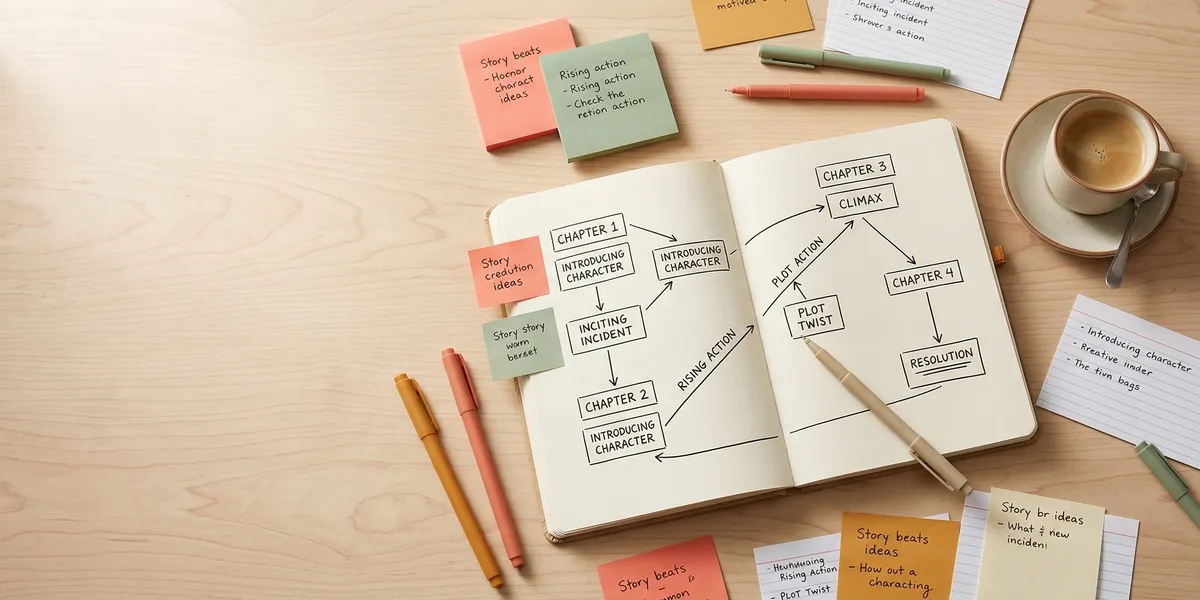
A good book outline template gives you a ready-made structure so you can start organizing your book immediately instead of staring at a blank document. Below you’ll find free templates for fiction, nonfiction, and memoir — each one designed to be copied and customized for your project.
Pick the template that matches what you’re writing, fill in the blanks, and start drafting with a clear plan.
Why use a book outline template
Starting from a template saves you from reinventing the structure every time. You get a proven framework that thousands of published authors have used, and you fill in the details that make it yours.
Authors who outline before drafting consistently finish their manuscripts faster and spend less time on structural rewrites. The outline catches missing arguments, plot holes, and thin chapters before you’ve written 30,000 words around them.
A template takes this one step further. Instead of figuring out what an outline should look like, you start with the skeleton already built.
Fiction book outline template (Three Act Structure)
The three act structure is the most widely used plotting framework in English-language fiction. It divides your story into setup (25%), confrontation (50%), and resolution (25%). This template maps the key beats you need in each act.
Copy and fill in each section:
Act 1 — Setup (first 25% of your book)
| Beat | Your Notes |
|---|---|
| Opening scene | Where does your protagonist’s story begin? What is their normal world? |
| Character introduction | Who is your protagonist? What do they want? What’s their flaw? |
| Inciting incident | What event disrupts their normal world and forces them to act? |
| First plot point / turning point | What decision or event pushes them into the central conflict? |
Act 2 — Confrontation (middle 50% of your book)
| Beat | Your Notes |
|---|---|
| Rising action (first half) | What obstacles does your protagonist face? List 3-5 escalating challenges. |
| Midpoint reversal | What event changes the stakes or the protagonist’s understanding of their situation? |
| Rising action (second half) | How do the stakes increase? What does your protagonist lose or risk? |
| Dark moment / all is lost | What is the lowest point? What makes the goal seem impossible? |
Act 3 — Resolution (final 25% of your book)
| Beat | Your Notes |
|---|---|
| Climax | How does your protagonist face the central conflict head-on? |
| Resolution | How is the conflict resolved? |
| Denouement | What is the new normal? How has your protagonist changed? |
This framework works for literary fiction, thrillers, romance, fantasy, and most genre fiction. If you need more detail on how to outline a novel, that guide walks through seven different methods.
Fiction book outline template (chapter-by-chapter)
Some writers prefer planning at the chapter level rather than the beat level. This template gives you a repeatable structure for each chapter that keeps pacing tight.
For each chapter, fill in:
| Field | Details |
|---|---|
| Chapter number | |
| POV character | Who is telling this chapter? |
| Chapter goal | What does the POV character want to accomplish in this chapter? |
| Opening hook | What pulls the reader into this chapter? |
| Key scene(s) | What happens? Summarize the main action in 2-3 sentences. |
| Conflict / tension | What obstacle or tension drives this chapter? |
| Chapter ending | How does it end? What question keeps the reader turning pages? |
| Plot threads advanced | Which subplots move forward here? |
Repeat this for every chapter. Most novels run 15-30 chapters, depending on genre and length. A good rule of thumb: each chapter should have one clear purpose. If you can’t articulate the chapter’s goal, the chapter may not need to exist.
For guidance on how many chapters a book should have or how many words per chapter, those references will help you plan the right scope.
Nonfiction book outline template
Nonfiction outlines follow a logical structure where each chapter teaches a concept, solves a problem, or advances an argument. The reader should be transformed by the end.
Copy and fill in:
Book-level planning
| Field | Details |
|---|---|
| Working title | |
| Core promise | What will the reader be able to do or understand after reading this book? |
| Target reader | Who is this book for? Be specific. |
| Unique angle | What makes your approach different from the 10 other books on this topic? |
Chapter template (repeat for each chapter)
| Field | Details |
|---|---|
| Chapter number and title | |
| Chapter thesis | What is the one thing this chapter proves or teaches? |
| Opening hook | An anecdote, question, or surprising fact that draws the reader in. |
| Key points (3-5) | The main arguments, steps, or ideas covered in this chapter. |
| Supporting evidence | Research, data, case studies, or personal stories that back up each point. |
| Actionable takeaway | What should the reader do after finishing this chapter? |
| Transition | How does this chapter connect to the next one? |
A strong nonfiction outline usually runs 10-15 chapters. The first chapter hooks the reader with the problem, the middle chapters deliver the solution, and the final chapter sends them off with a clear action plan.
If you’re writing a business book, self-help guide, or how-to book, Chapter.pub’s nonfiction software can generate a structured outline from your topic and expand it into a full draft — useful when you want a starting point to build on.
Memoir outline template
Memoir sits between fiction and nonfiction. You’re telling a true story, but it still needs narrative structure. The best memoir outlines combine chronological events with thematic threads.
Copy and fill in:
Memoir planning
| Field | Details |
|---|---|
| Central theme | What is this memoir really about? (Not events — the deeper truth.) |
| Time span | What period of your life does this cover? |
| Inciting incident | What event or moment sets the story in motion? |
| Transformation | How are you different at the end than at the beginning? |
Chapter template for memoir
| Field | Details |
|---|---|
| Chapter number and title | |
| Time period | When does this chapter take place? |
| Key events | What happens in this chapter? List the major moments. |
| Emotional arc | How does the narrator’s emotional state shift during this chapter? |
| Theme connection | How does this chapter connect to the central theme? |
| Sensory details | What specific images, sounds, or settings bring this chapter to life? |
Memoir outlines benefit from flexibility. You may rearrange chapters during drafting as you discover which emotional sequence works better than strict chronology. Writing a book about your life covers more on shaping personal stories into compelling narratives.
Short story outline template
Short stories need tight structure because every scene must earn its place. This template keeps you focused on the essentials.
Copy and fill in:
| Field | Details |
|---|---|
| Protagonist | Who is the main character? What do they want? |
| Setting | Where and when does the story take place? |
| Central conflict | What stands between the protagonist and what they want? |
| Opening | How do you drop the reader into the story? (Start as close to the action as possible.) |
| Rising tension | What 2-3 escalating complications build toward the crisis? |
| Climax | What is the moment of highest tension or the point of no return? |
| Resolution | How does it end? What has changed? |
| Word count target | Short stories typically run 1,000-7,500 words. |
Short stories don’t have room for subplots. One character, one conflict, one arc. If your outline suggests multiple threads, you may be looking at a novella.
How to use these templates effectively
Having a template is step one. Using it well is where the real benefit comes in.
Start messy, then refine
Don’t try to fill every field perfectly on your first pass. Get rough answers down for every section, then revisit with sharper details. Your outline is a living document — it will change as you write.
Match the template to your process
Some writers need a detailed chapter-by-chapter plan. Others only need the major beats. Use whichever template gives you enough structure to write confidently without feeling boxed in. There’s no single right approach.
Let the outline serve you, not constrain you
The best outlines are flexible. If you discover a better direction while drafting, update the outline and keep going. The outline’s job is to prevent you from getting lost, not to lock you into a path that isn’t working.
Use AI to speed up the process
AI outlining tools can generate a first-pass structure in minutes. AI book outline generators are useful for getting a starting framework that you then customize with your specific knowledge, voice, and ideas. The AI handles the structural heavy lifting while you bring the expertise.
Common mistakes when outlining a book
Outlining too much detail too early. If your outline reads like a full draft, you’ve gone too far. The outline should guide, not replace, the writing process.
Skipping the outline entirely. Writing without any plan works for a small percentage of authors. For most, it leads to abandoned manuscripts and structural rewrites that could have been avoided.
Making the outline rigid. An outline is a map, not a contract. Characters will surprise you. New ideas will emerge. Build in room for that.
Ignoring pacing. A common pitfall is front-loading your outline with too much setup. Check that your outline has conflict and tension distributed across the full book, not just piled at the beginning or end.
Not defining the reader’s transformation. Every book should leave the reader different than when they started — either they know something new, feel something new, or can do something new. If your outline doesn’t point toward that transformation, revisit your core promise.
FAQ
What should a book outline include?
At minimum, a book outline includes your core premise, chapter-by-chapter summaries, and the key turning points or arguments in your book. Fiction outlines focus on plot beats and character arcs. Nonfiction outlines focus on chapter theses, supporting evidence, and reader takeaways.
How detailed should a book outline be?
Detailed enough that you can sit down to write any chapter and know what it needs to accomplish. For some writers, that’s a single sentence per chapter. For others, it’s a full page of notes per chapter. The right level of detail depends on your writing process.
Can I write a book without an outline?
Yes. Some successful authors — often called “pantsers” — write by discovery. However, writing coaches and publishing professionals consistently recommend outlining for first-time authors because it reduces the risk of structural problems that lead to abandoned projects.
How long does it take to outline a book?
A basic outline can take a few hours. A detailed chapter-by-chapter outline might take a week or more. The time invested in outlining is almost always recovered during drafting because you spend less time stuck or rewriting.
What’s the best format for a book outline?
Whatever format you’ll actually use. Some authors prefer Google Docs templates, others use index cards, and others use dedicated software like Plottr or Scrivener. The format matters less than having a plan you can reference while writing.