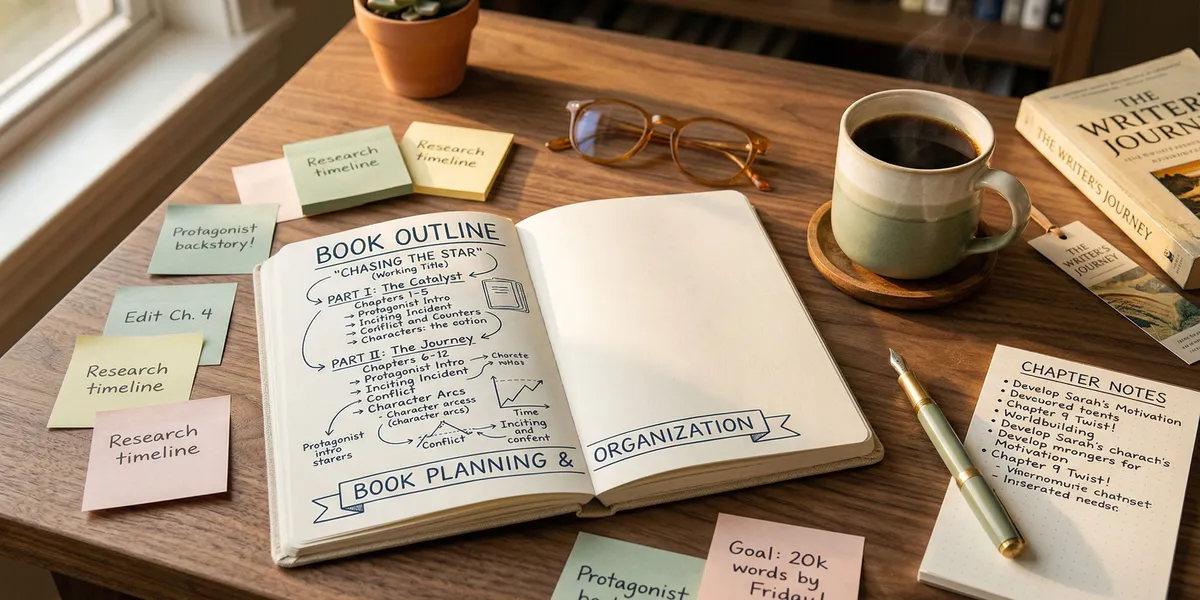
A good book planning template gives you a structured framework to organize your premise, audience, chapters, research, and timeline before you write a single draft page. The right templates prevent the two biggest reasons books stall out: unclear direction and missing organization.
Below you will find seven ready-to-use templates you can copy directly into your planning documents. Each one covers a different stage of the book planning process, from initial concept through final revision.
Why You Need a Book Planning Template
Most writers skip planning because it feels like extra work. Then they hit chapter eight, realize the structure does not hold together, and either rewrite everything or abandon the project entirely.
A planning template solves this by forcing you to answer critical questions early. What is this book actually about? Who is it for? What does each chapter accomplish?
The University of Michigan’s Sweetland Center for Writing research on writing processes shows that writers who plan before drafting produce more coherent, complete manuscripts. Planning is not optional overhead. It is the foundation that makes drafting faster and revision lighter.
Template 1: Book Premise and Concept Worksheet
Start every book project here. This template forces you to articulate what your book is and why it matters before you get lost in the details.
| Field | Your Answer |
|---|---|
| Working Title | |
| One-Sentence Summary | (Complete this: “This book helps [audience] to [outcome] by [method].”) |
| Core Problem It Solves | |
| Why Now? | (Why does this book need to exist today?) |
| Unique Angle | (What makes your take different from existing books?) |
| Comparable Titles | (List 2-3 books in the same space) |
| How Yours Differs | (What gap do those books leave?) |
| Desired Reader Outcome | (What can the reader do after finishing?) |
| Estimated Word Count | |
| Target Completion Date |
Fill every field before moving forward. If you cannot complete the one-sentence summary, your concept needs more development. That single sentence will guide every decision you make from this point on.
For a deeper look at how to structure your book once the premise is solid, see our guide on how to create a book outline.
Template 2: Target Reader Profile
Writing for “everyone” means writing for no one. This template helps you define exactly who your ideal reader is so every chapter speaks directly to them.
| Field | Details |
|---|---|
| Age Range | |
| Professional Background | |
| Current Knowledge Level | (Beginner / Intermediate / Advanced) |
| Primary Pain Point | |
| Secondary Pain Points | |
| What They Have Already Tried | |
| Where They Hang Out Online | (Subreddits, forums, social platforms) |
| Books They Have Already Read | |
| Language and Tone Preference | (Academic / Conversational / Direct) |
| Objections to Buying | (Price, time commitment, skepticism) |
The more specific your reader profile, the easier every writing decision becomes. Tone, examples, depth of explanation, and even chapter order all flow from knowing your reader.
According to Jane Friedman’s publishing guidance, defining your target audience is one of the first steps that separates published authors from writers with unfinished manuscripts.
Template 3: Chapter Outline Template
This is the structural backbone of your book. Each row represents one chapter, and the columns keep you focused on what each chapter must accomplish.
| Ch # | Chapter Title | Key Takeaway | Main Sections | Word Count Target | Status |
|---|---|---|---|---|---|
| 1 | Not Started | ||||
| 2 | Not Started | ||||
| 3 | Not Started | ||||
| 4 | Not Started | ||||
| 5 | Not Started | ||||
| 6 | Not Started | ||||
| 7 | Not Started | ||||
| 8 | Not Started | ||||
| 9 | Not Started | ||||
| 10 | Not Started |
Status options: Not Started / Outlined / Drafting / Draft Complete / Revised / Final
For each chapter, write the “Key Takeaway” as a single sentence the reader should walk away with. If you cannot state the takeaway clearly, that chapter needs rethinking.
The “Main Sections” column should list 3-5 subheadings per chapter. This gives you a detailed book outline template that makes drafting each chapter straightforward.
Chapter Planning Checklist
Use this checklist for each chapter before you start drafting:
- Key takeaway is a clear, single sentence
- Chapter connects logically to the previous chapter
- Chapter advances the reader toward the book’s promised outcome
- Main sections are ordered from simplest to most complex
- At least one concrete example or case study is planned
- Chapter does not duplicate content from another chapter
Template 4: Research Tracker
Nonfiction books require sources. Fiction books require worldbuilding research. Either way, tracking your research prevents lost sources and unverified claims.
| Source Title | Author/Org | Type | URL or Location | Key Facts/Quotes | Used In Chapter | Verified? |
|---|---|---|---|---|---|---|
| Book | [ ] | |||||
| Article | [ ] | |||||
| Study | [ ] | |||||
| Interview | [ ] | |||||
| Website | [ ] |
Type options: Book / Article / Academic Study / Interview / Website / Podcast / Video / Personal Experience
Track every source as you find it, not after. Writers who wait until revision to organize sources spend hours hunting down references they vaguely remember reading months earlier.
The Purdue Online Writing Lab (OWL) is an excellent free resource for proper citation formatting once your research is compiled.
Template 5: Writing Timeline and Schedule
A book without a deadline is a book that never gets finished. This template turns your word count goal into a daily and weekly schedule.
| Milestone | Target Date | Word Count Goal | Actual Date | Notes |
|---|---|---|---|---|
| Premise + Reader Profile Complete | 0 | |||
| Full Chapter Outline Complete | 0 | |||
| Research Phase Complete | 0 | |||
| Chapter 1-3 First Draft | ||||
| Chapter 4-6 First Draft | ||||
| Chapter 7-9 First Draft | ||||
| Chapter 10+ First Draft | ||||
| Full First Draft Complete | ||||
| Self-Edit Pass 1 | ||||
| Beta Reader Feedback | ||||
| Revision Complete | ||||
| Final Proofread | ||||
| Publication Date |
Daily Writing Calculator
Use this formula to find your daily word target:
Total Word Count Goal / Number of Writing Days = Daily Word Target
Example: 50,000 words / 90 writing days = 556 words per day
That is roughly 30-45 minutes of focused writing. Most authors can sustain that pace without burnout.
If you are just getting started on your writing journey, our guide on how to start writing a book walks through the practical first steps.
Template 6: Character Profile Template (Fiction)
Fiction writers need detailed character profiles to maintain consistency across a full manuscript. This template covers the essentials without the bloat of 50-field character sheets that nobody finishes.
Primary Character Profile
| Field | Details |
|---|---|
| Full Name | |
| Age | |
| Physical Description | (3-4 key details a reader would notice) |
| Occupation | |
| Core Motivation | (What do they want more than anything?) |
| Core Fear | (What are they most afraid of?) |
| Internal Conflict | (What belief or flaw holds them back?) |
| External Goal | (What tangible thing are they pursuing?) |
| Key Relationship | (Who matters most to them and why?) |
| Speech Pattern | (Formal? Slang? Short sentences? Rambling?) |
| Arc Summary | (Who are they at the start vs. the end?) |
Supporting Character Quick Sheet
For secondary characters, you need less detail but still enough to keep them consistent:
- Name and role in the story
- One defining personality trait
- Their relationship to the protagonist
- What they want from the protagonist
- One physical detail that makes them memorable
The Writer’s Digest archives contain extensive resources on character development techniques if you want to go deeper.
Template 7: Revision Checklist
After your first draft is complete, use this checklist to guide your revision passes. Do not try to fix everything at once. Work through one category at a time.
Pass 1: Structure and Story
- Every chapter has a clear purpose that serves the book’s premise
- Chapters flow logically from one to the next
- No major gaps in information or story logic
- Opening chapter hooks the reader within the first page
- Closing chapter delivers on the book’s promise
- No chapters that could be cut without losing value
Pass 2: Content and Clarity
- Every claim is supported with evidence, examples, or reasoning
- Technical terms are defined on first use
- Jargon is eliminated or explained
- Each section answers the question the reader has at that point
- Redundant content is consolidated or removed
Pass 3: Line-Level Polish
- Sentences are concise and active voice dominates
- Paragraph breaks occur every 3-4 sentences maximum
- Dialogue tags are simple (said/asked) and unobtrusive
- Filler words are eliminated (just, really, very, actually)
- Consistent formatting throughout (headings, lists, callouts)
Pass 4: Final Proofread
- Spelling and grammar checked
- Character names and place names are consistent
- Numbers and dates are consistent
- Table of contents matches actual chapter titles
- Front and back matter are complete
For a comprehensive approach to finishing your manuscript, see our guide on how to finish writing a book.
How to Use These Templates Together
These seven templates work as a system. Here is the recommended order:
- Premise Worksheet first. Nail your concept before anything else.
- Target Reader Profile second. Every subsequent decision filters through your reader.
- Chapter Outline third. Build the structure.
- Research Tracker fourth. Gather what you need before drafting.
- Timeline fifth. Set deadlines and daily targets.
- Character Profiles sixth (fiction only). Complete these before drafting scenes.
- Revision Checklist last. Use after the first draft is complete.
You can also use a book writing template alongside these planning documents to maintain consistent formatting as you draft.
If you want to accelerate this entire planning process, Chapter.pub handles book planning and outlining with AI assistance. It generates chapter structures, organizes your content, and helps you go from concept to complete manuscript. The platform costs $97 one-time and has helped over 2,100 authors create more than 5,000 books.
Common Mistakes to Avoid
Planning forever without writing. Templates are tools, not permission to procrastinate. Set a firm deadline to finish planning and start drafting. Two weeks of planning is enough for most books.
Making templates too complex. A 200-field character sheet for a minor character wastes time. Match the depth of your planning to the importance of the element. Primary characters get full profiles. Background characters get a sentence.
Skipping the premise worksheet. Writers who jump straight to outlining chapters often discover at chapter fifteen that their book has no clear through-line. Thirty minutes on the premise worksheet prevents thirty hours of structural revision.
Not defining the reader. A book about “productivity” for “professionals” is too vague. A book about “deep work habits” for “remote software engineers” gives you clear direction for tone, examples, and depth.
Ignoring the timeline. A plan without deadlines is a wish list. Harvard Business Review research on goal-setting consistently shows that specific deadlines dramatically increase completion rates. Put dates on your milestones.
Treating the outline as permanent. Your chapter outline will change during drafting. That is normal and healthy. The outline gives you a starting direction, not an unbreakable contract. Update it as you learn what the book actually needs.
Frequently Asked Questions
How detailed should my book planning template be?
Detailed enough to start drafting with confidence, but not so detailed that planning becomes a substitute for writing. For most nonfiction books, plan to spend one to two weeks filling out the premise, reader profile, and chapter outline templates. Fiction writers may need an additional week for character profiles and worldbuilding. If you have been planning for more than a month without writing a single chapter, your templates are too complex.
Can I use the same planning template for fiction and nonfiction?
Five of the seven templates above work for both fiction and nonfiction: premise worksheet, chapter outline, research tracker, timeline, and revision checklist. The target reader profile applies mainly to nonfiction. The character profile template applies only to fiction. Adapt the fields to fit your genre rather than forcing a single template to cover everything.
What is the best tool for book planning?
Any tool you will actually use consistently. Some writers prefer spreadsheets. Others use Notion or dedicated writing software like Scrivener. The key is keeping all your planning documents in one accessible location. If you want AI-assisted planning that generates outlines and chapter structures automatically, Chapter.pub streamlines the process from concept to manuscript.
Should I plan my entire book before writing, or plan as I go?
Plan the full structure before writing, but expect the plan to evolve. Complete the premise worksheet, reader profile, and chapter outline before drafting your first chapter. This gives you direction without requiring you to predict every detail. Many successful authors, as documented by NaNoWriMo’s community resources, use a hybrid approach where they outline broadly and discover specifics during drafting.
How do I know if my book plan is good enough to start writing?
Your plan is ready when you can explain your book’s premise in one sentence, describe your target reader in one paragraph, and list every chapter with a clear takeaway. You do not need perfect section breakdowns or complete research. Start drafting when the structure is clear, even if the details are rough. The drafting process itself will reveal what your plan is missing, and that is exactly what the how to write a book process looks like in practice.