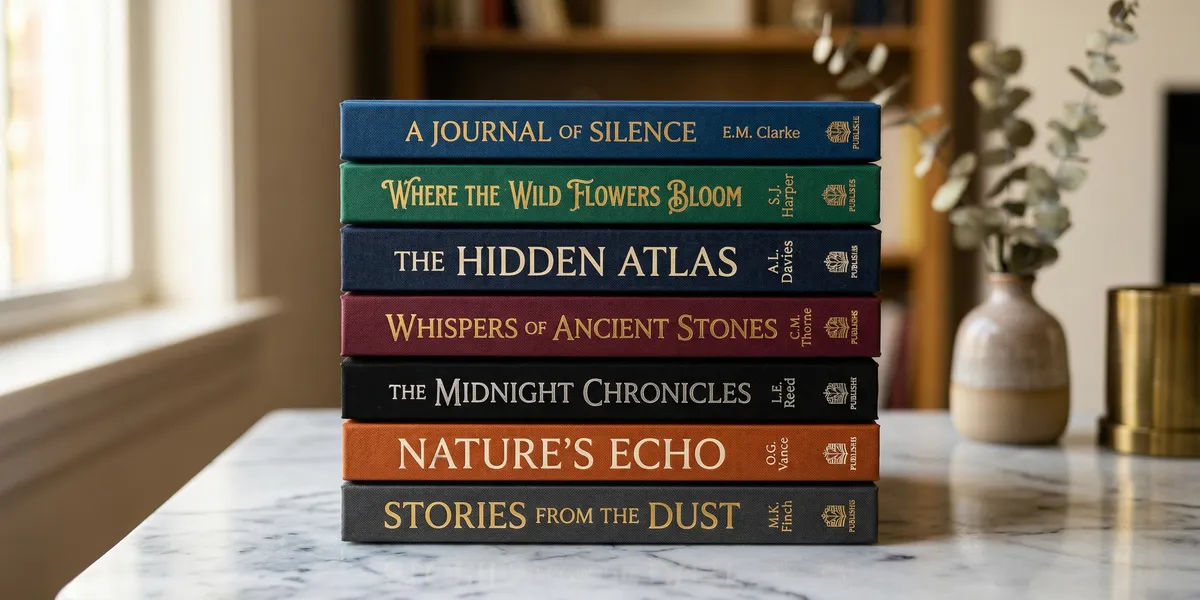
Your book title is the first thing potential readers see — and often the only thing that determines whether they click, pick it up, or scroll past. A strong title sells books. A weak one buries them.
The right title communicates what your book is about, who it’s for, and why it matters. It works on a bookstore shelf, in an Amazon search result, and when someone mentions it in conversation.
This guide covers how to brainstorm, evaluate, and finalize a title that serves your book well.
Why Book Titles Matter So Much
Readers judge books by their titles far more than authors expect. According to Penguin Random House’s reader research, the title is the single biggest factor in a reader’s initial decision to investigate a book further — ahead of the cover design and author name.
A title does several jobs simultaneously:
- Signals genre and tone. Readers instantly sort books by title style.
- Creates curiosity or clarity. It either makes readers ask “what’s this about?” or immediately answers that question.
- Enables word-of-mouth. Memorable titles get recommended. Forgettable ones don’t.
- Drives search traffic. On Amazon and Google, your title is a keyword-rich piece of real estate.
Nonfiction Book Title Formulas
Nonfiction titles follow patterns that readers recognize and respond to. You don’t need to be formulaic, but understanding the patterns gives you a starting advantage.
The “Benefit + Mechanism” Formula
State what the reader will gain and how they’ll gain it.
| Title | Benefit | Mechanism |
|---|---|---|
| The 4-Hour Workweek | Working less | A specific time framework |
| Atomic Habits | Better habits | A science-based approach |
| Deep Work | Professional success | A specific type of focus |
This formula dominates business and self-help because it answers the reader’s core question: “What will this book do for me?”
The “Intriguing Concept” Formula
Lead with a surprising or counterintuitive idea. The subtitle explains.
- Thinking, Fast and Slow — a metaphor for two cognitive systems
- Outliers: The Story of Success — reframes what drives achievement
- Quiet: The Power of Introverts in a World That Can’t Stop Talking — positions a trait as a strength
This approach works when your book’s central argument challenges assumptions.
The “How To” Formula
Direct, clear, and optimized for search.
- How to Win Friends and Influence People
- How to Talk So Kids Will Listen
- How to Write a Book (a structure we’ve explored in our how to write a book guide)
These titles sacrifice mystery for clarity. They work best when readers already know what they want and are looking for solutions.
The “Label” Formula
Name a concept, movement, or identity.
- Essentialism
- Grit
- Daring Greatly
Single-word or short-phrase titles feel authoritative. They work when you’re defining a concept or owning a category. The risk: they require stronger marketing to communicate what the book actually covers.
Fiction Book Title Approaches
Fiction titles play by different rules. Clarity matters less; mood, rhythm, and intrigue matter more.
Evocative Titles
These titles create feeling without giving away the plot.
- The Kite Runner — nostalgic, specific, visual
- Where the Crawdads Sing — mysterious, lyrical, rooted in place
- The Midnight Library — atmospheric, intriguing
Evocative titles work for literary fiction and genre fiction alike. They invite readers into an emotional space.
Character-Based Titles
Name a character and let readers discover who they are.
- Eleanor Oliphant Is Completely Fine
- Anna Karenina
- Bridget Jones’s Diary
This approach works when your character’s voice or personality is the book’s strongest selling point.
Place-Based Titles
Root the story in a specific setting.
- Wuthering Heights
- The House in the Cerulean Sea
- Station Eleven
Place-based titles signal that setting is central to the experience. They’re common in literary fiction, fantasy, and historical fiction. If you’re writing in a specific genre, our book genres guide covers the conventions for each.
Question or Statement Titles
Pose a question or make a provocative statement.
- Do Androids Dream of Electric Sheep?
- Everything I Never Told You
- All the Light We Cannot See
These create immediate curiosity. The reader wants the answer or wants to understand the statement.
The Subtitle: Your Title’s Best Friend
For nonfiction, the subtitle does the heavy lifting of explanation. The title grabs attention; the subtitle converts interest into action.
Subtitle Best Practices
Clarify the promise. If your title is intriguing but vague, the subtitle should explain exactly what the reader gets.
- Title: Atomic Habits
- Subtitle: An Easy & Proven Way to Build Good Habits & Break Bad Ones
Include keywords. Subtitles are indexed by Amazon and Google. Use the language your target readers would search for.
Keep it under 15 words. Long subtitles lose impact. Aim for clear and concise.
Avoid repeating the title. The subtitle should add new information, not rephrase what the title already says.
Subtitle Formula
A reliable pattern: [What the reader will achieve] + [How or for whom]
- “A Step-by-Step Guide for First-Time Authors”
- “The Science of Getting More Done in Less Time”
- “Practical Strategies for Growing Your Business Through Books”
How to Brainstorm Book Titles
Don’t try to find your perfect title in one brainstorm. Instead, generate a large quantity and then narrow down.
Step 1: Brain Dump (20 Minutes)
Set a timer and write down every possible title you can think of. Don’t evaluate. Don’t filter. Aim for 30-50 options. Include bad ones — they sometimes lead to good ones.
Step 2: Mine Your Manuscript
Look through your draft for phrases that stand out. Chapter titles, memorable sentences, and key concepts often contain your best title material.
If you haven’t started writing yet, how to write a book for beginners can help you get going.
Step 3: Study Competitors
Look at the top 20 books in your category on Amazon. Note their title patterns, lengths, and styles. Your title should fit the category while standing out from the crowd.
Step 4: Use a Title Generator
AI tools can spark ideas you wouldn’t think of on your own. Our roundup of the best AI book title generators reviews several options. You can also use Chapter.pub to brainstorm titles as part of the book planning process.
Step 5: Create a Short List
Narrow your list to 5-7 candidates. These should be titles you’d be proud to put on a cover.
How to Test Your Book Title
Don’t commit to a title based on your own opinion alone. Test it with real people.
The 3-Second Test
Show someone your title for three seconds. Then ask:
- What do you think this book is about?
- Who do you think it’s for?
- Would you pick it up?
If they can’t answer the first two questions quickly, your title isn’t clear enough.
The Comparison Test
List your title alongside 5 competing titles from Amazon. Ask someone unfamiliar with any of them which they’d click first and why.
Social Media Polling
Post your top 2-3 options on social media and ask your audience to vote. Instagram Stories polls and Twitter/X polls work well for this.
Amazon Search Test
Search for your proposed title on Amazon. If dozens of books already share the same name, consider differentiating. A unique title is easier to find and harder to confuse with competitors.
SEO and Amazon Optimization for Book Titles
On Amazon, your title is a search ranking factor. For self-published authors, this matters enormously.
Title Field Best Practices
Amazon’s title field allows up to 200 characters. Use this space strategically:
- Put your main title first
- Add a colon and subtitle
- Include your most important keyword naturally
For a deep dive on Amazon discoverability, read our guide on Amazon keywords for books.
What to Avoid
- Keyword stuffing. Amazon penalizes titles that read like search queries.
- All caps. It looks unprofessional and violates Amazon’s style guidelines.
- Special characters. Stick to standard punctuation.
- Misleading titles. If the title promises something the book doesn’t deliver, expect bad reviews.
Famous Book Titles: What We Can Learn
Some titles work so well they enter the cultural vocabulary.
“To Kill a Mockingbird” — Harper Lee’s editor suggested this title, replacing Atticus. The metaphor creates intrigue without revealing the plot.
“Thinking, Fast and Slow” — Daniel Kahneman’s title perfectly captures his book’s central framework: two systems of thought.
“The 7 Habits of Highly Effective People” — Stephen Covey’s title promises a specific number of actionable takeaways and identifies the aspirational identity (highly effective).
“Gone Girl” — Two words. Perfectly ambiguous. Is she gone as in missing, or gone as in unhinged? The title carries the book’s central tension.
The pattern: great titles are specific, evocative, and memorable. They make promises the book keeps.
Common Title Mistakes
Being Too Clever
Wordplay and puns feel satisfying to write but often confuse readers. If your title requires explanation, it’s not working.
Being Too Generic
“My Journey” or “Life Lessons” could describe thousands of books. Your title needs to differentiate your book from the competition.
Being Too Long
For fiction, 1-5 words is the sweet spot. For nonfiction, the main title should be 1-6 words, with a subtitle of 5-15 words.
Ignoring Your Genre
Each genre has title conventions. Romance titles signal romance. Thriller titles signal urgency. Violating these conventions confuses readers about what kind of book they’re getting.
Your Title Checklist
Before finalizing, run your title through this checklist:
| Criterion | Pass? |
|---|---|
| Communicates the book’s core topic or mood | |
| Fits the genre conventions | |
| Is memorable and easy to say aloud | |
| Works in an Amazon search result (clear at small size) | |
| Doesn’t duplicate an existing well-known title | |
| Tested with at least 5 people outside your inner circle | |
| The subtitle (if nonfiction) clarifies the promise | |
| You’d be proud to see it on a cover |
What Comes After the Title
A strong title gets readers to look at your book. The cover design, book description, and opening pages close the sale.
If you’re working on a book and need help with the full package — from title brainstorming to drafting to publishing — Chapter.pub walks you through the entire process. Over 2,147 authors have used the platform to bring their books to life.
Start with 50 title ideas. Test five. Choose one. Then write the book that earns it.