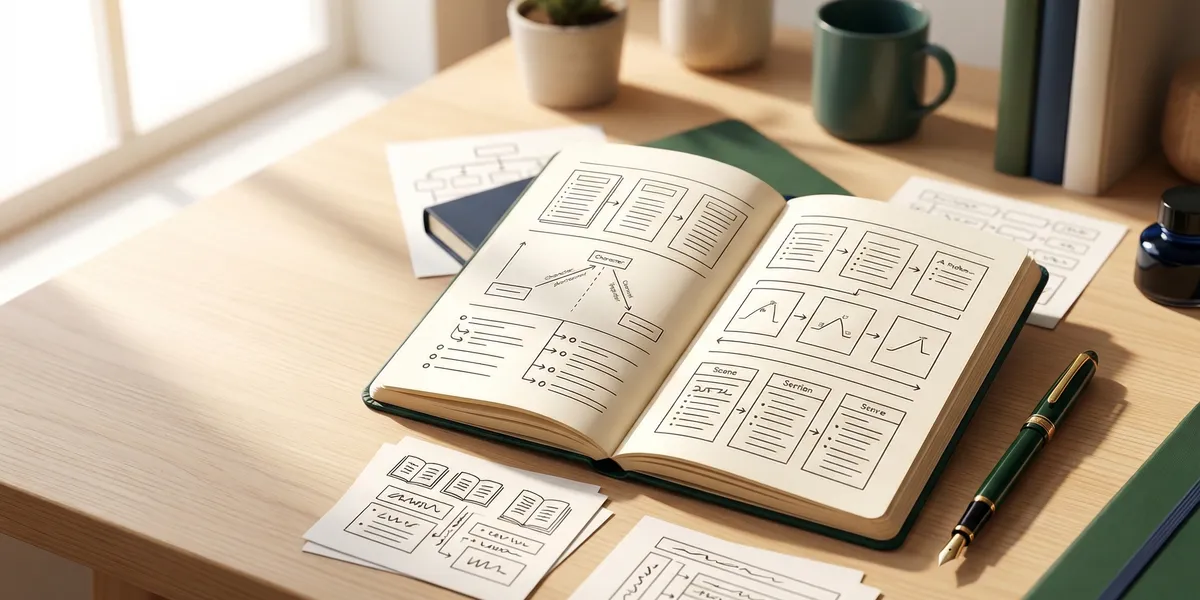
A book writing template gives you the structure of a finished book before you write a single chapter. Instead of staring at a blank page, you start with sections, headings, and prompts already in place — then fill them with your content.
The right template depends on what you are writing. A memoir needs a different structure than a business book. A fantasy novel needs a different framework than a self-help guide. This article breaks down templates by genre and type, with free downloads and the option to generate custom templates using AI.
Why templates work better than blank pages
The number-one reason books never get finished is not a lack of talent. It is a lack of structure. Writers stall in the middle because they never mapped the full arc before starting. According to Self-Publishing School, authors who use templates or outlines are significantly more likely to complete their manuscripts than those who start from scratch.
Templates solve three problems at once. They eliminate the organizational guesswork that causes writer’s block. They enforce proven structures that readers already expect. And they break a massive project into sections small enough to tackle one at a time.
A template is not a straitjacket. Think of it as scaffolding — you build your book inside the framework, then remove what you do not need.
Our Pick — Chapter
Chapter generates custom book writing templates for any genre using AI. Instead of downloading a generic document and adapting it, you describe your book and Chapter builds a tailored template with chapter breakdowns, section prompts, and structural guidance specific to your topic.
Best for: Authors who want a template shaped around their specific book, not a one-size-fits-all download Pricing: $97 one-time (nonfiction) | Varies (fiction) Why we built it: Every book is different — your template should be too
Nonfiction book writing templates
Nonfiction books follow predictable patterns based on their purpose. A how-to book teaches a process. A memoir tells a story. A business book establishes authority. Each pattern has a template that works.
How-to book template
A how-to book walks readers through a process step by step. The structure is linear: identify the problem, present the solution, guide the reader through each step.
Standard how-to book template:
| Section | Purpose | Typical length |
|---|---|---|
| Introduction | Define the problem and promise the outcome | 1,500-3,000 words |
| Chapters 1-3 | Foundation knowledge and mindset shifts | 3,000-5,000 words each |
| Chapters 4-8 | Step-by-step process (one major step per chapter) | 3,000-5,000 words each |
| Chapters 9-10 | Common pitfalls and advanced tips | 2,000-4,000 words each |
| Conclusion | Recap and next steps | 1,000-2,000 words |
Each chapter in a how-to book should follow an internal template too: open with what the reader will learn, teach the concept, provide an example, give them an action step.
Resources like Scribe Media offer free nonfiction outline templates specifically designed for expert-driven how-to books. Their template focuses on translating professional expertise into a chapter-by-chapter argument.
For a deeper walkthrough, see our guide on how to write a how-to book.
Memoir template
Memoirs look like nonfiction from the outside but behave like novels on the inside. They need narrative arc, scenes, and emotional progression rather than numbered steps.
Standard memoir template:
| Section | Purpose |
|---|---|
| Opening scene | Drop the reader into a pivotal moment |
| Act 1 (Chapters 1-4) | Set the world before the central event or transformation |
| Act 2 (Chapters 5-10) | The conflict, challenge, or journey unfolds |
| Act 3 (Chapters 11-14) | Resolution, reflection, and what you learned |
| Epilogue (optional) | Where you are now |
The biggest mistake memoir writers make is structuring their book chronologically from birth. The strongest memoirs focus on a single theme — one transformation, one period, one relationship — and build every chapter around that theme.
Creativindie offers free chapter outlining templates specifically for memoirs and narrative nonfiction.
Self-help book template
Self-help books promise transformation. Every chapter should move the reader closer to the outcome on the cover. The structure follows a problem-solution-action pattern that the American Society of Journalists and Authors describes as the standard five-part framework for the genre.
Standard self-help template:
| Section | Purpose |
|---|---|
| Introduction | Your credibility + the reader’s problem + the promised transformation |
| Chapter 1 | Name the problem clearly — make the reader feel seen |
| Chapter 2 | Overview of your approach with real-life proof |
| Chapters 3-8 | One principle or step per chapter, each with stories, exercises, and action items |
| Chapter 9-10 | Putting it all together, maintaining results |
| Conclusion | Inspire the reader to take the first step |
Each chapter in a self-help book should include at least one exercise or reflection prompt. Readers buy self-help to do something, not just to read. Our full guide on how to write a self-help book covers this structure in detail.
Business book template
Business books establish authority and attract clients. The structure should demonstrate your framework, prove it works, and make the reader want to work with you. For a complete walkthrough, see our guide to writing a business book.
Standard business book template:
| Section | Purpose |
|---|---|
| Introduction | Your story, the industry problem, your unique framework |
| Part 1 (Chapters 1-3) | The landscape — what is broken and why |
| Part 2 (Chapters 4-8) | Your framework, step by step, with case studies |
| Part 3 (Chapters 9-10) | Implementation guide and common obstacles |
| Conclusion | Vision for what is possible + call to action |
The most effective business books are built around a proprietary framework — a named methodology with 3 to 7 steps that the reader can follow. Think of it as your intellectual property in book form.
Fiction book writing templates
Fiction templates work differently than nonfiction. You are not organizing information — you are structuring a story. The template needs to account for plot, character arcs, pacing, and genre conventions.
Novel template (general fiction)
Most novels follow some version of three-act structure, whether the author plans it consciously or not. A novel template maps these beats across your chapters.
Standard novel template (80,000 words):
| Act | Chapters | Purpose | Word count target |
|---|---|---|---|
| Act 1: Setup | 1-6 | Introduce protagonist, world, stakes. End with inciting incident. | 20,000 |
| Act 2A: Rising action | 7-13 | Protagonist pursues goal, faces escalating obstacles | 20,000 |
| Midpoint | 14 | Major revelation or reversal that raises stakes | 3,000-4,000 |
| Act 2B: Complications | 15-20 | Consequences of midpoint, allies tested, all seems lost | 17,000 |
| Act 3: Resolution | 21-25 | Climax, final confrontation, resolution | 20,000 |
Reedsy offers free novel templates in their writing studio, including character sheets, world-building guides, and plot structure worksheets. For the complete process, see our guide on how to write a novel.
Genre-specific fiction templates
Different genres have different reader expectations, which means different structural templates.
Romance novel template:
- Chapters 1-3: Meet both protagonists separately, establish attraction
- Chapters 4-8: Growing connection with internal and external obstacles
- Midpoint: First major commitment or vulnerability
- Chapters 9-14: Conflict escalates, misunderstandings or external threats
- Black moment: The relationship appears destroyed
- Final chapters: Grand gesture, reconciliation, happily ever after
Mystery/thriller template:
- Chapter 1: The crime or inciting event
- Chapters 2-5: Introduction of suspects, clues, and red herrings
- Midpoint: A major clue shifts the investigation
- Chapters 6-10: Escalating danger, narrowing suspects
- Climax: Confrontation with the antagonist
- Resolution: Justice served, loose ends tied
Fantasy novel template:
- Chapters 1-3: Establish the ordinary world and magic system
- Chapters 4-6: Call to adventure, crossing into the unknown
- Chapters 7-12: Quests, battles, alliances formed
- Midpoint: Major revelation about the world or the protagonist’s destiny
- Chapters 13-18: Darkest hour, betrayals, sacrifices
- Final chapters: Epic climax and new equilibrium
Squibler provides free downloadable fiction templates with drag-and-drop scene organization for each of these genres.
Chapter writing templates
Beyond the whole-book structure, you need a template for individual chapters. A consistent chapter template keeps your pacing even and your readers oriented.
Nonfiction chapter template
Every nonfiction chapter should follow this internal structure:
- Opening hook — A story, statistic, or question that pulls the reader in (2-3 paragraphs)
- Core teaching — The main concept or step this chapter covers (the bulk of the chapter)
- Example or case study — A real-world illustration of the concept
- Action step or exercise — Something the reader can do immediately
- Transition — A sentence connecting to the next chapter
This pattern gives readers a predictable rhythm. They know each chapter will teach them something, show them how it works, and tell them what to do next.
Fiction chapter template
Fiction chapters are less formulaic, but strong chapters tend to share these elements:
- Scene goal — The POV character wants something specific
- Conflict — Something or someone opposes that goal
- Turning point — New information, a decision, or a setback changes the situation
- Hook — The final line creates a reason to turn the page
For detailed chapter-writing strategies, see our book outline guide which covers chapter-level planning for both fiction and nonfiction.
Book outline templates
An outline template is the skeleton that holds your entire book together. It sits between the high-level structure (acts, parts) and the chapter-level detail. Kindlepreneur recommends starting with a working title and premise, then building out chapter summaries of 2-3 sentences each before drafting.
Simple outline template (works for any genre)
Book Title: [Working title]
Premise: [One sentence describing the book's core promise or story]
Target reader: [Who this book is for]
Word count goal: [Target length]

Part 1: [Theme or purpose]
  Chapter 1: [Title] — [2-3 sentence summary]
  Chapter 2: [Title] — [2-3 sentence summary]
  Chapter 3: [Title] — [2-3 sentence summary]

Part 2: [Theme or purpose]
  Chapter 4: [Title] — [2-3 sentence summary]
  Chapter 5: [Title] — [2-3 sentence summary]
  ...

Part 3: [Theme or purpose]
  ...
This framework works whether you are writing a cookbook, a thriller, or a personal development guide. The key is to fill in the summaries with enough detail that you could hand the outline to someone else and they would understand what goes in each chapter.
For a full walkthrough of outlining methods, see our book outline guide.
Formatting templates
Once your manuscript is written, you need formatting templates to prepare it for publication. Formatting covers margins, fonts, headers, page size, and layout — the mechanical details that turn a Word document into a professional book.
Manuscript formatting template
If you are submitting to agents or publishers, follow standard manuscript format:
| Element | Standard |
|---|---|
| Font | Times New Roman, 12pt |
| Margins | 1 inch on all sides |
| Line spacing | Double-spaced |
| Paragraph indent | 0.5 inches (first line) |
| Text alignment | Left-aligned, ragged right |
| File format | .docx |
| Header | Last name / Title / Page number |
| Chapter starts | New page, title centered one-third down |
| Scene breaks | Centered # or *** |
Reedsy and MasterClass both offer free manuscript formatting templates that follow these standards exactly.
Print book formatting template
For self-publishing, you need templates sized to your trim dimensions. The most common sizes are 5” x 8”, 5.5” x 8.5”, and 6” x 9”. Amazon KDP provides free downloadable templates for every supported trim size with margins already configured.
For a complete walkthrough of Kindle formatting, see our guide on how to format a book for Kindle.
How to create a custom template with AI
Generic templates get you started, but every book is unique. A business book about supply chain management needs a different structure than a business book about leadership coaching. A romance set in Regency England has different structural needs than a contemporary rom-com.
This is where AI-generated templates change the process. Instead of adapting a generic framework, you describe your specific book — the topic, genre, target reader, and goals — and the AI builds a custom template around your content.
Chapter does this automatically. You input your book concept and Chapter generates a full outline with chapter breakdowns, section suggestions, and structural guidance calibrated to your genre and topic. Over 5,000 books have been created on the platform using this approach, and the templates adapt as you write — so the structure evolves with your content rather than locking you into a rigid framework.
The advantage over static templates is specificity. A downloaded Word template gives you generic chapter headings. An AI-generated template gives you chapter headings, content suggestions, and structural guidance that reflect your actual book.
Common mistakes to avoid
-
Using a fiction template for nonfiction (or vice versa). The structures are fundamentally different. A three-act narrative arc does not work for a how-to book, and a step-by-step process template will not serve a novel.
-
Following the template too rigidly. Templates are starting points. If a chapter needs to be split in two or combined with another, change the template. The book comes first.
-
Skipping the outline and jumping to a formatting template. Structure before formatting. Getting your margins perfect before your chapters are planned is like painting a house before the walls are up.
-
Using a template from the wrong era. Book structures evolve. A business book template from 2010 might emphasize length and theory. Modern readers want shorter chapters, more case studies, and actionable frameworks.
-
Choosing the fanciest template instead of the most functional one. Beautiful templates with elaborate designs can distract from writing. The best template is the one that helps you write, not the one that looks best empty.
FAQ
What is the best format for writing a book?
For drafting, use any word processor you are comfortable with — Google Docs, Microsoft Word, or Scrivener all work. For manuscript submissions, use .docx format with Times New Roman 12pt, double-spaced, one-inch margins. For self-publishing, use templates matched to your print trim size or your ebook platform’s requirements.
Do professional authors use templates?
Many do, especially for nonfiction. James Clear’s Atomic Habits follows a clear chapter template throughout. Most traditionally published nonfiction follows established genre structures that function as templates. Fiction authors are more likely to use loose structural frameworks (three-act structure, the hero’s journey) rather than rigid templates.
Can I use a book writing template for an ebook?
Yes. The structural templates (outlines, chapter frameworks) work identically for print and digital books. Formatting templates differ — ebooks use reflowable text rather than fixed page dimensions, so you will not need the same margin and trim size settings as a print book.
How long should each chapter be?
Nonfiction chapters typically run 3,000 to 5,000 words. Fiction chapters range more widely, from 1,500 to 5,000 words depending on genre and pacing. Thrillers tend toward shorter chapters. Literary fiction allows longer ones. The right length is whatever serves the content — consistency matters more than hitting a specific number.