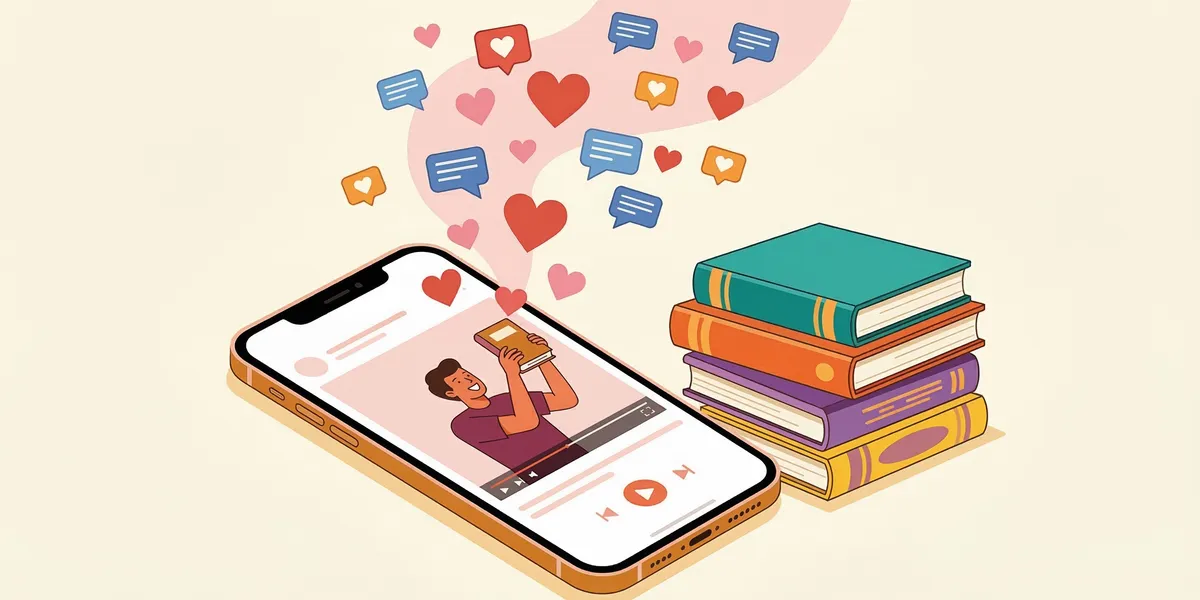
BookTok — the book-loving corner of TikTok — has turned unknown self-published authors into bestsellers overnight. Colleen Hoover’s backlist surged years after publication because BookTok readers could not stop recommending It Ends with Us. Adam Silvera’s They Both Die at the End hit the New York Times bestseller list five years after its original release, driven almost entirely by TikTok.
This is not a fluke. BookTok is a sustained force in book discovery, and it works for both fiction and nonfiction authors.
What BookTok actually is
BookTok is not a feature or a tool. It is a community of readers on TikTok who create and consume content about books. The hashtag #BookTok has accumulated over 250 billion views as of 2025, making it one of the platform’s largest subcultures.
What makes BookTok different from other book marketing channels:
- Authenticity drives everything. Readers trust other readers, not polished ads. The most viral BookTok videos are genuine emotional reactions — crying over an ending, screaming about a plot twist, quietly recommending a book that changed someone’s perspective.
- Discovery favors the unknown. TikTok’s algorithm does not care how many followers you have. A video from a zero-follower account can reach millions if it resonates. This makes BookTok uniquely powerful for debut and indie authors.
- Backlist books thrive. Unlike traditional marketing where launch week is everything, BookTok can resurface a book months or years after publication. The algorithm serves content based on engagement, not recency.
According to Circana’s BookScan data, BookTok-influenced titles drove a 65% increase in print sales for recommended books in 2024. Barnes & Noble now has permanent BookTok sections in every store.
How the algorithm works for book content
TikTok’s recommendation algorithm prioritizes three signals:
- Watch time. Videos watched to completion (or rewatched) get pushed to more users. Short, compelling book content performs well because viewers watch the entire video.
- Engagement. Comments, shares, saves, and stitches tell the algorithm a video is worth spreading. Book content generates high save rates because viewers bookmark recommendations for later.
- Relevance. TikTok matches content to user interests. Once someone engages with book content, they see more of it. This creates a self-reinforcing loop for BookTok creators.
The practical implication: you do not need a huge following. You need one video that hooks viewers in the first two seconds and keeps them watching.
Content ideas for authors on BookTok
Behind-the-scenes writing process
Show your actual writing setup. Film your screen as you outline a chapter. Share the messy first draft versus the polished final version. Readers are fascinated by how books get made.
Video ideas:
- “Day in the life of a writer” (your actual routine, not a romanticized version)
- “How I outlined my book in one day”
- “The paragraph that took me 3 hours to get right”
- “My writing playlist for [genre]“
Reading your own work
Read a compelling passage from your book. Pick a moment with emotional weight — the climax, a particularly vivid scene, or a line you are proud of. Authors reading their own words with genuine emotion is one of the most shareable formats on BookTok.
Book aesthetic videos
Create a visual mood board for your book’s world. For fiction, show objects, colors, locations, and music that capture the vibe. For nonfiction, show the problem your book solves — the before and after.
These perform well because they are visually engaging and give potential readers a feel for the book without requiring them to read a description.
Q&A and FAQ content
Answer the questions readers ask most. “Why did you write this book?” “How long did it take?” “Is [character] based on a real person?” “What research did you do?”
Each question is a separate video. This is an endless content well because readers always have more questions.
Trope and genre content
If you write fiction, lean into the tropes your book contains. Videos like “Books with the enemies-to-lovers trope” or “If you love found family, read this” perform exceptionally well. BookTok readers search by trope as much as by genre.
For nonfiction, the equivalent is “books that changed my [career/mindset/relationships]” or “the book that finally explained [concept]."
"How I wrote my book” series
Break your writing journey into a multi-part series. Part 1: the idea. Part 2: the outline. Part 3: the first draft. Part 4: editing. Part 5: publishing. This builds anticipation and gives viewers a reason to follow you for the next installment.
Cover reveals and unboxings
Film yourself seeing your book cover for the first time, holding the first printed copy, or unboxing a shipment of author copies. These milestone moments generate genuine emotion that resonates with viewers.
What actually goes viral on BookTok
After studying hundreds of viral BookTok videos, the patterns are clear:
Authenticity over production quality. The most-viewed BookTok videos are filmed on phones with natural lighting. Over-produced content signals “ad” and viewers scroll past it. According to a Morning Consult study, 88% of Gen Z consumers say authenticity matters more than production value in the content they engage with.
Emotion over information. A 15-second video of someone tearing up while describing a book’s impact outperforms a 3-minute plot summary every time. Lead with feeling.
Humor and relatability. “When you’re 300 pages into a book and the love interest dies” — relatable frustration and humor about the reading experience connects viewers to you as a person, not just a product.
Specific recommendations over broad ones. “Five books about grief that actually helped me heal” outperforms “five good books.” Specificity signals expertise and creates trust.
Hooks in the first 2 seconds. You have two seconds before a viewer scrolls. Start with the most compelling statement. “This book made me quit my job” is a hook. “Hey guys, today I want to talk about a book I read” is not.
Technical tips for BookTok
Trending sounds. Use trending audio when it fits naturally. TikTok’s algorithm gives a slight boost to videos using popular sounds. Check the “Trending” section in the sound library.
Hashtags. Always include #BookTok. Add genre-specific tags (#RomanceBookTok, #NonfictionBookTok, #DarkRomance, #SelfHelpBooks). Use 3 to 5 hashtags total — more than that looks spammy.
Posting times. According to Hootsuite’s 2025 analysis, optimal posting times for book content on TikTok are Tuesday through Thursday between 7 and 9 PM local time. However, consistency matters more than perfect timing.
Video length. BookTok videos between 15 and 60 seconds perform best for discovery. Longer videos (2 to 3 minutes) work for followers who already care about your content. Start short to build an audience, then experiment with length.
Captions and text overlays. Many TikTok users watch without sound. Add text overlays that convey your main point visually. TikTok’s built-in caption tool handles this well.
BookTok for nonfiction authors
Yes, BookTok works for nonfiction. The format is different but the results are real.
Nonfiction BookTok thrives on “this changed my life” recommendations. Videos about books on productivity, psychology, business, self-improvement, and finance consistently perform well. The #NonfictionBookTok hashtag has over 2 billion views.
Content angles for nonfiction authors:
- Share a single counterintuitive insight from your book
- Demonstrate a technique or framework in 30 seconds
- Show real results (yours or your readers’) from applying your book’s advice
- Respond to common misconceptions in your field
The advantage nonfiction authors have: your content is inherently educational, and educational content gets saved and shared at higher rates than entertainment content, according to TikTok’s own creator insights.
Realistic expectations
Most of your videos will not go viral. That is normal and not a sign of failure.
The typical trajectory for an author on BookTok:
- Months 1-2: 5 to 15 videos, most getting 200 to 500 views. You are learning the format.
- Months 3-4: You find your voice. A few videos break 1,000 views. You understand what your audience responds to.
- Months 5-6: Consistent posting (3 to 5 times per week) builds a small but engaged following. One or two videos may break through to 10,000+ views.
- Month 6+: Compounding takes over. Your back catalog of videos continues getting served to new viewers. A viral moment becomes more likely with more content in the algorithm.
Consistency is the strategy. Authors who post 3 to 5 times per week for six months almost universally report measurable increases in book sales, email signups, and reader engagement, regardless of whether any single video goes viral.
Common mistakes to avoid
- Being too salesy. “Buy my book, link in bio, use code AUTHOR20” kills engagement. BookTok viewers want authentic content, not commercials. Mention your book naturally within the context of your content.
- Over-polishing content. Professional lighting rigs, scripted dialogue, and corporate b-roll signal “advertisement” on TikTok. Film on your phone. Be yourself.
- Posting inconsistently. One video per month will not build momentum. The algorithm rewards consistent creators. Three times per week is the minimum for meaningful growth.
- Ignoring comments. BookTok thrives on conversation. Reply to every comment in your first months. Engaged communities grow faster than passive audiences.
- Copying what works for others verbatim. Study successful BookTok creators for inspiration, but find your own angle. Viewers recognize copies. What makes you different as an author is what will make your content stand out.
- Expecting overnight results. Most “overnight success” BookTok stories involved months of consistent posting before a video broke through. Treat BookTok as a long-term author platform strategy, not a lottery ticket.
Getting started today
You do not need a following, special equipment, or video experience.
- Download TikTok and spend 30 minutes watching BookTok content in your genre. Like and engage with videos so the algorithm learns your niche.
- Film your first video on your phone. Keep it under 30 seconds. Share one genuine thought about your book or your writing process.
- Post it with #BookTok and 2 to 3 genre-specific hashtags.
- Repeat tomorrow.
The authors who succeed on BookTok are not the most polished or the most viral. They are the ones who show up consistently, share authentically, and trust the process.
For more on building your visibility as an author, see our guides on how to market a self-published book and the book launch checklist every author needs.