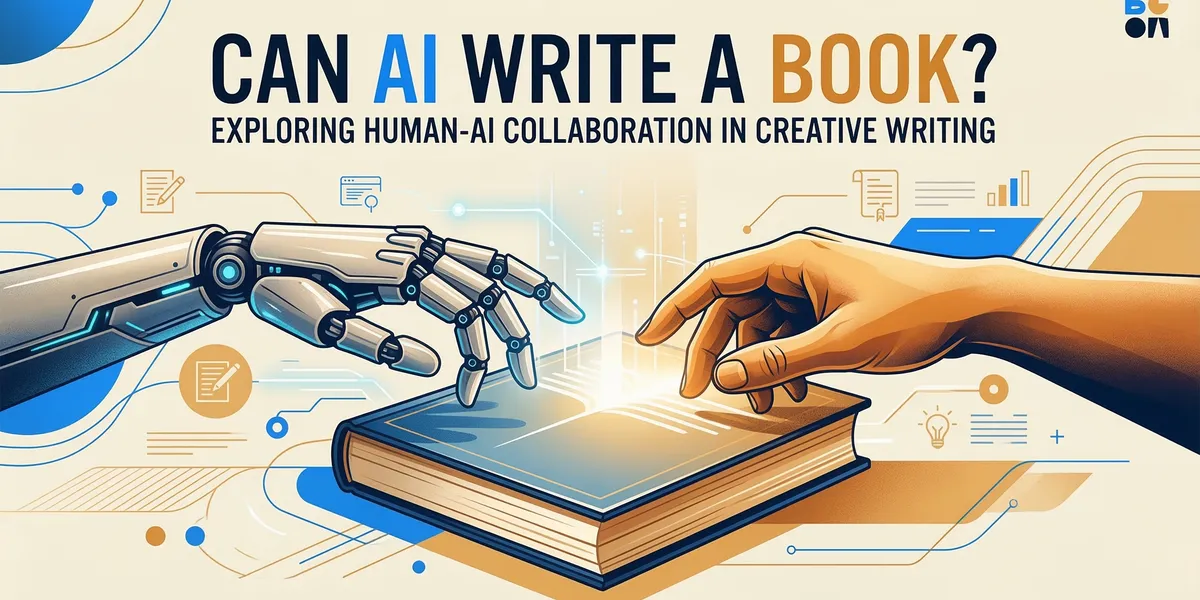
Yes, AI can write a book. Over 2,147 authors have used Chapter to create more than 5,000 books — nonfiction guides, romance novels, business authority books, memoirs, and fantasy epics. One author made $60,000 in 48 hours from a single AI-written book. Another landed a $13,200 client the same day someone read his.
But the answer is more nuanced than a simple yes. AI does not sit down and produce a masterpiece from nothing. It replaces the blank page, not the author. The quality, usefulness, and profitability of an AI-written book depend entirely on the person directing the process.
This article breaks down what 2,147 authors actually experienced — what worked, what did not, and where AI writing stands in 2026.
What “AI Writes a Book” Actually Means
When people ask “can AI write a book,” they usually picture a robot churning out a novel while a human sips coffee. The reality is different.
AI book writing is a collaboration. You provide the inputs — your expertise, your topic, your story premise, your character details, your outline preferences. The AI handles the writing labor: generating prose, structuring chapters, maintaining consistency across tens of thousands of words.
Think of it as the difference between an architect and a construction crew. You are the architect. You decide what gets built, where the rooms go, what materials to use. The AI is the crew that turns blueprints into a standing structure.
With a tool like Chapter, the process looks like this:
- You define your book — topic, audience, key points (nonfiction) or premise, characters, genre (fiction)
- AI generates structure — chapter outlines, section breakdowns, narrative arcs
- You review and adjust — rearrange chapters, add your stories, refine the direction
- AI writes the draft — full manuscript from your approved structure
- You edit and publish — add your voice, polish the prose, publish
The human stays in control at every decision point. The AI eliminates the months of staring at a blank document, struggling to get words on the page.
The Results: What 2,147 Authors Actually Achieved
Data tells a more honest story than opinions. Here is what authors using AI book writing have accomplished.
The Numbers
- 2,147+ authors have used Chapter to write books
- 5,000+ books created and published
- 4.7 out of 5 rating from over 2,000 users
- Featured in USA Today and the New York Times
What Authors Say (In Their Own Words)
These are real testimonials from real users — not cherry-picked edge cases, but representative outcomes across different use cases.
The consultant who landed a five-figure client:
“A stranger read my book and reached out: ‘I need your help. What does it cost?’ I said $13,200. He started the same day.” — Jim T.
Jim’s book was not a literary achievement. It was a positioning tool — a clear, credible demonstration of his expertise that converted a cold reader into a paying client in a single interaction.
The entrepreneur who turned a book into a launch event:
“$60,000 in 48 hours from one lead magnet — and that was a book.” — Arek Z.
Arek used his AI-written book as a lead magnet for his business. The book itself was not the product. It was the mechanism that attracted qualified buyers.
The romance writer who hit the Amazon charts:
“I went from idea to published book in 5 days. It hit #12 in Romance Contemporary!” — Sarah M.
Five days from concept to a top-15 Amazon ranking in one of the most competitive fiction categories. That timeline is not possible with traditional writing methods.
The author who skipped the ghostwriter:
“The book was totally perfect. It was almost like exactly what I would have written myself. Saved me $25K on a ghostwriter.” — Adam W.
For authors who know what they want to say but struggle with the writing process, AI delivers a draft that sounds like them — at a fraction of the cost of hiring a human ghostwriter.
The first-time author who thought she couldn’t do it:
“I’m 58 and not techy. It was so simple. Now I’m a published author.” — Linda R.
Linda’s story matters because it represents the largest group of AI book authors: people who always wanted to write a book but never had the time, skill, or confidence to start.
What AI Does Well in Book Writing
AI book writing tools have clear strengths. Understanding them helps you set realistic expectations.
Structure and Organization
AI excels at turning unstructured ideas into organized chapters. If you have expertise scattered across years of experience, blog posts, presentations, and notes, AI can synthesize that into a coherent book structure faster than any human outliner.
For fiction, tools like Chapter’s fiction software apply proven narrative frameworks — Three Act Structure, Save the Cat, Romance Beat Sheet — to your premise. The AI knows that a thriller needs escalating stakes by the midpoint and a romance needs the “dark moment” before the resolution.
First Drafts at Speed
A 50,000-word manuscript that takes a human writer three to six months takes AI hours. This speed advantage is not about cutting corners — it is about eliminating the mechanical labor of getting words on the page so you can spend your time on what matters: editing, refining, and adding your unique perspective.
Overcoming Writer’s Block
The blank page is where most books die. AI eliminates it entirely. You never sit down to an empty document. You sit down to a structured draft that you can react to, improve, and reshape. Reacting to existing text is psychologically easier than creating from nothing.
Consistency Across Long Manuscripts
Human writers drift. Character names change. Timelines contradict. Plot threads get dropped. AI maintains consistency across 50,000, 80,000, or 120,000 words because it tracks the details programmatically. For series writers, this consistency tracking across multiple books is especially valuable.
Accessible to Non-Writers
Not everyone who has a book worth writing has the writing skills to produce it. Consultants, coaches, entrepreneurs, subject matter experts — these people have knowledge and experience that belongs in a book. AI bridges the gap between having something to say and being able to say it in published form.
What AI Does NOT Do
Honesty about limitations builds more trust than overselling capabilities. Here is where AI falls short.
Original Research
AI cannot conduct interviews, run experiments, gather primary data, or observe phenomena firsthand. If your book requires original research — a journalistic investigation, a scientific study, an ethnographic account — AI cannot do that work. It can write about research you have already done, but it cannot generate the research itself.
Lived Experience
A memoir about overcoming addiction, a travel book about hiking the Appalachian Trail, a parenting book drawn from raising four children — these books derive their power from personal experience. AI can help you organize and articulate those experiences, but it cannot manufacture the experiences themselves.
Nuanced Literary Voice
AI prose is competent. It is clear, structured, and readable. What it is not — at least not yet — is distinctively literary. The sentence-level artistry of writers like Cormac McCarthy, Toni Morrison, or Kazuo Ishiguro remains beyond AI’s reach. AI can approximate genre conventions and maintain a consistent tone, but it does not produce sentences that make readers stop and reread them for their beauty alone.
Emotional Authenticity in Memoir
Related to lived experience, but worth its own point: the emotional truth that makes memoir compelling comes from vulnerability, self-awareness, and the willingness to be honest about painful experiences. AI can structure a memoir and generate prose, but the emotional authenticity has to come from the author.
Fiction vs. Nonfiction: AI Handles Each Differently
AI book writing is not one-size-fits-all. The approach — and the results — differ significantly between fiction and nonfiction.
Nonfiction: Where AI Excels Most
Nonfiction is AI’s strongest category for book writing, and the reason is straightforward: nonfiction books are structured around information, and AI is exceptionally good at organizing and presenting information.
A consultant’s authority book needs clear chapters, logical flow, supporting examples, and actionable advice. An AI book writer delivers all of those from your input. You provide your expertise, frameworks, and client stories. AI structures them into a professional manuscript.
The results speak for themselves. Jim T.’s $13,200 client came from a nonfiction authority book. Arek Z.’s $60,000 launch was powered by a nonfiction lead magnet. These books did not need to be literary — they needed to be clear, credible, and useful. AI delivered that.
Best nonfiction use cases for AI writing:
- Business and authority books
- How-to guides and educational content
- Self-help and personal development
- Lead magnets and marketing books
- Course companion books
- Industry guides and thought leadership
Fiction: Strong but Needs More Human Shaping
Fiction is more complex. AI can generate a complete manuscript with plot structure, character arcs, dialogue, and pacing — Sarah M.’s #12 Amazon romance proves that the output is commercially viable. But fiction writing involves creative choices that benefit from human judgment.
Voice is the biggest factor. Genre fiction (romance, thriller, fantasy, sci-fi) has established conventions that AI handles well. Literary fiction, where the writer’s unique voice is the primary draw, requires significantly more human editing and shaping after the AI draft.
The practical approach most fiction writers take: use AI for structure and first draft, then invest editing time in voice, dialogue refinement, and the emotional beats that readers remember.
Where AI fiction writing works best:
- Romance (strong genre conventions, established structures)
- Thriller and suspense (plot-driven, AI handles pacing well)
- Fantasy and sci-fi (worldbuilding consistency, series continuity)
- Genre fiction with clear reader expectations
Where it needs more human input:
- Literary fiction (voice-dependent)
- Memoir and creative nonfiction (experience-dependent)
- Experimental or avant-garde fiction
Learn more about how to write a book with AI across both fiction and nonfiction.
The Quality Reality Check
Let’s address the elephant in the room: is AI-written content actually good?
The honest answer depends on what “good” means for your specific purpose.
AI Books Are Publishable and Profitable
The data is clear on this point. Over 5,000 books published. A #12 Amazon ranking in a competitive category. A $60,000 launch. A $13,200 client conversion. These are not theoretical outcomes — they are documented results from real authors.
The books that produced these results were not nominated for the National Book Award. They did not need to be. They served their purpose: positioning an expert, generating leads, entertaining genre fiction readers, educating an audience.
AI Books Are Not Winning Literary Prizes
And they do not need to. The vast majority of books published each year — traditionally or self-published — are not literary masterpieces. They are useful, entertaining, or informative. AI-written books fit comfortably in that category.
A consultant does not need their authority book to read like Hemingway. They need it to clearly communicate their expertise, build trust with potential clients, and demonstrate that they know what they are talking about. AI delivers that.
A romance reader does not need every sentence to be poetry. They need compelling characters, satisfying emotional arcs, and a story that keeps them turning pages. AI delivers that too.
Where Quality Concerns Are Valid
If you are writing literary fiction intended for critical acclaim, AI is a drafting tool at best — you will spend significant time rewriting for voice and artistry. If you are writing memoir, the emotional authenticity cannot be outsourced. If you are writing academic work, every claim needs human verification and source checking.
For a deeper look at output quality across different use cases, see our AI writing quality analysis.
The “What About Quality” Debate
Critics of AI book writing tend to make one of two arguments. Both deserve honest responses.
”AI Writing Is Generic”
This is sometimes true — and sometimes irrelevant. AI prose without human direction tends toward the median. It is competent but unremarkable. With strong inputs (your expertise, your stories, your specific perspective), the output becomes significantly more specific and valuable.
More importantly, “generic” is a relative judgment. A first-time author who publishes a clear, well-structured business book has accomplished something valuable — even if a professional editor would improve the prose. The alternative for most of these authors is not “a better book.” It is no book at all.
”AI Books Are Flooding the Market”
The number of books published has increased. But the number of readers has not decreased. Readers find books through recommendations, search, social media, and Amazon’s algorithm. A well-positioned book with genuine expertise behind it gets discovered regardless of how many other books exist.
The authors getting results from AI-written books are not succeeding despite the market being flooded. They are succeeding because their books solve specific problems for specific audiences. The tool used to write the book matters less than the value the book delivers.
Who Is Using AI to Write Books
AI book writing is not limited to a single demographic or use case. The 2,147+ authors on Chapter represent a genuine cross-section.
Consultants and Coaches
The largest single group. A published book is the most powerful credibility tool in professional services. It positions you as an authority, generates inbound leads, and gives potential clients a preview of your thinking before they ever get on a call.
Jim T.’s story — $13,200 from a single reader who became a client — is the standard playbook. Write the book. Distribute it. Let it work as a 24/7 sales tool.
Entrepreneurs and Business Owners
Arek Z.’s $60,000 in 48 hours came from using his book as a lead magnet. Entrepreneurs use AI-written books for product launches, email list building, brand authority, and as the foundation for courses, workshops, and speaking engagements.
Fiction Writers
Sarah M. went from idea to #12 on Amazon in five days. Fiction writers use AI to produce manuscripts at a pace that genre readers demand — especially in romance, thriller, and fantasy where readers consume multiple books per month and expect series to progress quickly.
Explore AI tools for fiction with our AI story generator guide.
First-Time Authors
Linda R. — 58 years old, self-described as “not techy” — represents the aspiration that AI book writing fulfills for thousands of people. The dream of writing a book is nearly universal. The skills, time, and confidence required to actually do it are not. AI removes those barriers.
Subject Matter Experts
Doctors, lawyers, financial advisors, engineers, academics — professionals with deep knowledge who do not have the time or inclination to spend months writing. AI lets them convert their expertise into a published book in days rather than years.
The Bottom Line: AI Writing Is a Tool
Can AI write a book? Yes. Over 5,000 books from 2,147+ authors prove it.
But framing the question as “can AI write a book” misses the point. The better question is: what can you create when the writing labor is no longer the bottleneck?
AI is a tool. Like any tool, the output depends on the person using it. A chainsaw in the hands of a sculptor creates art. In the hands of someone with no plan, it creates a mess. AI book writing works the same way.
The authors who get the best results — the five-figure clients, the Amazon rankings, the $60K launches — bring three things to the process:
- Clear purpose — They know why the book exists and who it serves
- Real expertise or story — They have something genuine to say
- Willingness to shape the output — They treat the AI draft as a starting point, not a finished product
If you have knowledge worth sharing, a story worth telling, or a business that would benefit from a published book, AI has eliminated the biggest obstacle between you and a finished manuscript: the writing itself.
The blank page is no longer a barrier. The question is no longer “can AI write a book.” The question is what book will you write.
Ready to Write Your Book?
For nonfiction — business books, authority guides, how-to books, and lead magnets: Start writing with Chapter
For fiction — novels, romance, thriller, fantasy, and genre fiction: Start writing with Chapter Fiction
Join 2,147+ authors who have already created over 5,000 books. One-time pricing. No subscriptions. Your expertise or story, transformed into a published book.