Can ChatGPT write a novel? We tested it with a 60,000-word contemporary romance and a 45,000-word thriller. The short answer: ChatGPT can write scenes, dialogue, and short fiction well. For a full-length novel, it struggles with the things that make novels work — consistency, pacing, and memory across hundreds of pages.
Here is exactly what happened, what worked, and where it fell apart.
What We Tested
We used GPT-4 (ChatGPT Plus) for two projects:
- Romance novel: 60,000 words, dual POV, three-act structure with romance beat sheet
- Thriller: 45,000 words, single POV, ticking-clock plot with multiple twists
For each book, we followed the recommended approach: detailed outline first, chapter-by-chapter generation, consistency document maintained manually. We gave ChatGPT every advantage — clear prompts, structured inputs, and careful session management.
What ChatGPT Did Well
Individual scenes were strong. When given a single scene to write — a meet cute, a chase sequence, a tense confrontation — ChatGPT produced engaging, readable prose. Dialogue had decent rhythm. Action scenes moved.
Short fiction works. For stories under 10,000 words, ChatGPT produced complete, coherent narratives. A 5,000-word short story stayed consistent because the entire thing fit within the context window. No memory problems, no character drift.
Brainstorming and outlining excelled. ChatGPT generated plot structures, character backstories, subplot ideas, and chapter outlines faster than any human brainstorming session. We used it heavily for pre-writing on both projects.
Dialogue had personality. Character voice in individual scenes — especially when we provided dialogue samples and personality descriptions — was better than expected. Banter felt natural. Emotional exchanges hit the right notes within a single chapter.
Where ChatGPT Failed
The Context Window Problem
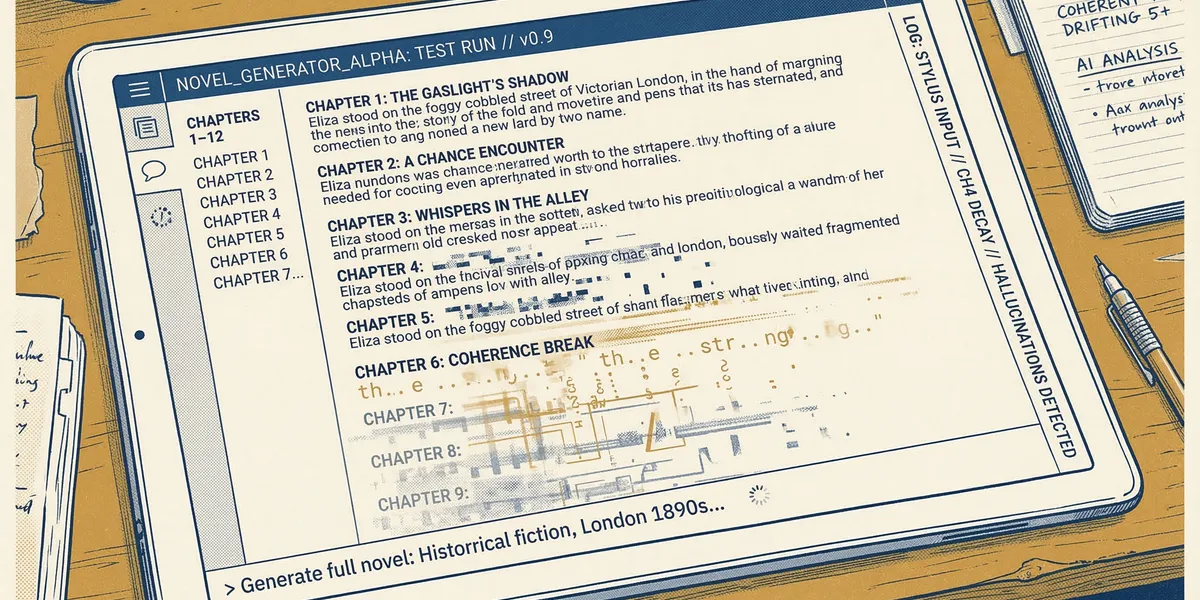
This is the fundamental issue. By chapter ten of the romance, ChatGPT could no longer hold the full manuscript in memory. We could paste in the outline and a summary of previous chapters, but that is a compressed approximation — not the actual text.
The result: chapter twelve referenced a conversation that happened differently than we wrote it in chapter four. A character’s emotional arc that was supposed to build gradually over eight chapters felt disconnected, because each chapter was written in isolation.
Character Consistency Drifted
Our romance protagonist was established as a reserved architect who expresses care through actions, not words. By chapter fifteen, she was delivering emotional speeches that contradicted her established personality. The shift was not dramatic enough to catch in a quick review — it happened gradually, which made it harder to fix.
In the thriller, our antagonist’s motivation subtly changed between chapters. He started as ideologically driven. By the climax, he read more like a generic power-hungry villain, because ChatGPT defaulted to common thriller tropes rather than maintaining the specific character we built.
Pacing Collapsed Over Length
A novel’s pacing depends on the relationship between scenes — how tension builds across chapters, how quiet moments earn the payoff of climactic ones. ChatGPT wrote each chapter as if it were a standalone piece. Chapter eight had a climactic confrontation. Chapter nine had another climactic confrontation. The rhythmic rise-and-fall that makes novels compulsive reading was absent.
The romance beat sheet expects specific story beats at specific points — the inciting incident by 12%, the midpoint shift at 50%, the dark moment at 75%. ChatGPT hit these beats when explicitly told to, but the emotional escalation between beats felt flat. Each chapter existed in its own bubble.
Subplots Disappeared
Both projects had subplots established in early chapters. The romance had a secondary character arc about the protagonist’s relationship with her sister. The thriller had a political subplot. Both subplots were introduced, referenced once or twice, and then vanished — because ChatGPT did not maintain them unless we explicitly reminded it in every chapter prompt.
Managing subplots manually across 20+ chapters added significant overhead to what was supposed to be an efficient process.
The Honest Verdict: It Depends on Length
| Project Type | ChatGPT Performance | Recommendation |
|---|---|---|
| Short story (under 10K words) | Strong | ChatGPT works well |
| Novella (10K-30K words) | Adequate with heavy management | Workable but labor-intensive |
| Full novel (50K-100K words) | Struggles significantly | Use a dedicated fiction tool |
| Series (multiple books) | Not viable | Requires purpose-built continuity tracking |
For short fiction, ChatGPT is a legitimate tool. For full-length novels, the manual effort required to compensate for its limitations — consistency tracking, context re-establishment, pacing management, subplot maintenance — nearly equals the effort of writing the novel yourself.
What a Dedicated Fiction Tool Does Differently
The problems we hit with ChatGPT are not AI problems. They are problems with using a general-purpose chatbot for a specialized task. Tools built specifically for novel writing solve them architecturally.
Chapter’s fiction software generates complete novels between 20,000 and 120,000+ words using the same narrative frameworks that published authors use — Save the Cat, Three Act Structure, Romance Beat Sheet, Hero’s Journey.
The key differences:
Full manuscript awareness. Chapter holds your entire book in context. Chapter twenty knows what happened in chapter two, not a compressed summary of it.
Character profiles maintained throughout. You define characters once — personality, motivations, flaws, speech patterns, relationship dynamics. Those profiles inform every scene the character appears in. Our reserved architect stays reserved. Our ideological antagonist keeps his ideology.
Built-in story structure. Instead of manually ensuring beats land at the right percentages, the structural framework handles pacing. The romance builds toward its dark moment organically because the system knows where that beat belongs.
Genre-specific trope libraries. Romance readers expect specific conventions — forced proximity, enemies to lovers, second chance. The trope library ensures your novel hits genre expectations without you spelling them out in every prompt.
Series continuity. For authors writing multi-book series, a continuity tracker maintains character details, world rules, and plot threads across up to nine books. ChatGPT cannot do this even within a single book.
“I went from idea to published book in 5 days. It hit #12 in Romance Contemporary!” — Sarah M.
Sarah’s result was not about writing speed alone. It was about maintaining quality across a full-length romance — consistent characters, proper beat structure, genre conventions — without the manual overhead that ChatGPT requires.
How to Decide: ChatGPT or Dedicated Fiction Tool
Choose ChatGPT if:
- You are writing short fiction under 10,000 words
- You want to brainstorm plots, characters, or dialogue for a novel you will write yourself
- You need help editing or rewriting specific scenes
- You are exploring whether AI fiction writing works for you before investing
Choose Chapter’s fiction software if:
- Your novel is 20,000 to 120,000+ words
- Character consistency across the full manuscript matters to you
- You want built-in story structures rather than managing beats manually
- You are writing romance, thriller, fantasy, or any genre with strong conventions
- You plan to write a series
- You want a finished manuscript without managing dozens of ChatGPT sessions
The Bottom Line
ChatGPT is a powerful general-purpose AI. It writes good prose at the scene level. But a novel is not a collection of individual scenes — it is a unified narrative where every chapter depends on what came before and sets up what comes after.
For that kind of sustained, interconnected storytelling, you need a tool that was built for it. ChatGPT was built for conversations. Novel writing is a different problem.
FAQ
How many words can ChatGPT write in one session?
ChatGPT typically generates 1,500 to 4,000 words per response, depending on the model and prompt. You cannot generate a full novel in one prompt — the output would be a shallow summary, not actual prose. Book writing with ChatGPT requires a chapter-by-chapter approach.
Can ChatGPT write in a specific author’s style?
ChatGPT can approximate a writing style if you provide examples and detailed style instructions. However, maintaining that style consistently across a full novel is difficult because each chapter is generated semi-independently. Style drift is common by the middle of longer manuscripts.
Is AI-written fiction good enough to publish?
Yes, with editing. AI-generated fiction from both ChatGPT and dedicated tools produces publishable first drafts that need human revision for voice, nuance, and emotional depth. Over 2,147 authors have published AI-assisted books, including Amazon bestsellers. The key is treating AI output as a first draft, not a final product.
Does ChatGPT work for romance novels specifically?
ChatGPT handles romance dialogue and individual scenes well. For full-length romance, it struggles with beat structure (meeting the genre’s expected emotional arc), heat-level consistency, and the gradual relationship development that romance readers expect. The best AI for writing romance includes tools with built-in romance frameworks.