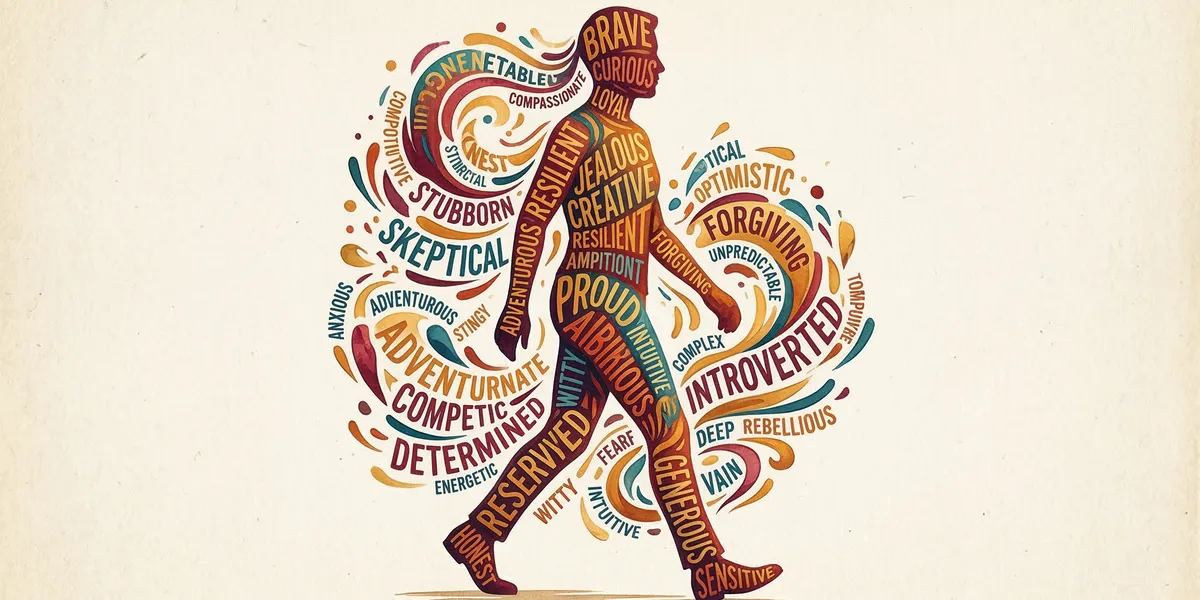
A complete character traits list is the fastest way to build fictional characters that feel real on the page. Below you’ll find 300+ traits organized by type — personality, physical, emotional, intellectual, social, moral, and more — each with a one-line description of how it shows up in behavior.
Bookmark this page. Come back whenever you’re building a new character for your novel, screenplay, or short story.
Positive Personality Traits
These are the traits readers admire. Give your protagonist a handful, but never make them a saint — pair these with flaws from the sections below.
| Trait | How It Shows Up |
|---|---|
| Ambitious | Sets goals others call impossible and works toward them without apology |
| Compassionate | Notices suffering others overlook and acts on it quietly |
| Curious | Asks the question nobody else in the room thinks to ask |
| Resilient | Gets knocked down repeatedly and finds a new angle each time |
| Witty | Diffuses tension with perfectly timed humor |
| Generous | Gives time, money, or energy without keeping score |
| Loyal | Stands by people even when it costs them something |
| Courageous | Acts despite fear, not in the absence of it |
| Patient | Waits for the right moment instead of forcing outcomes |
| Honest | Tells uncomfortable truths when lying would be easier |
| Optimistic | Looks for possibilities when everyone else sees dead ends |
| Resourceful | Solves problems with whatever’s at hand |
| Dependable | Shows up when they say they will, every time |
| Humble | Deflects praise and credits others |
| Perceptive | Reads body language and unspoken dynamics in a room |
| Adaptable | Adjusts to new environments without losing their identity |
| Empathetic | Feels what others feel and responds accordingly |
| Principled | Won’t bend their values under pressure |
| Charming | Makes people feel comfortable and valued within minutes |
| Disciplined | Follows through on commitments even when motivation fades |
| Forgiving | Releases grudges rather than letting them fester |
| Protective | Steps between danger and the people they love |
| Thoughtful | Remembers small details about people and acts on them |
| Adventurous | Chooses the unknown over the safe and familiar |
| Encouraging | Builds others up with specific, genuine praise |
| Creative | Sees connections and possibilities others miss |
| Determined | Refuses to quit when the goal still matters |
| Diplomatic | Navigates conflict without making enemies |
| Gracious | Accepts both victory and defeat with dignity |
| Nurturing | Creates safety for others to grow and make mistakes |
| Selfless | Puts others’ needs before their own, sometimes to a fault |
| Spirited | Brings energy and enthusiasm to everything they touch |
| Steadfast | Holds their ground when the world shifts around them |
| Warm | Makes strangers feel like they’ve known them for years |
| Tenacious | Grips a problem and won’t let go until it’s solved |
| Decisive | Makes choices quickly and stands behind them |
| Eloquent | Expresses ideas with clarity and precision |
| Idealistic | Believes the world can be better and acts accordingly |
| Magnanimous | Shows generosity toward a rival or defeated opponent |
| Open-minded | Considers perspectives that challenge their worldview |
| Playful | Finds lightness in serious situations |
| Sincere | Means what they say with no hidden agenda |
Negative Personality Traits
These are the traits that make characters interesting. A villain built entirely from this list feels flat — but a hero with two or three hidden here becomes unforgettable.
| Trait | How It Shows Up |
|---|---|
| Arrogant | Assumes they’re the smartest person in every room |
| Jealous | Compares themselves to others and resents what they see |
| Manipulative | Steers people toward outcomes that serve their own interests |
| Reckless | Acts without considering consequences for themselves or others |
| Vindictive | Keeps a mental ledger of wrongs and collects on every one |
| Cowardly | Avoids conflict and confrontation at any cost |
| Deceitful | Lies instinctively, even when the truth would serve them better |
| Greedy | Hoards resources, opportunities, and attention |
| Cruel | Takes satisfaction in others’ pain |
| Petty | Fixates on small slights that most people would forget |
| Spiteful | Does things specifically to hurt someone, even at their own expense |
| Vain | Obsesses over appearance and public perception |
| Dismissive | Writes off other people’s feelings, ideas, or concerns |
| Controlling | Needs to dictate how others behave and make choices |
| Dishonest | Fabricates stories to make themselves look better |
| Entitled | Believes they deserve special treatment without earning it |
| Hostile | Meets neutral interactions with aggression |
| Hypocritical | Holds others to standards they don’t follow themselves |
| Impatient | Demands results immediately and lashes out when they don’t come |
| Insensitive | Says hurtful things without recognizing the impact |
| Lazy | Avoids effort and expects others to pick up the slack |
| Melodramatic | Turns minor inconveniences into existential crises |
| Narcissistic | Centers every conversation, event, and situation around themselves |
| Obstinate | Refuses to change course even when proven wrong |
| Paranoid | Suspects hidden motives behind every friendly gesture |
| Possessive | Treats relationships as ownership rather than partnership |
| Resentful | Holds onto bitterness long after the event has passed |
| Sarcastic | Uses humor as a weapon to keep people at a distance |
| Self-pitying | Frames themselves as the victim in every narrative |
| Selfish | Considers their own needs first, second, and third |
| Shallow | Judges people entirely by surface-level qualities |
| Sneaky | Operates behind people’s backs rather than addressing things directly |
| Sulky | Withdraws into silence when things don’t go their way |
| Temperamental | Shifts moods unpredictably, keeping everyone on edge |
| Ungrateful | Takes favors and sacrifices for granted |
| Unreliable | Makes promises they have no intention of keeping |
| Volatile | Explodes at small triggers with disproportionate force |
| Wasteful | Burns through resources, goodwill, and second chances |
| Condescending | Talks down to people while pretending to be helpful |
| Apathetic | Feels nothing strongly enough to act on it |
| Judgmental | Forms rigid opinions about people based on limited information |
| Passive-aggressive | Expresses anger through indirect jabs and deliberate inaction |
Neutral and Complex Traits
These traits aren’t inherently good or bad. They become one or the other depending on context, motivation, and what’s at stake. Complex characters live here.
| Trait | How It Shows Up |
|---|---|
| Secretive | Keeps information close, revealing only what serves the moment |
| Stubborn | Refuses to budge — sometimes this saves them, sometimes it ruins them |
| Competitive | Turns everything into a contest, even when no one else is playing |
| Perfectionist | Holds work to impossibly high standards, delaying action |
| Quiet | Observes more than they speak, which others read as either wisdom or coldness |
| Intense | Approaches everything with a focus that others find either magnetic or exhausting |
| Independent | Handles things alone, even when asking for help would be smarter |
| Cautious | Weighs every risk, which keeps them safe but sometimes paralyzed |
| Blunt | Says exactly what they mean, regardless of social cost |
| Skeptical | Questions everything, including things that deserve trust |
| Reserved | Keeps emotions and opinions private until they decide someone has earned access |
| Ambitious | Drives toward success — the question is what they’ll sacrifice to get there |
| Calculating | Thinks three moves ahead, which can look like strategy or manipulation |
| Detached | Observes situations without emotional involvement |
| Eccentric | Operates by their own logic, which others find charming or baffling |
| Formal | Maintains propriety and distance in all interactions |
| Guarded | Protects themselves emotionally, sometimes at the cost of connection |
| Impulsive | Acts on instinct before thinking, which leads to breakthroughs and disasters equally |
| Meticulous | Pays extreme attention to detail, slowing everything down |
| Mysterious | Reveals little about themselves, creating fascination and suspicion |
| Obsessive | Fixates on a subject, person, or goal to the exclusion of everything else |
| Pragmatic | Prioritizes what works over what’s ideal |
| Relentless | Never stops pushing, even when rest would serve them better |
| Solitary | Prefers their own company, which can be strength or isolation |
| Traditional | Values established ways, resisting change even when it’s needed |
| Unpredictable | Keeps people guessing — allies and enemies alike |
| Restless | Can never sit still or stay in one place for long |
Physical Traits and Mannerisms
These are what readers see and hear. Physical traits and mannerisms make a character instantly recognizable on the page — they’re the difference between a name on a page and a person in the reader’s mind.
| Trait | How It Shows Up |
|---|---|
| Limps | Favors one leg, a constant reminder of a past injury or condition |
| Taps fingers | Drums on surfaces when thinking, impatient, or anxious |
| Talks fast | Words tumble out in a rush, especially when excited or nervous |
| Avoids eye contact | Looks away during conversation, suggesting shyness, dishonesty, or trauma |
| Speaks slowly | Chooses each word with deliberate care |
| Fidgets | Constantly shifting, adjusting clothing, or touching their face |
| Stands ramrod straight | Military posture that signals discipline or rigidity |
| Slouches | Curved shoulders that suggest defeat, laziness, or an attempt to take up less space |
| Bites nails | Gnaws at fingers under stress |
| Cracks knuckles | Pops joints habitually, often before doing something physical |
| Paces | Walks back and forth when processing information or making decisions |
| Whispers | Speaks so quietly that people lean in to hear them |
| Booming voice | Projects naturally, filling every room whether they intend to or not |
| Scarred | Carries visible marks from past violence, accidents, or surgery |
| Tattooed | Wears ink that tells a story about their past or beliefs |
| Nervous laugh | Fills uncomfortable silences with inappropriate laughter |
| Squints | Narrows eyes habitually, suggesting poor vision, suspicion, or concentration |
| Twirls hair | Wraps strands around fingers when distracted or flirting |
| Clenches jaw | Tightens their face when angry or stressed, visibly holding back words |
| Runs hands through hair | Rakes fingers through their hair when frustrated or thinking |
| Stares | Holds eye contact longer than comfortable, creating unease |
| Chews lip | Bites or worries their lower lip when anxious |
| Talks with hands | Gestures expansively while speaking |
| Stands with arms crossed | Default posture that signals defensiveness or self-protection |
| Scratches head | Reaches up when confused or working through a problem |
| Leans in | Closes physical distance during conversation, suggesting interest or intensity |
| Sighs audibly | Exhales dramatically to signal frustration or exhaustion |
| Sniffs constantly | Habitual sniffing from allergies, a tic, or a past habit |
| Walks on toes | Light, quiet footsteps that suggest stealth or nervous energy |
| Carries themselves heavily | Moves as though weighted down by invisible burdens |
| Smells like smoke | The scent of cigarettes or fire clings to clothing and hair |
| Always cold | Wraps up in layers, shivers in rooms others find comfortable |
| Clumsy | Bumps into furniture, drops things, trips over flat surfaces |
Emotional Traits
How a character processes and expresses emotion defines how readers connect with them. These traits shape every interaction, every decision, and every internal monologue.
| Trait | How It Shows Up |
|---|---|
| Quick-tempered | Anger arrives fast and hot, often before the situation warrants it |
| Stoic | Feels deeply but shows nothing on the surface |
| Anxious | Anticipates worst-case scenarios and struggles to quiet the noise |
| Empathetic | Absorbs other people’s emotions like a sponge |
| Melancholic | Carries a persistent sadness that colors how they see the world |
| Passionate | Throws themselves fully into whatever they care about |
| Numb | Has shut down emotional responses after sustained trauma |
| Volatile | Swings between emotional extremes with little warning |
| Sentimental | Attaches deep meaning to objects, places, and memories |
| Fearful | Lives with a baseline of dread that shapes every choice |
| Joyful | Finds genuine delight in small moments others overlook |
| Guarded | Keeps emotions locked down, releasing them only in private |
| Explosive | Bottles feelings until they detonate at the worst possible moment |
| Tender | Shows vulnerability and gentleness, even when it’s risky |
| Bitter | Views the world through a lens of past disappointments |
| Serene | Maintains calm even in chaos, sometimes unnervingly so |
| Nostalgic | Lives partly in the past, comparing everything to what was |
| Hopeful | Clings to the possibility of better outcomes despite evidence |
| Guilt-ridden | Carries responsibility for things they couldn’t have prevented |
| Emotionally unavailable | Present physically but absent in every way that matters |
| Easily hurt | Takes criticism, rejection, and indifference personally |
| Jealous | Feels threatened by others’ closeness to people they care about |
| Withdrawn | Retreats inward when overwhelmed rather than reaching out |
| Manic | Cycles through bursts of energy, euphoria, and crashing lows |
| Wistful | Yearns quietly for something lost or never had |
| Repressed | Has buried emotions so deeply they no longer recognize them |
Intellectual Traits
How a character thinks shapes how they solve problems, process information, and engage with the world around them. These traits determine what a character notices and what they miss entirely.
| Trait | How It Shows Up |
|---|---|
| Analytical | Breaks problems into components and examines each one systematically |
| Creative | Connects ideas from unrelated fields to generate original solutions |
| Absent-minded | Brilliant with abstract concepts but forgets where they left their keys |
| Street-smart | Reads situations and people with practical intelligence learned from experience |
| Book-smart | Commands encyclopedic knowledge but struggles with real-world application |
| Strategic | Thinks in long-term plans and contingencies |
| Intuitive | Arrives at correct conclusions through instinct rather than analysis |
| Methodical | Follows established processes step by step without deviation |
| Quick-witted | Processes new information and responds to it faster than anyone in the room |
| Slow but thorough | Takes time to reach conclusions but rarely makes errors |
| Philosophical | Questions the underlying meaning of events rather than accepting them at face value |
| Literal-minded | Takes statements at face value, missing sarcasm, metaphor, and subtext |
| Inventive | Builds new tools, systems, or solutions from scratch |
| Scattered | Juggles multiple trains of thought simultaneously, often losing all of them |
| Focused | Locks onto a single problem with laser precision, blocking out everything else |
| Overintellectualizes | Analyzes emotions and relationships like academic problems |
| Cunning | Uses intelligence to manipulate situations and people to their advantage |
| Naive | Lacks awareness of how systems, power, or deception operate |
| Wise | Applies accumulated experience and judgment to new situations |
| Autodidactic | Teaches themselves new skills and subjects with relentless drive |
Social Traits
How a character moves through social spaces — how they build alliances, handle conflict, and present themselves to the world — tells readers everything about their character development potential.
| Trait | How It Shows Up |
|---|---|
| Charismatic | Draws people in without apparent effort |
| Introverted | Recharges alone and finds crowds draining |
| Extroverted | Gains energy from social interaction and seeks it out constantly |
| Diplomatic | Navigates group dynamics and competing interests with skill |
| Confrontational | Addresses problems head-on, whether or not the timing is right |
| People-pleasing | Prioritizes others’ comfort over their own needs and opinions |
| Dominant | Takes charge in group settings, sometimes steamrolling quieter voices |
| Submissive | Defers to others’ wishes and avoids asserting their own |
| Gossipy | Trades in other people’s secrets and private information |
| Loyal | Sticks with their group through hardship and scandal |
| Flirtatious | Uses charm and attention as a social tool, sometimes as a weapon |
| Awkward | Misreads social cues and says the wrong thing at the wrong time |
| Magnetic | People want to be around them without fully understanding why |
| Aloof | Maintains distance in social settings, observing rather than participating |
| Generous | Shares resources, credit, and opportunities freely |
| Territorial | Guards their social position and relationships against perceived threats |
| Mediating | Steps in during conflicts to find common ground |
| Provocative | Says and does things designed to get a reaction |
| Trustworthy | Keeps confidences and follows through on promises |
| Cliquish | Bonds tightly with a small group and excludes outsiders |
| Gregarious | Treats strangers like old friends within minutes of meeting |
| Withdrawn | Pulls back from social situations, especially under stress |
Moral and Ethical Traits
A character’s moral framework drives their biggest decisions. These traits determine what lines they’ll cross, what they’ll sacrifice, and what principles they’ll die defending.
| Trait | How It Shows Up |
|---|---|
| Honorable | Follows a personal code even when breaking it would be easier and safer |
| Pragmatic | Does what works, even if it means bending moral rules |
| Ruthless | Eliminates obstacles without hesitation or remorse |
| Self-sacrificing | Puts others’ survival and wellbeing above their own |
| Just | Believes in fairness and works to enforce it, sometimes rigidly |
| Merciful | Grants grace to people who don’t deserve it |
| Corrupt | Uses their position for personal gain at others’ expense |
| Virtuous | Lives according to a strict moral code in all circumstances |
| Amoral | Operates without a moral framework — not evil, just unconcerned with right and wrong |
| Righteous | Believes their moral position is the only correct one |
| Forgiving | Grants second chances, sometimes to people who’ll waste them |
| Vengeful | Pursues payback as a moral imperative |
| Utilitarian | Calculates the greatest good for the greatest number, even at individual cost |
| Loyal to a fault | Stands by their people even when those people are wrong |
| Duplicitous | Presents one moral face publicly while acting differently in private |
| Principled | Won’t compromise their beliefs regardless of consequences |
| Opportunistic | Adjusts their ethics based on what benefits them in the moment |
| Conscience-driven | Haunted by past moral failures and determined not to repeat them |
| Protective | Uses force or deception to shield the innocent |
| Duty-bound | Fulfills obligations to institutions, family, or oaths above personal desire |
| Rebellious | Rejects imposed moral systems and defines their own |
| Compassionate | Extends kindness even to enemies and strangers |
Traits by Archetype
Archetypes give you a starting framework. The list below maps common character arc archetypes to the traits that define them — and the traits that make them more than a template.
The Mentor
| Trait | Role in the Archetype |
|---|---|
| Wise | Guides others through experience, not just instruction |
| Patient | Waits for the student to be ready |
| Secretive | Withholds crucial information until the right moment |
| Haunted | Carries failures from their own past that shape how they teach |
| Sacrificial | Willing to step aside or die so the hero can grow |
The Rebel
| Trait | Role in the Archetype |
|---|---|
| Defiant | Rejects authority on principle, sometimes without thinking |
| Charismatic | Draws followers through conviction and daring |
| Reckless | Prioritizes the cause over personal safety |
| Passionate | Burns with belief in a better world or system |
| Isolated | The cost of standing against the current separates them from others |
The Caregiver
| Trait | Role in the Archetype |
|---|---|
| Nurturing | Creates safety and comfort for those around them |
| Self-sacrificing | Puts others first so consistently it becomes self-destructive |
| Anxious | Worries constantly about the people in their care |
| Fierce | Becomes dangerous when their loved ones are threatened |
| Enabling | Sometimes protects people from consequences they need to face |
The Trickster
| Trait | Role in the Archetype |
|---|---|
| Cunning | Outsmarts opponents rather than overpowering them |
| Humorous | Uses wit to disarm, distract, and deflect |
| Unreliable | Allies never quite know which side they’re on |
| Perceptive | Sees the cracks in every system and every person |
| Lonely | The mask they wear keeps everyone at arm’s length |
The Innocent
| Trait | Role in the Archetype |
|---|---|
| Trusting | Takes people at their word, which makes them vulnerable |
| Hopeful | Believes in good outcomes even when evidence suggests otherwise |
| Naive | Lacks understanding of the world’s darker mechanics |
| Pure-hearted | Their goodness inspires others and shames villains |
| Resilient | Maintains their worldview even after encountering cruelty |
The Ruler
| Trait | Role in the Archetype |
|---|---|
| Commanding | Expects obedience and usually gets it |
| Strategic | Plans for power maintenance as carefully as acquisition |
| Isolated | The crown separates them from genuine human connection |
| Paranoid | Suspects betrayal from every direction |
| Burdened | Carries the weight of decisions that affect many lives |
Flaws That Make Characters Interesting
Flaws are the engine of fiction. A character without meaningful flaws has nowhere to grow, nothing to overcome, and no reason for readers to worry about them. The best flaws create internal conflict that mirrors the external plot.
| Flaw | Why It Works in Fiction |
|---|---|
| Hubris | They believe they can’t fail — until the world proves them spectacularly wrong |
| Naivety | Their trust becomes a vulnerability that the plot exploits |
| Self-destructive | They sabotage their own success, relationships, or safety |
| People-pleasing | They lose themselves trying to make everyone else happy |
| Avoidant | They dodge problems until those problems become catastrophic |
| Perfectionist | They can’t act until everything is ideal, so they never act in time |
| Martyr complex | They suffer unnecessarily and resent others for not noticing |
| Trust issues | They push away the people who could help them most |
| Imposter syndrome | They believe they don’t deserve their position, success, or love |
| Addiction | A dependency that controls their decisions and relationships |
| Denial | They refuse to see what’s obvious to everyone around them |
| Savior complex | They need to rescue others, whether or not those people want saving |
| Emotional suppression | They bottle everything up until it breaks something important |
| Jealousy | They can’t celebrate others’ success without comparing it to their own |
| Control obsession | They micromanage everything because uncertainty terrifies them |
| Inability to forgive | They hold grudges that poison every current relationship |
| Chronic dishonesty | They lie so often they’ve lost track of what’s true |
| Cowardice at crucial moments | They freeze or flee exactly when courage matters most |
| Blind loyalty | They follow a person or cause past the point of reason |
| Self-isolation | They build walls so high that no one can reach them |
| Overconfidence | They underestimate every threat and overestimate every ability |
| Catastrophizing | They assume the worst outcome is the only possible outcome |
| Emotional dependency | They collapse without the validation of one specific person |
| Grudge-holding | They keep a running tally of every slight, real or imagined |
| Reckless generosity | They give away what they can’t afford — money, time, emotional energy |
How to Choose Traits for Your Character
Having 300+ options doesn’t help if you can’t narrow them down. Here’s a practical framework for choosing traits that work together to build a compelling character.
Pick 3-5 core traits. Any more than that and the character becomes diffuse. Readers should be able to describe your character’s personality in a sentence. “She’s fiercely loyal, brutally honest, and terrified of failure” gives you someone you can write.
Make sure at least one is a flaw. A character who is brave, intelligent, kind, and resourceful is boring. A character who is brave, intelligent, kind, and incapable of asking for help has a story. The flaw is where the plot applies pressure.
Let traits create internal conflict. The most interesting characters contain contradictions. A compassionate soldier. A loyal spy. An honest politician. When two traits pull a character in opposite directions, you have built-in tension that drives scenes without needing external action.
Match traits to your plot’s demands. If your story requires a character to make a morally questionable decision in act three, plant the traits that make that decision believable in act one. A pragmatic character will make a different hard choice than a principled one — and the reader needs to see both traits operating before the moment arrives.
Let traits evolve across your character arc. A character who starts reckless and ends cautious has changed in a visible way. A character who starts guarded and ends vulnerable has grown. Traits aren’t static — they shift under pressure, and tracking those shifts is what gives your story emotional weight.
If you want to go deeper on building multi-dimensional characters, check out our guide to character development or try the AI character generator to see how these traits combine in practice.
Ready to build characters with these traits and turn them into a complete novel? Chapter’s fiction writing software lets you define character profiles with traits, backstories, and relationships — then generates full manuscripts where those characters stay consistent from the first page to the last.