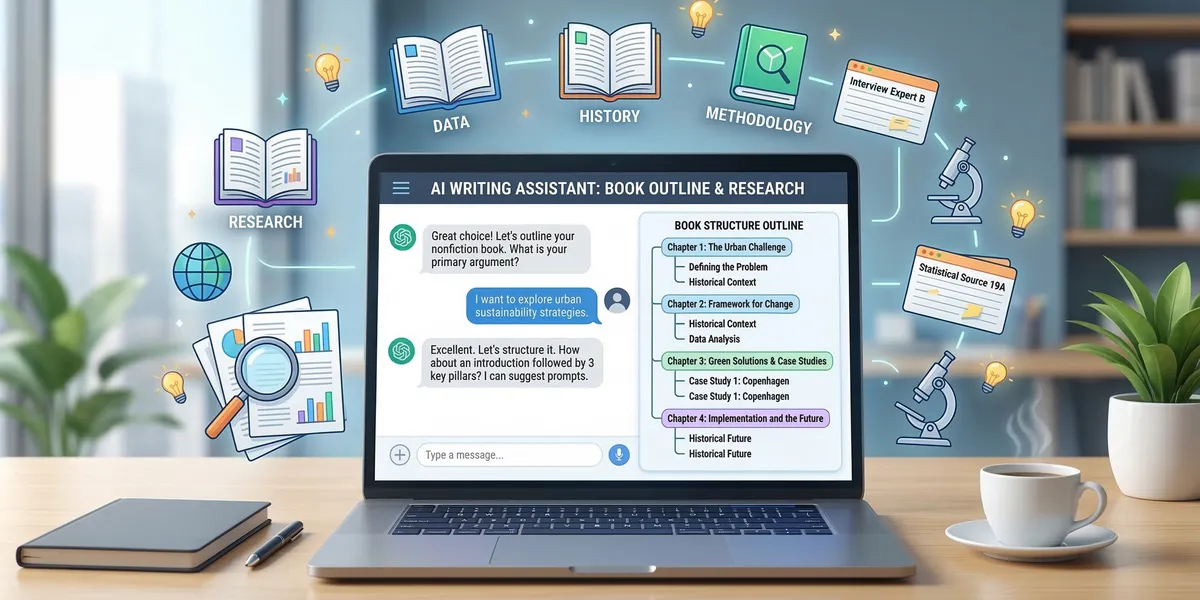
Writing a nonfiction book with ChatGPT requires different prompts than fiction. You need templates for research synthesis, argument structure, case study development, and authority building, not character arcs and plot twists.
These 50+ prompts are organized by the nonfiction writing workflow: from research through marketing copy. Each is a fill-in-the-blank template. Paste it into ChatGPT, replace the bracketed sections with your specifics, and get output that actually moves your book forward.
Topic research prompts (8)
Start with research prompts that help you explore and refine your subject before writing.
1. Topic viability analyzer
I want to write a nonfiction book about [topic] for [target audience]. Analyze the viability: What are the 5 biggest questions this audience has about this topic? What existing books cover this? What angle is underserved? What expertise would make a book on this credible?
2. Audience pain point mapper
My target reader is [detailed audience description]. Map their pain points related to [topic] across 4 levels: surface-level frustrations, underlying challenges, emotional impacts, and aspirational desires they are not articulating. Give me 5 items per level.
3. Competitive gap finder
The top 5 books on [topic] are: [list titles]. For each, describe in 2 sentences what it covers well and what it misses. Then identify 3 gaps that no existing book addresses adequately.
4. Expert interview question generator
I’m interviewing [type of expert] about [topic] for my book. Generate 15 questions that go beyond surface-level answers. Include questions that challenge common assumptions, ask for specific examples, and draw out stories rather than just facts.
5. Counterargument explorer
My book argues that [thesis]. Play devil’s advocate and present the 5 strongest counterarguments to this position. For each, explain who holds this view, why it’s compelling, and how I might address it without dismissing it.
6. Data pattern finder
Here is raw data/research I’ve collected on [topic]: [paste data or key findings]. Identify patterns, contradictions, and surprising connections. Organize findings into 3-5 thematic categories that could become chapters.
7. Case study researcher
I need case studies that demonstrate [principle/argument]. Suggest 10 real-world examples from [industry/field] that illustrate this concept. For each, provide the key details I should research further and explain what makes it a compelling case study.
8. Terminology clarifier
I’m writing about [technical topic] for [non-expert audience]. Here are 15 terms I need to use: [list terms]. For each, give me a plain-language definition, a concrete analogy, and guidance on whether to introduce the term or use the simpler alternative throughout the book.
Outlining prompts (8)
Structure your book before you draft. A solid outline prevents the “messy middle” that kills nonfiction projects.
9. Book structure architect
My book is about [topic] for [audience]. The core argument is [thesis]. Design a book structure with [8-12] chapters. For each chapter, provide a title, a one-sentence thesis, the key question it answers, and how it builds on the previous chapter.
10. Chapter deep-dive outliner
Chapter [number] of my book covers [topic]. The chapter’s goal is to convince the reader that [argument]. Create a detailed outline with: opening hook, 4-6 main sections with subpoints, placement of 2 case studies, a key takeaway, and a transition to the next chapter.
11. Introduction builder
My book [title] argues that [thesis] for [audience]. Draft an outline for the introduction that includes: a compelling opening anecdote or statistic, the problem the reader faces, why existing solutions fail, what this book offers differently, a brief chapter preview, and a promise of what the reader will be able to do after reading.
12. Framework creator
I’m creating a [3-5-7]-step framework for [achieving outcome]. Help me: name the framework something memorable, define each step with a clear action, ensure the steps follow a logical sequence, identify potential objections at each step, and create an acronym or mnemonic if one works naturally.
13. Progressive disclosure planner
My book teaches [complex topic]. Design a learning progression across [number] chapters that takes the reader from complete beginner to practitioner. Each chapter should build one concept on top of the previous, with a clear “you can now do X” milestone at each stage.
14. Story-argument interleaver
My chapter covers [argument/lesson]. I have these stories and examples available: [list stories]. Design the chapter structure so that stories and arguments alternate naturally, each story illustrates a specific point, and the chapter builds to a conclusion that feels earned rather than stated.
15. Section transition writer
Here are my chapter topics in order: [list chapters]. Write the transition paragraph that would end each chapter and lead into the next. Each transition should summarize the key insight, create anticipation for what comes next, and maintain forward momentum.
16. Conclusion architect
My book [title] has covered [list key topics across chapters]. Design a conclusion that: synthesizes the core argument without repeating the book, provides a clear action plan the reader can start today, addresses the “what could go wrong” fears, and ends with a forward-looking vision of what the reader’s life looks like after implementing the book’s advice.
Chapter drafting prompts (8)
Turn your outline into prose that sounds like you, not like a textbook.
17. Opening hook generator
My chapter is about [topic]. Generate 5 opening hooks: one with a surprising statistic, one with a brief story, one with a provocative question, one with a bold statement, and one with a “picture this” scenario. Each should be 50-100 words and immediately establish why this chapter matters.
18. Complex concept explainer
Explain [complex concept] at three levels: 1) The 10-second cocktail party explanation, 2) The 2-minute explanation with one concrete example, 3) The full explanation with nuances, caveats, and common misconceptions. I need all three for different points in my book.
19. Argument builder
I need to argue that [claim]. Build the argument in this structure: state the claim, provide 3 pieces of supporting evidence (data, expert opinion, case study), address the strongest counterargument, and restate the claim as a conclusion. Aim for 500 words.
20. Analogy generator
I need to explain [concept] to [audience]. Generate 5 analogies comparing this concept to everyday experiences my audience would relate to. Rank them from simplest to most nuanced. Avoid cliches and overused comparisons.
21. Authority section writer
Write a section establishing my credibility on [topic]. My background: [credentials, experience, results]. The tone should be confident without being boastful — demonstrate expertise through specifics, not self-congratulation. Aim for 200 words.
22. Data storyteller
Here is a set of data points: [paste data]. Write a 300-word narrative that turns these numbers into a story. Lead with the most surprising finding, provide context that makes the numbers meaningful, and end with the implication for the reader.
23. Principle-to-practice converter
I’ve explained the theory of [concept]. Now write the practical application section: give the reader a step-by-step process for implementing this concept. Include common mistakes to avoid, what “good” looks like vs. “great,” and a quick self-assessment they can do.
24. Chapter summary writer
Here is my drafted chapter: [paste chapter or detailed summary]. Write a “Key Takeaways” section with 5-7 bullet points that capture the essential lessons. Each bullet should be actionable and self-contained, so a reader who only reads the summary gets real value.
Case study prompts (5)
Case studies are the backbone of persuasive nonfiction. These prompts help you structure them.
25. Case study structure template
Write a case study about [subject/company/person] demonstrating [principle]. Structure: Situation (the problem they faced), Approach (what they did differently), Results (specific outcomes with numbers), and Lesson (what the reader should take from this). Aim for 400 words.
26. Before-and-after narrative
My reader is currently [current state]. My book helps them reach [desired state]. Write a before-and-after narrative that makes this transformation concrete. Include specific daily experiences, emotional states, and measurable outcomes for both the “before” and “after.”
27. Multiple perspective case study
The situation is [describe scenario]. Write this case study from 3 perspectives: the decision-maker, the person affected by the decision, and an outside observer. Each perspective should be 200 words and reveal different aspects of the lesson.
28. Failure case study
Write a case study about a failure in [field/industry] related to [topic]. Structure: What happened, why it happened, what they missed, and what the reader can learn from it. Failure case studies are often more instructive than success stories — emphasize the lesson, not the blame.
29. Composite case study creator
I have these real examples: [list 3-4 brief examples]. Combine them into one composite case study that illustrates [principle] while drawing on the strongest elements of each real example. Note: I’ll include a disclaimer that this is a composite.
Introduction and hook prompts (5)
First impressions determine whether a reader keeps going or puts your book down.
30. Problem agitator
My reader is [description] struggling with [problem]. Write a 200-word passage that validates their frustration, demonstrates that I understand the problem deeply, and hints that a solution exists without revealing it yet. No generic sympathy — use specific, recognizable details.
31. Surprising statistic opener
My book is about [topic]. Here are statistics I’ve found: [list stats]. Write an opening paragraph that leads with the most surprising statistic and uses it to challenge the reader’s existing assumptions. The stat should make them think “wait, really?”
32. “What if” future vision
My book helps [audience] achieve [outcome]. Write a “what if” opening that paints a vivid picture of their life after implementing the book’s advice. Be specific: what does their Tuesday morning look like? What conversations are they having? What problems have disappeared?
33. Myth buster opener
The biggest myth about [topic] is [myth]. Write an opening that states this myth as if it were true, then systematically dismantles it with evidence. The tone should be confident and slightly provocative without being condescending.
34. Story-to-principle bridge
Here is an anecdote: [your story]. Write the transition from this story to the broader principle it illustrates: [principle]. The bridge should feel natural, not forced — the reader should arrive at the principle feeling like they discovered it rather than being told.
CTA and persuasion prompts (5)
For books that drive business results, these prompts help with calls-to-action and persuasive sections.
35. End-of-chapter CTA
My chapter on [topic] leads to this next step for the reader: [action]. Write a 100-word call-to-action that motivates without being pushy. Connect the action to a specific benefit they just learned about in the chapter. Include a low-friction first step.
36. Resource recommendation section
Write a “Recommended Resources” section for my chapter on [topic]. Include [number] items across categories: books for deeper reading, tools for implementation, communities for support, and one “start here” action item. For each, write a 1-sentence description of why it’s valuable.
37. Objection handler
My book recommends [approach/solution]. The reader’s likely objections are: [list 3-5 objections]. For each objection, write a 50-100 word response that acknowledges the concern, reframes it, and provides evidence or reasoning that resolves it.
38. Urgency without hype
I need to communicate that [action/change] is time-sensitive for my reader. Write 200 words that create genuine urgency based on opportunity cost, competitive advantage, or real trends — not fake scarcity or fear tactics. Use data where possible.
39. Social proof compiler
Here are results from people who have followed this approach: [list testimonials or results]. Weave these into a narrative section that demonstrates a pattern of success across different types of people. Don’t just list them — tell a story about what they have in common.
Editing prompts (5)
These prompts help you refine your draft into a polished manuscript.
40. Jargon filter
Review this chapter: [paste chapter]. Identify every instance of jargon, technical language, or assumed knowledge that a [describe target reader] might not understand. For each instance, suggest a plain-language alternative or a brief clarifying phrase.
41. Structure audit
Here is my chapter: [paste chapter]. Evaluate the structure: Does each section have a clear purpose? Is there a logical flow from one idea to the next? Where does the argument lose momentum? What could be cut without losing the core message?
42. Voice consistency checker
Here are excerpts from 3 different chapters of my book: [paste excerpts]. Analyze the voice for consistency. Flag shifts in formality, tone, sentence structure patterns, or vocabulary that would feel jarring to a reader going through the book sequentially.
43. Redundancy eliminator
I suspect my manuscript repeats itself. Here is [chapter/section]: [paste text]. Identify any ideas, phrases, or arguments that appear more than once. Suggest which instance to keep and which to cut, and flag any “echo” phrases that use different words to say the same thing.
44. Readability optimizer
This section reads too dense: [paste section]. Rewrite it for clarity and readability without dumbing it down. Break long sentences, replace passive voice with active, add paragraph breaks, and ensure each paragraph focuses on one idea. Maintain my authoritative tone.
Marketing copy prompts (6)
Your book needs to sell. These prompts generate marketing materials from your manuscript.
45. Book description writer
My book [title] is about [topic] for [audience]. Key benefits: [3-5 outcomes for the reader]. Write a book description for Amazon/retailers in 200 words. Lead with the reader’s problem, present the book as the solution, include social proof if available, and end with a CTA. No hype words.
46. One-liner pitch generator
My book [title] helps [audience] achieve [outcome] by [method]. Generate 10 one-line descriptions I can use for social media, email signatures, and podcast introductions. Each should be under 15 words and communicate the core value proposition.
47. Email launch sequence
I’m launching my book [title] about [topic] to my email list of [audience description]. Write a 5-email launch sequence: teaser (1 week before), value preview (3 days before), launch day, social proof follow-up (2 days after), and last chance (1 week after). Each email should be 150-200 words.
48. Social media content extractor
Here is a chapter from my book: [paste chapter]. Extract 10 standalone insights that work as social media posts. Each should be self-contained, valuable without context, and make people want to read the full chapter. Format each as a short paragraph post.
49. Podcast pitch writer
I’m the author of [title], a book about [topic]. Write a podcast pitch email I can send to hosts of shows about [related topics]. Include: why their audience would care, 3 talking points I can cover, a brief bio, and a specific episode angle that is not just “let me talk about my book.”
50. Reader persona developer
My nonfiction book is about [topic]. Create 3 detailed reader personas who would buy this book. For each: demographics, current frustrations, what they’ve already tried, what would make them grab this book off a shelf, and the specific result that would make them recommend it to a friend.
Bonus: specialized nonfiction prompts
51. How-to process validator
Here is the process I’m teaching: [list steps]. Stress-test it: What assumptions does each step make about the reader’s resources, skills, or access? Where might someone get stuck? What shortcuts do experts take that beginners wouldn’t know about? Add clarifying details for each gap.
52. Thought leadership differentiator
In the [field/industry], the conventional wisdom is [common advice]. My counter-argument is [your position]. Write a 500-word section that positions my view as the informed alternative: acknowledge why the conventional wisdom exists, explain what it gets wrong, present my evidence, and make the case for a better approach.
53. Glossary and definitions builder
My book uses these [20] terms frequently: [list terms]. Create a glossary section with: a concise definition for each, an example of each in context, and a note on any terms that are commonly confused with each other.
Getting more from these prompts
Three practices separate writers who get mediocre ChatGPT output from those who get useful material:
Paste your existing work. Every prompt works better when you give ChatGPT your outline, your draft, or your research notes. Context is the difference between generic output and output that fits your specific book.
Iterate in the same conversation. After the first output, respond with what is wrong. “This is too formal for my audience” or “Add more concrete examples from the SaaS industry” refines the output significantly. The best results come from the third or fourth iteration.
Treat output as raw material. ChatGPT drafts are first drafts. The prompts above generate structure and ideas; you provide the expertise, the stories, and the voice that make a nonfiction book worth reading.
When prompts are not enough
These prompts handle individual writing tasks. They do not produce a cohesive book.
If you want a complete, structured nonfiction manuscript — outlined, chaptered, and generated as a unified whole — Chapter is built for that. The platform interviews you about your expertise, builds a structure around your knowledge, and generates an 80-250 page manuscript that follows proven nonfiction frameworks.
Over 2,147 authors have used Chapter to create 5,000+ books. Jim T. turned his consulting expertise into an authority book in 3 days — then landed a $13,200 client from a single reader. Adam W. saved $25,000 compared to hiring a ghostwriter. Linda R., who describes herself as “58 and not techy,” went from zero to published author.
The difference between prompt-by-prompt drafting and using Chapter is the difference between assembling ingredients and using a recipe. Both can produce a meal. One is dramatically faster and more consistent.
FAQ
Can I use ChatGPT to write my entire nonfiction book?
You can, but prompt-by-prompt generation produces inconsistent quality and voice across chapters. Each conversation starts fresh, so ChatGPT loses context about your book’s structure, tone, and earlier arguments. For complete manuscripts, a purpose-built tool like Chapter or a detailed outline with careful chapter-by-chapter prompting works better. See our full guide on how to use ChatGPT to write a book.
Which ChatGPT model is best for nonfiction writing?
GPT-4 and GPT-4o produce noticeably better nonfiction output than GPT-3.5 — better reasoning, fewer hallucinations, and stronger structure. For research tasks, consider Perplexity or Claude alongside ChatGPT, as they handle source attribution differently.
How do I maintain my voice when using AI prompts?
Start every session by pasting 500-1000 words of your own writing and instructing ChatGPT to match that voice. Be specific about tone markers: “conversational but authoritative,” “short sentences, no jargon,” or “academic rigor with accessible language.” Review all output for voice consistency before incorporating it.
Should I disclose that I used AI in my nonfiction book?
Amazon KDP requires disclosure for content that is substantially AI-generated. Most nonfiction authors using AI as a research and drafting tool do not need to disclose, similar to using a ghostwriter or research assistant. The ethical standard is whether you can verify and stand behind every claim in the book. See our guide on using AI to write a book for more on the disclosure question.
How do I fact-check AI-generated nonfiction content?
Every claim, statistic, and quote generated by AI must be independently verified. AI confidently produces incorrect information. Verify statistics against original sources, check that cited studies actually exist, and run key claims past subject matter experts. This is non-negotiable for nonfiction. Our guide on how to write a book covers the full quality assurance process.