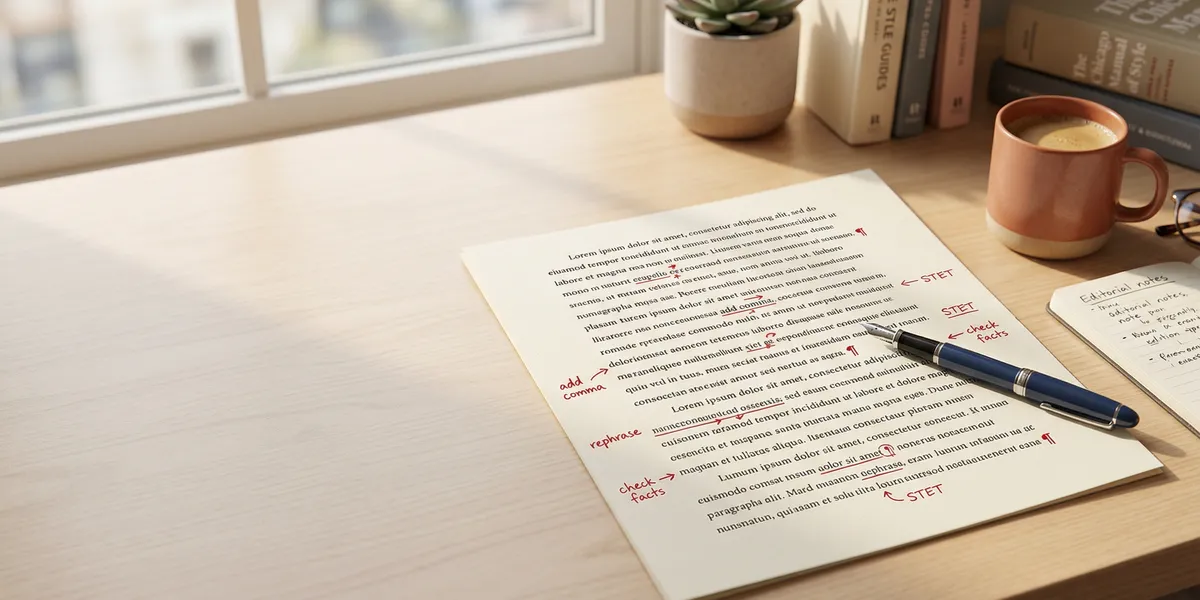
Copy editing is the process of reviewing your manuscript for grammar, spelling, punctuation, and consistency errors before publication. It sits between developmental editing (big-picture structure) and proofreading (final typo catch) — and skipping it is the fastest way to undermine an otherwise good book.
In this guide, you’ll learn:
- What copy editors actually fix (and what they don’t)
- The difference between copy editing, line editing, and proofreading
- How to copy edit your own work using a three-pass system
- What professional copy editing costs in 2026
Here’s everything you need to know.
What Is Copy Editing?
Copy editing is the stage of editing where a trained editor corrects mechanical errors in your manuscript — grammar, spelling, punctuation, capitalization, and internal consistency. A copy editor ensures your book reads cleanly, follows a consistent style, and doesn’t confuse or distract your reader with avoidable mistakes.
Think of it this way: a developmental editor asks “does this chapter belong here?” A copy editor asks “is this character’s name spelled the same way on page 12 and page 247?”
Copy editing doesn’t rewrite your prose or restructure your argument. It polishes what’s already there so nothing mechanical gets between your words and your reader.
What Does a Copy Editor Fix?
A professional copy editor works through your manuscript looking for specific categories of errors. Here’s what falls under their scope:
Grammar and syntax:
- Subject-verb agreement
- Dangling modifiers
- Incorrect pronoun references
- Tense inconsistencies
Punctuation and mechanics:
- Comma usage (including the Oxford comma, if your style guide requires it)
- Hyphenation and em dashes
- Quotation mark placement
- Apostrophe errors
Spelling and word usage:
- Commonly confused words (affect/effect, lie/lay, further/farther)
- Proper nouns and place names
- Specialized terminology
Consistency:
- Character name spellings throughout the manuscript
- Timeline accuracy (a character can’t be 30 in chapter 2 and 28 in chapter 8)
- Formatting of numbers, dates, and measurements
- Capitalization rules applied uniformly
Style guide adherence:
- Chicago Manual of Style (most common for books)
- AP Style (journalism and some nonfiction)
- Publisher-specific house style rules
A copy editor does not typically restructure chapters, rewrite weak sections, or evaluate whether your plot works. That’s the domain of developmental and line editing.
Copy Editing vs Line Editing vs Proofreading
These three terms get confused constantly. Here’s how they differ:
| Type | Focus | When It Happens | What Changes |
|---|---|---|---|
| Line editing | Sentence-level style and flow | After developmental edits | Word choice, rhythm, clarity, voice |
| Copy editing | Mechanical correctness and consistency | After line editing | Grammar, spelling, punctuation, style |
| Proofreading | Final error catch | After layout/formatting | Typos, formatting issues, missed errors |
Line editing improves how you say something. Your line editor might flag a clunky sentence and suggest a more elegant phrasing, tighten wordy passages, or note where your voice drops out.
Copy editing corrects what’s wrong mechanically. Your copy editor fixes the grammar error, standardizes your em dash usage, and catches that you switched from “grey” to “gray” halfway through chapter 4.
Proofreading is the final safety net. Your proofreader reads the formatted, laid-out version and catches any remaining typos, formatting glitches, or errors introduced during typesetting.
You need all three for a professional book. Skipping copy editing and jumping straight from line edits to proofreading leaves systematic errors in your manuscript that a proofreader isn’t equipped to fix.
How to Copy Edit Your Own Book (Three-Pass System)
Professional copy editors use multiple passes rather than trying to catch everything in a single read. You can apply the same approach to your own manuscript using this three-pass system.
Pass 1: The Style Sheet Pass
Before you fix a single error, create a style sheet — a document that records every stylistic decision in your manuscript. This is the technique professional editors use that most self-editing guides skip entirely.
Your style sheet tracks:
- Character name spellings and nicknames
- Place names and their formatting
- Hyphenation decisions (is it “decision-making” or “decision making”?)
- Number formatting (spell out under ten? Under one hundred?)
- Specialized terms unique to your book
- Your chosen style guide (Chicago, AP, or custom)
Read through your manuscript once, noting every decision on the style sheet. Don’t fix errors yet — just record what you find. This pass gives you a reference document that makes the next two passes faster and more consistent.
Pass 2: The Mechanical Pass
Now work through the manuscript correcting errors against your style sheet. Focus on one category at a time:
- Grammar first. Read specifically for subject-verb agreement, tense consistency, and pronoun clarity.
- Punctuation second. Check every comma, period, dash, and quotation mark.
- Spelling third. Run spell-check, then manually verify proper nouns, character names, and specialized terms.
Reading your manuscript aloud during this pass catches errors your eyes skip over. Your brain autocorrects on screen, but your mouth stumbles on awkward constructions.
Pass 3: The Consistency Pass
Your final pass focuses exclusively on internal consistency:
- Search for each character name and verify spelling matches your style sheet
- Check timeline references (dates, ages, seasons) against each other
- Verify facts you’ve cited (statistics, quotes, historical dates)
- Confirm formatting is uniform (heading styles, list formatting, block quote treatment)
Use your word processor’s Find function liberally during this pass. Search for common error patterns: double spaces, straight quotes that should be curly, inconsistent capitalization of terms you’ve defined on your style sheet.
Tools That Help With DIY Copy Editing
Several tools can supplement your manual passes:
- Grammarly or ProWritingAid — Catches grammar and style errors you’ll miss on your own
- Hemingway Editor — Flags overly complex sentences and passive voice
- PerfectIt — Specifically designed for consistency checking in long documents
- Read-aloud function — Built into most word processors; forces you to hear every word
No tool replaces a human copy editor for a book-length manuscript. But these tools catch the low-hanging errors so you can focus your attention on the subtler problems.
How Much Does Copy Editing Cost in 2026?
Professional copy editing rates vary based on genre, manuscript complexity, and editor experience. Here are the current industry ranges:
| Manuscript Type | Per-Word Rate | 70,000-Word Book |
|---|---|---|
| Adult fiction | $0.022–$0.026 | $1,540–$1,820 |
| Adult nonfiction | $0.027–$0.031 | $1,890–$2,170 |
| Academic/technical | $0.03–$0.05 | $2,100–$3,500 |
| Children’s/YA | $0.02–$0.03 | $1,400–$2,100 |
Rates based on 2026 data from the Editorial Freelancers Association and Reedsy marketplace surveys.
Several factors push rates higher:
- Heavy manuscript — A first draft with extensive errors costs more than a clean fourth draft
- Rush turnaround — Standard is 2–4 weeks; rush fees add 25–50%
- Specialized subject matter — Technical, legal, or medical content requires domain expertise
- Author platform — Some editors charge more for manuscripts destined for major distribution
If you’re budgeting for a self-published book, plan for copy editing to cost $1,500–$2,500 for a standard-length manuscript. It’s one of the best investments you can make — readers notice sloppy editing, and Amazon reviews regularly call out grammar errors as a reason for low ratings.
How to Find a Good Copy Editor
Not every copy editor is the right fit for your book. Here’s how to find and evaluate candidates:
Where to look:
- Reedsy — Curated marketplace with editor profiles, reviews, and sample edits
- Editorial Freelancers Association — Professional directory searchable by specialty
- Writing community referrals — Ask in genre-specific Facebook groups or writing forums
- Publisher acknowledgments — Check the acknowledgment pages of books in your genre
What to evaluate:
- Sample edit — Most editors offer a free sample edit of 1,000–2,000 words. This is non-negotiable. If an editor won’t provide one, move on.
- Genre experience — A copy editor who specializes in romance will catch different issues than one who works in academic nonfiction
- Style guide familiarity — Confirm they work with your preferred style guide (Chicago Manual of Style for most books)
- Communication style — You’ll be working closely together. Make sure their feedback style works for you.
- Turnaround time — Standard is 2–4 weeks for a full manuscript. Build this into your publishing timeline.
Red flags:
- No sample edit offered
- Rates significantly below market (you get what you pay for)
- No references or portfolio
- Promises to “rewrite” your book (that’s not copy editing)
When to Use AI for Copy Editing
AI tools have changed what’s possible for self-editing, but they haven’t replaced human copy editors — they’ve added a useful first layer.
Here’s where AI copy editing tools work well:
- Grammar and spelling — Tools like Grammarly catch most mechanical errors reliably
- Consistency flags — Some tools identify when you’ve used different spellings of the same term
- Style suggestions — AI can flag passive voice, wordiness, and readability issues
Here’s where they fall short:
- Context-dependent decisions — AI can’t tell that your character’s dialect errors are intentional
- Book-level consistency — Most AI tools process text in chunks, missing timeline errors across 300 pages
- Style guide nuance — The difference between AP and Chicago comma rules in edge cases still trips AI up
- Voice preservation — AI style suggestions can homogenize your writing voice if you accept them blindly
The smartest approach: run your manuscript through an AI tool first, accept the obvious corrections, then send the cleaner manuscript to a human copy editor. You’ll save money (editors charge less for clean manuscripts) and get a better result.
If you’re writing your book with AI assistance, copy editing becomes even more critical. AI-generated text often has subtle consistency errors — switching between British and American spelling, inconsistent terminology, or factual claims that need verification.
Copy Editing Checklist for Authors
Before you send your manuscript to a copy editor (or start your own DIY passes), run through this pre-editing checklist:
- Spell-check completed (catches the easy stuff)
- Find-and-replace for your known bad habits (overused words, double spaces)
- Character name list verified against manuscript
- Timeline/chronology reviewed
- All chapters present and in order
- Headers and formatting consistent
- Track Changes turned on (if sending to an editor)
- Style guide chosen and noted for your editor
- Front and back matter included (title page, copyright, dedication, etc.)
Sending a clean manuscript to your copy editor means they spend more time on the subtle errors and less time on problems you could have fixed yourself.
Common Copy Editing Mistakes to Avoid
Whether you’re editing your own work or reviewing a copy editor’s suggestions, watch for these pitfalls:
- Overcorrecting voice — Copy editing fixes errors, not style. If your narrator uses sentence fragments intentionally, don’t “fix” them into complete sentences.
- Inconsistent application — If you decide to use the Oxford comma, use it everywhere. Half-committed style decisions create more problems than they solve.
- Skipping the style sheet — Editing without a style sheet means you’re relying on memory for hundreds of micro-decisions across 70,000+ words. You will be inconsistent.
- Editing in one pass — The three-pass system exists because your brain can’t catch grammar, spelling, punctuation, and consistency errors simultaneously. Separate your focus.
- Trusting spell-check alone — Spell-check won’t catch “their” when you meant “there,” or “form” when you meant “from.” It only flags non-words, not wrong words.
Do You Need a Copy Editor if You Use AI to Write?
Yes — arguably more than ever. AI writing tools produce grammatically correct text most of the time, but they introduce different categories of errors:
- Terminology drift — AI might call something a “dashboard” in one chapter and a “control panel” in the next
- Spelling variation — Switching between British and American English within the same manuscript
- Factual inconsistencies — Stating a character lives in Portland on page 40 and Seattle on page 180
- Citation accuracy — AI-generated statistics and quotes often need verification
A copy editor catches these issues because they read your entire manuscript as a connected whole, not as isolated chunks of text. This is precisely where AI editing tools still struggle.
How Long Does Copy Editing Take?
Copy editing a book-length manuscript typically takes 2 to 4 weeks for a professional editor, depending on manuscript length and condition. Here’s a rough breakdown:
| Manuscript Length | Clean Manuscript | Heavy Edit Needed |
|---|---|---|
| 40,000 words | 1–2 weeks | 2–3 weeks |
| 70,000 words | 2–3 weeks | 3–4 weeks |
| 100,000+ words | 3–4 weeks | 4–6 weeks |
If you’re self-editing using the three-pass system, budget roughly 1 hour per 3,000–5,000 words per pass. A 70,000-word manuscript needs about 45–70 hours of self-editing across all three passes.
Build copy editing time into your publishing schedule from the start. Rushing this stage is how errors slip through to the published book.
Should You Copy Edit Before or After Formatting?
Copy edit before formatting your book. Here’s why:
Formatting tools like Atticus or Vellum convert your manuscript into its final layout. If you copy edit after formatting, every correction means re-importing and re-formatting — doubling your work.
The correct editing sequence:
- Developmental editing (structure and story)
- Line editing (sentence-level polish)
- Copy editing (mechanical errors and consistency)
- Formatting and layout
- Proofreading (final check of the formatted version)
Proofreading is the only editing stage that happens after formatting. Everything else — including copy editing — should be complete before your manuscript enters layout.
FAQ
What is copy editing in simple terms?
Copy editing is reviewing a written document to fix grammar, spelling, punctuation, and consistency errors. A copy editor doesn’t rewrite your content or change your ideas — they make sure your existing writing is mechanically correct and internally consistent. Every published book goes through copy editing before it reaches readers.
What is the difference between copy editing and proofreading?
Copy editing corrects grammar, spelling, punctuation, and consistency errors in a manuscript before it’s formatted. Proofreading catches remaining typos and formatting issues after the manuscript has been laid out in its final design. Copy editing is more substantive — it can involve rewriting sentences for clarity — while proofreading makes only minimal corrections.
How much should I pay for copy editing?
You should expect to pay $0.02 to $0.05 per word for professional copy editing in 2026, according to the Editorial Freelancers Association. For a standard 70,000-word book, that’s roughly $1,500 to $2,500. Rates vary by genre, manuscript condition, editor experience, and turnaround time. Always request a sample edit before committing.
Can I copy edit my own book?
You can improve your manuscript significantly with self-editing, but most published authors recommend hiring a professional copy editor before publication. Your brain automatically fills in errors in your own writing because you know what you meant to say. If budget is tight, use the three-pass system described above with AI tools to get your manuscript as clean as possible, then hire an editor for a final professional pass.
What qualifications should a copy editor have?
Look for copy editors with training in a recognized editing program, experience in your genre, and fluency with your preferred style guide (usually Chicago Manual of Style for books). Professional memberships like the Editorial Freelancers Association or ACES indicate commitment to the field. The best indicator is a strong sample edit — always request one before hiring.