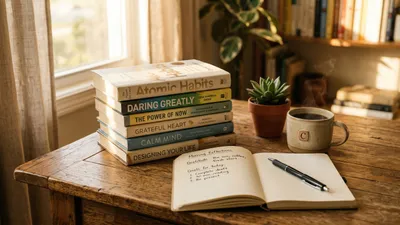
You can write a moving piece of creative nonfiction in a single sitting if you start with the right prompt — one specific enough to pull a real memory, moment, or obsession out of your head and onto the page.
In this guide, you’ll get:
- 55 creative nonfiction writing prompts, grouped by type (memoir, personal essay, lyric essay, literary journalism, and braided essay)
- A simple framework for turning any prompt into a full draft
- The questions to ask yourself before, during, and after writing
- How to expand a prompt into a book-length memoir
Grab a notebook or open a blank doc. Here’s where to start.
What Counts as a Creative Nonfiction Prompt?
A creative nonfiction writing prompt is a specific seed — a question, scene, object, or constraint — that invites you to shape a true story using literary techniques. Unlike fiction prompts, the content has to be real. But the craft — scene, voice, structure, imagery — belongs to the same toolkit you’d use in a short story.
The best prompts do three things at once. They narrow your focus to a single moment or image. They give you permission to be honest. And they leave enough room for the story underneath the story to surface.
How to Use These Prompts
Pick one that makes your chest tighten a little. That flicker of resistance usually means you’re close to something real. Set a timer for 25 minutes and write without stopping. Don’t edit, don’t polish, don’t Google — just get the first pass down.
When the timer ends, read what you wrote. Circle the one sentence that surprised you. That’s usually where the real essay lives.
If you want to turn any of these prompts into a full book, Chapter can help you structure your chapters and turn messy drafts into a publishable manuscript.
15 Memoir Writing Prompts
These pull directly from your own life. They’re best when you can’t tell the story in a single tidy arc — memoir thrives on the scenes we can’t quite explain.
- Write about a room in a house you no longer live in. Describe it in the present tense, as if you’re standing in the doorway right now.
- Describe the exact moment you realized a parent was a full person and not just your parent.
- Tell the story of a meal that changed something between you and someone else.
- Write about the last time you saw someone who has since died or disappeared from your life.
- Recall a lie you told that grew into something bigger than you expected.
- Write about an object you’ve kept for no practical reason. What does it hold?
- Describe a time you were wrong in public — and what happened inside you afterward.
- Write about a song that still ambushes you when it comes on unexpectedly.
- Tell the story of a teacher who saw something in you that you couldn’t yet see.
- Describe the exact moment your body betrayed you — through illness, injury, exhaustion, or desire.
- Write about a place you once loved that no longer exists.
- Recall a stranger whose kindness you’ve never stopped thinking about.
- Describe a ritual your family had that you didn’t realize was strange until you were older.
- Write about the first time you understood what fear actually was.
- Tell the story of a decision you made in under 10 seconds that changed everything.
12 Personal Essay Prompts
Personal essays are smaller than memoir — they explore a single idea through lived experience. The best ones start with a question the writer genuinely doesn’t know the answer to.
- Write about something you used to believe strongly and no longer do. What changed your mind?
- Describe an opinion you hold that most of your friends don’t understand.
- Tell the story of a skill or hobby you abandoned. Why did you stop?
- Write about a time you kept a secret you probably shouldn’t have.
- Describe the weirdest advice someone ever gave you that turned out to be right.
- Write about an ordinary object you feel unreasonably strong feelings about — a spoon, a coat, a particular type of pen.
- Tell the story of something you learned from a person you didn’t respect.
- Describe a time you felt most like yourself — and a time you felt least like yourself.
- Write about a word you hate, or a word you love, and what it means to you personally.
- Recall a grudge you held for years. What does it feel like to write about it now?
- Describe the most uncomfortable thing someone has ever said to you in public.
- Write about the moment you realized an adult in your life was afraid.
10 Lyric Essay Prompts
The lyric essay plays with form. It leans on imagery, rhythm, and fragment. These prompts are built for writers who want to experiment with structure — think braided narrative, collage, or list-based writing.
- Write a 500-word essay that’s really just one extended description of a color and what it means to you.
- List 20 things you’ll never do again. Then pick three and write a paragraph about each.
- Write an essay built from 10 short numbered sections, each starting with the phrase “I remember.”
- Describe a single photograph you’ve never shown anyone. Don’t explain why.
- Write an essay in the shape of a recipe — with ingredients and instructions for something that isn’t food.
- Pick a song lyric that haunts you. Use it as the title and write the essay it demands.
- Write about silence — the kind in a specific room, in a specific relationship, in a specific year of your life.
- Compose an essay as a series of questions you’ve never asked out loud.
- Write about an hour of your day in extreme slow motion — every breath, every movement, every thought.
- Pick three seemingly unrelated things from your life and braid them into a single essay where the connection reveals itself by the end.
10 Literary Journalism Prompts
Literary journalism — sometimes called narrative nonfiction — applies reporting and research to real-world subjects and tells them like stories. These prompts push you out of your own head and into the world.
- Find a place in your town that most people walk past without noticing. Spend an hour there and write what happens.
- Interview the oldest person in your family. Turn one story they tell into a scene.
- Choose a news event from the year you were born. Research it, then write about how it shaped the world you entered.
- Profile a person whose job fascinates you but who you’ve never actually spoken to.
- Write about a local business that’s been around longer than you’ve been alive. What’s its real story?
- Pick an object you use every day and research where it actually comes from. Tell that supply chain as a story.
- Write about a specific historical photograph. Research the moment, then reconstruct it in scene.
- Spend an hour in a place where people wait — an ER, a DMV, a bus station — and write what you observe.
- Investigate something you’ve always wondered about in your own neighborhood. Report the answer.
- Write about a conflict or event your family went through — a move, a lawsuit, a scandal — as if you were a journalist, not a participant.
8 Braided and Hybrid Essay Prompts
These prompts ask you to weave two or more unrelated threads into a single piece. The power comes from the reader realizing, late in the essay, why the threads belong together.
- Braid a memory from childhood with a current obsession — a show, a hobby, a news story — and find the thread that connects them.
- Alternate between scenes from a road trip you once took and research about the places you passed through.
- Write an essay that moves between a recipe, a memory of eating that food, and the person who taught it to you.
- Braid your own experience with a specific illness, loss, or fear with scientific or historical research about it.
- Alternate between a letter you wish you’d sent and the events that made you want to send it.
- Weave together three different versions of the same event — yours, another witness’s, and the official account.
- Braid a natural phenomenon (a tide, a migration, a storm) with a personal story it reminds you of.
- Write an essay that moves between your own journal entries from a difficult year and what you’d tell that version of yourself now.
Quick Comparison: Which Type of Prompt Fits Your Story?
Not every memory wants to be a memoir, and not every idea wants to be a personal essay. Match the prompt type to what you’re actually trying to say.
| Prompt Type | Best For | Length Range | Voice |
|---|---|---|---|
| Memoir | A single meaningful scene from your life | 1,500-5,000 words | Personal, reflective |
| Personal Essay | Exploring an idea through experience | 800-3,000 words | Curious, questioning |
| Lyric Essay | Emotional truth via fragment and image | 500-3,000 words | Poetic, experimental |
| Literary Journalism | Real-world subjects researched and told as story | 2,000-8,000 words | Observant, detailed |
| Braided Essay | Connecting two or more threads | 1,500-5,000 words | Layered, associative |
If you’re not sure which form your piece wants, default to personal essay. It’s the most forgiving, and the shortest path from idea to draft.
How to Turn a Prompt Into a Full Draft
Picking a prompt is the easy part. Turning it into a real piece is where most writers get stuck. Here’s the process I use, adapted from workflows taught by places like the Gotham Writers Workshop and essay collections reviewed by the Creative Nonfiction Foundation.
Step 1 — Freewrite the first pass. 25 minutes, no stopping, no editing. You’re not writing for anyone yet. You’re excavating.
Step 2 — Find the heat. Read your freewrite. Mark the sentence that made you uncomfortable. That’s your real subject. Everything else is scaffolding.
Step 3 — Build the scene. Pick the most important moment and write it with all five senses. What did the room smell like? What was the exact thing someone said?
Step 4 — Ask the essay’s question. Every good piece of creative nonfiction is secretly asking something. Write the question at the top of your draft. It gives the piece a spine.
Step 5 — Revise for voice. Read the draft out loud. Cut anything that sounds like someone else. Keep anything that sounds uncomfortably like you.
Most drafts need three rounds of revision before they’re ready to share. Don’t rush step 5 — voice is what separates creative nonfiction from a diary entry.
Common Mistakes to Avoid
- Writing the story you think you should tell, not the one you actually want to tell. Readers smell this instantly. Pick the prompt that scares you a little.
- Explaining instead of showing. If you catch yourself writing “it was really hard,” delete it and write the scene that proves it was really hard.
- Ignoring other people’s feelings without thinking about it. You can write about real people — but think hard about consent, especially with family. The Nieman Storyboard has useful essays on ethics in personal narrative.
- Trying to make every sentence beautiful. Lyrical prose is great. Overwrought prose is exhausting. Simple, precise sentences beat “poetic” ones nine times out of ten.
- Treating the first draft as the final draft. Creative nonfiction is a revision game. The piece you publish will barely resemble the one you freewrote.
How Do You Start a Creative Nonfiction Piece?
You start a creative nonfiction piece by opening in the middle of a concrete scene — not with backstory, summary, or an announcement of your theme. Drop the reader into a moment with sensory detail, a specific time and place, and a hint of what’s at stake. Save the explanation for later, once the reader is already hooked.
The Paris Review interview archives are full of writers describing this exact move. Start small. Start specific. Zoom out later.
How Long Should a Creative Nonfiction Piece Be?
Creative nonfiction pieces typically run between 800 and 8,000 words, depending on form. A personal essay for a magazine usually lands between 1,500 and 3,000 words. A flash essay is under 1,000. A literary journalism feature can hit 10,000 or more. Let the story dictate the length — not the other way around.
If your draft feels padded, it probably is. Cut until the piece feels like it’s barely holding itself together. That’s usually where it starts to breathe.
How Do You Turn a Prompt Into a Full Memoir?
A full memoir is just a series of connected scenes, each of which could have started from its own prompt. To expand one prompt into a book, list five to seven related moments from your life that orbit the same theme — a relationship, a year, a place — and treat each one as its own chapter seed. Then find the question the whole book is asking.
This is the exact approach I teach in how to write a memoir with AI. You don’t need to know the whole book up front — you need to know the heat at the center of it, and trust that the scenes will find each other.
If you want help structuring a memoir from individual essays and prompts, Chapter was built exactly for this. It lets you outline chapters from your existing drafts, keep your voice consistent across scenes, and shape a full manuscript without losing the specific moments that made you want to write in the first place. Over 2,147 authors have used it to turn scattered memories into finished books — including several memoirs that started as single freewrite exercises.
FAQ
What is a creative nonfiction writing prompt?
A creative nonfiction writing prompt is a specific question, scene, image, or constraint designed to spark a piece of true storytelling. Unlike fiction prompts, the content must be real — but the craft (scene, voice, structure) comes from the literary toolkit. The best prompts narrow your focus to a single moment while leaving room for discovery.
Can I change the facts in creative nonfiction?
No — creative nonfiction requires factual accuracy in what happened, who was there, and what was said. You can compress time, combine minor characters for clarity, and reconstruct dialogue from memory as long as you’re honest about the process. Inventing events or fabricating quotes crosses into fiction. For more on the ethics, see our creative nonfiction guide.
How do I pick the right prompt for me?
Pick the prompt that makes you slightly uncomfortable — the one you’d rather skip. Creative nonfiction works best when you’re writing toward something that still has a charge for you. If a prompt makes you feel “I could never write about that,” that’s almost always the one to pick.
What’s the difference between a memoir prompt and a personal essay prompt?
A memoir prompt asks you to tell a story from your life with a clear narrative arc. A personal essay prompt asks you to explore an idea or question using lived experience as evidence. Memoir focuses on what happened; personal essay focuses on what it means. The same material can become either one depending on the angle.
Do professional writers use prompts?
Yes — many professional creative nonfiction writers keep a list of prompts or “idea seeds” they return to. Writers like Cheryl Strayed, Roxane Gay, and John Jeremiah Sullivan have all discussed using constraints, questions, and single images as starting points. Prompts are training wheels and professional tools at the same time.
Where can I publish creative nonfiction pieces?
Start with literary magazines that publish creative nonfiction — Brevity, Creative Nonfiction, The Sun, and Longreads are all strong starting points. For longer work, Granta and Paris Review publish longer-form essays. Most literary magazines accept submissions via Submittable with a short cover letter and bio.