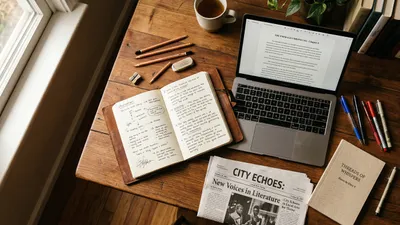
Creative writing exercises for beginners work best when they are short, low-pressure, and focused on one skill at a time. These 30 drills build the foundational habits that every writer needs — generating material quickly, observing the world closely, and trusting your voice on the page.
Each exercise takes 5 to 20 minutes. No experience required. Grab a notebook or open a blank document and start wherever feels right.
Warm-Up Exercises (1-5)
These get words flowing before your inner critic wakes up. Think of them as stretches before a run.
1. The Five-Minute Sprint
Set a timer for five minutes. Write about anything without stopping. Do not delete, backspace, or pause. If your mind goes blank, write “blank blank blank” until the next thought arrives.
This is freewriting in its purest form. Over 400 studies on expressive writing confirm that writing without self-editing builds fluency and reduces the anxiety that keeps beginners staring at empty pages.
Time: 5 minutes
2. Three Things I Noticed Today
Write three short paragraphs about things you noticed today — a sound, a texture, a stranger’s gesture, a shift in light. Focus on concrete sensory details instead of opinions or analysis.
Observation is the raw material of all creative writing. This exercise trains you to collect it deliberately.
Time: 10 minutes
3. Wrong Answers Only
Pick an everyday question like “Why is the sky blue?” or “Why do cats purr?” Write a completely fictional, absurd answer in three to five sentences. Make it vivid and specific.
This exercise loosens the grip of “getting it right” — the biggest block for new writers. Permission to be wrong is permission to be creative.
Time: 5 minutes
4. Stream of Senses
Close your eyes for 30 seconds. Open them and immediately write down everything you hear, smell, feel, taste, and see in rapid-fire sentences. No pausing to organize or beautify.
Speed is the point. This drill builds the habit of translating sensory input into words before your analytical mind filters it out.
Time: 5 minutes
5. One Word, One Page
Pick a single word — “rust,” “midnight,” “bread,” “thunder” — and freewrite about it for one full page. Let your mind wander. Follow associations, memories, images, and sounds wherever they lead.
This is excellent practice for generating material from almost nothing, a skill you will use every time you sit down to write.
Time: 10 minutes
Observation Exercises (6-10)
Good creative writing starts with seeing the world more clearly. These exercises sharpen your eye for detail.
6. People Watching Portrait
Go somewhere public — a cafe, park, or bus stop — and pick one person. Write a physical description in one paragraph. Include at least one detail about their hands, one about their posture, and one about how they move.
The goal is precision. “She had brown hair” teaches you nothing. “She twisted a strand of dark hair around her index finger while reading the menu upside down” builds a character.
Time: 15 minutes
7. Room Inventory
Pick a room you know well. List 20 objects in it. Then circle the five that reveal the most about the person who uses the room. Write a paragraph using only those five objects to suggest who lives there.
Fiction writers build characters through specific, telling details. This exercise teaches you which details carry weight.
Time: 15 minutes
8. Weather Journal Entry
Write a paragraph describing the weather right now without using the words “hot,” “cold,” “sunny,” “rainy,” or “cloudy.” Use only sensory descriptions — what you feel on your skin, what you see in the light, what you hear.
Eliminating easy words forces you to find precise, original language. That is the difference between flat writing and writing that makes readers feel something.
Time: 10 minutes
9. Before and After
Describe a place twice. First, describe it as welcoming and safe. Then describe the exact same place as unsettling and threatening. Change nothing about the physical space — only change which details you emphasize and how you describe them.
This teaches you that description is never neutral. Word choice shapes the reader’s emotional experience of every scene.
Time: 15 minutes
10. Sound Map
Sit quietly for two minutes and listen. Write down every sound you hear, from obvious (traffic, voices) to subtle (your own breathing, a distant hum). Then write a single paragraph that weaves at least five of those sounds into a scene.
According to the MasterClass creative writing guide, engaging multiple senses is one of the most effective ways for beginners to make their writing vivid. Sound is often the most overlooked sense in beginner prose.
Time: 10 minutes
Character Exercises (11-16)
Characters drive stories. These drills teach you to build people on the page who feel real.
11. Interview Your Character
Invent a character. Then write a one-page interview with them. Ask about their morning routine, their biggest regret, what they keep in their pockets, and what they lie about. Write the answers in their voice, not yours.
You will learn more about a character from their evasions and contradictions than from a biography. Let them surprise you.
Time: 15 minutes
12. Opposite Day Monologue
Think of someone you know well — a family member, a close friend, a coworker. Write a one-paragraph inner monologue from the perspective of someone who is their exact opposite in personality. If your friend is cautious, write someone reckless. If they are quiet, write someone loud.
Building characters unlike yourself is a core fiction skill. This exercise stretches your empathy and imagination.
Time: 10 minutes
13. The Wallet Drop
A stranger drops their wallet. Describe what falls out — every card, receipt, photo, ticket stub, and scrap of paper. Use only those objects to tell the reader who this person is. Do not write a single line of narration about the person’s appearance or personality.
This is character development through inference. When readers piece a character together from clues, the character feels more real than any direct description.
Time: 15 minutes
14. Two People, One Diner
Write a scene where two characters sit in a diner. One wants something from the other. Do not reveal what they want until the final paragraph. Use body language, small talk, and pauses to build tension.
This exercise combines character with scene craft. It teaches you to write dialogue that carries subtext — what characters mean versus what they say.
Time: 20 minutes
15. Six-Word Backstory
Write 10 different six-word backstories for fictional characters. Each should suggest an entire life in a single line. Examples: “Sold the farm. Bought a guitar.” or “Third foster home. Same suitcase. Smiled.”
Compression forces clarity. If you can imply a whole person in six words, you can write a strong character introduction in a paragraph.
Time: 10 minutes
16. Voicemail From the Future
Your character leaves a voicemail for themselves from 10 years in the future. Write the full message. What do they warn about? What do they celebrate? What do they wish they had done differently?
This is a fast way to discover what your character values, fears, and wants — the three ingredients that drive every story forward.
Time: 10 minutes
Scene and Setting Exercises (17-22)
These exercises teach you to build the world around your characters so readers feel present in every moment.
17. The Five-Sentence Scene
Write a complete scene in exactly five sentences. Sentence one establishes where and when. Sentence two introduces a character. Sentence three introduces a problem. Sentence four escalates. Sentence five resolves — or deliberately refuses to.
Constraints spark creativity. Working within a tight structure teaches you that every sentence in a scene must earn its place.
Time: 10 minutes
18. Rewrite the Ordinary
Pick something completely mundane — making coffee, waiting for a bus, brushing your teeth. Write it as if it were the most dramatic moment in a novel. Use pacing, sensory detail, and tension.
Great writers find the extraordinary inside the ordinary. This drill trains that instinct.
Time: 10 minutes
19. Setting Without Sight
Describe a place using every sense except sight. What does the room sound like? What does the air taste like? What textures surround you? How does it smell?
Beginners default to visual description because it feels safest. Removing sight forces you to build a richer, more immersive world. The Iowa Writers’ Workshop famously uses multi-sensory exercises like this to push students past surface-level description.
Time: 10 minutes
20. The Transition Scene
Write a scene where a character moves from one emotional state to another. They enter a room angry and leave calm, or they start a conversation confident and end it uncertain. Show the shift through action and dialogue — not narration.
Transitions are where character and plot meet. Mastering them is what separates promising writers from published ones.
Time: 15 minutes
21. Map Your Childhood Room
Draw a rough map of a room from your childhood — a bedroom, a classroom, a grandparent’s kitchen. Then write a one-page scene set in that room. Use the map to ground the scene in specific, real details.
Personal memory is a rich source of authentic detail. Memoir and fiction writers both draw from it constantly. Writing from a map keeps you spatially honest instead of vague.
Time: 15 minutes
22. The Eavesdrop Rewrite
Recall a conversation you overheard recently — at a store, on the street, in a waiting room. Write it from memory as accurately as you can. Then rewrite it as a fictional scene between two characters who have a secret they are both avoiding.
Real speech patterns make fictional dialogue believable. This two-step exercise trains you to capture authenticity first, then layer in narrative purpose.
Time: 15 minutes
Flash Fiction Exercises (23-27)
Flash fiction — very short stories, usually under 500 words — is the best training ground for beginners. You practice story structure without committing to 50 pages.
23. The 100-Word Story
Write a complete story in exactly 100 words. It must have a character, a conflict, and an ending. Count every word.
Flash fiction teaches economy. When you cannot waste a single word, you learn what stories actually need versus what writers habitually include out of habit.
Time: 15 minutes
24. First Line, Last Line
Write down a first sentence and a last sentence that have no obvious connection. Then write a 200-word story that connects them. The fun is in discovering the bridge.
This exercise builds plotting instincts. Every story is fundamentally about getting from one point to another through a series of surprising but inevitable steps.
Time: 15 minutes
25. The Twist Ending
Write a 250-word story where the final sentence completely reframes everything the reader just read. Plan the ending first, then write backward.
Reverse engineering a story from its conclusion teaches structure more effectively than outlining. You learn what information to plant and what to withhold.
Time: 15 minutes
26. One Room, One Hour
Your character is stuck in a single room for one hour. Something changes by the end of that hour — emotionally, physically, or psychologically. Write the scene in 300 words or fewer.
Constraints on space and time sharpen your focus. With nowhere for the character to go, you are forced to go inward. That is where the best fiction lives.
Time: 15 minutes
27. The Object Story
Pick a random object near you. Write a 200-word story where that object is central to the plot. It can be a weapon, a gift, a clue, a symbol, or a MacGuffin — but the story cannot exist without it.
Objects anchor abstract stories in concrete reality. This exercise trains you to build narrative around tangible things readers can picture.
Time: 10 minutes
Style and Voice Exercises (28-30)
These final exercises help you discover and develop your unique writing voice.
28. Copy Then Depart
Find a paragraph by an author you admire. Read it three times. Close the book. Write your own paragraph on a completely different subject, using the same sentence rhythm and structure. Do not copy words — copy the music.
Every writer develops a voice by first imitating voices they love. This is how musicians learn, how painters learn, and how writers have always learned. The Reedsy writing exercises guide recommends imitation exercises as one of the fastest paths to finding your own style.
Time: 15 minutes
29. Same Story, Three Voices
Write a single event — a car breaking down, a surprise phone call, a dog escaping the yard — in three different voices. Write it once as a detached, literary narrator. Write it again as a sarcastic teenager. Write it a third time as an anxious perfectionist.
Voice is the most powerful tool a writer owns. This exercise proves that the same facts become entirely different stories depending on who tells them.
Time: 20 minutes
30. Your Manifesto
Write a one-page manifesto about why you want to write. What stories do you want to tell? What do you believe about language, truth, or imagination? Who do you want to reach?
This is not an exercise in craft. It is an exercise in commitment. Pin it above your desk and return to it when writing feels pointless. Every published author started as a beginner who decided not to stop.
Time: 15 minutes
How to Build a Creative Writing Practice
Finishing these 30 exercises is a strong start. Turning that start into lasting skill requires consistency. Here is how to build a practice that sticks.
Start small. Research from Stanford’s Behavior Design Lab shows that tiny habits — as small as five minutes a day — build more reliably than ambitious schedules. One exercise per day beats five exercises on Saturday.
Rotate your focus. Alternate between observation, character, scene, and flash fiction exercises across the week. Variety prevents creative fatigue and builds a wider range of skills.
Do not edit during exercises. The purpose of a drill is to produce raw material and build fluency. Editing comes later, during revision. Mixing the two processes is the fastest way to freeze up.
Track your progress. Keep a writing journal or spreadsheet. Note which exercises felt easy, which felt hard, and which produced surprising results. Patterns in your practice reveal your natural strengths and growth areas.
Read as a writer. When you read books, articles, or stories, pay attention to how the author handles the skills you are practicing. Notice dialogue rhythm, sensory description, pacing, and voice. Reading as a writer accelerates everything.
Turn Exercises Into a Book
Creative writing exercises build skills. At some point, those skills are ready for a bigger project. If you have been practicing regularly and feel the pull toward writing something longer — a novel, a memoir, a collection of short stories — that instinct is worth following.
Chapter helps beginners turn writing practice into finished books. The AI-powered platform guides you through outlining, drafting, and refining a complete manuscript, so you can go from exercises to a published book without getting lost in the process.
FAQ
How often should beginners do creative writing exercises?
Three to five times per week is the sweet spot for most beginners. Consistency matters more than session length — a focused 10-minute drill every day builds more skill than a two-hour marathon once a month.
Do creative writing exercises actually improve your writing?
Yes. Research published in Frontiers in Psychology confirms that regular writing practice improves fluency, reduces writing anxiety, and builds cognitive patterns associated with stronger creative output. Exercises isolate specific skills so you improve faster than writing without structure.
What supplies do I need to start creative writing exercises?
A notebook and a pen, or any device with a text editor. That is it. No special software, no courses, no prerequisites. If you want a structured digital writing space, a tool like Chapter provides templates and guidance, but a blank page works perfectly for exercises.
Can I use creative writing exercises to start a novel?
Absolutely. Many of the exercises in this list — particularly the flash fiction and character drills — produce material that can grow into larger projects. Exercise 11 (Interview Your Character) and Exercise 24 (First Line, Last Line) are especially good starting points for novel writing.
What is the best creative writing exercise for total beginners?
Start with Exercise 1, The Five-Minute Sprint. Freewriting removes every barrier — no topic, no rules, no judgment. Once you prove to yourself that you can fill a page, the other exercises feel much less intimidating.