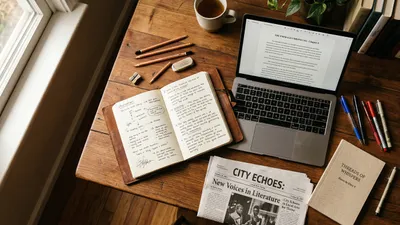
Every creative writing project starts with a single idea. These 50 creative writing ideas cover fiction, memoir, poetry, personal essays, and experimental forms — each one specific enough to write from today, open enough to make entirely your own.
Pick one that pulls at you. Don’t overthink it. Start writing.
Fiction Ideas
-
A woman receives a voicemail from her own number. The message is her voice, describing tomorrow in detail — and none of it is good.
-
Two siblings inherit a house they’ve never heard of. When they arrive, the neighbors greet them by name and say they’ve been expected for years.
-
A small-town veterinarian starts treating animals with injuries that match unsolved crimes in the county.
-
Your character wakes up fluent in a language they’ve never studied. The only person who speaks it lives three thousand miles away and has been waiting for their call.
-
A retired detective receives a letter confessing to a crime she solved twenty years ago — but the details prove her original suspect was innocent.
-
Write a story set entirely in a hotel elevator stuck between floors. Two strangers, four hours, and a secret one of them has been carrying for a decade.
-
A food truck owner discovers that a specific recipe makes every customer who eats it tell the truth for exactly one hour.
-
Your character finds a door in their apartment that wasn’t there yesterday. It opens to a version of their home where they made every opposite choice.
-
A lighthouse keeper on a remote island starts receiving letters washed ashore in bottles — letters describing events on the island that haven’t happened yet.
-
Write from the perspective of a book that has been read by 200 people over 80 years. Each owner left something behind in the margins.
Memoir and Personal Essay Ideas
-
Write about a meal that changed a relationship. Not the food — the conversation, the silence, or what someone said between bites.
-
Describe a place you can never return to. Not because it’s gone, but because you are different now.
-
Write about the first time you realized an adult in your life was wrong about something important.
-
Explore a skill you gave up. Why you started, why you stopped, and what it would mean to try again.
-
Write about a lie you told that turned out to be more true than you expected.
-
Describe a sound from your childhood that you haven’t heard in years. What memory does it carry?
-
Write about a friendship that ended without a fight. No dramatic moment — just a slow fade. Try to find the exact week it happened.
-
Explore something you own that you should have thrown away a long time ago. Why is it still there?
-
Write about a time you were a stranger somewhere. A new school, a foreign city, a job where you didn’t belong. Focus on the first day.
-
Describe the last ordinary day before something in your life changed permanently. You didn’t know it was the last ordinary day at the time.
Poetry and Flash Fiction Ideas
-
Write a poem structured as a recipe. The ingredients are emotional, but the instructions are precise.
-
Tell a complete story in exactly 100 words. Every word must earn its place.
-
Write a poem from the perspective of an object that’s been in your family for generations.
-
Create a flash fiction piece that takes place in the two minutes before a photograph is taken.
-
Write a poem using only words you can see from where you’re sitting right now.
-
Tell a story backward. Start with the ending. Each paragraph moves earlier in time.
-
Write a prose poem about a color without naming the color. Make the reader feel it instead.
-
Create a flash fiction piece set entirely in text messages between two people who haven’t spoken in five years.
-
Write a poem that is also a list of things found in someone’s coat pocket after they disappeared.
-
Tell a story in the form of a series of voicemails left on an answering machine that is never checked.
Genre-Bending and Experimental Ideas
-
Write a fairy tale set in a modern office. The dragon is middle management. The treasure is a corner office with a window.
-
Tell a mystery story where the narrator is unreliable — not because they’re lying, but because they genuinely can’t remember.
-
Write a love story where the two characters never meet in person. They communicate only through notes left in the same library book.
-
Create a horror story where nothing supernatural happens. The terror comes entirely from human behavior.
-
Write a story told through a series of classified ads, Craigslist postings, or lost-and-found notices.
-
Write speculative fiction about a world where people can only lie. Truth-telling is the taboo.
-
Create a story structured as an instruction manual for something that doesn’t exist yet.
-
Write a detective story where the detective is the one who committed the crime — but they don’t know it.
-
Tell a story from two points of view that completely contradict each other. Let the reader decide who is telling the truth.
-
Write a romance set during a natural disaster. Not a metaphor — an actual hurricane, earthquake, or wildfire. The survival and the relationship happen at the same time.
Nonfiction and Creative Exploration Ideas
-
Research a historical event that happened on today’s date. Write about it as if you were there. Use real details, but fill the gaps with informed imagination.
-
Interview someone in your family about a memory from before you were born. Write it as a scene, not a summary.
-
Pick an object in a museum, thrift store, or antique shop. Write its biography — where it came from, who owned it, and how it ended up here.
-
Write about a neighborhood you know well, but describe it as though you’re a travel writer visiting for the first time.
-
Choose a piece of advice you were given as a child. Write an essay testing whether it holds up now.
-
Write about a job you once had through the lens of one specific day — the most ordinary or the most chaotic.
-
Explore a tradition your family follows that no one can explain the origin of. Investigate it. Write what you find.
-
Write a creative nonfiction piece about learning to do something with your hands — cooking, carpentry, gardening, sewing. Focus on the physical sensations.
-
Pick a photograph of a stranger from a flea market or online archive. Write their story based on nothing but what you can see.
-
Write about a place in your city or town that everyone knows but no one talks about. The abandoned lot, the building with the painted-over sign, the bridge where people go to think.
How to Turn a Creative Writing Idea Into a Finished Piece
An idea is a starting point. Here’s how to carry it across the finish line.
Start messy. Pick any idea from this list and write for fifteen minutes without stopping. Don’t edit. Don’t second-guess. A rough draft with momentum beats a perfect first paragraph that goes nowhere.
Find the question. Every strong piece of writing is driven by a question the writer genuinely wants to answer. Look at your rough pages and find the question hiding inside them. That question is your compass.
Commit to a form. Decide whether this idea wants to be a short story, a personal essay, a memoir, a poem, or something longer. The form shapes the writing. A short story demands compression. A memoir demands honesty. A novel demands patience.
Build a writing habit. The National Endowment for the Arts reports that literary reading and writing participation rises when people commit to regular creative practice. Even fifteen minutes a day adds up to over 90 hours a year — enough to draft a full book.
Use tools that match your ambition. If your idea is growing into a book-length project, tools like Chapter help you organize chapters, develop structure, and keep writing without getting lost in the logistics. When the creative idea is there, the last thing you need is software getting in the way.
If you want more sparks, explore 300 writing prompts across every genre, dive into fantasy writing prompts or romance prompts, or learn more about what creative writing is and how to build a lasting practice around it.
FAQ
How do I choose the right creative writing idea?
Pick the idea that makes you curious — the one where you immediately start asking “what happens next?” or “why?” Curiosity sustains writing better than obligation. If nothing grabs you right away, try writing the first paragraph of three different ideas. The one you don’t want to stop writing is your answer.
Can I combine multiple ideas from this list?
Absolutely. Some of the best writing comes from colliding two unrelated concepts. A memoir idea paired with an experimental structure, or a fiction scenario layered with personal essay elements, can produce something more original than either idea alone.
What if I start writing and get stuck?
Getting stuck usually means you’re trying to control the outcome too soon. Go back to freewriting — set a timer for ten minutes and write without stopping, even if what comes out feels wrong. Writer’s block often breaks when you give yourself permission to write badly.
How long should a piece based on these ideas be?
As long as it needs to be. A flash fiction piece might be 500 words. A personal essay might run 2,000. A short story could land anywhere from 1,500 to 7,000 words. If the idea keeps expanding, you might be looking at a novella or a full novel. Let the material dictate the length, not a word count target.