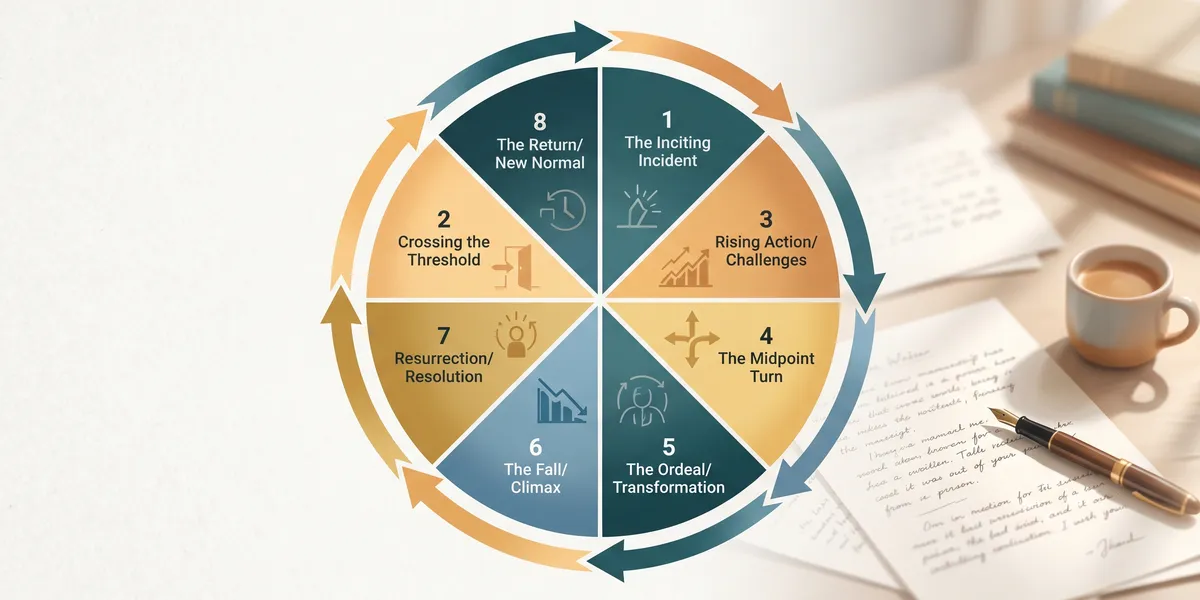
The Dan Harmon Story Circle is an 8-step narrative framework that maps any story as a circular journey — a character leaves comfort, faces trials, and returns transformed.
In this guide, you’ll learn:
- What each of the 8 steps means (with clear examples)
- How Dan Harmon used the circle to write Rick and Morty and Community
- How the Story Circle compares to the Hero’s Journey and other structures
- A step-by-step method to apply the circle to your own fiction
Here’s how the framework works and why writers keep coming back to it.
What Is the Dan Harmon Story Circle?
The Dan Harmon Story Circle is a simplified storytelling framework built on 8 steps that trace a character’s journey from comfort to chaos and back again. Dan Harmon — creator of Community and co-creator of Rick and Morty — developed it in the late 1990s for his short-film festival, Channel 101.
Harmon’s goal was practical. He wanted filmmakers to tell a complete story in five minutes. So he took Joseph Campbell’s Hero’s Journey (which has 12-17 stages) and compressed it into 8 universal steps arranged in a circle.
The circle shape matters. The top half represents the character’s known world (order, comfort, routine). The bottom half represents the unknown world (chaos, challenge, growth). Every story crosses that threshold and returns.
Think of it as the simplest possible map for a satisfying story. If your narrative hits all 8 points, your reader feels a complete emotional arc — whether you’re writing a novel, a screenplay, or a single scene.
The 8 Steps of the Dan Harmon Story Circle
Each step sits at a specific position on the circle. Here’s what happens at each one.
Step 1: You (A Character in Their Comfort Zone)
The story starts with your protagonist in their ordinary world. You establish who they are, what their life looks like, and what feels normal to them.
This doesn’t mean they’re happy. It means they’re settled. The comfort zone can be miserable — it just has to be familiar.
Example: In the Rick and Morty pilot, Morty is a nervous, underperforming high school kid living in the shadow of his chaotic grandfather. That’s his normal.
Step 2: Need (But They Want Something)
Something disrupts the status quo. Your character realizes — or is forced to confront — a desire, lack, or problem they can’t ignore.
This is the engine of your story. Without a clear need, the circle has no momentum. The need can be external (a threat, an opportunity) or internal (loneliness, ambition, guilt).
Example: In The Matrix, Neo feels something is wrong with reality. He needs the truth. That nagging pull is Step 2.
Step 3: Go (They Enter an Unfamiliar Situation)
The character crosses the threshold into an unfamiliar world. They leave comfort behind — willingly or not.
This is the top-to-bottom crossing on the circle. Everything after this point is new territory. The character is out of their depth, and the audience feels it.
Example: Frodo leaves the Shire. Luke boards the Millennium Falcon. Morty gets dragged through a portal to an alien dimension.
Step 4: Search (They Adapt and Face Trials)
Now in the unknown world, the character struggles, learns, and adapts. They encounter allies, enemies, and obstacles. They start to figure out how this new world works.
This is usually the longest section of your story. It’s where subplots develop, skills are tested, and relationships form. The rising action lives here.
Example: In Finding Nemo, Marlin navigates sharks, jellyfish, and the East Australian Current. Each challenge teaches him something and pushes the story forward.
Step 5: Find (They Get What They Wanted)
The character achieves their goal — or at least what they thought they wanted. This is the peak moment at the bottom of the circle, the farthest point from their comfort zone.
But here’s the catch: getting what you want is never free in a well-told story. Step 5 always sets up Step 6.
Example: In Avengers: Infinity War, the heroes assemble every possible defense against Thanos. They find their strategy. It’s not enough.
Step 6: Take (They Pay a Heavy Price)
Success comes with a cost. The character must sacrifice something — a belief, a relationship, their safety, their old identity. This is where the story earns its emotional weight.
Harmon considers this the most important step. Without a real price, the transformation feels hollow. The bigger the cost, the more the audience feels the change.
Example: In Toy Story, Woody gets what he wanted (Buzz out of the picture), but he loses the respect of the other toys and nearly loses himself. The price forces him to rethink everything.
Step 7: Return (They Go Back to the Familiar World)
The character returns to their ordinary world — but they’re carrying everything that happened in the unknown. They cross back over the threshold.
The return can be literal (going home) or figurative (returning to a familiar situation with new eyes). Either way, the audience should feel the contrast between who the character was in Step 1 and who they are now.
Example: At the end of each Rick and Morty episode, Rick and Morty return to the Smith household. The house is the same. They are not.
Step 8: Change (They Have Been Transformed)
The character is fundamentally different from who they were at the start. Their character arc is complete. The circle closes — but not where it began, because the person standing at the top is not the same person who left.
This is what makes the circle satisfying. The audience measures the change by comparing the character now to Step 1. That gap is the emotional payoff of your entire story.
Example: In Breaking Bad (full series arc), Walter White starts as a mild-mannered chemistry teacher and ends as a drug kingpin. The circle closes — he’s back “home” — but the change is devastating.
Dan Harmon Story Circle vs. the Hero’s Journey
The Story Circle is built on Joseph Campbell’s monomyth, but they’re not the same tool. Here’s how they compare:
| Feature | Dan Harmon Story Circle | Hero’s Journey (Campbell) |
|---|---|---|
| Steps | 8 | 12-17 |
| Structure | Circular | Linear path |
| Focus | Character transformation | Mythological archetypes |
| Best for | Any genre, any length | Epic/adventure stories |
| Complexity | Simple, fast to apply | Detailed, more prescriptive |
| Origin | TV writing (Channel 101) | Academic mythology research |
The Hero’s Journey includes stages like “Meeting the Mentor,” “The Belly of the Whale,” and “The Magic Flight.” These are powerful — but they carry genre baggage. They feel built for fantasy and adventure.
Harmon stripped away the mythological language. His 8 steps work for a romantic comedy, a horror short, or a workplace sitcom. That’s the trade-off: you lose specificity and gain universality.
Which should you use? If you’re writing epic fantasy or adventure, the Hero’s Journey gives you more granular guidance. If you want a flexible framework that works for any story in any genre, the Story Circle is faster and more adaptable.
Dan Harmon Story Circle vs. Other Story Structures
The Story Circle isn’t the only framework out there. Here’s how it stacks up against other popular options:
| Structure | Steps/Beats | Best For | Complexity |
|---|---|---|---|
| Dan Harmon Story Circle | 8 steps | Any genre, any length | Low |
| Three-Act Structure | 3 acts | Film, novels | Low |
| Save the Cat Beat Sheet | 15 beats | Screenplays, commercial fiction | Medium |
| Hero’s Journey | 12-17 stages | Epic/adventure | High |
| Snowflake Method | 10 stages | Novels (planning-heavy) | High |
The Story Circle sits in a sweet spot. It’s more specific than the three-act structure (which only gives you three broad phases) but simpler than the Save the Cat beat sheet (which prescribes 15 exact beats with page targets).
For writers who want enough structure to feel confident but enough freedom to be creative, Harmon’s 8 steps hit the balance.
How to Apply the Dan Harmon Story Circle to Your Writing
Knowing the 8 steps is one thing. Using them is another. Here’s a practical method you can apply today.
Map Your Character’s Core Need First
Before you touch the circle, answer one question: What does your character want, and what do they actually need?
The “want” drives Steps 2-5. The “need” drives Steps 6-8. In the strongest stories, the character gets what they need — not what they want. The gap between want and need is where the transformation lives.
Write a single sentence for each: “My character wants ___. They actually need ___.”
Fill In the Circle From Both Ends
Start with Step 1 (who they are) and Step 8 (who they become). Then work inward. When you know the starting point and the ending point, the middle steps become obvious.
Step 1 and Step 8 should mirror each other. Same setting, same situation — different character. That contrast is the whole point.
Use It at Every Scale
Here’s something most guides miss: the Story Circle works at multiple scales simultaneously.
- Series level: Your character’s arc across an entire book series
- Book level: The transformation within a single novel
- Chapter level: A mini-arc within a single chapter
- Scene level: Even individual scenes can follow the 8-step pattern
Harmon himself uses this nested approach in Rick and Morty. Each episode follows the circle. Each season follows the circle. The whole series follows the circle. When you layer circles inside circles, your story gains a rhythmic pulse that keeps audiences hooked.
Test Your Draft Against the Circle
Already have a draft? Map it onto the circle. For each step, ask:
- Is this step present? (If not, something may feel missing.)
- Is this step earning its weight? (Step 6 — the price — is the one most drafts skip.)
- Does the transition between steps feel natural? (Forced transitions break immersion.)
If your story sags in the middle, check Steps 4 and 5. If the ending feels flat, check Steps 6 and 8. The circle becomes a diagnostic tool, not just a planning tool.
Dan Harmon Story Circle Example: Full Breakdown
Let’s walk through a complete example with a story you probably know — Star Wars: A New Hope.
| Step | What Happens |
|---|---|
| 1. You | Luke Skywalker is a bored farm kid on Tatooine |
| 2. Need | He wants adventure — and gets a message from Princess Leia |
| 3. Go | He leaves Tatooine with Obi-Wan on the Millennium Falcon |
| 4. Search | He trains with a lightsaber, rescues Leia, navigates the Death Star |
| 5. Find | He locates the Death Star’s weakness and joins the Rebel attack |
| 6. Take | Obi-Wan dies. The cost of this journey is losing his mentor. |
| 7. Return | He flies back to the Rebel base for the final battle |
| 8. Change | He’s a Rebel hero — no longer a passive farm boy, but a pilot who trusts the Force |
Notice how Step 1 and Step 8 mirror each other. Same person, completely different identity. That’s the circle doing its work.
Common Mistakes When Using the Story Circle
Even with a simple framework, writers make predictable errors. Avoid these:
- Skipping Step 6 (The Price). This is the most common mistake. If your character gets what they want without paying for it, the transformation feels unearned. Every meaningful change requires sacrifice.
- Making Step 2 too vague. “The character wants to be happy” isn’t a need. Make it specific and concrete. “The character wants to prove she can run the family business” gives the story direction.
- Rushing Steps 3 and 4. The crossing into the unknown and the adaptation period are where tension builds. Rushing them deflates the story.
- Forgetting that Step 8 must mirror Step 1. The audience measures change by comparison. If they can’t clearly see the difference between the character at Step 1 and Step 8, the arc doesn’t land.
- Using the circle as a rigid formula. Harmon himself treats it as a guide, not a rulebook. Steps can overlap. Steps can be implied. The circle should serve the story — not the other way around.
Can You Use AI to Apply the Story Circle?
Yes — and it’s one of the most practical uses of AI writing tools for fiction.
You can feed the 8 steps into an AI writing assistant and ask it to generate options for each step of your specific story. This works especially well for brainstorming Step 2 (need), Step 6 (price), and Step 8 (change) — the three steps writers struggle with most.
Our Pick — Chapter
Chapter helps you build complete stories using AI-assisted outlining and drafting. You can map your Story Circle steps, generate scene ideas for each stage, and draft full chapters — all while keeping creative control over your voice and vision.
Best for: Fiction writers who want AI assistance with structure and drafting Why we built it: Plotting frameworks like the Story Circle become even more powerful when you can quickly test different options for each step.
Who Is Dan Harmon?
Dan Harmon is an American writer, producer, and showrunner. He created the TV series Community (2009-2015) and co-created Rick and Morty (2013-present) with Justin Roiland.
Before his TV success, Harmon co-founded Channel 101 — a monthly short-film festival in Los Angeles — in 2003. It was there that he developed the Story Circle as a teaching tool for aspiring filmmakers who needed to structure a story in five minutes or less.
Harmon didn’t invent the underlying ideas. He openly credits Joseph Campbell’s The Hero with a Thousand Faces (1949) as his primary influence. What Harmon did was translate academic mythology into a practical writing tool that anyone could use in any genre.
He’s written extensively about the Story Circle on Channel 101’s website, where his original essays on story structure remain some of the most-cited writing craft resources online.
How Long Does It Take to Outline a Story With the Circle?
Most writers can map a full story onto the Dan Harmon Story Circle in 30-60 minutes once they understand the 8 steps. The first time takes longer because you’re learning the framework. After that, it becomes a fast diagnostic tool.
For a novel, expect to spend a full working session (2-4 hours) mapping the main plot and key subplots onto separate circles. For a short story or single episode, 30 minutes is plenty.
The speed is the point. Harmon designed this framework for people making five-minute films on a deadline. It’s meant to be fast.
Does the Story Circle Work for Every Genre?
The Dan Harmon Story Circle works for any genre that involves character transformation. That includes literary fiction, thriller, romance, sci-fi, fantasy, horror, and comedy.
It’s less useful for:
- Purely plot-driven stories with no character arc (rare, but they exist)
- Experimental or anti-narrative fiction that deliberately avoids structure
- Slice-of-life stories where the point is that nothing fundamentally changes
For most commercial fiction and screenwriting, the circle applies. Harmon has demonstrated this himself — Community is a sitcom, Rick and Morty is animated sci-fi comedy, and both follow the circle religiously.
FAQ
What is the Dan Harmon Story Circle?
The Dan Harmon Story Circle is an 8-step storytelling framework that traces a character’s journey from their comfort zone, through an unfamiliar world, and back again — transformed by the experience. Dan Harmon created it as a simplified version of Joseph Campbell’s Hero’s Journey, designed to work in any genre and any story length.
What are the 8 steps of the Story Circle?
The 8 steps of the Dan Harmon Story Circle are: (1) You — character in comfort zone, (2) Need — they want something, (3) Go — they enter an unfamiliar situation, (4) Search — they face trials, (5) Find — they achieve their goal, (6) Take — they pay a price, (7) Return — they come back, and (8) Change — they are transformed.
How is the Story Circle different from the Hero’s Journey?
The Story Circle is a simplified version of the Hero’s Journey with 8 steps instead of 12-17. It drops the mythological language (no “belly of the whale” or “magic flight”), focuses on character transformation over archetypes, and works across all genres — not just epic adventure. Both map the same fundamental pattern of departure and return.
Can you use the Story Circle for a novel?
Yes. The Dan Harmon Story Circle works at any scale — from a single scene to an entire novel series. For novels, you can map the main plot onto one circle and each subplot onto its own circle. Many published novels and screenplays follow this structure, whether the authors used the framework consciously or not.
What is the most important step in the Story Circle?
Dan Harmon considers Step 6 (Take/Pay the Price) the most important. This is where your character pays for what they’ve gained. Without a genuine cost, the transformation in Step 8 feels hollow. The sacrifice is what makes the audience believe the character has truly changed.