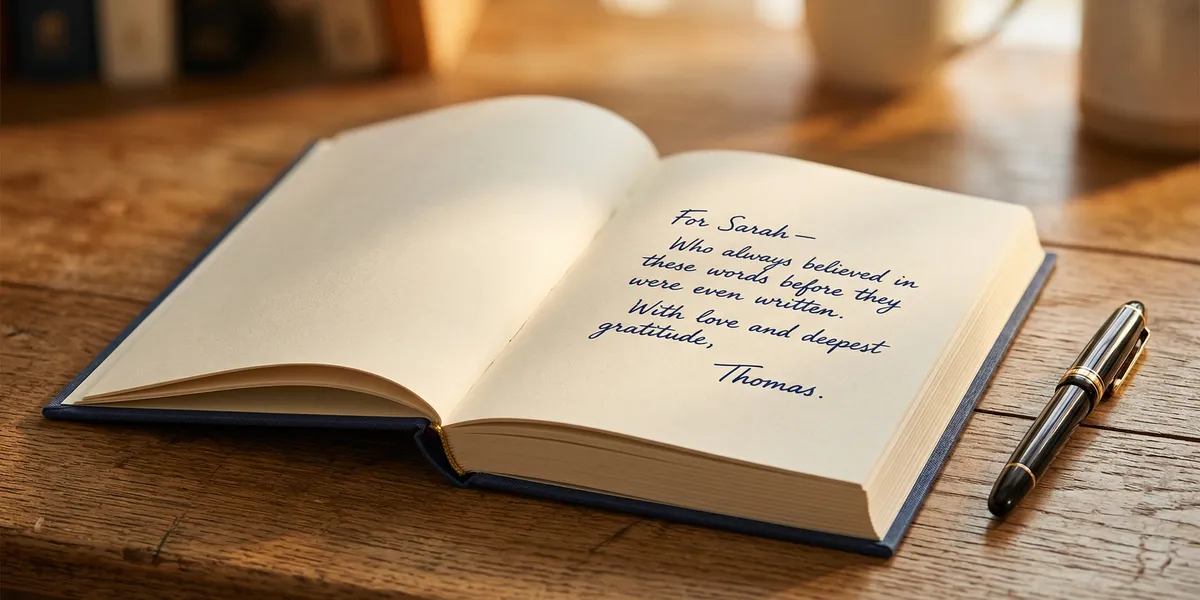
A dedication page is the short, personal note at the front of a book where the author honors someone who mattered to the work or to their life. You can dedicate your book to anyone, for any reason, in as few or as many words as you want.
This guide covers what goes on a dedication page, where it belongs in your book, how to write one that feels genuine, and dozens of examples sorted by tone and relationship.
What is a dedication page?
A dedication page is a single page in the front matter of a book where the author personally addresses someone. It usually starts with “For” or “To” followed by a name and, optionally, a brief message explaining why.
The dedication sits between the copyright page and the table of contents. Readers encounter it before the book itself begins, which gives it a quiet, intentional weight. It signals that a real person wrote this, and that someone real inspired it.
Dedications have deep roots in publishing. In ancient Rome, authors dedicated works to wealthy patrons who funded their writing. The personal, heartfelt dedication we know today is a much more recent tradition, emerging as authorship became less dependent on aristocratic sponsorship.
Dedication page vs. acknowledgements
These two sections serve different purposes, and many first-time authors confuse them.
| Dedication Page | Acknowledgements | |
|---|---|---|
| Purpose | Honor someone personally significant | Thank everyone who helped with the book |
| Length | 1-3 sentences | 1-3 pages |
| Tone | Personal, intimate | Professional, grateful |
| Location | Front matter (before content) | Back matter (after content) |
| Required? | No | No |
A dedication is a love letter. Acknowledgements are a thank-you speech. You can include both, either, or neither in your book. The dedication is selective and intimate, while acknowledgements cast a wider net to recognize editors, agents, beta readers, and anyone else who contributed.
Where to place your dedication page
The standard placement in a printed book follows this order:
- Half title page
- Title page
- Copyright page
- Dedication page
- Table of contents
- Foreword or preface (if any)
- Chapter one
In ebooks, the placement is the same. Most self-publishing platforms like Amazon KDP and IngramSpark support dedication pages in both digital and print formats. The dedication gets its own page with no other content on it.
For formatting, keep it simple. Center the text vertically and horizontally on the page. Use the same font as the rest of your book’s front matter. No headers, no page numbers, no decorative borders unless your book’s design specifically calls for them.
How to write a dedication page
There is no wrong way to write a dedication. That said, the best ones share a few qualities.
Keep it short
The most memorable dedications are brief. One sentence is standard. Two or three sentences work if you have something specific to say. Anything longer than a short paragraph starts to feel like an acknowledgements section.
Be specific
“To my family” is fine. “To my daughter Ellie, who asked me every morning if the book was done yet” is better. Specificity makes a dedication feel real instead of obligatory.
Match your book’s tone
A thriller can have a dark, wry dedication. A children’s book can have a playful one. A memoir about grief can have a tender one. The dedication sets the emotional temperature for everything that follows, so let it reflect your book’s personality.
Decide who deserves the honor
Most authors dedicate their book to someone who falls into one of these categories:
- Family members — spouse, children, parents, siblings
- Mentors or teachers — someone who shaped your writing or thinking
- Friends — especially those who supported you through the writing process
- The reader — a direct address to whoever picked up the book
- Someone you lost — a memorial dedication
- A cause or community — people affected by your book’s subject
- Yourself — uncommon but increasingly accepted, especially for first books written through significant personal difficulty
Dedication page examples by tone
Simple and classic
These work for any genre and any relationship. They’re clean, dignified, and never go out of style.
- “For Mom and Dad.”
- “To Sarah, with love.”
- “For my students, past and present.”
- “To everyone who told me I could.”
Heartfelt and emotional
These dedications carry more weight. They work well in memoirs, literary fiction, and books written through personal struggle.
- “For my grandmother, who read to me before I could read to myself. I wish you could hold this one.”
- “To James — you believed in this book before a single word existed. Every page is proof you were right.”
- “For my daughter. Everything I write, I write so you’ll know who I was.”
Funny and irreverent
Humor works especially well in comedy, satire, and genre fiction where readers expect personality.
- “To my cat, who sat on every draft of this manuscript. Your contributions were noted.”
- “For my editor, who only threatened to quit twice.”
- “To coffee. You know what you did.”
Mark Twain was a master of the wry dedication. His warning in the front of Adventures of Huckleberry Finn playfully threatens anyone looking for a motive, moral, or plot.
Inspirational and motivational
These dedications speak to the reader or to a broader audience. They work well in nonfiction, self-help, and books about overcoming obstacles.
- “To anyone who’s been told their story doesn’t matter. It does.”
- “For the ones who start over. Again and again and again.”
- “To every writer who almost gave up. This book almost didn’t exist either.”
Memorial dedications
These honor someone who has passed. They’re common in both fiction and nonfiction, and they carry a quiet gravity that readers respect.
- “In memory of my father, Robert, 1947-2019. You taught me that every good story starts with listening.”
- “For Grandma Rose, who is in every word I write whether I mean her to be or not.”
- “To David. I finished it.”
Dedications for children’s books
Children’s book dedications are often playful and warm, speaking directly to the young reader or to a child in the author’s life.
- “For Lily, who asked for a story about a brave rabbit. Here it is.”
- “To every kid who reads under the covers with a flashlight.”
- “For my nephew Max — the real hero of this story, whether he knows it or not.”
Famous book dedications worth studying
Some of the most celebrated books in history have dedications that are just as memorable as the stories themselves.
C.S. Lewis dedicated The Lion, the Witch and the Wardrobe to his goddaughter with a poignant note about how quickly children grow. Antoine de Saint-Exupery’s dedication in The Little Prince apologized to children for dedicating the book to a grown-up, then explained that this grown-up was his best friend in the world.
E.B. White kept it characteristically simple for Charlotte’s Web, and A.A. Milne’s dedications in the Winnie-the-Pooh books remain some of the most tender in children’s literature.
What makes these dedications stick? They’re honest. They reveal something about the author that the book itself doesn’t. That transparency is what transforms a dedication from a formality into something a reader remembers.
Common mistakes to avoid
- Writing a second acknowledgements section. If your dedication is longer than four sentences, it probably belongs in the back of the book instead.
- Dedicating to too many people. A dedication addressed to fifteen people by name loses its intimacy. Pick one person or one small group.
- Being vague when you could be specific. “To those who helped” says nothing. Name someone. Say why.
- Forgetting it’s optional. Not every book needs a dedication. If you don’t feel strongly about including one, skip it. A forced dedication is worse than none at all.
- Including inside jokes no reader will understand. Your dedication is public, even if it’s personal. Make sure it doesn’t confuse everyone who isn’t the dedicatee.
How to add a dedication page to your book
The process depends on how you’re publishing.
Self-publishing with a formatting tool
Most book formatting tools — including Atticus, Vellum, and Amazon KDP’s built-in tools — have a dedicated front matter section where you can add a dedication page. You type your text, and the tool handles placement and formatting.
If you’re writing your book with Chapter.pub, your dedication goes into the front matter section of your manuscript. Chapter handles the formatting and export, so the dedication appears correctly in both ebook and print-ready files.
Working with a publisher or formatter
If you have a traditional publisher or a freelance book formatter, simply include your dedication text in your manuscript file. Mark it clearly as “Dedication” so the designer knows where to place it. Most formatters expect to find it on its own page between the copyright page and the table of contents.
Manual formatting
If you’re formatting in Word or Google Docs, create a page break after your copyright page, center your dedication text both horizontally and vertically, and use the same typeface as your body text. Keep the font size consistent with your other front matter pages.
FAQ
Can I change my dedication after publishing?
Yes. If you’re self-publishing, you can update your manuscript file and upload a new version. Traditional publishers may allow changes between print runs. Ebook dedications can typically be updated at any time through your publishing dashboard.
Should I tell the person I’m dedicating my book to?
That’s entirely your choice. Some authors tell the dedicatee before publication as a personal gesture. Others let them discover it when they read the book. Neither approach is wrong.
Can I dedicate my book to someone who has passed away?
Absolutely. Memorial dedications are common and respected. Phrases like “In memory of” or “For [name], who I wish could read this” are both appropriate.
Is it okay to dedicate a book to myself?
Yes. Especially if the book represents a significant personal achievement or you wrote it through difficult circumstances. “For myself, because no one else was going to write this” is a perfectly valid dedication.
Do I need permission to dedicate a book to someone?
No. A dedication is a personal statement from the author. You don’t need the dedicatee’s permission, though it’s courteous to let them know if the dedication reveals personal information about them.