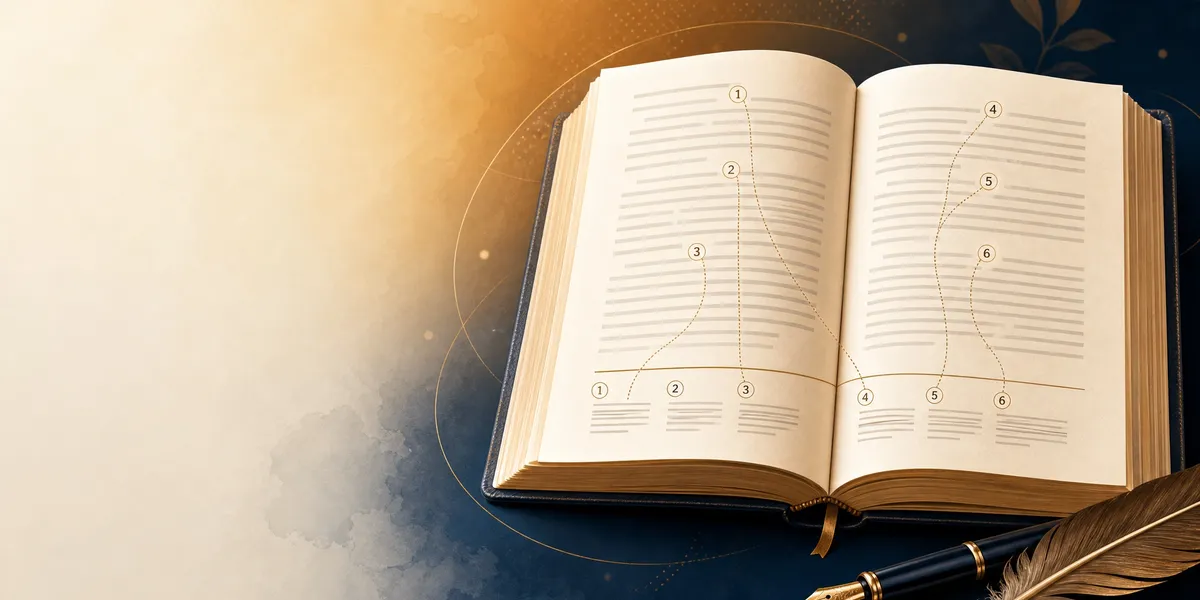
The difference between a footnote and an endnote is location: a footnote appears at the bottom of the same page as the text it references, while an endnote is grouped with all the other notes at the end of a chapter or book.
In this guide, you’ll learn:
- The exact difference between footnotes and endnotes, with real examples
- When Chicago, MLA, and APA actually expect you to use each one
- Why ebooks handle footnotes differently than print books — and what that means for your manuscript
- How to insert either one in Word and Google Docs
- The mistakes that make notes distracting instead of useful
Here’s how the two actually work.
What Is a Footnote?
Footnote — a numbered note that appears at the bottom of the same page as the superscript number in your text, giving a source citation or extra detail without leaving the page.
A footnote’s whole job is proximity. Your reader hits a small superscript number¹ mid-sentence, glances down to the bottom margin, reads the note, and looks back up — all without losing their place.
That immediacy is the footnote’s biggest advantage. In dense academic or historical nonfiction, where a single paragraph might lean on three or four sources, footnotes let a reader verify a claim in seconds instead of flipping pages.
Footnotes reset or continue numbering by page, chapter, or the whole document, depending on your style guide and word processor settings. Chicago-style footnotes typically restart at 1 with each new chapter.
What Is an Endnote?
Endnote — a numbered note that appears in a single list at the end of a chapter or the entire book, rather than at the bottom of the page where its superscript number occurs.
If a footnote is a quick glance down, an endnote is a deliberate trip. The reader has to leave the page, find the “Notes” section, locate the matching number, and read the entry — then find their place again.
That extra friction is exactly why some writers prefer endnotes. Long, detailed citations or lengthy tangential commentary can clutter a page if forced into a footnote. Pushed to the back of the book, they stop interrupting the reading experience entirely.
Endnotes are the default in most trade nonfiction, memoir, and narrative history — genres where publishers want the page to look clean and the prose to read like a story, not a research paper.
Footnote vs Endnote: Side by Side
Here’s the difference between a footnote and an endnote at a glance:
| Aspect | Footnote | Endnote |
|---|---|---|
| Location | Bottom of the same page | List at the end of the chapter or book |
| Reader effort | Glance down, no page turn | Flip to the back, then flip back |
| Best for | Frequent, short citations readers need immediately | Long notes, tangents, or books with heavy sourcing |
| Visual effect on page | Can crowd the bottom margin if notes run long | Keeps the main text completely uninterrupted |
| Common in | Academic papers, legal writing, textbooks | Memoir, narrative nonfiction, trade history books |
| Numbering | Often resets per page or chapter | Usually continuous per chapter or whole book |
The underlying content — a citation, a clarification, an aside — is identical either way. What changes is purely where your reader has to look to find it.
When Should You Use Footnotes Instead of Endnotes?
You should use footnotes when your readers need to verify or read a source immediately, without breaking their reading flow to flip to the back of the book. This matters most in academic papers, legal documents, and reference works where citation density is high.
Footnotes also work well when your notes are short — a page number, a quick source, a one-line clarification. Short notes barely dent the bottom margin, so the page still reads cleanly.
If you’re writing for professors, journal editors, or an academic press, check their house style before you decide. Many academic disciplines default to footnotes specifically because reviewers expect to fact-check claims without hunting through a back-of-book list, a preference Merriam-Webster’s own usage guide confirms is standard across most classroom settings.
When Should You Use Endnotes Instead of Footnotes?
You should use endnotes when you want your main text to read without visual interruption — the priority in memoir, narrative nonfiction, and any book where the reading experience matters more than instant source-checking.
Endnotes are also the better choice when individual notes run long. A three-sentence tangent or a full bibliographic citation looks cramped squeezed under a page of prose, but it reads fine as its own line in a back-of-book list.
Publishers of trade nonfiction lean toward endnotes for this exact reason. A memoir with footnotes on every page can look and feel like a textbook — which usually isn’t the tone the author or the marketing department wants.
How Do Footnotes and Endnotes Differ Across Citation Styles?
The choice between footnotes and endnotes isn’t always yours to make — it depends heavily on which citation style governs your writing:
| Style | Preferred note type | Typical use case |
|---|---|---|
| Chicago (Notes-Bibliography) | Footnotes preferred, endnotes acceptable | History, art, and many humanities disciplines |
| MLA 9th | Rarely uses either — prefers parenthetical citation | Literature, language, and humanities papers |
| APA 7th | Rarely uses either — prefers parenthetical citation | Psychology, education, and social sciences |
| Trade nonfiction (no fixed style) | Endnotes by convention | Memoir, popular history, business books |
Chicago’s notes-bibliography system is the one style built around footnotes and endnotes as the primary citation method. Every time you quote or paraphrase a source, a superscript number points to a full note containing the source details — a structure the Chicago Manual of Style’s own citation guide lays out in full.
MLA and APA both center on parenthetical in-text citations — (Author, Year) or (Author Page) — with a reference list or works cited page at the end. Footnotes and endnotes exist in both styles, but only for supplementary commentary, not standard sourcing. The MLA Style Center and APA Style’s own guidelines both confirm notes are the exception, not the rule, in their respective systems.
If you’re weighing citation formats more broadly, our guide to the difference between citation and reference breaks down how in-text citations connect to your source list, and referencing a book in APA format walks through APA’s parenthetical system step by step.
What Do Footnotes and Endnotes Actually Look Like?
Seeing the two side by side makes the difference concrete. Say your sentence reads: “Reading habits shifted dramatically after 2020.¹” That superscript 1 points to a note — and where that note physically lives is the only thing that changes.
As a footnote, at the bottom of that same page:
- Tara Nguyen, The Quiet Reader (New York: Riverhead Books, 2023), 42.
As an endnote, in a “Notes” section at the end of the chapter or book, listed under the same number:
- Tara Nguyen, The Quiet Reader (New York: Riverhead Books, 2023), 42.
Identical content, identical formatting, identical Chicago-style citation. The only variable is whether your reader finds it by glancing down or by flipping to the back.
Chicago style also distinguishes between a full note (the complete citation above, used the first time a source appears) and a short note for every citation after that:
- Nguyen, The Quiet Reader, 58.
That shortened format — author surname, shortened title, page number — applies whether you’re using footnotes or endnotes. The note type and the note format are two separate decisions, and it’s easy to conflate them when you’re new to Chicago style.
One more wrinkle worth knowing: some writers use “footnote” loosely to describe any note, including ones at the end of a document. Technically that’s a misnomer — a note at the back of a book is never a footnote, no matter what a writer calls it in conversation. The Chicago Manual of Style and most academic style guides are precise about this, even when everyday usage isn’t.
Footnotes and Endnotes in Ebooks vs Print Books
This is the part most citation guides skip, and it matters more than style preference if you’re self-publishing: reflowable ebooks cannot support true footnotes at all.
A print page has a fixed bottom margin, so a footnote always knows exactly where to sit. An EPUB or Kindle file is reflowable — its “page” resizes based on the reader’s font size, screen, and device — so there’s no fixed bottom edge for a note to anchor to.
Because of that technical limit, ebook conversion services and most professional formatters convert every footnote into a linked endnote automatically. If your manuscript has Word footnotes, expect them to become clickable jump-links to a notes section when the file becomes an EPUB or MOBI.
Those jump-links behave inconsistently across reading apps. Some show a pop-up overlay, some send the reader to the end of the chapter, and older Kindle devices sometimes lose the “back” link entirely, stranding the reader in the notes section.
The practical takeaway for authors: if your book will exist as both print and ebook, write and format for endnotes from the start. It’s the one note style that works identically — and predictably — in both formats.
If you’re prepping a manuscript for KDP or another platform, our ebook formatting guide covers testing your file in Kindle Previewer before you publish, and how to self-publish a book on Amazon walks through the full upload process end to end.
Our Pick — Chapter
Chapter helps nonfiction authors draft and structure a book with AI, keeping your research and source notes organized as you write — so choosing between footnotes and endnotes later is a formatting decision, not a scramble to reconstruct where every fact came from.
Best for: nonfiction authors who want a clean manuscript that formats cleanly for both print and ebook. Pricing: $97 one-time (nonfiction). Why we built it: over 10,000 authors have used Chapter to write books, and it’s been featured in USA Today and The New York Times — because a well-sourced manuscript shouldn’t fall apart the moment you convert it to EPUB.
How Do You Insert a Footnote or Endnote in Word and Google Docs?
You insert a footnote or endnote in Microsoft Word from the References tab — click “Insert Footnote” or “Insert Endnote,” and Word automatically numbers it and formats the note area for you.
In Google Docs, go to Insert > Footnote (or use the keyboard shortcut Ctrl+Alt+F on Windows, Cmd+Option+F on Mac). Google Docs only supports footnotes natively — there’s no built-in endnote command.
To create endnotes in Google Docs, most writers insert footnotes throughout the draft, then use Find & Replace or a formatting pass at the end to move all notes into a manually built “Notes” section — or export to Word, where true endnotes are supported.
Both programs let you switch a note’s numbering style (numbers, letters, or symbols) and reset numbering per section. Check your citation style’s rules before you pick — Chicago typically wants continuous numbers per chapter, not the whole book.
Common Mistakes to Avoid
- Mixing footnotes and endnotes in the same manuscript. Pick one system and use it consistently — a reader shouldn’t have to guess where note 12 lives.
- Writing endnotes so long they read like a second chapter. If a note runs past a few sentences, ask whether it belongs in the main text instead.
- Forgetting to test ebook conversion before publishing. Footnotes that convert to endnotes can lose their links. Preview the final file before it goes live.
- Inconsistent numbering resets. Restarting at 1 every page in one chapter and never resetting in the next confuses readers and looks unedited.
- Using footnotes for citation-heavy academic work when the house style calls for parenthetical citation, or vice versa — always confirm what your publisher, professor, or press actually requires.
- Skipping ibid. rules — Chicago-style notes have specific conventions for repeating a source directly above, and getting that shorthand wrong is a common giveaway of an unedited manuscript.
Can You Use Both Footnotes and Endnotes in the Same Book?
Generally, no — most style guides and publishers expect a single, consistent note system throughout a manuscript, not a mix of footnotes and endnotes.
The rare exception is a book that separates content types: using footnotes for brief translations or definitions readers need instantly, and endnotes for full source citations they can check later. Even then, this split needs to be explicit and consistent, not accidental.
If you’re not sure which system your project needs, our guide to citing sources in a book covers how trade nonfiction conventions differ from academic requirements.
How Many Footnotes or Endnotes Is Too Many?
There’s no fixed limit on footnotes or endnotes — the right number depends on how research-heavy your book is, not a formatting rule. A dense academic history might carry hundreds; a memoir might carry a dozen.
The better test isn’t a count, it’s a rhythm check. If notes appear on nearly every line, your reader’s eye never settles into the main text — that’s usually a sign some of those notes belong inline instead.
For genre-specific guidance on how formal your sourcing needs to be, citing sources in a nonfiction book covers matching citation density to your genre, from lightly-sourced memoir to heavily-footnoted narrative history.
FAQ
What is the main difference between a footnote and an endnote?
The main difference is location: a footnote sits at the bottom of the page it refers to, while an endnote is grouped with all other notes in a list at the end of a chapter or book.
Which is better, footnotes or endnotes?
Neither is universally better — footnotes suit dense, citation-heavy work readers need to verify instantly, while endnotes suit narrative nonfiction and memoir where an uninterrupted reading experience matters more than instant fact-checking.
Do ebooks use footnotes or endnotes?
Ebooks effectively use endnotes only — reflowable formats like EPUB and Kindle have no fixed page for a footnote to anchor to, so any Word footnotes typically convert into linked endnotes during ebook formatting.
Does Chicago style prefer footnotes or endnotes?
Chicago’s notes-bibliography system prefers footnotes but accepts endnotes, and citations follow the identical format either way. The choice usually comes down to publisher or instructor preference, not a strict Chicago rule.
Can a footnote and an endnote contain the same information?
Yes — a footnote and an endnote can contain identical content; the only difference is placement on the page versus placement in a back-of-book list. What changes your choice is reader experience, not the note’s substance.
Still sorting out citation vocabulary? Our guides to the difference between bibliography and works cited and what “ibid.” actually means clear up two more terms writers mix up constantly. And if “cite” keeps autocorrecting to “site” in your drafts, cite vs. site vs. sight settles that in under two minutes. For tracking sources as you write instead of reconstructing them later, organizing research for a book covers a capture-as-you-go system. For an academic-writing perspective on the same distinction, Scribbr’s footnotes vs. endnotes guide and Purdue OWL’s research and citation resources are both worth a look.