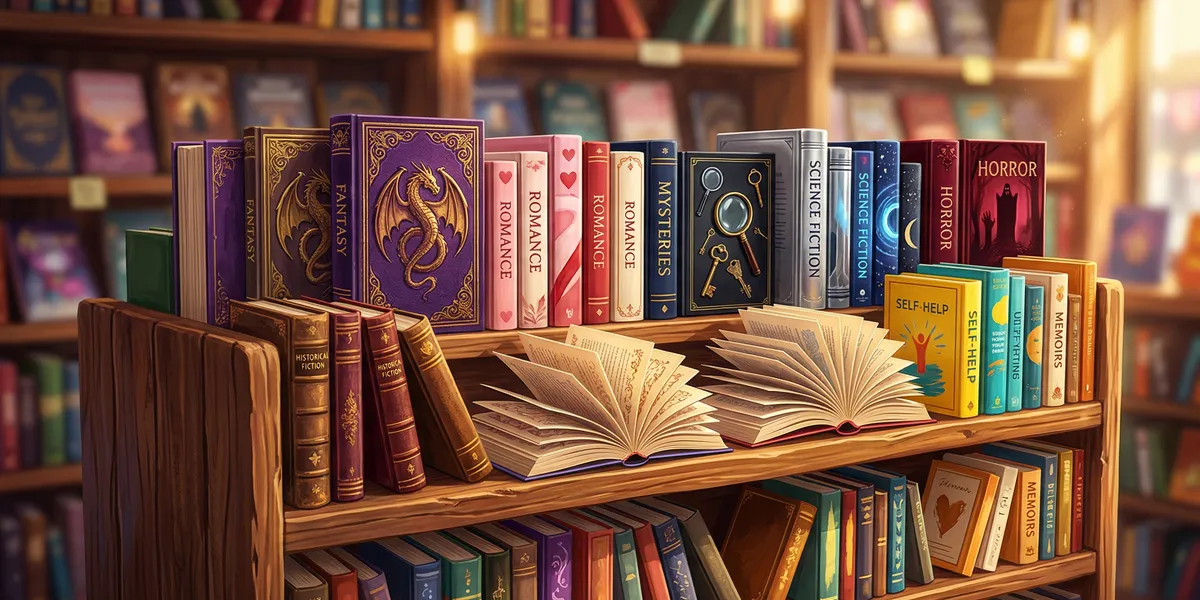
There are over 40 recognized book genres — and hundreds of subgenres beneath them. Whether you’re choosing what to read next or deciding what to write, understanding different book genres helps you find exactly the right fit.
In this guide, you’ll learn:
- Every major fiction and nonfiction genre (with clear definitions)
- How genres differ from subgenres — and why it matters
- Which genres are trending in 2026
- How to pick the right genre for your own book
Here’s the full breakdown, starting with fiction.
What Is a Book Genre?
A book genre is a category that classifies books by shared themes, writing style, tone, and narrative structure. Genres set reader expectations — when you pick up a mystery, you expect a crime to solve. When you grab a romance, you expect a love story with an emotionally satisfying ending.
Genres exist for practical reasons too. Publishers use them to market books. Bookstores use them to organize shelves. Amazon alone has over 16,000 genre and subgenre categories — which shows just how granular classification can get.
But at the top level, every book falls into one of two camps: fiction or nonfiction.
Fiction Genres
Fiction covers any book built on invented characters, settings, or events. Here are the major fiction genres you should know.
Romance
Romance is the best-selling fiction genre in the United States, generating over $1.4 billion in annual revenue. The defining feature is a central love story with an emotionally satisfying ending (HEA — happily ever after — or HFN — happy for now).
Popular subgenres include contemporary romance, historical romance, paranormal romance, dark romance, and billionaire romance.
Readers expect: Emotional depth, chemistry between leads, and a satisfying resolution.
Mystery
Mystery novels revolve around a crime — usually a murder — that the protagonist must solve. Clues are planted throughout the story, and the satisfaction comes from piecing them together before the reveal.
Key subgenres: cozy mystery (lighter tone, amateur sleuth), hardboiled detective, police procedural, and locked-room mystery.
Readers expect: Suspense, red herrings, and a logical solution.
Thriller and Suspense
Thrillers keep you on the edge of your seat with high stakes, fast pacing, and constant tension. While mysteries focus on solving a past crime, thrillers focus on preventing a future one.
Subgenres include psychological thriller, legal thriller, spy thriller, and techno-thriller.
Readers expect: Relentless pace, plot twists, and a ticking clock.
Science Fiction
Science fiction explores speculative concepts rooted in science and technology — space travel, artificial intelligence, time travel, parallel universes, and advanced civilizations.
The genre splits broadly into hard sci-fi (scientifically rigorous) and soft sci-fi (focused more on social and political themes).
Subgenres: space opera, cyberpunk, post-apocalyptic, military sci-fi, and climate fiction.
Readers expect: World-building, big ideas, and internal consistency.
Fantasy
Fantasy features supernatural or magical elements that don’t exist in the real world. Stories may take place in entirely invented worlds (epic fantasy) or blend magic into our own (urban fantasy).
Subgenres include epic/high fantasy, dark fantasy, urban fantasy, fairy tale retellings, and YA fantasy.
Readers expect: Rich world-building, magic systems, and quests or journeys.
Horror
Horror fiction is designed to frighten, disturb, or unsettle the reader. It taps into primal fears — death, the unknown, loss of control — and can use supernatural or psychological elements to create dread.
Subgenres: supernatural horror, psychological horror, gothic horror, cosmic horror, and body horror.
Readers expect: Atmosphere, escalating tension, and genuine scares.
Historical Fiction
Historical fiction is set in a specific past time period and uses real historical events, settings, or figures as a backdrop. While the characters may be fictional, the world they inhabit is grounded in documented history.
Subgenres: historical romance, historical mystery, alternate history, and war fiction.
Readers expect: Period-accurate detail, immersive settings, and stories that illuminate real events.
Literary Fiction
Literary fiction prioritizes prose style, character depth, and thematic exploration over plot-driven entertainment. These books often tackle complex social, emotional, or philosophical questions.
The line between literary and commercial fiction is blurry — many books straddle both. Literary fiction is sometimes called “upmarket fiction” when it blends literary quality with accessible storytelling.
Readers expect: Beautiful writing, layered characters, and ideas that linger.
Contemporary Fiction
Contemporary fiction is set in the present day and deals with current themes and modern life. It’s a broad category that overlaps with many others — a contemporary novel could also be literary fiction, romance, or a family drama.
Readers expect: Relatable settings, modern issues, and character-driven stories.
Young Adult (YA)
YA fiction targets readers aged 12-18 but has a massive adult readership too. Protagonists are typically teenagers navigating identity, relationships, and coming-of-age experiences.
YA spans every genre — YA fantasy, YA sci-fi, YA romance, YA thriller. The audience defines it more than the content.
Readers expect: Teen protagonists, accessible voice, and emotional authenticity.
New Adult
New Adult bridges the gap between YA and adult fiction, featuring protagonists aged 18-25 dealing with college, first jobs, new independence, and adult relationships. It emerged as a distinct category around 2012.
Readers expect: More mature themes than YA, relatable life transitions.
Dystopian Fiction
Dystopian fiction imagines oppressive future societies where personal freedom is restricted by government, technology, or social structures. It’s a subgenre of sci-fi that consistently resonates during periods of political tension.
Classic examples have shaped the genre into a cultural touchstone, and the category continues to produce bestsellers.
Readers expect: Totalitarian systems, rebellion, and social commentary.
Magical Realism
Magical realism blends supernatural elements into an otherwise realistic narrative — without treating the magic as extraordinary. Characters accept impossible events as normal parts of life.
It differs from fantasy in tone and intent. Fantasy builds alternate worlds; magical realism inserts wonder into this one.
Readers expect: Lyrical prose, cultural richness, and the extraordinary treated as ordinary.
Action and Adventure
Action and adventure novels deliver fast-paced physical conflict, quests, and high-stakes journeys. The protagonist faces danger head-on, often traveling to exotic locations.
Readers expect: Pace, physicality, and a protagonist who acts.
Graphic Novels
Graphic novels use sequential art combined with text to tell complete stories. They span every genre — memoir, fantasy, literary fiction, horror — and are recognized as a distinct format rather than a single genre.
Readers expect: Visual storytelling, panel-by-panel pacing, and art that carries narrative weight.
Nonfiction Genres
Nonfiction covers any book based on real events, people, facts, or ideas. Here are the major categories.
Memoir and Autobiography
Memoirs focus on a specific period, theme, or experience from the author’s life. Autobiographies cover a broader life span. Both are first-person accounts of real events.
The distinction: a memoir is selective and thematic. An autobiography is comprehensive and chronological.
Readers expect: Honesty, vulnerability, and a compelling personal narrative.
Biography
Biographies are accounts of someone’s life written by another person. They require extensive research — interviews, archives, correspondence — and range from scholarly to popular.
Readers expect: Thorough research, balanced perspective, and a well-told life story.
Self-Help
Self-help books provide strategies, frameworks, and actionable advice for personal improvement. Topics range from productivity and habits to relationships and mental health.
The genre is one of the fastest-growing in publishing, with the global self-improvement market valued at over $40 billion.
Readers expect: Practical takeaways, clear frameworks, and results they can apply immediately.
History
History books present researched accounts of past events, periods, or cultures. They range from academic works to narrative history that reads like a novel.
Subgenres: military history, social history, cultural history, and microhistory (deep dives into a single event or object).
Readers expect: Accurate research, compelling narrative, and fresh perspective.
True Crime
True crime explores real criminal cases — murders, heists, fraud, and cold cases. The genre surged in popularity with podcasts and documentaries, and book sales have followed.
Readers expect: Investigative depth, factual accuracy, and ethical sensitivity.
Science and Nature
Science books translate complex scientific concepts for general readers. They cover everything from astrophysics and biology to climate science and neuroscience.
Readers expect: Accuracy, accessible explanations, and a sense of wonder.
Business and Finance
Business books cover entrepreneurship, management, economics, investing, and career development. They often present a central thesis supported by case studies and data.
Readers expect: Actionable insight, real-world examples, and frameworks they can use.
Travel
Travel writing captures places, cultures, and journeys. It ranges from practical guidebooks to literary travel narratives that use location as a lens for deeper themes.
Readers expect: Vivid description, cultural insight, and a sense of place.
Essay Collections
Essay collections gather short-form nonfiction pieces around a theme, topic, or simply by a single author. They’ve grown in popularity as readers embrace shorter, focused reading.
Readers expect: Strong voice, varied perspectives, and standalone pieces that form a larger whole.
Religion and Spirituality
Books in this genre explore faith, spiritual practice, theology, and philosophical questions about meaning and purpose. They range from scripture commentary to modern spiritual guides.
Readers expect: Sincerity, depth, and respect for the reader’s own journey.
How-To and Reference
How-to books teach specific skills or processes — cooking, woodworking, coding, gardening. Reference books provide organized information designed for consultation rather than cover-to-cover reading.
Readers expect: Clear instructions, visual aids, and practical results.
Genre vs. Subgenre: What’s the Difference?
A genre is a broad category. A subgenre is a more specific classification within that category. Think of it like a family tree:
| Level | Example |
|---|---|
| Genre | Romance |
| Subgenre | Historical Romance |
| Sub-subgenre | Regency Romance |
Subgenres matter because they set more precise expectations. A reader who loves Regency romance may not enjoy contemporary romance at all — even though both fall under the same genre umbrella.
Amazon uses this hierarchy extensively. Choosing the right subgenre categories when you publish is one of the most impactful things you can do for discoverability.
How to Choose the Right Genre for Your Book
If you’re writing a book, picking the right genre isn’t just creative — it’s strategic. Here’s a practical framework:
1. Identify your core story element. What drives the narrative? A love story is romance. A crime to solve is mystery. A speculative world is sci-fi or fantasy. Start with the engine of your plot.
2. Study the reader expectations. Every genre has conventions. Romance readers expect a satisfying ending. Thriller readers expect pace. Breaking conventions is fine — but you need to know what you’re breaking.
3. Research the market. Some genres have enormous readership (romance, thriller) while others are more niche (literary fiction, essay collections). Neither is better, but understanding the market size helps you set realistic expectations.
4. Check where your book would sit on a shelf. Imagine walking into a bookstore. Where would your book belong? If you can’t answer that clearly, your genre may be too vague.
5. Use AI tools to test your concept. Modern AI writing tools can help you develop your book idea within a specific genre framework, testing outlines and chapter structures before you commit to months of writing.
Our Pick — Chapter
Chapter helps you write your book in any genre — fiction or nonfiction. Its AI-powered workflow guides you from outline to finished manuscript, adapting to your genre’s conventions automatically.
Best for: Authors writing their first book who need structure and guidance Pricing: $97 one-time (nonfiction) | Varies (fiction) Why we built it: Every genre has different structural requirements, and Chapter adapts to all of them
Which Book Genres Are Most Popular in 2026?
Genre popularity shifts constantly, but some categories consistently dominate sales:
| Genre | Why It’s Popular |
|---|---|
| Romance | Largest fiction market by revenue, massive indie author ecosystem |
| Thriller/Suspense | Universal appeal, strong adaptation pipeline to film and TV |
| Fantasy | Boosted by streaming adaptations and global fandoms |
| Self-Help | Growing personal development culture, fueled by social media |
| Memoir | Authenticity-driven reading trends, celebrity and creator memoirs |
| True Crime | Podcast crossover effect continues to drive book sales |
The rise of AI book writing tools has also lowered the barrier to entry across all genres, particularly in nonfiction categories like self-help and how-to guides. Over 5,000 books have been created using Chapter alone, spanning nearly every genre listed in this guide.
Can a Book Belong to Multiple Genres?
Yes — and most books do. A novel might be classified as both historical fiction and romance (historical romance). A nonfiction book could be both business and self-help.
The key is identifying your primary genre for marketing purposes. When you publish on Amazon or pitch to agents, you lead with the genre that best describes the core reading experience. Secondary genres help with discoverability.
Cross-genre books can be harder to market because they don’t fit neatly into one box. But they can also reach wider audiences by appearing in multiple category searches.
How Many Book Genres Are There?
The answer depends on how granular you get. At the broadest level, there are two: fiction and nonfiction. Most industry professionals recognize 30-50 distinct genres. Amazon lists over 16,000 categories and subcategories.
The number keeps growing. Genres like LitRPG (literary role-playing game fiction), cozy fantasy, and climate fiction barely existed a decade ago. Reader demand creates new genres, and publishing adapts.
Common Mistakes When Choosing a Genre
- Being too vague. Calling your book “fiction” doesn’t help readers or retailers find it. Get specific.
- Chasing trends blindly. Writing in a hot genre you don’t enjoy leads to burnout and mediocre books. Write what you love, then market it strategically.
- Ignoring genre conventions. Every genre has rules. You can bend them, but readers who pick up a mystery expect a solution. Defy that at your peril.
- Confusing genre with audience. YA is an audience category, not a genre. Your YA book still needs a genre — YA fantasy, YA contemporary, YA thriller.
- Picking too many genres. If your book is “a sci-fi romance thriller with horror elements and literary prose,” you may need to simplify your concept.
FAQ
What Are the Main Types of Book Genres?
The main types of book genres are fiction and nonfiction. Fiction includes romance, mystery, thriller, science fiction, fantasy, horror, historical fiction, literary fiction, and contemporary fiction. Nonfiction includes memoir, biography, self-help, history, true crime, and business. Most sources recognize 30-50 distinct genres in total.
What Is the Most Popular Book Genre?
The most popular book genre is romance, which generates over $1.4 billion in annual revenue in the United States alone. Thriller and suspense ranks second, followed by mystery and science fiction/fantasy. In nonfiction, self-help and memoir are consistently the top-selling categories.
How Do I Know What Genre My Book Is?
To determine your book’s genre, identify the core element driving your narrative. Ask what promise your book makes to the reader. A central love story means romance. A crime to solve means mystery. A speculative world means sci-fi or fantasy. Then look at comparable titles — what genre are similar books shelved under? That’s likely yours too.
What’s the Difference Between Genre Fiction and Literary Fiction?
Genre fiction follows established conventions and prioritizes plot, pacing, and reader entertainment — think mystery, romance, and thriller. Literary fiction prioritizes prose quality, character depth, and thematic complexity over plot structure. The boundary is blurry, and many successful books blend both approaches. The distinction matters more for marketing than for quality.
Can You Create a New Book Genre?
Yes — new book genres emerge regularly as reader tastes evolve. LitRPG (literary role-playing game fiction), cozy fantasy, and climate fiction are all genres that developed in the last decade. New genres typically start as subgenres within existing categories and gain recognition once enough books and readers cluster around shared conventions.