Dystopian fiction is one of the most powerful genres in literature, and yes, you can write it. This guide walks you through every step, from building a believable oppressive world to crafting characters who fight back against it.
Whether you are planning a full novel or a short story, dystopian writing follows a clear structure. You need a broken society, a character who sees through it, and a central theme that connects everything. Here is how to put those pieces together.
What Makes Fiction Dystopian
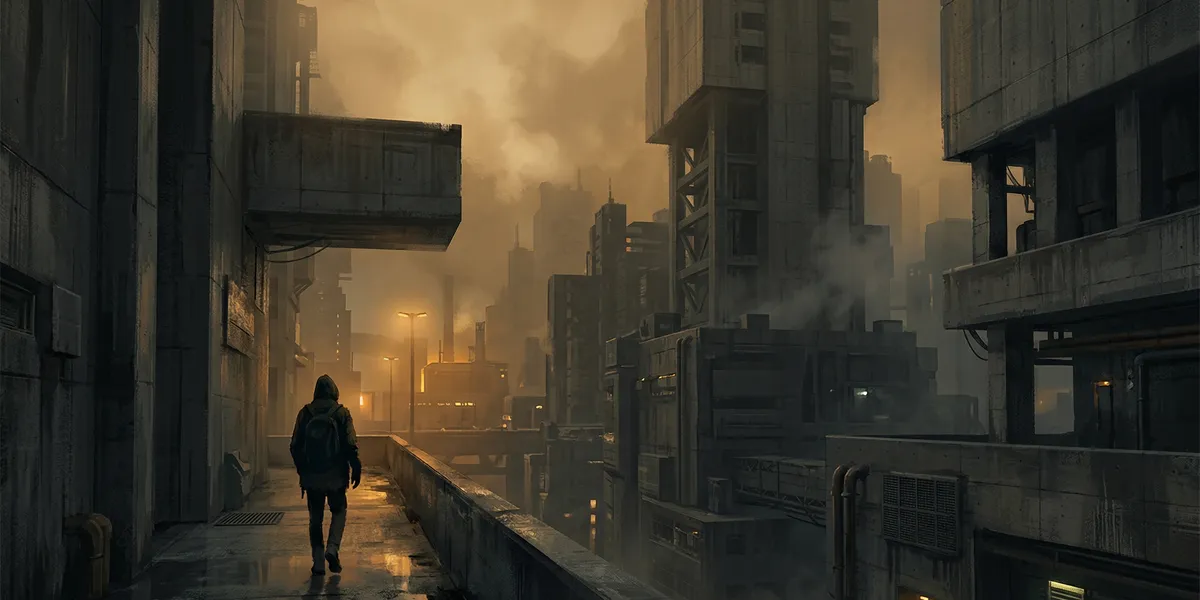
A dystopian story takes place in a society where something has gone fundamentally wrong. That could mean a totalitarian government, environmental collapse, technological overreach, or the erosion of personal freedoms. The key ingredient is that the world feels like it could happen.
George Orwell’s 1984 explored government surveillance taken to its extreme. Aldous Huxley’s Brave New World showed control through pleasure rather than pain. Margaret Atwood’s The Handmaid’s Tale imagined a theocratic takeover of reproductive rights. Each of these classics started with a real fear and pushed it to its logical conclusion.
That is what separates dystopian fiction from general science fiction. Dystopian stories are not about technology for its own sake. They are about what happens to people when systems designed to protect them become the threat.
Step 1: Choose Your Central Theme
Every strong dystopian novel orbits a single theme. Pick yours before you build anything else.
Common dystopian themes include:
- Government overreach — surveillance, censorship, thought control (1984, Fahrenheit 451)
- Environmental collapse — climate disaster, resource wars, poisoned landscapes (Parable of the Sower, The Road)
- Technological control — AI dominance, social scoring, genetic engineering (Brave New World, Never Let Me Go)
- Class and inequality — rigid caste systems, wealth hoarding, labor exploitation (The Hunger Games, Elysium)
- Loss of identity — forced conformity, memory erasure, dehumanization (We, The Giver)
Your theme is your story’s spine. Once you choose it, every world-building decision, every character motivation, and every plot point should connect back to it.
Example: If your theme is technological control, your world might feature mandatory brain implants, your protagonist might be someone whose implant malfunctions, and your central conflict is what happens when one person can think freely in a society that cannot.
Step 2: Build Your Dystopian World
World-building is the backbone of dystopian fiction. But the best dystopias feel less like alien planets and more like a twisted version of Tuesday.
Start With the Present
The most effective approach is to take one real trend and extrapolate it forward. Ask yourself: What if this thing that already worries me got ten times worse?
- Social media addiction becomes mandatory digital connection
- Climate change becomes permanent toxic atmosphere
- Wealth inequality becomes a literal physical divide between classes
Define the Rules
Your dystopian society needs clear, consistent rules. Answer these questions:
| Question | Why It Matters |
|---|---|
| Who holds power? | Defines the oppressive force |
| How is power maintained? | Reveals the system’s enforcement mechanism |
| What is forbidden? | Creates the stakes for your protagonist |
| What do citizens believe? | Shows the propaganda or accepted narrative |
| What happened to get here? | Grounds the world in plausibility |
Show, Do Not Explain
Resist the urge to open your novel with three pages of world-building exposition. Let readers discover the rules through your character’s daily life. A scene where someone avoids eye contact with a surveillance drone tells us more than a paragraph explaining the drone surveillance program.
Step 3: Create a Protagonist Who Awakens
Dystopian protagonists follow a specific arc. They start inside the system, something shakes them loose, and they cannot go back.
The classic dystopian protagonist moves through three phases:
- Compliance — They live within the system, possibly even supporting it
- Awakening — Something forces them to see the truth (a forbidden book, a chance encounter, a system glitch)
- Resistance — They act against the system, at personal cost
What makes your protagonist compelling is not superhuman ability. It is their specific vulnerability. In The Handmaid’s Tale, Offred’s power comes from memory, from refusing to forget who she was before. In 1984, Winston Smith’s rebellion starts with the small act of writing in a diary.
Give your protagonist:
- A personal stake — not just ideological opposition, but something they stand to lose
- A flaw that the system exploits — fear, loyalty, desire for comfort
- A skill or perspective that lets them see what others cannot
For more on building layered characters, see our guide on character development.
Step 4: Design Your Opposition
The antagonist in dystopian fiction is usually a system rather than a single villain. But that system still needs a face.
The system itself — In 1984, Big Brother may not even exist as a person, but the Party is an overwhelming, faceless antagonist.
A human enforcer — President Snow in The Hunger Games gives the Capitol a personal, hateable representative.
An ideology — Sometimes the antagonist is not a person at all but a set of beliefs that society has accepted as truth.
The strongest dystopian antagonists are the ones readers can almost understand. A villain who believes they are building a better world is more frightening than one who is simply evil. If your oppressive government genuinely eliminated famine by controlling reproduction, readers are forced to wrestle with the moral cost. That discomfort is where great dystopian fiction lives.
Step 5: Structure Your Plot
Dystopian novels typically follow one of three plot structures:
The Rebellion Arc
The protagonist joins or sparks a revolution. This is the most common structure (The Hunger Games, Divergent, Red Rising). The story escalates from personal survival to collective action.
The Escape Arc
The protagonist tries to flee the dystopian society rather than overthrow it. This works well for more intimate, character-driven stories (Never Let Me Go, The Road).
The Infiltration Arc
The protagonist works within the system to expose or undermine it. This creates sustained tension because discovery means death (1984, The Testaments).
No matter which structure you choose, your story structure needs escalating stakes. Each act should raise the personal cost for your protagonist:
- Act 1 — Establish the world and the character’s place in it. End with the awakening moment.
- Act 2 — The protagonist acts against the system and faces consequences. Introduce allies and betrayals. The midpoint should shift the protagonist from reactive to proactive.
- Act 3 — The final confrontation. Dystopian endings do not have to be happy, but they do need to be meaningful.
Step 6: Get the Details Right
The small, specific details are what make dystopian fiction feel real rather than generic.
Language and Terminology
Create a few terms specific to your world. Orwell invented “Newspeak” and “doublethink.” Atwood gave us “Handmaid” and “Ceremony.” You do not need a full glossary, but three or four original terms make your world feel lived-in.
Daily Life
What do people eat? How do they commute? What entertainment exists? These mundane details ground even the most extreme premise. A character eating government-issued protein paste at a communal table tells us about resource scarcity, surveillance, and social structure in a single image.
The Cost of Resistance
Show what your protagonist sacrifices. Not just physical danger but relationships, comfort, certainty. The reader needs to feel that resistance is genuinely costly, not a heroic adventure.
Common Mistakes to Avoid
- Info-dumping the dystopia — Do not explain the entire history of your world in chapter one. Let it unfold through action and dialogue.
- Making the protagonist a chosen one — The strongest dystopian heroes are ordinary people in extraordinary circumstances, not genetically special saviors.
- Forgetting the human story — World-building is a tool, not the destination. Readers stay for the characters, not the political system.
- Creating a cartoonishly evil government — If your oppressive regime has no internal logic, it will not feel believable. Real tyranny is often bureaucratic, not dramatic.
- Ignoring the ending — Dystopian stories need resolution, even if it is ambiguous. A protagonist who simply survives is a valid ending. A story that just stops is not.
Writing Your Dystopian Novel With AI
If you have a dystopian concept but struggle to turn it into a full manuscript, AI writing tools can help you develop your world-building, flesh out character arcs, and draft chapters faster.
Our Pick — Chapter
Chapter helps fiction writers go from concept to complete manuscript. Feed it your dystopian premise, and it helps you build out chapters, maintain consistency across your world-building details, and draft scenes that match your voice.
Best for: Fiction writers who have a story concept and want to turn it into a finished book Pricing: Varies by plan Why we built it: Because the hardest part of writing a dystopian novel is not the idea, it is getting 80,000 words onto the page
For more on using AI as a writing partner, see our guide on how to write a fiction book.
FAQ
What is the difference between dystopian and post-apocalyptic fiction?
Dystopian fiction features an organized (but oppressive) society. Post-apocalyptic fiction takes place after society has collapsed. The Hunger Games is dystopian because Panem has a functioning government. The Road is post-apocalyptic because civilization is gone. Some stories blend both.
Can dystopian fiction have a happy ending?
Yes. While many classics end on ambiguous or dark notes, a protagonist who achieves meaningful change or personal freedom can provide a satisfying conclusion. The ending should match the story’s tone and theme rather than follow a formula.
How long should a dystopian novel be?
Most dystopian novels fall between 70,000 and 100,000 words. Young adult dystopian tends to run shorter (60,000 to 80,000 words). Literary dystopian can push longer. Match your length to your audience and the complexity of your world.
Is dystopian fiction still popular?
The genre continues to perform well, particularly in hybrid forms like dystopian romance and climate fiction. Real-world events around AI, climate change, and political polarization keep readers drawn to stories that explore where current trends might lead.
Do I need to read classic dystopian novels before writing one?
Reading 1984, Brave New World, Fahrenheit 451, and The Handmaid’s Tale gives you a strong foundation. But you should also read recent dystopian fiction to understand how the genre has evolved. Contemporary readers expect more nuance, diverse perspectives, and faster pacing than the classics typically offer.
Looking for creative sparks? Check out our dystopian writing prompts for over 100 scenario ideas to get your story started. And for a deeper dive into structuring your plot, explore conflict in fiction and how to write a plot twist.