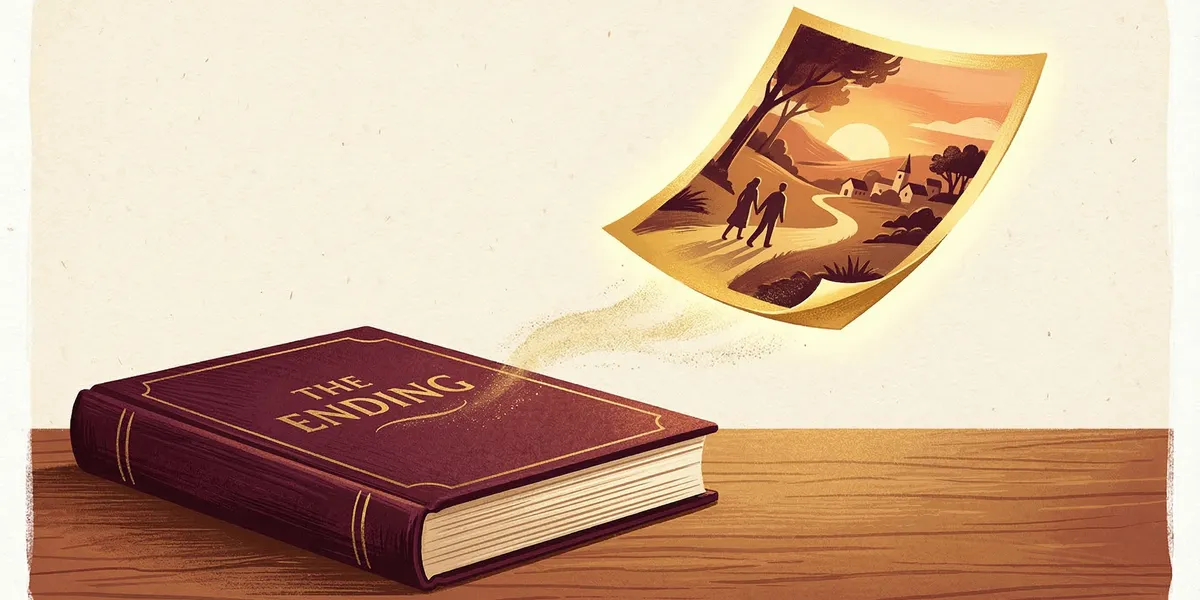
An epilogue is a final section that comes after a story’s main narrative has ended, offering a glimpse of what happens beyond the last chapter. It stands apart from the rest of the book — separated by time, perspective, or both — and gives the reader one last look at the world they have been living in.
What Is an Epilogue?
The word comes from the Greek epilogos, meaning “conclusion” or “closing word.” In practice, an epilogue is a short passage set after the story’s conflict has been resolved and its denouement has played out. It is not part of the plot. It is what comes after the plot.
Most epilogues share a few characteristics. They jump forward in time. They shift tone, often becoming quieter and more reflective. And they answer a question the main story deliberately left open: what happened next?
An epilogue can be a single page or a full chapter. It can follow the protagonist or shift to a different point of view entirely. There are no strict rules about format. The only requirement is that the main story must already be complete without it. An epilogue adds — it should never be the load-bearing wall.
Epilogue vs Conclusion
These terms often get used interchangeably, but they describe different things.
A conclusion is the natural ending of your story. It includes the falling action after the climax, the resolution of the central conflict, and the denouement that ties up remaining threads. Every story has a conclusion. It is built into the narrative structure.
An epilogue is optional. It exists outside the story’s timeline, usually jumping weeks, months, or years into the future. The conclusion closes the story. The epilogue reopens the door just long enough to show what life looks like on the other side.
A novel can have a conclusion without an epilogue. It cannot have an epilogue without a conclusion. If the story does not feel finished before the epilogue begins, the epilogue is doing work that belongs in the main narrative — and that is a structural problem, not a stylistic choice.
Famous Epilogues
The best way to understand what epilogues do is to see them working in published fiction.
Harry Potter and the Deathly Hallows — J.K. Rowling
The most discussed epilogue in modern fiction. Titled “Nineteen Years Later,” it jumps nearly two decades past Voldemort’s defeat to show Harry, Ginny, Ron, and Hermione as parents sending their own children to Hogwarts. The story’s conflict is long settled. Rowling uses the epilogue to answer the reader’s emotional question — did they get to live normal, happy lives? — with a single scene on Platform 9¾.
The Hunger Games: Mockingjay — Suzanne Collins
Collins closes the trilogy with an epilogue set years after the revolution. Katniss and Peeta have children. Katniss still carries her trauma but has found a fragile peace. The epilogue does not pretend everything is fine. It shows that survival is possible even when healing is incomplete — a tonal choice that matches the series perfectly.
1984 — George Orwell
Orwell’s appendix on “The Principles of Newspeak” functions as a kind of epilogue, written in past tense, implying that the Party eventually fell. It is never stated outright. The reader has to notice the tense shift and draw the conclusion themselves. It is one of the most subtle epilogues in literature — a single grammatical choice that reframes the entire novel.
The Handmaid’s Tale — Margaret Atwood
Atwood ends Offred’s story mid-sentence, then follows it with “Historical Notes” — a transcript of an academic conference set centuries in the future. Scholars discuss Offred’s account as a historical artifact. The epilogue confirms that Gilead fell, but it also shows how easily future generations can be detached from past suffering. It is simultaneously reassuring and chilling.
When to Include an Epilogue
Not every story needs one. An epilogue earns its place when it does something the main narrative cannot.
Time jumps. If the consequences of your story take years to unfold, an epilogue lets you show the long view without dragging the final act across decades. The reader gets closure on a timeline the plot could not reasonably cover.
Showing long-term consequences. The climax changed your characters’ lives. The denouement showed the immediate aftermath. But what about five years later? Ten? An epilogue answers whether the change stuck — whether the hero’s sacrifice actually mattered, whether the relationship survived, whether the world rebuilt itself.
Wrapping up threads that outlive the plot. Some subplots resolve on a longer timeline than the main story. A character who left town might return years later. A child born during the story might grow up. An epilogue gives these threads a place to land without inflating the final chapters.
Series closure. When a multi-book series ends, readers have invested hundreds of pages in these characters. An epilogue provides the extended goodbye that a single resolution scene cannot.
When NOT to Include One
An epilogue is a tool. Like any tool, using it when it is not needed weakens the work.
If the ending already satisfies. Some stories close so cleanly that adding an epilogue would dilute the impact. The final image is perfect. The reader feels complete. Adding more words after that moment is like explaining a joke.
If it exists only to set up a sequel. An epilogue that ends on a cliffhanger or introduces a new villain is not an epilogue — it is marketing. Readers can feel the difference. If you need to set up the next book, find a way to do it within the story’s natural structure.
If it answers questions the reader does not have. Not every loose thread needs tying. Sometimes ambiguity is the point. An epilogue that over-explains robs the reader of the pleasure of wondering.
If the story’s power comes from uncertainty. Some endings are deliberately open. The protagonist walks into the unknown. The reader is left to decide what happens. An epilogue that resolves that uncertainty can collapse the very thing that made the ending resonate.
How to Write a Strong Epilogue
Writing a good epilogue is harder than it looks. The story is already over. The tension that carried readers through three hundred pages is gone. You are writing without your best engine. Every sentence has to justify itself on pure craft.
Jump forward meaningfully. An epilogue set two weeks after the climax is just another chapter. Give it enough distance that the reader feels time has passed — that lives have been lived offscreen. The gap itself communicates something. It tells the reader that the characters kept going after the story stopped watching.
Change the texture. The epilogue should feel distinct from the chapters before it. Shift the pacing. Quiet the prose. Let the rhythm slow. The reader should sense immediately that they have crossed a threshold into a different emotional space.
Answer one or two questions, not all of them. The best epilogues are selective. They pick the one thing the reader most needs to know and deliver it clearly. They leave the rest alone. An epilogue that tries to account for every character and every subplot reads like a Wikipedia summary of your own book.
Earn the emotion. If the epilogue is going to make the reader cry — and the good ones often do — it should earn that response through specificity, not sentimentality. Show the small, concrete detail that proves life went on. Harry naming his son. Katniss watching her children play. The particular, not the general.
End on an image, not a statement. The final line of an epilogue is the final line of the entire book. It should land like a photograph, not a thesis. Give the reader something to see, something to carry. Let the meaning rise from the image itself.
Epilogue vs Prologue
These two bookend a story, but they serve opposite purposes.
| Prologue | Epilogue | |
|---|---|---|
| Position | Before the story begins | After the story ends |
| Time | Usually set before the main events | Usually set after the main events |
| Purpose | Establishes context, hooks the reader | Provides closure, shows consequences |
| Tension | Raises questions | Answers them |
| Necessity | Sets up what the reader needs to know | Adds what the reader wants to know |
A prologue says “before all this happened.” An epilogue says “and after it was over.” Both are optional. Both work best when they do something the main narrative cannot do on its own.
The strongest books use one or the other sparingly. Using both is not wrong, but it does frame the story twice — once before it begins and once after it ends. Make sure the main narrative is strong enough to stand between them without leaning on either for support.
If you are starting a story and considering a prologue, ask yourself whether that information could live in Chapter 1. If you are ending a story and considering an epilogue, ask yourself whether the final chapter already says enough. The answer, more often than not, is yes. But when the answer is no — when the story genuinely needs one more page — an epilogue can be the most quietly powerful part of the entire book.