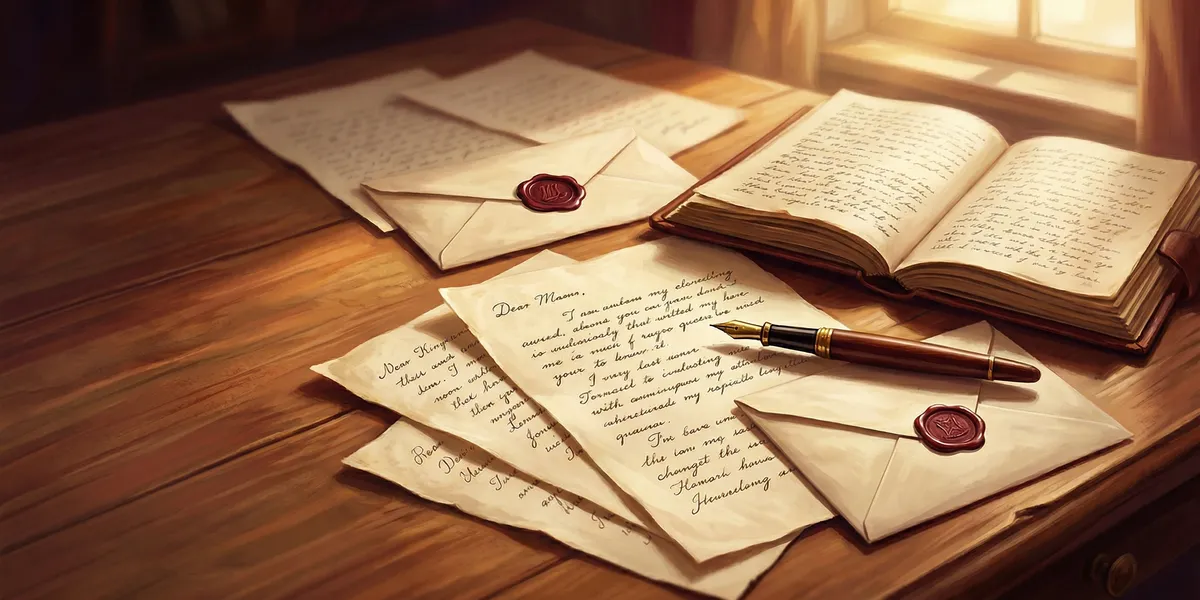
Epistolary is a form of storytelling told entirely through documents — letters, diary entries, emails, text messages, or any written record created by the characters themselves. The word comes from the Latin epistola, meaning letter, and the form has been shaping fiction since the 18th century.
This guide covers the epistolary definition, its three main types, examples from classic and modern fiction, and practical advice for writing your own epistolary story.
What Does Epistolary Mean?
Epistolary refers to any literary work composed of documents rather than traditional narration. Instead of a narrator describing events, the reader pieces the story together from artifacts the characters leave behind.
Those artifacts can be anything written:
- Letters between characters
- Diary or journal entries
- Emails and text messages
- News articles and reports
- Blog posts and social media updates
- Voicemails and transcripts
The defining feature is that no omniscient narrator exists. The reader sees only what the characters choose to write down, which means every document carries bias, gaps, and personality. That constraint is what gives the form its power.
The Three Types of Epistolary Fiction
Not every epistolary novel works the same way. The form breaks into three distinct structures based on how many voices are present.
Monologic
A monologic epistolary story uses a single voice. Only one character’s documents appear on the page. The reader never sees replies, reactions, or outside perspectives.
This creates deep intimacy but also deep unreliability. Everything the reader knows is filtered through one person’s perception. Diary novels almost always fall into this category.
Example: The Perks of Being a Wallflower by Stephen Chbosky — told entirely through letters the protagonist Charlie writes to an unnamed recipient. The reader never sees a reply.
Dialogic
A dialogic epistolary story shows correspondence between two characters. Letters go back and forth, and the reader watches a relationship develop in real time through the exchange.
The tension in dialogic epistolary fiction comes from the gap between what each character says and what the reader suspects they actually feel. Both voices reveal and conceal at the same time.
Example: Poor Folk by Fyodor Dostoevsky — a series of letters between Makar Devushkin and Varvara Dobroselova that reveals their growing connection and the social pressures working against them.
Polylogic
A polylogic epistolary story uses three or more voices and often multiple document types. Letters, diary entries, newspaper clippings, and official reports blend together to build a picture no single character could provide.
This is the most complex form. It allows for dramatic irony — the reader knows things individual characters do not — and it can create suspense by showing the same event from conflicting perspectives.
Example: Dracula by Bram Stoker — told through the journals, letters, newspaper articles, and telegrams of multiple characters. No single character understands the full scope of what is happening, but the reader does.
Famous Epistolary Novels
The epistolary form has a long history across genres and time periods. Here are some of the most significant examples.
| Novel | Author | Year | Document Type |
|---|---|---|---|
| Pamela | Samuel Richardson | 1740 | Letters |
| Clarissa | Samuel Richardson | 1748 | Letters |
| Les Liaisons dangereuses | Pierre Choderlos de Laclos | 1782 | Letters |
| Frankenstein | Mary Shelley | 1818 | Letters and narrative |
| Dracula | Bram Stoker | 1897 | Journals, letters, articles |
| The Color Purple | Alice Walker | 1982 | Letters |
| Carrie | Stephen King | 1974 | Articles, letters, excerpts |
| The Perks of Being a Wallflower | Stephen Chbosky | 1999 | Letters |
| We Need to Talk About Kevin | Lionel Shriver | 2003 | Letters |
| Where’d You Go, Bernadette | Maria Semple | 2012 | Emails, letters, documents |
What connects these books across centuries is the same core principle: the story lives in the documents, not beside them. The letters are not decoration. They are the architecture.
How to Write Epistolary Fiction
Writing in this form requires a different set of skills than traditional narration. Here is what to focus on.
Give Every Document a Reason to Exist
In a traditional novel, a character can think something and the reader sees it. In epistolary fiction, someone has to write it down. That means every letter, email, or diary entry needs a believable motivation.
Ask yourself: why is this character writing this, right now, to this person? If you cannot answer that question, the document will feel forced.
Make Each Voice Distinct
When multiple characters contribute documents, the reader should be able to identify the writer without checking the heading. Vocabulary, sentence length, tone, what each character notices and ignores — these all signal identity.
A teenager texting uses different language than a professor writing a formal letter. Make that difference felt on the page. If you need help developing distinct character voices, the fundamentals of character development apply here with extra urgency.
Use the Gaps
The most powerful tool in epistolary fiction is what the documents leave out. A character who writes around a topic instead of addressing it directly tells the reader more than a full confession would.
Letters can lie. Diaries can omit. Emails can perform. The gap between what characters write and what actually happened is where the real story lives. This principle connects directly to show, don’t tell — the form forces you to dramatize rather than explain.
Control the Timeline
Documents have dates. Use them strategically. A gap of three months between diary entries signals something the character could not bring themselves to write about. A burst of five letters in one day signals urgency or crisis.
The rhythm of correspondence — how often, how quickly, how the frequency changes — is a narrative tool as potent as pacing in any traditional narrative structure.
Choose Your Document Type Deliberately
The type of document shapes what kind of story you can tell:
- Letters create distance and formality. Characters perform for their audience.
- Diary entries create intimacy and rawness. The character writes for themselves alone.
- Emails and texts create speed and immediacy. Ideal for modern settings.
- Official documents (reports, articles, transcripts) create authority and dramatic irony. The reader sees institutional language hiding human reality.
Mix document types when your story needs multiple registers. A novel told through both personal diary entries and cold police reports creates a tension that neither could achieve alone.
Epistolary vs Related Narrative Forms
Writers sometimes confuse epistolary fiction with other techniques that share surface similarities.
Epistolary vs first person point of view: First person narration uses “I” but addresses the reader directly through continuous prose. Epistolary fiction uses “I” but addresses a specific recipient or the writer’s own diary. The audience within the story changes everything about tone and disclosure.
Epistolary vs frame narrative: A frame narrative uses a story-within-a-story structure, sometimes involving letters or journals as framing devices. But the inner story is typically told in traditional prose. In epistolary fiction, the documents are the entire story — there is no traditional narrative underneath.
Epistolary vs found footage: Found footage in film (think The Blair Witch Project) shares the same DNA as epistolary fiction. Both present “discovered” artifacts and ask the audience to reconstruct what happened. Epistolary is the literary ancestor of that technique.
Common Mistakes to Avoid
- Dropping the conceit. If your character is writing a letter, they would not describe their own appearance in a mirror. Stay in the logic of the document.
- Making every document sound the same. If five characters all write with the same vocabulary and rhythm, the form loses its point. Vary the voices.
- Over-explaining. Characters writing to people they know would not explain shared context. Let the reader figure out the backstory from clues.
- Ignoring the physical constraints. A character fleeing for their life would not stop to write a five-page letter. Match the document’s length and detail to the situation.
- Treating the form as a gimmick. Epistolary works best when the document format is essential to the story, not a stylistic coat of paint over a conventional plot.
FAQ
Is epistolary fiction still popular today?
Yes. Modern epistolary novels use emails, texts, social media posts, and mixed media to update the form for contemporary readers. Books like Where’d You Go, Bernadette and Attachments by Rainbow Rowell prove the format adapts well to digital communication.
Can a novel be partially epistolary?
Absolutely. Stephen King’s Carrie mixes traditional narration with newspaper clippings, letters, and book excerpts. Many novels weave epistolary sections into an otherwise conventional narrative to add texture or shift perspective.
What genres work well with epistolary structure?
The form suits almost any genre. It has been used effectively in horror (Dracula), literary fiction (The Color Purple), romance (Pamela), thriller (We Need to Talk About Kevin), and young adult fiction (The Perks of Being a Wallflower). The key is whether the story benefits from the intimacy and constraint the format provides.