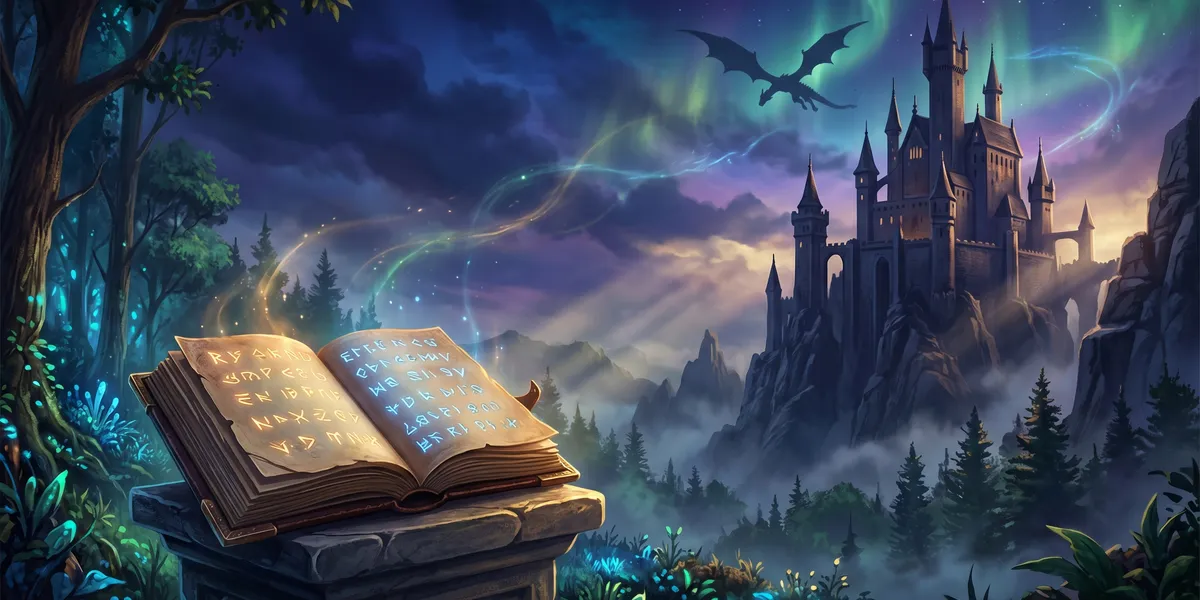
The fantasy genre is fiction built on supernatural elements — magic, mythical creatures, invented worlds, or powers that don’t exist in reality. From Tolkien’s Middle-earth to Sanderson’s Cosmere to the romantasy boom flooding BookTok, fantasy is one of the largest and fastest-growing categories in publishing.
In this guide, you’ll learn:
- What officially defines the fantasy genre (and what separates it from sci-fi)
- Every major subgenre, from epic fantasy to cozy fantasy to grimdark
- The tropes readers love — and how to use them without feeling derivative
- How the fantasy market is shifting in 2026
- How to actually write a fantasy novel that finds readers
Here’s everything you need to know about the genre.
What Is the Fantasy Genre?
The fantasy genre is a category of speculative fiction in which the story includes elements that do not exist in the real world — typically magic, supernatural forces, mythical creatures, or invented worlds with their own physical laws.
The defining line is simple. If the impossible elements in your story are explained by technology or science, you’re writing science fiction. If they’re explained by magic, mythology, or simply accepted as part of how the world works, you’re writing fantasy.
That said, the boundary blurs constantly. Star Wars has laser swords and a mystical energy field — is it sci-fi or fantasy? Most genre scholars call it “science fantasy.” Anne McCaffrey’s Dragonriders of Pern starts as fantasy and reveals a sci-fi backstory. The honest answer is that genre categories exist to help readers find books they’ll enjoy, not to draw clean taxonomic lines.
The Core Elements of Fantasy
Every fantasy story, regardless of subgenre, contains at least one of these elements:
- Magic or supernatural powers. Spells, enchantments, prophecies, abilities that defy physics.
- Non-human beings. Elves, dragons, fae, demons, shapeshifters, sentient trees — creatures that don’t exist in the natural world.
- Secondary worlds. An invented setting with its own geography, history, cultures, and rules. (Not required — urban fantasy is set in the real world.)
- Mythological or folkloric roots. Many fantasy stories draw on existing mythology, fairy tales, or legends as source material.
You don’t need all four. Urban fantasy might only have magic and supernatural creatures in a real-world city. A portal fantasy starts in the real world and moves to a secondary one. A low fantasy novel might have a single magical element in an otherwise realistic setting.
Fantasy Subgenres: The Complete Breakdown
Fantasy isn’t one genre — it’s a family of dozens of subgenres, each with its own conventions, audience, and shelf expectations. Here are the ones that matter most for writers in 2026.
Epic Fantasy (High Fantasy)
Epic fantasy is the big one. These are stories set in fully invented secondary worlds with large-scale conflicts — wars, dark lords, prophecies, the fate of civilizations hanging in the balance. Multiple POV characters, complex magic systems, sprawling casts, and word counts north of 100,000 are standard.
Key conventions: Secondary world, large scope, multiple POVs, detailed magic systems, good-versus-evil tension, multi-book series.
Touchstone authors: J.R.R. Tolkien, Brandon Sanderson, Robert Jordan, Robin Hobb, Tad Williams.
Urban Fantasy
Urban fantasy drops supernatural elements into a modern, real-world city. The setting is usually recognizable — Chicago, London, New York — but vampires run the nightclubs, werewolves work as private investigators, and magic hums underneath the subway system. First-person narration and a noir-adjacent voice are common.
Key conventions: Real-world setting, present day, magic hidden or semi-hidden, often first-person, mystery or thriller plot structure alongside the fantasy elements.
Touchstone authors: Jim Butcher, Ilona Andrews, Ben Aaronovitch, Kevin Hearne.
Dark Fantasy
Dark fantasy sits at the intersection of fantasy and horror. The worlds are dangerous, the magic has costs, and the atmosphere is designed to unsettle. Not all dark fantasy is violent — some achieves its darkness through dread, moral ambiguity, or psychological tension.
Key conventions: Horror elements, oppressive atmosphere, morally gray characters, magic with serious costs or corruption, often higher stakes and body counts.
Touchstone authors: Joe Abercrombie, Glen Cook, Mark Lawrence, Anna Smith Spark.
Grimdark Fantasy
Grimdark pushes dark fantasy further. The protagonists are morally compromised. The world is brutal and unfair. Plot armor doesn’t exist. These stories deliberately subvert the optimistic conventions of epic fantasy — there’s no chosen one coming to save everyone, and “good” is a matter of perspective.
Key conventions: Anti-heroes, graphic violence, moral ambiguity taken to extremes, subversion of traditional fantasy tropes, bleak settings, cynical worldview.
Touchstone authors: Joe Abercrombie, R. Scott Bakker, Mark Lawrence, Anna Smith Spark.
Cozy Fantasy
The newest and fastest-growing subgenre. Cozy fantasy deliberately lowers the stakes — no world-ending threats, no graphic violence. The focus is on community, found family, small-scale personal goals (opening a bakery, tending a garden, finding belonging), and a warm emotional tone. BookTok drove the cozy fantasy boom starting in 2023, and it hasn’t slowed down.
Key conventions: Low stakes, warm tone, found family, domestic settings (cottages, tea shops, small villages), no graphic violence or sexual content, emphasis on comfort and belonging.
Touchstone authors: Travis Baldree (Legends & Lattes), Becky Chambers, T.J. Klune, Katherine Addison.
Romantasy (Romantic Fantasy)
Romantasy gives equal weight to a fantasy plot and a central romance. This subgenre exploded in the 2020s, driven by Sarah J. Maas, Rebecca Yarros, and Jennifer L. Armentrout. The worldbuilding is full-scale fantasy, but the love story isn’t a subplot — it’s co-primary. Check our romance genre guide for more on how romance conventions shape these stories.
Key conventions: Full worldbuilding, magic systems, romance as co-primary plot, slow-burn pacing, high heat at the climax, frequently series-length, often marketed with illustrated covers.
Touchstone authors: Sarah J. Maas, Rebecca Yarros, Jennifer L. Armentrout, Holly Black.
Portal Fantasy
A character from the real world enters a secondary fantasy world — through a wardrobe, a rabbit hole, a mirror, or a magical doorway. The fish-out-of-water dynamic lets the author explain worldbuilding naturally through the protagonist’s discovery. Portal fantasy was huge in the mid-20th century, faded in the 2000s, and is making a quiet comeback.
Key conventions: Real-world starting point, passage to a secondary world, discovery-driven exposition, often coming-of-age themes.
Touchstone authors: C.S. Lewis, Lewis Carroll, Lev Grossman, Seanan McGuire.
Sword and Sorcery
Action-forward fantasy centered on individual heroes rather than world-shaking conflicts. Sword and sorcery protagonists are fighters, thieves, and rogues navigating dangerous situations through combat skill and cleverness. The scope is personal, the pace is fast, and the tone leans pulpy.
Key conventions: Individual hero focus, fast-paced action, morally gray protagonists, smaller-scale conflicts, adventure-driven plots, often standalone or short-series.
Touchstone authors: Robert E. Howard, Fritz Leiber, Michael Moorcock, David Gemmell.
Historical Fantasy
Real historical periods reimagined with magical elements. The setting is grounded — medieval Japan, Renaissance Italy, Victorian London — but magic, mythical creatures, or supernatural forces exist alongside historical events. The appeal is the collision between meticulous historical detail and impossible elements.
Key conventions: Recognizable historical period, accurate cultural detail, magic layered into real history, often alternate-history elements.
Touchstone authors: Guy Gavriel Kay, Naomi Novik, Susanna Clarke, Ken Liu.
Literary Fantasy
Fantasy that prioritizes prose quality, thematic depth, and character interiority over plot-driven conventions. Literary fantasy often blurs the line between genre and literary fiction — it appears on both the fantasy shelf and the general fiction shelf. These books win literary prizes and generate crossover readership.
Key conventions: Elevated prose, thematic ambition, character-driven narrative, often quieter pacing, may use magical realism or subtle supernatural elements.
Touchstone authors: Ursula K. Le Guin, N.K. Jemisin, Susanna Clarke, Kazuo Ishiguro, Gene Wolfe.
Progression Fantasy (LitRPG)
A rapidly growing subgenre, especially in self-publishing and web fiction. The protagonist starts weak and levels up through a structured system — gaining skills, advancing through ranks, or literally gaining experience points. LitRPG (Literary Role-Playing Game) includes explicit game-like mechanics. Progression fantasy is the broader category.
Key conventions: Power scaling, structured advancement systems, quantified abilities, training arcs, often serialized, web-fiction origins, strong overlap with cultivation fantasy from Chinese xianxia tradition.
Touchstone authors: Will Wight, Andrew Rowe, Shirtaloon, pirateaba.
Fantasy Subgenres at a Glance
| Subgenre | Scope | Tone | Typical Word Count | Series or Standalone |
|---|---|---|---|---|
| Epic / High | World-scale | Grand, serious | 100,000-200,000+ | Series |
| Urban | City-scale | Noir, witty | 70,000-100,000 | Series |
| Dark | Varies | Bleak, tense | 80,000-120,000 | Both |
| Grimdark | Varies | Brutal, cynical | 90,000-150,000 | Series |
| Cozy | Personal | Warm, gentle | 60,000-90,000 | Both |
| Romantasy | World-scale | Romantic, sweeping | 90,000-150,000 | Series |
| Portal | Two worlds | Wondrous | 70,000-100,000 | Both |
| Sword & Sorcery | Personal | Pulpy, fast | 60,000-90,000 | Both |
| Historical | Real-world | Grounded, rich | 80,000-120,000 | Both |
| Literary | Varies | Lyrical, thematic | 70,000-100,000 | Standalone |
| Progression / LitRPG | Personal | Exciting, systematic | 80,000-150,000 | Series |
Common Fantasy Tropes (and How to Use Them Well)
Tropes aren’t cliches — they’re genre conventions that signal to readers what kind of story they’re getting. The problem isn’t using tropes. It’s using them without adding anything new.
The Chosen One
A seemingly ordinary person discovers they’re destined to save the world. This is the most iconic fantasy trope, from Harry Potter to Rand al’Thor to Frodo Baggins.
How to use it well: Give the chosen one a reason to resist the call. Make the prophecy ambiguous or wrong. Let the “chosen” status be political rather than magical. Subvert it entirely — the chosen one fails, and someone else has to step up.
The Quest
The characters must travel somewhere dangerous to accomplish something critical — destroy a ring, find a magical artifact, reach a lost city, deliver a message before a kingdom falls.
How to use it well: Make the journey change the characters, not just test them. Give the quest a moral cost — what do they sacrifice along the way? Let the destination matter less than who they become getting there.
Found Family
Strangers — often outcasts, orphans, or people with nowhere else to go — form a bond that becomes as strong as or stronger than blood ties. This trope dominates cozy fantasy and is a staple of epic fantasy party dynamics.
How to use it well: Let the found family have real conflict. People who chose each other still argue, disappoint, and hurt each other. The strength of the trope is that they stay anyway.
Forbidden Magic
A type of magic that’s banned, taboo, or dangerous to use — but the protagonist needs it. Blood magic, necromancy, deals with dark entities, magic that costs the caster’s life force.
How to use it well: Make the forbidden status understandable. If blood magic is banned, show what happened the last time someone used it freely. Then put your protagonist in a situation where using it is the least terrible option.
Mentor and Apprentice
An older, experienced character trains a younger one. Gandalf and Frodo. Bayaz and Jezal. Kvothe and every musician he encounters. The mentor often dies, forcing the apprentice to complete their journey alone.
How to use it well: Give the mentor flaws, secrets, or an agenda that complicates the relationship. The most interesting mentor stories are the ones where the apprentice eventually disagrees with the mentor’s methods or values.
The Dark Lord
A singular evil force that the heroes must oppose — Sauron, the White Witch, Voldemort. The dark lord provides a clear antagonist and raises the stakes to existential levels.
How to use it well: Give the dark lord a motivation beyond “I want power.” A backstory that makes the villain at least understandable (not sympathetic, necessarily) makes the conflict richer. Or skip the dark lord entirely — some of the best modern fantasy has no singular villain at all.
The Fantasy Market in 2026
Fantasy is having a massive commercial moment, and understanding the market helps you write books that find readers.
Print sales are surging. Fantasy and science fiction combined represent one of the fastest-growing print categories, with fantasy driving the majority of that growth. BookTok and Bookstagram have turned fantasy novels into cultural events, and the audience skews younger than it did a decade ago.
Romantasy dominates. The crossover between fantasy and romance is the single biggest trend in genre fiction. Authors like Sarah J. Maas and Rebecca Yarros sell millions of copies, and publishers are actively acquiring romantasy at premium rates.
Cozy fantasy is the breakout subgenre. Travis Baldree’s Legends & Lattes proved there’s a massive audience for low-stakes, comfort-focused fantasy. The subgenre barely existed five years ago; now it has its own shelf space.
Self-publishing is a major path. Progression fantasy, LitRPG, and serialized web fiction have enormous audiences on platforms like Royal Road, Kindle Unlimited, and Patreon. Many of the top-earning fantasy authors in 2026 are self-published or hybrid.
AI tools are changing the writing process. More fantasy authors are using AI writing assistants for worldbuilding, outlining, drafting, and brainstorming. The authors finding success use AI as a collaborator for the heavy lifting — generating initial drafts, filling in world details, stress-testing plot logic — while keeping their voice and vision human.
Our Pick — Chapter
Chapter is an AI book writing platform built specifically for fiction authors. It handles world-building scaffolding, character development, and drafting while you maintain creative control over your story’s voice and direction.
Best for: Fantasy writers who want AI to accelerate worldbuilding and drafting without losing their creative voice.
Why we built it: Writing a 100,000-word fantasy novel with deep worldbuilding is one of the hardest things in fiction. Chapter makes the process faster without making it generic.
How to Write a Fantasy Novel: The Core Process
This is an overview of the key steps. For the full deep dive, see our complete how to write a fantasy novel guide.
1. Choose Your Subgenre
Your subgenre determines almost everything — word count, structure, tone, pacing, and reader expectations. An epic fantasy reader expects 100,000+ words and deep worldbuilding. A cozy fantasy reader expects warmth and low stakes. Know which audience you’re writing for before you draft a single word.
2. Build Your World
Worldbuilding is the backbone of fantasy writing. You need at least three layers:
- Physical world. Geography, climate, distances, natural resources.
- Cultural world. Societies, religions, languages, power structures, class systems.
- Magical world. Your magic system — its rules, costs, limitations, and how it shapes society.
The iceberg rule applies: you should know ten times more about your world than the reader ever sees on the page. The depth shows even when the details don’t.
3. Create Characters That Fit the World
Fantasy characters need to feel shaped by their world. A character raised in a rigid magical caste system thinks differently than one from a frontier settlement with no central authority. The best fantasy characters are inseparable from their setting.
4. Plot With Rising Stakes
Fantasy plots benefit from escalating scale. Start personal — a character’s immediate problem. Expand to communal — the threat affects their village, city, or guild. Build to existential — the world itself is at risk. This natural escalation gives you room to deepen the worldbuilding as the scope grows.
5. Draft, Then Revise for Consistency
The hardest part of revising fantasy is continuity. Magic system rules established in chapter three can’t be violated in chapter thirty. Character names, place names, and historical references need to stay consistent across 100,000+ words. Keep a “bible” document — a running reference sheet of every name, rule, and fact.
What Makes Fantasy Different From Other Speculative Fiction?
Fantasy gets confused with adjacent genres regularly. Here’s where the lines fall.
Fantasy vs Science Fiction
Fantasy explains the impossible through magic, mythology, or accepted supernatural elements. Science fiction explains the impossible through technology, science, or extrapolation from real-world physics. Some stories blend both — Star Wars, Dune, The Book of the New Sun.
Fantasy vs Horror
Fantasy uses supernatural elements to create wonder, adventure, or discovery. Horror uses supernatural elements to create fear, dread, and revulsion. Dark fantasy occupies the overlap — the supernatural elements exist to unsettle, not to inspire awe.
Fantasy vs Magical Realism
Fantasy creates worlds where magic is a primary element of the story’s engine. Magical realism presents magical elements matter-of-factly within an otherwise realistic story — the magic is not explained, questioned, or central to the plot mechanics. Gabriel Garcia Marquez is magical realism. Brandon Sanderson is fantasy.
Is Fantasy Hard to Write?
Fantasy is one of the most demanding genres because you’re building everything from scratch. A contemporary fiction writer can say “she walked into a Starbucks” and every reader sees the same thing. A fantasy writer has to build the coffeehouse, the city it sits in, the currency used to pay for the drink, and the cultural norms around who sits where.
That said, the skills aren’t mysterious:
- Worldbuilding is learnable. Start with our worldbuilding guide and build one layer at a time.
- Magic systems have frameworks. Brandon Sanderson’s Three Laws of Magic give you a blueprint. See our magic system guide.
- Plotting follows the same principles as any genre — rising action, turning points, climax.
- Prose improves with practice. Read widely in your subgenre and study what works.
The biggest mistake new fantasy writers make is spending months worldbuilding without writing the actual story. Build enough world to start drafting, then expand as you go.
How Long Should a Fantasy Novel Be?
Fantasy novels run longer than most genres because worldbuilding requires extra page space. Here are the standard ranges by subgenre:
| Subgenre | Word Count Range | Notes |
|---|---|---|
| Epic / High Fantasy | 100,000 - 200,000+ | Series installments can exceed 200K |
| Urban Fantasy | 70,000 - 100,000 | Closer to thriller pacing |
| Dark Fantasy | 80,000 - 120,000 | Varies widely |
| Cozy Fantasy | 60,000 - 90,000 | Shorter, tighter |
| Romantasy | 90,000 - 150,000 | Romance arcs need room |
| Sword & Sorcery | 60,000 - 90,000 | Action-focused, leaner |
| Portal Fantasy | 70,000 - 100,000 | Moderate length |
| Literary Fantasy | 70,000 - 100,000 | Quality over quantity |
| Progression / LitRPG | 80,000 - 150,000 | Serialized installments often shorter |
First-time fantasy authors should aim for 80,000 to 100,000 words. That’s long enough to build a compelling world and short enough that agents and publishers won’t reject it on length alone.
Can You Publish a Fantasy Novel With AI Help?
Yes. There’s nothing legally or ethically preventing you from using AI tools in your fantasy writing process — as long as the final product reflects your creative vision, voice, and editorial judgment.
The most effective approach is using AI as a collaborator, not a replacement:
- Worldbuilding acceleration. Generate initial world details — geography, cultural customs, naming conventions — then curate and refine what works.
- Drafting support. Use AI to produce first drafts of scenes you’ve outlined, then rewrite them in your voice.
- Consistency checking. AI can flag continuity errors across a 100,000-word manuscript faster than you can.
- Brainstorming. Generate plot alternatives, character backstories, or magic system variations to stress-test your ideas.
Over 2,147 authors have used Chapter to create more than 5,000 books, including fantasy novels. The platform is designed for exactly this kind of collaborative workflow — you drive the story, AI handles the heavy lifting.
Fantasy Writing Prompts to Get You Started
Need a spark? Here are five prompts across different subgenres. For the full collection, see our fantasy writing prompts guide.
- Epic fantasy. The kingdom’s last dragon hasn’t eaten in three hundred years. It’s not starving — it’s waiting for something specific.
- Urban fantasy. You’re a public defender in a city where supernatural beings have legal standing. Your newest client is a river spirit accused of drowning a real estate developer who was going to dam its source.
- Cozy fantasy. A retired adventurer opens a repair shop for magical artifacts. Most items just need new enchantments. One item is ticking.
- Dark fantasy. A healer discovers that her power to cure any disease works by transferring the illness to someone she’s never met. She’s been practicing for twenty years.
- Romantasy. Two rival court mages are assigned to create the same ward spell. The spell only works if cast by two people who trust each other completely.
FAQ
What is the fantasy genre in simple terms?
The fantasy genre is fiction that includes magic, supernatural elements, or imaginary worlds that don’t exist in reality. Fantasy stories feature things like spells, mythical creatures, invented civilizations, and powers that break the laws of physics. The genre ranges from epic adventures in made-up worlds to magical stories set in modern cities.
What are the most popular fantasy subgenres right now?
The most popular fantasy subgenres in 2026 are romantasy (romantic fantasy), cozy fantasy, and progression fantasy / LitRPG. Epic fantasy and urban fantasy remain perennial bestsellers, but the growth is concentrated in romantasy (driven by BookTok) and cozy fantasy (driven by readers seeking comfort-focused stories with low stakes).
What is the difference between fantasy and science fiction?
Fantasy uses magic, mythology, or supernatural forces to explain impossible elements. Science fiction uses technology, science, or extrapolation from real physics. If the impossible thing in your story runs on enchantments or divine power, it’s fantasy. If it runs on warp drives or genetic engineering, it’s science fiction. Many stories blend both.
How do you start writing a fantasy novel?
Start by choosing your subgenre — it determines word count, tone, and reader expectations. Then build enough of your world to begin drafting: a rough map, a magic system with clear rules, and two or three cultural details that shape your characters. Don’t over-build before you start writing. See our full how to write a fantasy novel guide for the complete process.
Is fantasy the same as fiction?
No. Fiction is any invented narrative — it includes contemporary novels, thrillers, mysteries, literary fiction, and every other genre. Fantasy is a specific type of fiction defined by supernatural or magical elements. All fantasy is fiction, but not all fiction is fantasy. For a full breakdown of book genres, see our complete genre guide.