Found family is the trope where characters who are not related by blood form bonds as deep and unbreakable as any biological family. Sometimes deeper. It is a loner who finds a crew. A group of misfits who become each other’s people. A character who lost their family and builds a new one from scratch.
The reason found family makes readers cry harder than almost any other trope is simple: it says that love is a choice, not an obligation. These people do not have to stay. They choose to. Every single time.
Why Found Family Resonates
Everyone Wants to Belong
Found family taps into something universal. Not everyone has a loving biological family. Not everyone fits into the group they were born into. But almost everyone has felt the moment when a group of people went from strangers to something that felt like home. That recognition — that exhale of “these are my people” — is one of the most powerful emotions fiction can create.
Chosen Love Hits Different
When a parent loves their child, it is expected. When a stranger decides you matter to them — when someone who has no biological imperative to care about you shows up at three in the morning because you called — that love carries a different weight. Found family earns every ounce of its emotional payoff because the bonds were built from nothing. No shared DNA. No legal obligation. Just repeated choices to stay.
It Heals What Blood Family Broke
Many found family stories begin with characters running from broken homes, abusive parents, or families that failed them. The found family becomes proof that the damage was not the character’s fault and that they are capable of being loved. This healing arc is quietly devastating when done well. The reader watches a character learn to trust again, and the vulnerability of that process creates deep emotional investment.
Genres Where Found Family Shines
Fantasy. The quest party. The band of rebels. The magical academy friend group that becomes a unit. Fantasy found families work because the stakes are life-and-death, and nothing bonds people faster than surviving together. The Fellowship of the Ring. The crew of the Stormlight Archive. Every D&D party ever written.
Science fiction. Spaceship crews are found family by nature. You are stuck in a metal tube hurtling through space with people who were strangers six months ago. Firefly, Guardians of the Galaxy, Becky Chambers’ Wayfarers series — sci-fi understands that the ship is the home and the crew is the family.
Romance. The friend group that surrounds the main couple. The heroine’s tight circle of friends who become the hero’s people too. Romance uses found family as an emotional support structure around the central love story, and series that follow friend groups capitalize on the reader’s attachment to the entire unit.
Young adult. Teens finding their people is one of YA’s most powerful engines. The Losers’ Club in It. The kids at Camp Half-Blood. Every boarding school story where the roommates become siblings. YA found family works because adolescence is when belonging matters most.
Literary fiction. More quietly, literary fiction uses found family through neighborhood communities, workplace bonds, and unlikely friendships. The characters in A Man Called Ove. The tenants in a shared building. The regulars at a bar. These stories prove the trope does not need dragons or spaceships to devastate.
The Key Beats
Found family stories follow an emotional arc that is remarkably consistent across genres. The specifics change. The structure holds.
The Loners Meet
The characters come together through circumstance, not choice — a mission, a workplace, a crisis. Nobody signed up for a family. They were stuck with each other. And then something shifted.
Reluctant Bonding
Small acts of connection happen before anyone is ready. Someone shares food. Someone keeps watch while others sleep. These moments are deniable — no one has to admit they care yet. But the reader sees the threads forming. The tension between “I do not need anyone” and “I am starting to need these specific people” is where the trope lives.
The First Family Moment
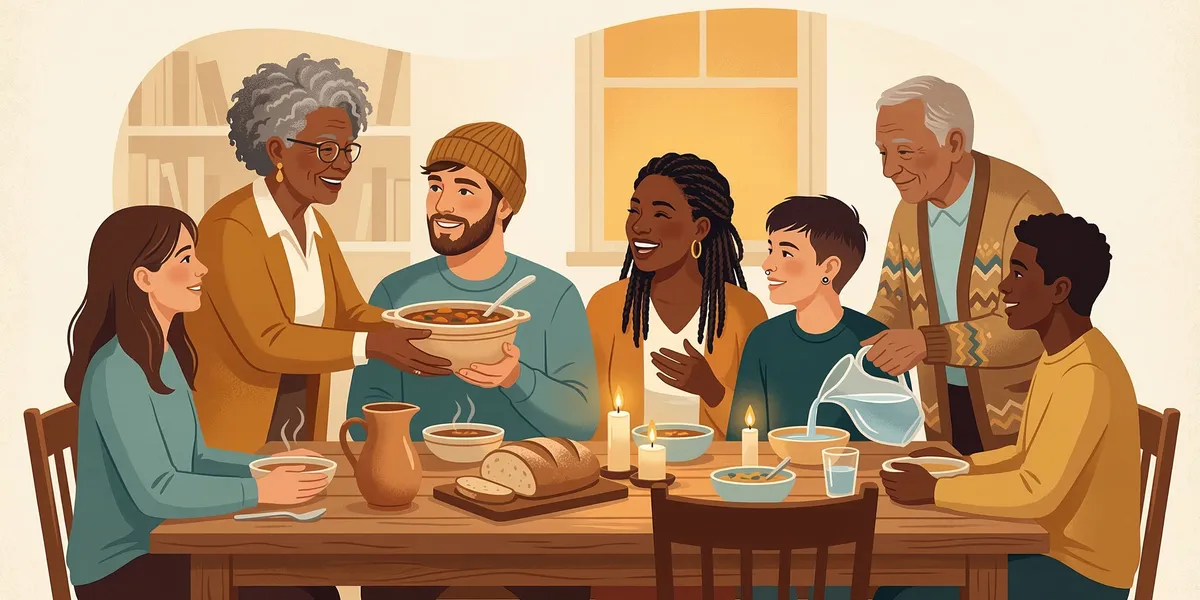
One scene crystallizes the shift. A shared meal that feels different. Everyone laughing at the same thing. Someone instinctively protecting someone else without thinking. The characters may not recognize it, but the reader does: this group just became a family.
External Threat Unites Them
Something threatens the group or one of its members. A villain, a system, a disaster, an outside force. The response reveals how much they have come to mean to each other. Characters who said “I work alone” suddenly cannot imagine leaving. Characters who said “I do not care” are the first ones to fight.
The external threat forces the internal truth to the surface. It is easy to deny you are a family during peacetime. It is impossible when someone you care about is in danger.
Someone Almost Leaves
The emotional climax of most found family stories. One character — usually the one most afraid of belonging — tries to leave. They convince themselves the group is better off without them, or that they were never really part of it, or that leaving before being left is the safer option.
This beat works because it forces both the departing character and the remaining group to articulate what they mean to each other. The character who chases after them, who says “you are one of us,” who refuses to let the family fracture — that moment is found family’s emotional peak.
They Choose Each Other
The resolution. Not a dramatic scene necessarily, but a moment of quiet, definitive choice. They stay. Not because they have to. Because they want to. The loner who started the story running from connection ends it sitting at a table surrounded by people who would go through fire for them. And the reader, probably, is crying.
Famous Examples Worth Studying
The Fellowship of the Ring by J.R.R. Tolkien — Nine strangers bound by a mission who become something greater than the sum of their parts. Study how Tolkien uses shared hardship to forge bonds and how the fellowship’s fracture makes reunion all the more powerful.
Guardians of the Galaxy — A thief, an assassin, a warrior, a tree, and a raccoon. None of them wanted a family. All of them needed one. The film understands that found family works best when the characters are aggressively unsuited to domesticity.
The House in the Cerulean Sea by TJ Klune — A quiet, devastating found family story about a caseworker and the magical children he is sent to evaluate. Klune demonstrates that found family does not need action or adventure — it needs vulnerability and the slow decision to open your heart.
One Piece by Eiichiro Oda — The Straw Hat crew is perhaps fiction’s longest-running found family narrative. Each crew member has a backstory of loss and isolation. Each chose to sail with Luffy. The moment any of them is threatened, the entire crew moves as one.
Schitt’s Creek — The Rose family is biological, but the town becomes their found family. The show proves the trope can be funny without losing its emotional core.
How to Write It Well
Each member fills a role. Not a job — a role in the family dynamic. The parent figure. The chaotic younger sibling. The quiet one who sees everything. The protector. These roles should emerge naturally from personalities, not be assigned.
Show the small moments. Found family is built in the margins. Someone making tea without being asked. Inside jokes. The way one character always sits next to the same person. These tiny moments accumulate into something lived-in and real.
The family must be tested. A found family that never faces pressure is a friend group. Betrayal, separation, sacrifice — these reveal whether the bonds hold. The moment a character chooses the family over self-preservation is the moment the reader believes in it.
Give each member a reason to fear belonging. The most emotionally rich found families are full of people who have reasons not to trust. If every character has a wound that makes attachment risky, every act of connection becomes brave.
Found family is not a replacement for character development. Each character needs their own arc, their own growth, their own story. The group makes them stronger. It does not make them interchangeable.
Common Mistakes
Instant bonding. If your characters go from strangers to ride-or-die in one chapter, you have skipped the process that makes found family powerful. The reluctance and the gradual warming are not obstacles to the trope — they are the trope.
One-dimensional members. If the reader cannot distinguish between group members or if half the group exists only to fill space, the family will not feel real. Every member needs a distinct voice, a reason for being there, and at least one moment where they carry a scene.
No internal conflict. Real families argue. They misunderstand each other. They hurt each other and have to repair it. A found family that never has friction is a fantasy in the worst sense — unbelievable and emotionally flat.
Making one character the center. Found family is an ensemble trope. If one character is clearly the protagonist and everyone else orbits them, you have a main character with friends, not a family. Every member should matter.
Building Found Family Across a Series
Found family is one of the strongest tools for reader retention across a series. Readers who fall in love with a group will follow that group through multiple books. Romance series that follow friend groups, fantasy series that track a party, sci-fi series about a crew — these all leverage the reader’s attachment to the family unit.
If you are building a found family across a multi-book series and want structural support for tracking each character’s arc, their relationships, and the ensemble dynamics, Chapter’s fiction software includes character relationship mapping and beat sheets that help you weave individual character arcs through the larger family story. The ensemble cast tools make it easier to give every member their moment without losing the thread of who your characters are to each other.