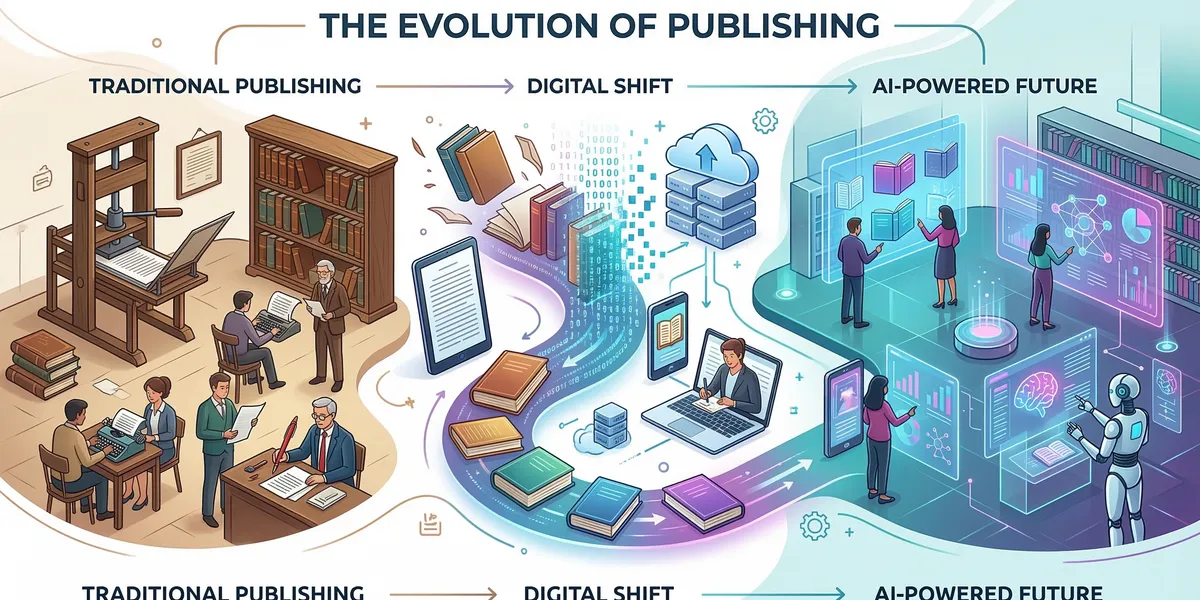
AI in publishing passed the novelty stage somewhere in mid-2024. By 2026, the conversation shifted from “can AI write a book?” to “how do we separate AI-assisted quality from AI-generated noise?” That is a more useful question, and a harder one.
Here is an honest assessment of where things stand, what is coming, and what it means for authors who want to build careers rather than chase trends.
Where things stand in 2026
AI-assisted writing is mainstream
The debate about whether authors should use AI is effectively over. A Gotham Ghostwriters survey of 1,481 writers found that 61% now use AI tools in some capacity, reporting an average 31% productivity increase. For thought leadership and business content, that number climbs to 84%.
This does not mean every published book is AI-generated. It means AI has joined spell-check, Scrivener, and Google Docs in the toolkit most writers use without thinking twice. The stigma has not disappeared entirely — literary fiction circles remain skeptical — but in commercial fiction, nonfiction, and self-publishing, AI assistance is normal.
The distinction that has emerged is between AI-assisted (human-directed, AI-accelerated) and AI-generated (minimal human input). Readers, reviewers, and Amazon’s algorithms have gotten better at distinguishing between the two. The market rewards the former and increasingly penalizes the latter.
The quality bar is rising
Amazon now limits authors to three self-published titles per day. Goodreads, BookTok, and online review communities actively flag obvious AI-generated content. Readers have developed an informal literacy for detecting low-effort AI writing — the telltale signs of generic structure, absence of personal voice, and oddly balanced paragraphs.
This is good news for serious authors. The flood of zero-effort AI books that hit Amazon in 2023-2024 raised the floor (more books exist) but lowered the average quality. As readers and platforms develop filters, books that combine AI efficiency with genuine human input stand out more, not less.
The winning formula has become clear: use AI for production speed, invest human time in expertise, voice, and editing. The authors who follow this approach report results that the zero-effort crowd never achieves.
The copyright picture is clearer
The U.S. Copyright Office issued guidance in January 2025 confirming that AI-assisted works with sufficient human creative input are copyrightable. The key word is “sufficient” — works that are purely AI-generated without meaningful human contribution do not qualify for copyright protection.
In practice, this means authors who direct the AI, make creative decisions, edit the output, and add original content own their work. Authors who type a prompt and publish the raw output may not. The line is not perfectly defined, but the direction is clear: human creative contribution is the threshold.
Internationally, the picture varies. The EU’s AI Act requires transparency about AI-generated content. China has recognized AI-generated works for copyright when human authorship is demonstrated. The UK is still debating its position. For authors publishing globally, understanding local copyright requirements has become part of the publishing checklist.
What is coming
Personalized reading experiences
The next frontier is not AI-generated books but AI-personalized books. Imagine a business book that adapts its examples to your industry, or a self-help book that adjusts its exercises to your situation. The technology to do this exists. The distribution infrastructure does not — yet.
Amazon’s Kindle platform is the most likely first mover. Early patents and experiments suggest a future where ebook content shifts based on reader preferences, reading speed, and engagement patterns. This would not change the author’s core message but would tailor presentation to the individual reader.
This development would advantage authors who create strong frameworks and original content. The personalization layer would adapt delivery, not substance. Authors who rely on AI to generate generic content would find personalization exposing the thinness of their material.
AI audiobook narration
AI narration quality crossed the “good enough for most listeners” threshold in late 2025. Services like ElevenLabs, Google’s text-to-speech, and Amazon’s own AI narration tools produce audiobooks that are dramatically cheaper than human narrators — $100-500 versus $3,000-10,000 for a full-length book.
The quality gap between AI and top human narrators is real and may always exist. A skilled narrator adds interpretation, emotion, and character differentiation that AI approximates but does not match. However, for nonfiction and straightforward narrative fiction, AI narration is already good enough for most listeners who would not have paid for a premium human-narrated version.
What this means: audiobooks are no longer a premium format that most indie authors cannot afford. They are accessible to every self-published author, which expands the market significantly. The authors who benefit most are those with content worth listening to — another reason why substance matters more than production method.
AI translation
AI translation for books is improving rapidly but is not yet reliable enough for unsupervised publication. Current AI translations handle straightforward nonfiction competently but struggle with idiom, cultural nuance, humor, and voice — exactly the elements that make a book worth reading rather than merely informative.
The realistic near-term future is AI-assisted translation: AI produces a first draft, and a human translator refines it. This cuts translation costs by 40-60% and time by a similar margin. For indie authors, this makes translated editions economically viable for the first time.
The languages where AI translation is closest to production-quality: Spanish, French, German, and Portuguese. Languages with less training data (many Asian and African languages) have a longer path to reliable AI translation.
Enhanced editing and quality control
AI editing tools are getting substantially better at detecting issues beyond grammar: structural problems, pacing inconsistencies, character voice drift, and factual contradictions within a manuscript. Tools like ProWritingAid and Grammarly already offer some of this. The next generation will understand narrative structure well enough to flag when a subplot is unresolved or a character’s motivation shifts without explanation.
This represents the most unambiguously positive AI development for authors. Better editing tools make better books, regardless of how the first draft was produced.
The big debates
”Is AI writing cheating?”
This question has faded in the business and self-publishing communities and persists mainly in literary fiction and creative writing education. The pragmatic answer: AI writing is a tool, like dictation software, ghostwriters, and developmental editors. The quality of the final product determines its value, not the method of production.
The more nuanced answer: AI writing changes who can write books, which changes what books exist, which changes the literary ecosystem. Whether that is good depends on whether you believe more voices in publishing is inherently valuable (even if some are AI-amplified) or whether you believe the craft of writing from scratch has irreplaceable value.
Both positions have merit. The market is resolving the debate by rewarding books that demonstrate genuine expertise and voice regardless of production method. Read our full exploration of this question at is AI writing cheating?
How traditional publishers are adapting
Traditional publishing’s response to AI has been cautious and uneven. The major publishers (Penguin Random House, HarperCollins, Simon & Schuster) have implemented policies requiring authors to disclose AI use in submissions. Some literary agents have begun adding AI clauses to representation agreements.
Behind the scenes, publishers are using AI in ways they are less vocal about: automated manuscript screening, market analysis for acquisition decisions, marketing copy generation, and metadata optimization. The “AI for me but not for thee” approach has drawn criticism from author advocacy groups.
The practical impact for indie authors: traditional publishing’s cautious stance creates an opportunity gap. Indie authors using AI effectively can publish faster, test markets more efficiently, and iterate on what works while traditional publishing moves slowly.
The authenticity question
Readers in 2026 increasingly value authenticity — but their definition has evolved. “Authentic” no longer means “written without any tools.” It means “written by someone with genuine expertise or experience who stands behind the content.” A consultant’s AI-assisted authority book is authentic because the expertise is real. A fiction writer’s AI-assisted novel is authentic because the creative vision is theirs.
What readers reject is inauthenticity: books by authors with no expertise on the topic, books with no original insight, books that exist purely because AI made them cheap to produce. The tool matters less than the person behind it.
What this means for indie authors
The opportunity
Indie authors are better positioned than traditional authors to benefit from AI because they control their entire workflow. They can adopt new tools immediately, experiment with AI-assisted processes, and publish at whatever pace the market rewards. There is no committee, no editorial board, and no 18-month production cycle standing between an idea and a published book.
The economics favor speed to market combined with quality. AI provides the speed. Human expertise provides the quality. The combination is why indie publishing is growing at 30%+ annually while traditional publishing grows in single digits.
The risk
The risk is complacency. AI makes it easy to publish mediocre books quickly, and the short-term revenue from low-quality content masks the long-term cost to an author’s reputation. Readers remember bad books. Amazon algorithms eventually penalize consistently low-rated titles. The race to the bottom is a trap.
Authors who invest AI-saved time into higher quality — better research, deeper expertise, more thorough editing, and genuine audience building — will outperform those who invest it into higher volume.
The playbook
- Use AI for what it is good at: First drafts, research synthesis, marketing copy, metadata optimization, and editorial assistance.
- Invest your time in what AI cannot do: Original expertise, personal stories, audience relationships, strategic decisions, and quality control.
- Build assets, not just books: An email list, a brand, a body of work that compounds over time. AI makes individual books faster to produce. Strategy makes them worth producing.
- Stay current without chasing every trend. The AI landscape changes monthly. Adopt tools that solve real problems in your workflow and ignore hype cycles.
Over 2,147 authors have used Chapter to create 5,000+ books, positioning themselves at the intersection of AI efficiency and human expertise. The platform was built for this exact approach: AI handles manuscript production while the author provides the substance that makes the book valuable.
The future of publishing is not AI versus humans. It is AI-equipped humans versus humans working alone. For authors willing to learn the tools and maintain their standards, that future is promising. For more context, explore our articles on AI writing quality and whether AI can write a book.
FAQ
Will AI replace human authors?
No. AI will replace the production labor of writing (the typing, structuring, and first-drafting) while increasing the value of what humans uniquely provide (expertise, experience, voice, and creative vision). Authors who treat writing as assembly-line labor are at risk. Authors who treat writing as a vehicle for their knowledge and creativity are enhanced by AI.
How will Amazon handle AI books going forward?
Amazon is moving toward quality signals rather than production method detection. Their three-books-per-day limit, enhanced review monitoring, and reader feedback systems all filter for quality regardless of how the book was produced. Authors producing quality AI-assisted books are not penalized. Authors producing AI spam are increasingly filtered out.
Should I disclose AI use in my books?
Amazon KDP requires disclosure for substantially AI-generated content. For AI-assisted content (where you direct the process, provide expertise, and edit the output), disclosure is optional but increasingly viewed as a mark of transparency rather than a stigma. The trend is toward normalization — disclosing AI use will likely become as unremarkable as listing your editor in the acknowledgments.
What skills should authors develop for the AI publishing era?
The premium skills are shifting: subject matter expertise, audience building, editorial judgment, and strategic thinking are more valuable than raw writing speed. Authors who invest in understanding their audience, building email lists, and developing genuine expertise will outperform those who focus solely on production efficiency.