Genres of writing are the categories that organize all written work by purpose, style, and audience expectations. Whether you write novels, blog posts, academic papers, or poetry, every piece you create falls into at least one genre.
In this guide, you’ll learn:
- The four foundational modes of writing and how they shape everything else
- Every major fiction and nonfiction genre with clear definitions and examples
- How to identify your genre so your work reaches the right readers
- What crossing genres means and when it works
Here’s a complete breakdown of every genre of writing you should know.
What Are the Genres of Writing?
A genre of writing is a classification system that groups written works by shared conventions, themes, structures, and reader expectations. The word “genre” comes from the French word for “kind” or “type.”
Genres exist because readers develop expectations. When you pick up a mystery novel, you expect a crime, clues, and a resolution. When you open a memoir, you expect a true personal story told with narrative craft.
Understanding genres matters for three practical reasons:
- Readers find your work faster when it’s correctly categorized
- Your writing improves when you understand the conventions you’re working within
- Publishers and agents know how to sell it when you can name your genre clearly
Genres break down into two large systems: the four foundational modes of writing (how you write) and the literary content genres (what you write about).
The Four Foundational Modes of Writing
Before diving into fiction, nonfiction, and everything else, you need to understand the four core modes. These are the building blocks every genre uses.
Narrative Writing
Narrative writing tells a story. It follows a sequence of events with a beginning, middle, and end. You’ll find narrative writing in novels, short stories, memoirs, personal essays, and even journalism.
Key elements of narrative writing:
- Characters who drive or experience the action
- Plot with conflict and resolution
- Setting that grounds the story in time and place
- Point of view that determines whose perspective the reader follows
Every fiction genre relies on narrative writing. But narrative also appears in nonfiction — memoirs, biographies, and creative nonfiction all use storytelling techniques to present true events.
Expository Writing
Expository writing explains, informs, or instructs. Its purpose is to transfer knowledge from writer to reader as clearly as possible.
You encounter expository writing constantly: textbooks, how-to guides, news articles, business reports, and encyclopedia entries. This blog post is expository writing.
The hallmarks of strong expository writing:
- Logical structure (chronological, cause-and-effect, or problem-solution)
- Evidence-based claims supported by facts, data, or examples
- Objective tone that prioritizes clarity over style
- Defined terms for any specialized language
Persuasive Writing
Persuasive writing argues a position and tries to change your mind. It uses logic, evidence, and emotional appeals to convince the reader of a particular viewpoint.
Examples include opinion editorials, political speeches, advertising copy, legal briefs, and book reviews. Academic argumentative essays also fall here.
Strong persuasive writing includes:
- A clear thesis stated early
- Supporting evidence from credible sources
- Counterargument acknowledgment that addresses opposing views
- A call to action or definitive conclusion
Descriptive Writing
Descriptive writing paints a picture with words. It uses sensory language — sight, sound, smell, taste, and touch — to create a vivid experience in the reader’s mind.
Descriptive writing rarely stands alone as a genre. Instead, it’s woven into narrative, expository, and persuasive writing to make the prose more engaging.
You’ll see heavy descriptive writing in:
- Poetry
- Travel writing
- Food writing and restaurant reviews
- Literary fiction with rich scene-setting
- Nature writing and environmental journalism
Most writing you encounter blends two or more of these modes. A memoir (narrative) might use descriptive passages and persuasive arguments. A how-to guide (expository) might open with a narrative hook.
Fiction Genres: Every Major Category
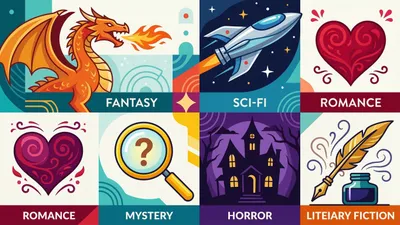
Fiction covers any writing where the events, characters, and settings are invented by the author. Within fiction, genres are defined primarily by content — the themes, settings, and emotional experiences the story delivers.
Literary Fiction
Literary fiction prioritizes prose style, character depth, and thematic exploration over plot-driven pacing. These novels tend to explore the human condition, moral ambiguity, and psychological complexity.
Examples: The Great Gatsby by F. Scott Fitzgerald, Beloved by Toni Morrison, Normal People by Sally Rooney
Literary fiction often resists neat categorization. It’s sometimes defined by what it isn’t — it’s not genre fiction with predictable conventions.
Romance
Romance is defined by two non-negotiable elements: a central love story and an emotionally satisfying ending. Everything else — setting, time period, heat level — varies by subgenre.
Romance is the highest-earning fiction genre, generating over $1.4 billion in annual sales in the U.S. alone.
Popular subgenres: contemporary romance, dark romance, billionaire romance, historical romance, slow burn romance, and paranormal romance.
Mystery and Crime Fiction
Mystery fiction centers on a crime (usually murder) that must be solved. The reader follows an investigator — amateur or professional — as clues are uncovered and suspects eliminated.
Key conventions: A crime occurs early. Clues are planted fairly. The solution is revealed in the climax. Red herrings keep the reader guessing.
Subgenres: cozy mystery (amateur sleuth, no graphic violence), noir (dark tone, morally ambiguous protagonist), police procedural, whodunit, and legal thriller.
Science Fiction
Science fiction explores speculative ideas grounded in science and technology. The best science fiction asks “what if?” and follows the implications of that question to their logical conclusion.
Subgenres: hard sci-fi (rigorous scientific accuracy), space opera (grand-scale adventures), cyberpunk (technology meets societal decay), dystopian fiction, and climate fiction.
Examples: Dune by Frank Herbert, The Left Hand of Darkness by Ursula K. Le Guin, Project Hail Mary by Andy Weir
Fantasy
Fantasy features magical systems, mythical creatures, or supernatural elements that don’t exist in our world. Unlike science fiction, fantasy doesn’t require scientific plausibility.
Subgenres: epic fantasy, urban fantasy, dark fantasy, portal fantasy, YA fantasy, and romantic fantasy.
Examples: The Lord of the Rings by J.R.R. Tolkien, A Court of Thorns and Roses by Sarah J. Maas, The Name of the Wind by Patrick Rothfuss
Thriller and Suspense
Thriller fiction is built on tension, stakes, and pacing. Where mystery asks “who did it?”, thriller asks “what happens next?” The protagonist is often in direct danger.
Subgenres: psychological thriller, spy thriller, techno-thriller, domestic thriller, and political thriller.
The line between thriller and mystery is often blurry. Many books are marketed as “mystery/thriller” because they contain elements of both.
Horror
Horror fiction aims to evoke fear, dread, or disgust. It confronts readers with the unknown, the dangerous, or the deeply unsettling.
Subgenres: supernatural horror, cosmic horror (Lovecraftian), slasher, gothic horror, body horror, and folk horror.
Examples: The Shining by Stephen King, The Haunting of Hill House by Shirley Jackson, Mexican Gothic by Silvia Moreno-Garcia
Historical Fiction
Historical fiction is set in a specific past era and uses real historical details — events, settings, social norms — as the backdrop for fictional characters and plots.
The genre rule: the historical setting isn’t just wallpaper. It should shape the characters’ choices, conflicts, and worldview in ways that wouldn’t apply in a different era.
Examples: All the Light We Cannot See by Anthony Doerr, The Pillars of the Earth by Ken Follett, Pachinko by Min Jin Lee
Western
Western fiction is set in the American frontier, typically during the 19th century. It features cowboys, outlaws, sheriffs, and the conflicts between civilization and wilderness.
Modern westerns have expanded beyond the traditional mold to include revisionist westerns, contemporary westerns set in the modern rural West, and “weird west” stories that blend western settings with fantasy or horror.
Young Adult (YA) Fiction
YA fiction features protagonists aged 13-18 and deals with themes of identity, belonging, first love, and coming of age. YA isn’t a genre based on content — it’s a category based on audience.
A YA book can be fantasy, romance, science fiction, or thriller. What makes it YA is the age of the protagonist and the emotional lens through which the story is told.
Nonfiction Genres: Every Major Category
Nonfiction covers writing about real events, people, ideas, and information. The nonfiction world is just as rich and varied as fiction.
Memoir
A memoir focuses on a specific theme, period, or experience from the author’s life. Unlike autobiography, which covers a full life chronologically, memoir zooms in on what matters most.
Examples: Educated by Tara Westover, When Breath Becomes Air by Paul Kalanithi, The Year of Magical Thinking by Joan Didion
Memoir is one of the fastest-growing nonfiction categories. Readers connect with authentic personal stories that illuminate universal truths.
Biography and Autobiography
Biography tells the story of someone’s life, written by a different author. Autobiography is a life story written by the subject themselves.
Both follow a narrative arc, but biography requires extensive research, interviews, and fact-checking. Autobiography requires ruthless honesty and self-awareness.
Self-Help and Personal Development
Self-help books promise transformation — a better relationship, more money, improved health, or greater productivity. The genre follows a consistent formula: identify a problem, present a solution framework, and give the reader actionable steps.
Examples: Atomic Habits by James Clear, The 7 Habits of Highly Effective People by Stephen Covey
Business and Finance
Business nonfiction covers strategy, leadership, entrepreneurship, marketing, economics, and personal finance. The best business books combine original research with practical frameworks.
Subgenres: startup guides, leadership books, investment strategy, case study analysis, and business biography.
History
History books reconstruct and analyze past events, eras, or movements. Narrative history reads like a story. Academic history prioritizes analysis and argumentation.
Examples: Sapiens by Yuval Noah Harari, The Warmth of Other Suns by Isabel Wilkerson
Science and Nature Writing
Science writing makes complex scientific concepts accessible to non-specialist readers. Nature writing focuses on the natural world and humanity’s relationship with it.
Examples: A Short History of Nearly Everything by Bill Bryson, The Hidden Life of Trees by Peter Wohlleben, Silent Spring by Rachel Carson
True Crime
True crime recounts real criminal cases — investigations, trials, and the psychology of perpetrators and victims. The genre has exploded thanks to podcasts and docuseries, but its roots are in long-form journalism and book-length investigations.
Travel Writing
Travel writing documents journeys, places, and cultures through the author’s personal experience. The best travel writing goes beyond describing sights — it explores how a place changes the traveler.
Essay Collections
Essay collections gather short-form nonfiction pieces on related or varied themes. Personal essays, cultural criticism, humor writing, and literary journalism often appear in this format.
Prescriptive Nonfiction (How-To)
How-to books provide step-by-step instructions for learning a skill or completing a task. Cookbooks, craft guides, writing guides, and technical manuals all fall here.
This is where tools like Chapter come in — if you’re writing a nonfiction book that teaches something, AI writing assistants can help you organize your expertise into a clear, structured manuscript faster than writing from scratch.
Poetry as a Genre
Poetry is a genre unto itself — distinct from both fiction and nonfiction. It uses condensed language, rhythm, imagery, and often formal structure to convey meaning and emotion.
Major Forms of Poetry
- Sonnet: 14 lines with a specific rhyme scheme (Shakespearean or Petrarchan)
- Haiku: Three lines with a 5-7-5 syllable pattern, traditionally about nature
- Free verse: No fixed meter or rhyme scheme — the most common form in contemporary poetry
- Epic: Long narrative poem telling a heroic story (The Odyssey, Beowulf)
- Lyric: Short poem expressing personal thoughts and emotions
- Slam/spoken word: Poetry written for oral performance, emphasizing rhythm and delivery
Poetry overlaps with other genres. Narrative poetry tells stories. Prose poetry abandons line breaks and reads like dense fiction. Verse novels use poetry to tell full-length stories.
Drama and Scriptwriting
Drama is writing designed to be performed — on stage, screen, or through audio. The defining feature is that the story is told primarily through dialogue and stage directions rather than narration.
Key Forms of Drama
- Plays (stage drama): Structured in acts and scenes, performed live
- Screenplays: Written for film, using specific formatting conventions
- Teleplays: Written for television, structured around episode arcs
- Radio/audio drama: Stories told entirely through dialogue, sound effects, and music
- Musicals/libretti: Drama combined with songs and choreography
Drama has its own subgenres that mirror fiction: comedy, tragedy, melodrama, farce, and tragicomedy.
Hybrid and Emerging Genres
The most exciting writing often happens when genres collide. Here are forms that don’t fit neatly into a single category.
Creative Nonfiction
Creative nonfiction applies literary techniques — narrative arc, vivid description, dialogue, scene-setting — to factual content. Memoir, narrative journalism, and personal essays all fall under this umbrella.
The genre has grown enormously as readers seek true stories told with the same craft and emotional power as fiction.
Literary Journalism / Narrative Nonfiction
Long-form journalism that reads like a novel. Writers like Joan Didion, Gay Talese, and Ta-Nehisi Coates use immersive reporting, scene reconstruction, and character development to tell true stories.
Autofiction
A blend of autobiography and fiction. The author is the protagonist, but events may be embellished, rearranged, or partially invented. The reader is never entirely sure what’s “real.”
Examples: My Year of Rest and Relaxation by Ottessa Moshfegh, Outline by Rachel Cusk
Flash Fiction and Microfiction
Extremely short fiction — typically under 1,000 words (flash) or under 300 words (micro). These forms demand precision. Every sentence must earn its place.
Graphic Novels and Comics
Long-form storytelling that combines visual art with text. Graphic novels span every content genre — memoir (Maus, Persepolis), fantasy, science fiction, literary fiction, and journalism.
Epistolary Writing
Stories told through documents — letters, emails, text messages, diary entries, or found footage. The format creates intimacy and unreliable narration.
Interactive Fiction and Choose-Your-Own-Adventure
Digital and print fiction where the reader makes choices that affect the plot. The genre has seen a revival through apps, video games, and platforms like Twine.
What Does It Mean to Cross Genres?
Genre-crossing (or genre-blending) means your work combines conventions from two or more genres. This isn’t new — some of the most celebrated books in history are genre hybrids.
Common genre crosses:
| Blend | What It Looks Like | Example |
|---|---|---|
| Romance + Fantasy | Love story in a magical world | A Court of Thorns and Roses |
| Mystery + Historical | Crime-solving in a past era | The Name of the Rose |
| Thriller + Sci-Fi | High-stakes tension in a speculative setting | The Martian |
| Memoir + Self-Help | Personal story with prescriptive takeaways | Educated meets advice |
| Horror + Romance | Love story with terror elements | Mexican Gothic |
| Literary + Thriller | Elevated prose with page-turning pacing | Gone Girl |
When genre-crossing works: You understand the core conventions of each genre and deliver on the promises of both. Romance-fantasy readers expect both a satisfying love story and compelling worldbuilding.
When it fails: You break the promises of one genre to serve the other. A mystery that never reveals the killer because it’s “literary” frustrates mystery readers.
How to Find Your Writing Genre
If you’re not sure which genre fits your work — or which genre you should write in — try this framework.
1. What Do You Read Most?
Your natural genre is usually the one you consume obsessively. If your bookshelf is 80% thrillers, you probably understand thriller conventions instinctively.
2. What Emotional Experience Do You Want to Create?
Each genre promises a specific emotional payoff:
- Romance: Hope, warmth, emotional satisfaction
- Horror: Fear, dread, unease
- Mystery: Curiosity, intellectual engagement
- Literary fiction: Insight, emotional complexity
- Self-help: Empowerment, clarity, motivation
Ask yourself: what do you want readers to feel when they finish?
3. Study the Conventions
Read 10 recent bestsellers in the genre you’re considering. Note what they have in common: structure, pacing, character types, tone, and ending type. These patterns are your genre’s conventions.
4. Write and Test
Write a sample chapter or short story in your target genre. If it flows naturally, you’ve found your fit. If it feels forced, try a neighboring genre.
5. Use AI Tools to Experiment Faster
If you want to test multiple genres quickly, AI writing tools let you draft sample chapters in different styles without committing weeks to each experiment.
Our Pick — Chapter
Chapter helps you write full-length books in any nonfiction genre — memoir, self-help, business, or how-to — with AI-powered drafting that follows your voice and outline.
Best for: Nonfiction authors who want to get a structured first draft done fast Pricing: $97 one-time (nonfiction) Why we built it: Writing a book is hard. Finding your genre and getting the first draft onto the page should be the easy part.
Genres of Writing in Academic and Professional Contexts
Not all writing fits into “fiction vs. nonfiction” categories. Academic and professional writing has its own genre system.
Academic Genres
- Research paper: Original research with methodology, findings, and analysis
- Literature review: Survey of existing research on a topic
- Thesis/dissertation: Extended argument supported by original research
- Lab report: Structured account of a scientific experiment
- Annotated bibliography: Summary and evaluation of sources
Professional Genres
- Business report: Data-driven analysis and recommendations
- White paper: In-depth exploration of a topic with expert perspective
- Case study: Detailed examination of a specific example
- Proposal: Persuasive document requesting approval or funding
- Technical documentation: Instructions for using products or systems
Journalistic Genres
- News reporting: Factual, objective coverage of events
- Feature writing: In-depth, narrative-driven stories
- Opinion/editorial: Persuasive commentary on current issues
- Investigative journalism: Deep research exposing hidden truths
- Review/criticism: Evaluation of books, films, art, or performances
What Are the Most Popular Writing Genres Right Now?
Genre popularity shifts over time. Based on current market data, here are the genres seeing the strongest reader demand in 2026:
| Genre | Trend | Why It’s Growing |
|---|---|---|
| Romance | Consistently #1 in fiction sales | BookTok and social media fuel discovery |
| Fantasy | Surging, especially romantasy | Adult fantasy crossover from YA readership |
| Thriller | Steady high demand | Domestic and psychological thrillers dominate |
| Memoir | Fastest-growing nonfiction | Readers crave authentic personal stories |
| Self-Help | Perennial strong seller | Post-pandemic focus on mental health and habits |
| True Crime | Booming | Podcast-to-book pipeline drives sales |
Genre trends matter if you’re writing to publish. But the best career advice is still to write in the genre you love reading — authenticity beats trend-chasing every time.
How Many Genres of Writing Are There?
There’s no single definitive count. The number depends on how granular your classification system is.
At the broadest level, you have four modes (narrative, expository, persuasive, descriptive) and two content categories (fiction and nonfiction).
At the genre level, most systems identify 10-20 major genres across fiction and nonfiction.
At the subgenre level, the number explodes into hundreds. Romance alone has 30+ recognized subgenres. Fantasy, mystery, and science fiction each have dozens more.
The key insight: genres are tools for communication, not rigid boxes. They help readers find books they’ll love and help writers understand the conventions they’re working within.
FAQ
What are the five main genres of writing?
The five main genres of writing are fiction, nonfiction, poetry, drama, and creative nonfiction. Fiction covers invented stories. Nonfiction covers factual writing. Poetry uses condensed language and rhythm. Drama is written for performance. Creative nonfiction applies literary techniques to true stories.
What is the difference between a genre and a writing style?
A genre is a category based on content, conventions, and reader expectations — like romance, mystery, or memoir. A writing style is how you express yourself on the page — your sentence structure, vocabulary, tone, and voice. You can write in any author writing style within any genre.
What are the four types of writing?
The four types of writing are narrative (storytelling), expository (informing and explaining), persuasive (arguing a position), and descriptive (creating vivid sensory experiences). Most published writing blends two or more of these types within a single piece.
Can a book belong to more than one genre?
Yes. Many successful books are genre hybrids that combine conventions from two or more genres. The Martian blends science fiction with thriller. Outlander mixes historical fiction with romance and fantasy. The key is delivering on the core promises of each genre you’re blending.
What genre should I write in?
Write in the genre you read most passionately. Your deep familiarity with that genre’s conventions gives you a natural advantage. If you’re unsure, try writing a short piece in two or three genres and see which flows most naturally. Tools like Chapter can help you draft sample chapters quickly to test your fit.