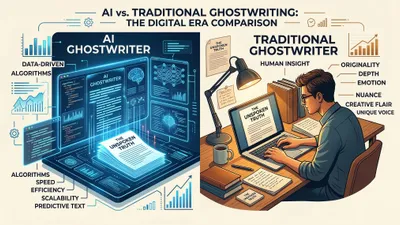
Ghostwriter vs AI comes down to what your book needs that you can’t supply yourself. For most experts and genre novelists that is a finished draft, which Chapter writes for $97, while a human ghostwriter earns $18,000 to $50,000 for nonfiction when the book depends on interviews, judgment or a publisher’s trust.
In this guide, you’ll get:
- A situation-by-situation answer on which route fits your book
- Real costs for AI, human and hybrid routes as of November 2026
- A plain list of what a human ghostwriter does better than Chapter
- A way to run the hybrid route without surprises on copyright or Amazon disclosure
This is Chapter’s own blog, so we aren’t neutral, and that is why the section on where a ghostwriter wins is as specific as we could make it.
Ghost Writer or AI: Which One Fits Your Book?
The ghost writer or AI choice depends on where your material lives, what the book is worth to you and who has to approve it. If the knowledge is yours and you are self-publishing, start with AI. If other people, a publisher or legal risk are involved, hire a human.
| Your situation | Best route | Why |
|---|---|---|
| You know your subject and want a business, authority or how-to book | Chapter | Your expertise is the raw material, and you can supply it yourself |
| You have a genre novel or a series in your head | Chapter | Clear genre conventions suit a planned, full-length draft |
| You want a family memoir or a personal keepsake | Chapter, plus a copyeditor if it will be sold | You hold the stories, and the stakes are personal rather than legal |
| The book carries your reputation and you can spend $2,000 to $6,000 | Hybrid | You get the speed of AI and a professional’s eye on the result |
| You are pitching literary agents or have a publishing deal | Human ghostwriter | Publishers have their own AI rules, and proposals are a craft of their own |
| Your memoir covers trauma or names living people | Human ghostwriter | The hard part is deciding what to say and how |
| The book relies on interviews with people other than you | Human ghostwriter | Software can’t sit down with your co-founder or your mother |
| You want poetry, a picture book or a screenplay | Not Chapter | Chapter doesn’t list these formats |
If you want a feature-by-feature comparison rather than a decision, our AI ghostwriter vs traditional breakdown goes deeper on that.
What Does Each Route Cost as of November 2026?
As of November 2026, Chapter costs $97 one time with 2 books included, and Reedsy’s 2026 marketplace data puts nonfiction ghostwriting at $18,000 to $50,000. Hybrid routes land in between, at roughly $1,600 to $6,100 for a 50,000-word book, depending on how much human work you buy.
| Route | Cost for a 50,000-word nonfiction book | Time | What stays on your plate |
|---|---|---|---|
| Chapter alone | $97 one time, 2 books included | About an hour, plus your read-through | Reading, correcting and adding what only you know |
| Chapter + copyeditor | About $1,600 to $2,100 | Add the editor’s schedule | Your read-through and the editor’s queries |
| Chapter + developmental editor + copyeditor | About $3,600 to $4,600 | Add the editors’ schedules | Acting on structural notes before the copyedit |
| Chapter + ghostwriter rewrite (60-hour example) | About $5,200 to $6,100 | Add the writer’s schedule | Briefing the writer and approving changes |
| Human ghostwriter | $18,000 to $50,000 | Three to six months, sometimes over a year | Interviews and draft reviews |
We did the hybrid arithmetic ourselves from the Editorial Freelancers Association’s 2026 rate chart, which surveys what members charged in 2025. It lists nonfiction copyediting at 3 to 4 cents a word, developmental editing at 4 to 5 cents, and ghostwriting at $85 to $100 an hour, so your quotes will vary with the person and the manuscript.
Human prices also depend on who you hire and which source you read. Reedsy’s freelancer guide puts experienced ghostwriters at $30,000 to $60,000 per book, with one ghostwriter it quotes aiming for six to seven months. The EFA’s 33 to 50 cents a word works out to $16,500 to $25,000 for the same 50,000 words.
Fiction is where the sources disagree. Reedsy lists novels at $3,500 to $18,000, while the EFA’s 25 to 50 cents a word would make an 80,000-word novel $20,000 to $40,000, so collect real quotes before you budget. Our full ghostwriter pricing guide breaks down what pushes a quote up or down.
Five Questions That Settle the Decision
The fastest way to choose between a ghostwriter and AI is to answer five questions about your book rather than comparing features. Each one points toward a route, and together they usually settle it.
Is the material in your head or in other people’s?
Chapter works from your drafts, notes, outline or idea, a few questions it asks you, and its own topic research for nonfiction. If you know the subject, that is plenty. If the book needs your former business partner’s account of the same events, you need someone who can go and get it.
What is this one book worth to you?
If one signed client or one keynote would repay a $30,000 fee, price stops being the deciding factor and you should choose on quality of fit. If the book is a first attempt, a lead magnet or a test of an idea, a five-figure fee is hard to justify before you know how it will perform.
Are you self-publishing or pitching a publisher?
Self-publishing leaves the rules to you and Amazon, and AI fits comfortably there as long as you disclose it. If you plan to find a literary agent, find out where they stand on AI before you draft a page, because that answer may make the choice for you.
What kind of time can you give?
A ghostwriter wants hours of your talking and months of your availability, and in return takes the writing off your hands. Chapter needs minutes up front, then asks you to read the whole book and fix what’s off. If you love talking and hate editing, the ghostwriter suits your temperament better.
What does a wrong sentence cost you?
For a how-to guide, a slip gets fixed in the next edition. In a book that names living people or gives medical, legal or financial guidance, a mistake can be expensive. The AI Guidelines for Ghostwriting warn that AI tools aren’t dependable for checking facts, and they hold writers and clients jointly responsible for accuracy.
Where a Human Ghostwriter Beats Chapter
A human ghostwriter beats Chapter when your book needs a person in the room: someone who interviews other people, argues with you, handles sensitive material and answers to a contract. These advantages are real, and if your book depends on them, $97 is the wrong kind of saving.
They notice what you didn’t say
A good ghostwriter catches the story you mention once and quickly move past, then brings it up again next week. Chapter builds from what you give it, so the subject you’d rather avoid stays out of the book, even when it is the most interesting thing you have.
They can interview other people
Reedsy describes the job as gathering background, interviewing the author and related characters, then drafting and editing. Chapter researches your topic online, but it can’t phone your first employee or sit with your mother for an afternoon, and some books live or die on exactly that.
They push back
Chapter writes to the plan you approve. An experienced ghostwriter may tell you the premise is weak, that your third framework repeats your second, or that the story you love makes you look bad. Having someone willing to disagree with you before the book exists is one of the things a big fee buys.
Your copyright and disclosure position is simpler
Human-written text gets US copyright in the ordinary way, and a ghostwriting contract can assign it to you. According to the Authors Guild’s summary of the Copyright Office report, AI-generated material isn’t copyrightable and prompting alone doesn’t change that, though human-written parts and your compilation can still protect a mixed work.
Chapter gives you 100% ownership with no royalties, which settles things between you and Chapter. It doesn’t make every AI-written sentence enforceable against a copycat, so if stopping imitators matters to your business, read our guide on copyrighting an AI-written book.
Disclosure works the same way. Amazon’s KDP guidelines require you to declare AI-generated text, “even if you applied substantial edits afterwards,” and the Authors Guild’s best practices ask authors to tell readers about substantial AI text as well. A book a person drafted, with no AI-generated text in it, carries neither obligation.
They know how traditional publishing works
An experienced ghostwriter can shape a book proposal to what an agent expects, and Reedsy lists proposals alone at $1,000 to $10,000. The Authors Guild also tells authors to check that AI use doesn’t breach the original-work warranty in a publishing contract. If a publisher commissions the book, Reedsy notes that the publisher usually pays for the collaboration.
They can carry sensitive books
A memoir about abuse, a book naming family members or a CEO’s account of a failed merger calls for judgment about what to leave out. A ghostwriter bound by an NDA can sit with hard material, talk through the consequences and write around them. Our memoir ghostwriter cost guide covers what that level of care runs to.
They shine when voice is the product
Chapter writes in your voice, which is plenty for a book people buy for the information or the story. In a comic essay collection or a prize-minded literary memoir, every sentence is the point. There, a gifted human or your own hand will go further, and we’d rather tell you that now.
Someone else carries the project
On a ghostwriting contract, another person owns the deadlines and the drafting, and Reedsy offers mediation if a collaboration on its marketplace goes off track.
With Chapter, the final read-through and any rewriting belong to you, and if you won’t do them, a contract may be the better purchase. Our guide to working with a ghostwriter shows what that relationship asks of you.
Why Chapter Still Leads for Most Authors
Chapter leads for most authors because most books don’t need what’s in that last section. A consultant’s framework, a how-to guide, a family history or a romance series usually needs a complete, well-structured draft and an author who knows the material, and that is what $97 buys.
Our Pick: Chapter
Chapter researches your topic, builds an outline you approve and writes the complete book in your voice, then runs its DoubleCheck editing pass over all of it. You bring drafts, notes or just the idea. Chapter for fiction writes novels of 20,000 to 120,000+ words.
Best for: experts, coaches, business owners, memoirists and genre novelists who hold the material themselves Pricing: $97 one time, 2 books included (fiction or nonfiction), 30-day money-back guarantee Why we built it: most people who want to write a book never start, because a ghostwriter costs too much and doing it alone takes too long
The price changes the order you can make decisions in. Instead of signing a five-figure contract based on a sample, you can see your actual book on the page, read it, and then decide whether it needs human help.
A ghostwriting fee is generally paid part up front and the rest in installments, while Chapter’s 30-day guarantee means support tries to fix a quality problem and refunds you in full if it can’t.
Speed matters when a launch, a speaking date or your own motivation is on a clock. The nonfiction software shows an outline in about 15 minutes and is built to finish the book within the hour, against Reedsy’s three to six months for a ghostwriter.
Unlimited editing, revisions and voice tweaks come with the $97, so you can keep reshaping the book without negotiating another round.
More than 10,000 authors have used Chapter, and it has been featured in USA Today and the New York Times. Adam W., a copywriter who had planned to hire a ghostwriter, said: “The book was totally perfect. It was almost like exactly what I would have written myself. Saved me $25K on a ghostwriter.”
Chapter has clear limits, and you should weigh them. It has no free tier or trial, it gets you to “ready to publish” without publishing for you, and it can’t supply expertise you don’t have, so a book on a subject you’ve never worked in will come out generic. Our Chapter review goes through who should walk away.
How Does the Hybrid Route Work?
The hybrid route means AI writes the draft and a human improves it, so you pay for judgment rather than typing. It suits authors who want a professional’s eye but can’t justify a full ghostwriting fee, and it comes in three forms depending on how much help the draft needs.
AI draft plus a human editor is the simplest version. Read the Chapter draft and fix what only you can fix first, because an editor’s hour is wasted on facts you could have corrected for free.
Then bring in developmental editing if the structure needs work, and save the copyedit for last. Our guides on hiring a book editor and what editors cost cover the details.
AI draft plus ghostwriter polish makes sense when the content is right but the prose isn’t yet yours. You buy a block of hours rather than a whole book, and the writer rewrites the chapters that matter most, such as the opening, your signature stories and the ending.
You can also ask for an hour or two of interview time to pull out what the draft missed.
A ghostwriter who uses AI flips the arrangement, with the human leading and AI handling research and transcripts. You pay close to full price, but you can ask for the savings in time. The next section explains why this option is more common than you might expect.
Whichever you choose, three rules keep the hybrid clean:
- Tell your hired writer up front. The AI Guidelines for Ghostwriting ask clients to disclose AI-generated source material and agree on clear rules, and some writers may decline the job.
- Declare it to Amazon anyway. Editing doesn’t change the KDP category, so a Chapter draft polished by a person still counts as AI-generated. Our KDP AI rules guide walks through the form.
- Rewrite what you most want to protect. Passages a person actually writes are human-authored, so the parts of your book worth defending are the ones to revise by hand.
For the hands-on process on the AI side, our ghostwriter AI walkthrough covers the workflow from setup to manuscript.
Do Ghostwriters Use AI Themselves?
Yes, many ghostwriters use AI, though few publish its text. In Gotham Ghostwriters’ 2025 survey, 68% of the 115 primary ghostwriters said they use AI at least sometimes, mostly for search, research and brainstorming, while 5% said they publish AI-generated text. That small sample carries a margin of error of about 9%.
So “human vs AI” is less of a clean split than the search term suggests. When you interview a ghostwriter, ask exactly how they use it, because a demand for no AI at all doesn’t work.
The guidelines point out that grammar checkers and web search already include it, and they offer a checklist running from transcription through to generating draft text.
Use that checklist to agree on what’s allowed, then write it into your contract. If you are paying $30,000 partly for the assurance that a person drafted your book, the contract should say so.
How to Decide If You’re Still Torn
If you are still torn, try the cheaper route first, since it costs little to learn and the 30-day guarantee covers a quality problem. A finished draft shows you quickly whether you need a polish, a structural edit or a different plan altogether.
Each result points to a next step:
- The draft sounds like you and the facts hold. You are nearly done, so read it closely and consider a copyedit.
- The ideas are right but the prose feels flat. Move to the hybrid and buy a block of hours from an editor or ghostwriter.
- The book feels thin because the material isn’t on the page. That points to interviews, which is the moment to hire a ghostwriter, and for a business book you’ll now know what to ask for.
Skip this test and go straight to a human if your agent or publisher restricts AI, or if the material is too sensitive for you to want it in a draft at all. Those are the two cases where starting with software works against you.
If your book doesn’t need interviews or a publisher’s sign-off, a ghostwriter’s fee is hard to justify before you have seen a draft. Chapter for nonfiction and Chapter for fiction write the complete book for $97 one time, with 2 books included, no subscription and a 30-day money-back guarantee.
FAQ
Is a ghostwriter better than AI?
A ghostwriter is better than AI for books that need interviews, editorial pushback or sensitive judgment, such as trauma memoirs and traditionally published titles. AI is the better choice for most self-published expert books and genre novels, where you already hold the material and $97 beats a five-figure fee.
Can AI replace a ghostwriter for a business book?
AI can replace a ghostwriter for a business book when the expertise is already yours and you will review the draft closely. A human still wins if the book needs interviews with clients or colleagues, or if it is going to a traditional publisher whose AI rules restrict machine-written text.
Can I hire a ghostwriter to fix an AI draft?
Yes, you can hire a ghostwriter to fix an AI draft, usually for a block of hours rather than a full fee. Tell them the draft came from AI before they quote, since some writers may decline AI source material. On a 50,000-word book, expect far less than a from-scratch ghostwriting project.
Do I have to disclose a ghostwriter or AI on Amazon?
You must disclose AI-generated text to Amazon KDP, even after substantial human edits, but KDP’s AI declaration doesn’t cover a human ghostwriter. Editing or brainstorming help on text you wrote yourself counts as AI-assisted and doesn’t need declaring. Check the current guidelines each time you publish or republish.
Who owns the book with a ghostwriter vs AI?
You own the book in both cases if your paperwork says so: a ghostwriting contract assigns the rights, and Chapter gives you 100% ownership with no royalties. The difference is copyright strength, because AI-generated text isn’t protected in the US, while human-written passages and your compilation can be.