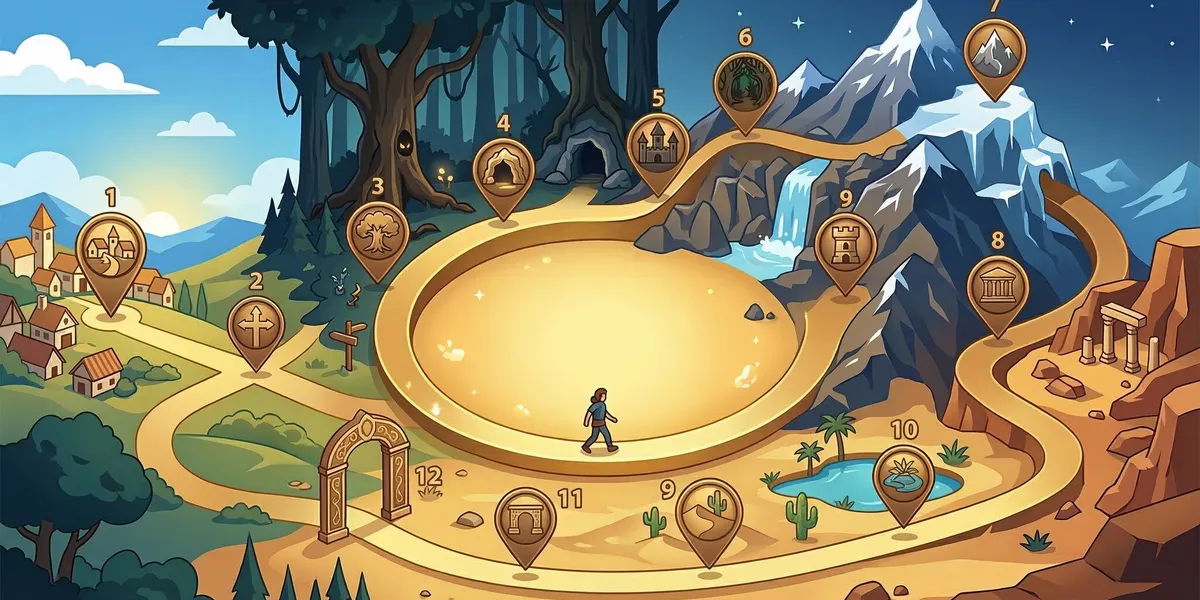
The hero’s journey is a 12-stage narrative pattern identified by mythologist Joseph Campbell in The Hero with a Thousand Faces (1949). It describes a universal story arc: a hero leaves the familiar world, faces trials in an unknown realm, and returns transformed. Nearly every myth, epic, and blockbuster follows some version of this pattern.
Campbell called it the monomyth. Screenwriters, novelists, and game designers call it indispensable.
The 12 stages of the hero’s journey
Below are all 12 stages, each illustrated with Star Wars: A New Hope, the film George Lucas explicitly built using Campbell’s framework.
1. The Ordinary World
The hero’s normal life before the adventure begins. This establishes who they are, what they lack, and what their world looks like.
Star Wars: Luke Skywalker is a restless farm boy on Tatooine, dreaming of something more while fixing moisture vaporators.
The ordinary world matters because it is the baseline. Without it, the transformation at the end means nothing.
2. The Call to Adventure
An event or message disrupts the ordinary world and invites the hero into the unknown.
Star Wars: R2-D2 plays Princess Leia’s holographic message: “Help me, Obi-Wan Kenobi. You’re my only hope.”
The call can be a letter, a death, a stranger, a discovery. It must present a problem the hero cannot ignore forever.
3. Refusal of the Call
The hero hesitates. Fear, obligation, or self-doubt holds them back.
Star Wars: Luke tells Obi-Wan he cannot leave. He has responsibilities on the farm. His uncle needs him.
The refusal is not cowardice. It shows the stakes are real and the hero is human.
4. Meeting the Mentor
The hero encounters a guide who provides wisdom, training, or a crucial tool.
Star Wars: Obi-Wan Kenobi gives Luke his father’s lightsaber and begins teaching him about the Force.
The mentor does not solve the hero’s problem. They equip the hero to solve it themselves.
5. Crossing the Threshold
The hero commits to the adventure and leaves the ordinary world behind. There is no turning back.
Star Wars: After stormtroopers kill his aunt and uncle, Luke tells Obi-Wan: “I want to come with you to Alderaan. I want to learn the ways of the Force.”
This is the Act 1 turning point in three act structure terms. The hero enters the special world.
6. Tests, Allies, and Enemies
The hero navigates the new world, facing challenges and forming relationships. They learn the rules of this unfamiliar terrain.
Star Wars: Luke meets Han Solo and Chewbacca in the Mos Eisley cantina. They escape Imperial forces, get pulled into the Death Star, and discover the scope of the Empire’s power.
This is the bulk of Act 2. The hero is tested and begins to grow.
7. Approach to the Inmost Cave
The hero prepares for the central ordeal. Tension builds. The stakes become clear.
Star Wars: Luke and the group infiltrate the Death Star’s detention level to rescue Princess Leia. They are deep inside enemy territory.
The “cave” is metaphorical. It is whatever place holds the hero’s greatest fear or the story’s central challenge.
8. The Ordeal
The hero faces their greatest test. This is the crisis point where death (literal or symbolic) is a real possibility.
Star Wars: Obi-Wan duels Darth Vader and sacrifices himself. Luke watches his mentor die.
The ordeal is the midpoint reversal of the story. It changes the hero fundamentally. What they lose here cannot be recovered.
9. The Reward
After surviving the ordeal, the hero gains something: a weapon, knowledge, reconciliation, or new understanding.
Star Wars: Luke escapes the Death Star with the princess and the plans. He gains purpose and allies.
The reward is not the end of the story. It is what makes the final confrontation possible.
10. The Road Back
The hero begins the journey home, but new dangers arise. The consequences of the ordeal catch up.
Star Wars: The Empire tracks the Millennium Falcon to the Rebel base. The Death Star is en route to destroy them.
The road back introduces urgency. The clock is ticking.
11. The Resurrection
The climax. The hero faces a final, decisive test that requires everything they have gained. They are symbolically reborn.
Star Wars: Luke flies the trench run. With the targeting computer urging him to rely on technology, he hears Obi-Wan’s voice and trusts the Force instead. He fires the shot that destroys the Death Star.
The resurrection proves the hero has truly changed. They use what they learned, not what they started with.
12. Return with the Elixir
The hero returns to the ordinary world, transformed. They bring something back, knowledge, treasure, or healing, that benefits the community.
Star Wars: Luke receives a medal in the Rebel ceremony. He is no longer a farm boy. He is a hero of the Rebellion.
The return mirrors the ordinary world from Stage 1, but everything is different because the hero is different.
The hero’s journey at a glance
| Stage | What happens | Story function |
|---|---|---|
| 1. Ordinary World | Hero’s normal life | Establish baseline |
| 2. Call to Adventure | Disruption arrives | Launch the story |
| 3. Refusal of the Call | Hero hesitates | Show real stakes |
| 4. Meeting the Mentor | Guide appears | Equip the hero |
| 5. Crossing the Threshold | Hero commits | Enter Act 2 |
| 6. Tests, Allies, Enemies | New world challenges | Build and test |
| 7. Approach to the Inmost Cave | Tension mounts | Prepare for crisis |
| 8. The Ordeal | Greatest test | Midpoint crisis |
| 9. The Reward | Hero gains something | Turn toward resolution |
| 10. The Road Back | New dangers, urgency | Drive toward climax |
| 11. The Resurrection | Final test, rebirth | Climax |
| 12. Return with the Elixir | Hero returns changed | Resolution |
Beyond Star Wars: other examples
The Lord of the Rings: Frodo leaves the Shire (Ordinary World), receives the Ring (Call), resists at first (Refusal), is guided by Gandalf (Mentor), leaves Rivendell (Threshold), survives Moria and Shelob (Tests/Ordeal), and destroys the Ring (Resurrection) before returning to a Shire he no longer fits (Return).
The Hunger Games: Katniss’s life in District 12 (Ordinary World), the reaping (Call), volunteering for Prim (Threshold), Haymitch as mentor (Mentor), the arena (Tests/Ordeal), survival (Reward), and returning as a changed person who has defied the Capitol (Return).
Harry Potter: Privet Drive (Ordinary World), the Hogwarts letter (Call), the Dursleys blocking it (Refusal), Hagrid (Mentor), Platform 9 3/4 (Threshold), every year’s escalating threats (Tests/Ordeal), and Harry’s final walk into the Forbidden Forest (Resurrection).
How to use the hero’s journey in your writing
Not every stage needs a dedicated chapter. Some stages merge. Some are implied. The journey is a lens, not a checklist.
Start with the ordeal. What is the worst thing your hero faces? Work backward to establish what makes it devastating and forward to show what it transforms.
Make the ordinary world specific. Generic “normal life” scenes bore readers. Give the ordinary world texture and something worth missing.
Earn the mentor. The mentor should not hand the hero a solution. They hand the hero a tool the hero does not yet know how to use.
Let the refusal be real. If the hero has no reason to hesitate, the stakes are not high enough.
The hero’s journey maps onto the three act structure: Stages 1-5 are Act 1, Stages 6-9 are Act 2, and Stages 10-12 are Act 3. It also aligns with story beats and specific structural moments like the inciting incident (Stage 2) and the dark night of the soul (the transition from Stage 10 to 11).
Campbell did not invent this pattern. He found it. It appears across cultures and centuries because it mirrors something fundamental about how humans experience change. That is why it still works.