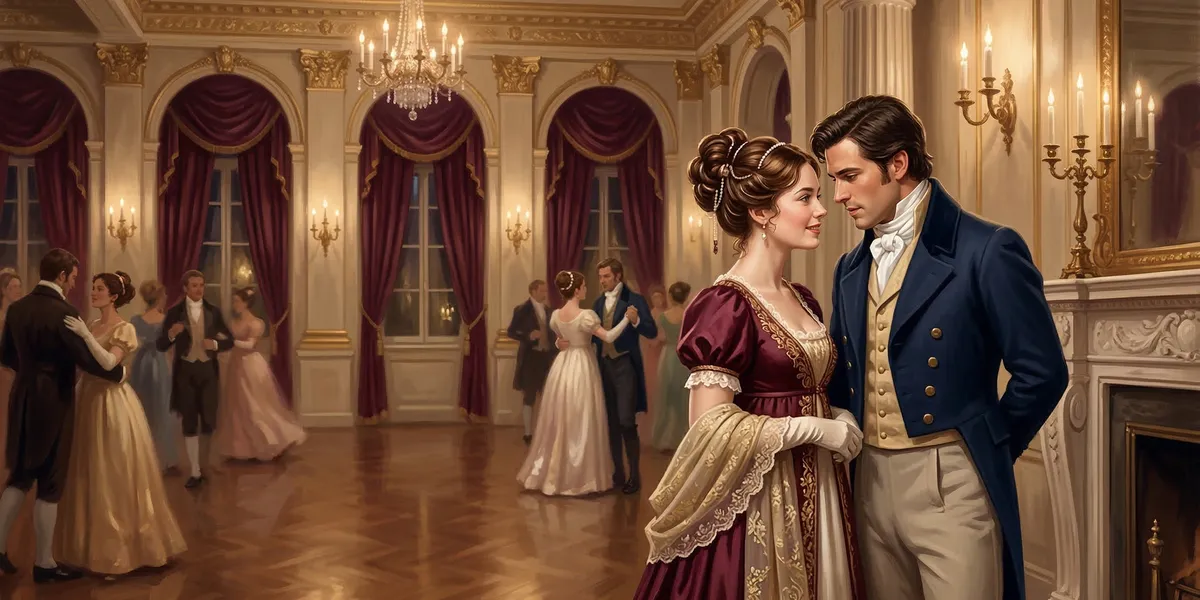
Historical romance sets a love story in the past and uses the period’s social rules as both obstacle and opportunity. The constraints of the era — who could marry whom, what was scandalous, where unchaperoned meetings happened — create romantic tension that contemporary settings have to manufacture artificially.
The best historical romance makes the past feel alive without making the reader feel like they’re studying for an exam.
Choosing Your Era
Regency England (1811-1820) dominates historical romance, and for good reason. The era’s rigid social rules, emphasis on manners and reputation, the Season, and the marriage market create a natural framework for romantic tension. But Regency is not the only option, and readers increasingly seek historical romances set in underexplored periods and places.
Regency (1811-1820)
The most popular era by far. Balls, assemblies, the ton, calling cards, chaperones, and the ever-present pressure to marry well. Jane Austen codified the appeal, and Julia Quinn’s Bridgerton series (plus the Netflix adaptation) brought it to a new generation. Regency works because the social constraints are extreme enough to create conflict but familiar enough that readers understand the rules quickly.
Best for: Writers who want a large, established readership and well-understood social conventions.
Victorian (1837-1901)
Longer, more varied, and darker than Regency. The Victorian era spans industrialization, empire, massive social change, and evolving gender roles. The repression of the era — public propriety masking private passion — creates tension that’s less dance-card-elegant and more pressure-cooker intense.
Best for: Writers who want grittier settings, wider class dynamics, and stories about social change.
Medieval (5th-15th Century)
Knights, castles, arranged marriages with real political stakes, and a social structure where women’s options were severely constrained. Medieval romance allows for adventure, political intrigue, and physical danger alongside the love story. The arranged marriage trope has its most organic setting here.
Best for: Adventure-romance blends where physical danger and political stakes complement the love story.
American Historical
The American West, Civil War era, Gilded Age, Roaring Twenties, and World War II home front offer distinct settings with different social dynamics than British-focused historicals. These periods provide more physical mobility and less rigid class structure, but their own set of social conventions and conflicts.
Best for: Writers who want to explore American history, diverse settings, and stories where characters have more physical freedom but face different social constraints.
Non-Western Historical
Korean Joseon dynasty, Mughal India, feudal Japan, Ottoman Empire, ancient China — historical romance set outside Western Europe and America is growing rapidly. These settings offer readers genuine freshness and writers the chance to explore social conventions that create entirely different romantic dynamics.
Best for: Writers with cultural knowledge or a commitment to deep research who want to expand the genre’s boundaries.
Research Depth: How Much Is Enough?
The research question paralyzes more historical romance writers than any other issue. How much period accuracy does the romance need?
The reader contract. Historical romance readers are not historians. They’re romance readers who enjoy historical settings. They want the era to feel authentic without being a textbook. The contract is: don’t break the illusion, but don’t sacrifice the romance for historical accuracy.
Get the big things right. Transportation, communication speed, social hierarchy, what women could and couldn’t do, major historical events happening in the background. If your Regency heroine drives a car or your medieval knight uses a telescope, readers will notice.
Sweat the telling details. Period-specific details that most readers won’t fact-check but that create atmosphere: what people ate for breakfast, how long a journey took by carriage, what a ballroom smelled like (candle wax, perfume, and too many people), the specific fabrics of the era. These details make the setting feel lived-in.
Forgive yourself the small things. Some historical realities don’t serve the romance. Actual Regency dental hygiene. The smell of cities before modern sanitation. The reality of corset-wearing (less dramatic than fiction suggests). It’s acceptable to soften unromantic historical realities when they’d distract from the story.
Three reliable sources. For any historical detail that’s plot-relevant, verify it with at least three sources. For atmosphere and daily life details, one well-regarded social history of the period is usually sufficient.
Language Balance
The language of historical romance is a performance. You’re not writing in actual period English — you’re creating the impression of period English while remaining accessible to modern readers.
What to Do
Use period-appropriate vocabulary selectively. Sprinkle in era-specific terms (calling cards, assemblies, curricle, waistcoat) to establish setting. These words act as anchors that remind the reader they’re in the past.
Match sentence rhythm to the era. Regency dialogue tends toward longer, more formal sentence structures. Medieval dialogue is more direct. Victorian characters use more passive construction and circumlocution. The rhythm of speech signals the period as much as specific vocabulary.
Let the setting do the work. If the carriage, the ballroom, and the chaperone are clearly established, the dialogue doesn’t need to work as hard to feel historical. The context carries the period flavor.
What to Avoid
Full period speech. Actual Regency English is harder to read than most modern readers want. Aim for an impression, not a recreation.
Anacronistic slang. “Okay” (first documented 1839), “boyfriend/girlfriend” (late 19th century), “stressed out” (mid-20th century). These words snap readers out of the historical setting instantly. Keep a reference list of anachronisms for your chosen era.
Modern therapy-speak. Historical characters can have emotional intelligence, but they shouldn’t sound like they’ve been to couples counseling. “I feel like you’re not respecting my boundaries” doesn’t belong in a Regency ballroom. Find period-appropriate ways to express modern emotional concepts.
Inconsistency. If your characters speak formally in dialogue, the narrative voice should match. A Regency heroine who thinks in formal period language in chapter one but uses modern slang internally by chapter ten breaks immersion.
Social Conventions as Plot Devices
Historical romance’s greatest asset is that the era’s social rules create built-in conflict. The rules aren’t arbitrary obstacles — they’re the specific shape of the world your characters must navigate.
Reputation
In most historical periods, a woman’s reputation was her most valuable social asset and the easiest thing to destroy. Being seen alone with a man, having a perceived improper relationship, or simply being the subject of gossip could ruin her marriage prospects and social standing.
This creates tension at every encounter. Every private conversation is a risk. Every stolen moment has consequences. The weight of reputation makes romance dangerous in a way contemporary settings can’t replicate.
Chaperones
The chaperone exists to prevent exactly what the reader wants to happen. This makes them one of romance’s best structural devices. The chaperone who falls asleep, steps away, or is cleverly distracted becomes a collaborator in the romance (willingly or not).
The effort characters expend to get a moment alone communicates how much the connection matters. A hero who orchestrates an entire garden party rearrangement for five minutes of private conversation with the heroine is making a declaration louder than words.
Marriage as Social Contract
In historical settings, marriage isn’t just personal — it’s economic, political, and social. Families negotiate. Fortunes are at stake. Alliance and advantage matter. This means the characters’ feelings must contend with external pressures that contemporary romance characters don’t face.
A heroine who loves a second son instead of the wealthy heir isn’t just following her heart — she’s defying her family’s financial strategy. A hero who proposes to a woman without fortune instead of the heiress his estate needs is choosing love over survival. The stakes are real.
Class and Station
Rigid class structure means cross-class romance is transgressive. A duke falling for a governess, a merchant’s daughter marrying into the aristocracy, a servant and their employer — these pairings are inherently conflict-rich because the society around the couple actively opposes the match.
The class conflict must be resolved, not just ignored. How the characters navigate social disapproval, financial implications, and family opposition gives the romance its depth.
Famous Examples
Bridgerton series by Julia Quinn. Eight siblings, eight romances, one sprawling Regency world. The Netflix adaptation made Bridgerton a cultural phenomenon, but the books established the template for modern Regency romance series — witty, warm, and grounded in the social dynamics of the ton.
Outlander by Diana Gabaldon. Time travel provides the mechanism, but the historical setting — 18th-century Scotland — provides the substance. Gabaldon’s research depth shows what thorough period knowledge adds to a romance: specificity, authenticity, and a setting that feels as real as the characters.
Courtney Milan’s Brothers Sinister series. Milan writes Victorians who feel like real people navigating real social constraints. Her characters are diverse, her historical research is impeccable, and her romances address issues of class, gender, and race within historically accurate frameworks.
An Offer from a Gentleman by Julia Quinn. A Cinderella retelling set in Regency England that uses social class as the primary obstacle. The fairy tale structure maps naturally onto historical romance conventions.
The Duchess Deal by Tessa Dare. A scarred duke and a seamstress in a marriage of convenience. Dare’s signature wit makes the Regency setting feel fresh while the social dynamics — what it means for a woman of no means to become a duchess — provide genuine stakes.
Tips for Writing Historical Romance
Pick one era and go deep. Surface knowledge of five periods is less valuable than thorough knowledge of one. Readers who love Regency will follow you through a Regency series for twenty books. Mastering one era builds your authority and your readership.
Read social histories, not just events. You need to know what people ate, wore, did for entertainment, worried about, and talked about — not just what wars were happening. A social history of Regency England (like Venetia Murray’s An Elegant Madness) will serve you better than a political history.
Use the constraints, don’t fight them. The social rules aren’t obstacles to work around — they’re the source of your romantic tension. A world where a stolen kiss could ruin a reputation makes every kiss count.
Anchor each scene in a period detail. One specific historical detail per scene — the feel of silk gloves, the sound of carriage wheels on cobblestones, the taste of ratafia at an assembly — keeps the setting present without overwhelming the romance.
Write your romance tropes through the period’s lens. Enemies to lovers in Regency England looks different from enemies to lovers in modern New York. The period shapes how the trope plays out. Let historical context make familiar tropes feel fresh.
Writing Historical Romance With Chapter
Historical romance demands consistency — period details, social conventions, and character behavior must stay accurate across a full manuscript. Chapter’s fiction software tracks your world’s rules and character details throughout the entire romance beat sheet, ensuring your Regency manners stay consistent from chapter one to the epilogue. The series management feature is especially valuable for historical romance writers building multi-book family sagas — character details, titles, social standings, and relationship histories stay consistent across every installment. Sarah M. hit #12 in Romance Contemporary in five days using Chapter — the structure works across every subgenre, historical included.