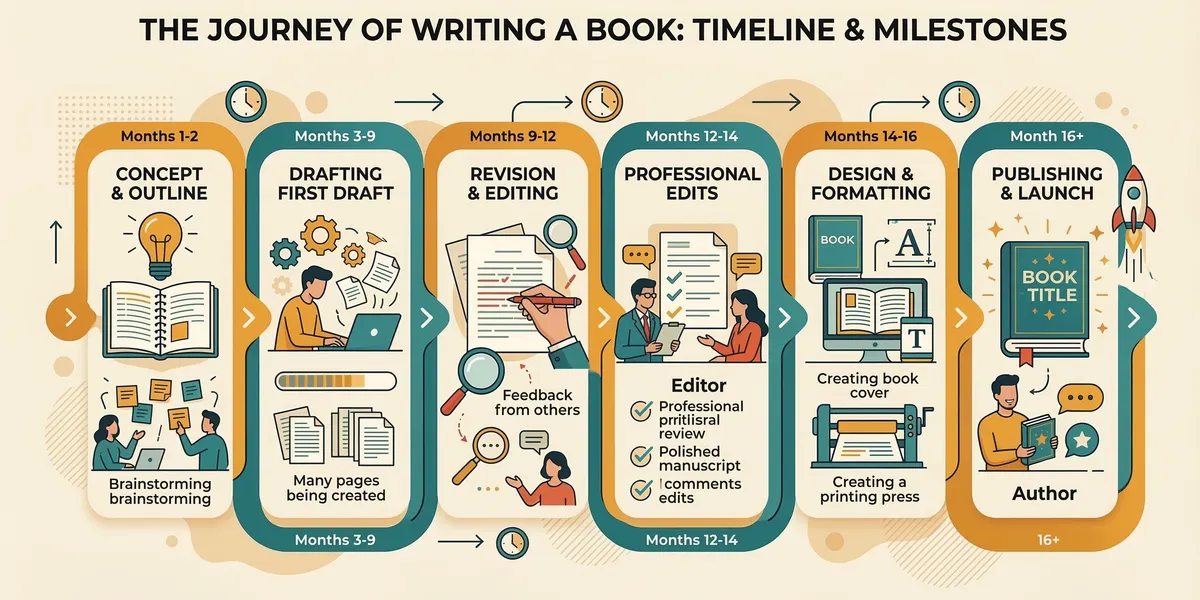
Writing a book takes 6 to 18 months using traditional methods. With AI assistance, that timeline drops to 1 to 7 days for nonfiction and 2 to 4 weeks for fiction. The actual number depends on your book’s length, genre, writing experience, and whether you use an outline or AI tools.
Here is a complete breakdown of realistic timelines for every method and genre.
How Long to Write a Book by Method
Your writing approach is the single biggest factor in how long your book takes. A writer with no outline and no system will take ten times longer than someone with a structured process.
| Writing Method | Timeline | Notes |
|---|---|---|
| Traditional (no outline) | 12-24 months | Most common for first-time authors |
| Traditional (with outline) | 6-12 months | Outline eliminates decision fatigue |
| Full-time focused writing | 3-6 months | 2,000-4,000 words per day |
| With AI assistance (Chapter.pub) | 1-7 days (nonfiction) | AI generates structured drafts from your expertise |
| With AI assistance (fiction) | 2-4 weeks | More revision needed for voice and narrative |
The traditional range of 6 to 18 months assumes you are writing part-time — evenings and weekends — which is how most first-time authors work. If you quit your job and write full-time at 2,000 words per day, a 60,000-word manuscript takes roughly 30 writing days. But few people have that luxury.
Outlining before you draft is the simplest way to cut your timeline in half. A solid book outline prevents you from writing chapters that don’t belong, restructuring your manuscript three times, or staring at a blank page wondering what comes next.
How Long to Write a Book by Genre
Genre determines word count, and word count determines timeline. A 30,000-word authority book is a fundamentally different project than a 120,000-word epic fantasy.
| Genre | Word Count | Traditional Timeline | With AI Assistance |
|---|---|---|---|
| Short nonfiction / authority book | 20,000-40,000 | 2-6 months | 1-5 days |
| Standard nonfiction | 50,000-80,000 | 6-12 months | 1-2 weeks |
| Self-help / how-to | 40,000-60,000 | 4-9 months | 1-2 weeks |
| Romance novel | 50,000-80,000 | 3-9 months | 2-4 weeks |
| Mystery / thriller | 70,000-90,000 | 6-12 months | 3-6 weeks |
| Literary fiction | 70,000-100,000 | 12-24 months | 4-8 weeks |
| Fantasy / epic fiction | 100,000+ | 12-36 months | 6-12 weeks |
Nonfiction books with shorter word counts are naturally faster to write, especially when the author already has expertise on the subject. If you have spent ten years in an industry, your authority book is already in your head — you just need to get it on paper.
Fiction takes longer at every word count because the creative demands are higher. You are inventing characters, dialogue, plot structure, and pacing from scratch. Even with AI tools, fiction requires more rounds of human revision to sound authentic.
What Slows Writers Down
Most books don’t take long because the writing itself is slow. They take long because writers get stuck. Here are the five most common reasons a book stalls.
No outline. Writing without an outline is like driving cross-country without a map. You will get somewhere eventually, but you will waste months on wrong turns. Writers without outlines are 3-4x more likely to abandon their manuscript. Start with a book outline and your first draft writes itself.
Perfectionism on the first draft. Editing while you draft is the fastest way to never finish. The first draft exists to get ideas on paper. Revising sentence by sentence on page 12 while you have 40 chapters to go is a trap. Write the full draft first, then edit.
Research rabbit holes. Spending three weeks researching 18th-century shipbuilding for a single chapter is procrastination disguised as productivity. Research enough to write the scene, mark what needs fact-checking, and move on. Fix the details in revision.
Inconsistent writing schedule. Writing once a week for four hours produces less than writing daily for 30 minutes. Consistency builds momentum. When you write every day, you spend less time re-reading what you wrote last time and more time making progress.
No deadline. A book with no due date will take forever. Set a realistic completion date and work backward. If your book is 60,000 words and you have six months, that is 10,000 words per month, or roughly 330 words per day. That is one page.
What Speeds Writers Up
The fastest writers aren’t faster typists. They have better systems.
A detailed outline. An outline breaks 60,000 words into a series of small, achievable writing sessions. Instead of “write a book,” your daily task becomes “write the section on pricing strategy.” That clarity eliminates procrastination. Here is how to start writing a book with the right foundation.
A daily word count goal. Most published authors recommend 500 to 2,000 words per day. At 1,000 words daily, a 60,000-word book takes two months of writing. Track your count and protect your writing time like any other appointment.
Writing sprints. Set a timer for 25 minutes and write without stopping. No editing, no re-reading, no checking your phone. Many writers find they can produce 500-1,000 words in a single sprint. Three sprints per session adds up fast.
AI writing tools. AI tools like Chapter.pub generate structured first drafts from your outline and expertise. Instead of starting from a blank page, you start with a complete draft that you can revise and personalize. This is the biggest timeline shift in modern book writing. Learn more about how to write a book using these approaches.
Accountability partners. Tell someone your deadline. Join a writing group. Hire a coach. External accountability adds social pressure that internal motivation alone cannot match. Writers with accountability partners finish at roughly twice the rate of solo writers.
Real Examples: AI-Assisted Book Timelines
These timelines are real, but context matters. Both examples are nonfiction authority books — not literary novels.
Sarah M. went from idea to published book in 5 days using Chapter. She had 15 years of expertise in her subject, used AI to generate a structured first draft, then spent three days revising and adding personal stories. Her book is 32,000 words.
Jim T. finished his book in 3 days. He came in with a detailed outline already written, used AI to draft each chapter, and did a single revision pass. His book is a 25,000-word business guide.
These are not outliers for short nonfiction. When you already know your subject and have a clear structure, AI tools eliminate the slowest part of writing — staring at a blank page and figuring out what to say. The expertise and revision still come from you.
For longer nonfiction (50,000+ words) or any fiction project, add proportionally more time. A 70,000-word novel with AI assistance still requires weeks of revision for character voice, dialogue, and narrative flow.
The Honest Take on AI Book Writing
AI has genuinely changed how fast you can produce a first draft. A tool like Chapter.pub can generate a full nonfiction draft in under an hour from your outline and inputs. That part is real.
What AI does not do is replace your thinking. A good book needs:
- Your expertise and perspective. AI can structure information, but the insights that make a book worth reading come from your experience. Without your point of view, the draft reads like a Wikipedia summary.
- Human editing. AI-generated text needs revision for tone, accuracy, flow, and voice. Plan for at least one to three full revision passes after the AI draft.
- Personal stories and examples. Readers connect with specific, lived experience. The AI draft gives you the framework. You fill it with the stories only you can tell.
- Fact-checking. AI can generate plausible-sounding information that is wrong. Every claim, statistic, and recommendation in your book needs verification.
The “60 minutes to a first draft” claim you see from AI writing tools is accurate for the draft itself. But the finished, publish-ready book takes longer — typically 2 to 7 days for short nonfiction after the AI draft is generated. That is still dramatically faster than 6 to 18 months of traditional writing.
The writers who get the best results from AI tools are the ones who bring real expertise and treat the AI draft as a starting point, not a finished product. If you are looking for an AI book writer that handles the structure while you focus on the substance, that is the right way to think about it.
FAQ
How long does it take to write a 200-page book? A 200-page book is roughly 50,000-60,000 words. Traditionally, that takes 6 to 12 months writing part-time. With a solid outline and daily writing habit, 3 to 6 months. With AI assistance, 1 to 2 weeks including revision.
How long did famous authors take to write their books? It varies wildly. Jack Kerouac wrote On the Road in three weeks. J.R.R. Tolkien spent 12 years on The Lord of the Rings. Stephen King writes about 2,000 words per day and finishes a first draft in roughly three months. The average traditionally published novel takes 1 to 2 years.
Can you write a book in 30 days? Yes. National Novel Writing Month (NaNoWriMo) challenges writers to draft 50,000 words in 30 days — roughly 1,667 words per day. Thousands of writers complete this challenge every November. The result is a first draft that still needs revision, but the core manuscript is done.
How many hours does it take to write a book? Most authors report 300 to 600 hours of total work for a traditionally written book, including drafting, revising, and editing. AI-assisted nonfiction can reduce this to 20 to 60 hours depending on length and revision depth.
What is the fastest way to write a book? Start with a detailed outline, use AI tools to generate the first draft, then focus your time on revision and adding personal expertise. This combination routinely produces finished nonfiction books in under a week. For a complete walkthrough, see the guide on how to write a book.