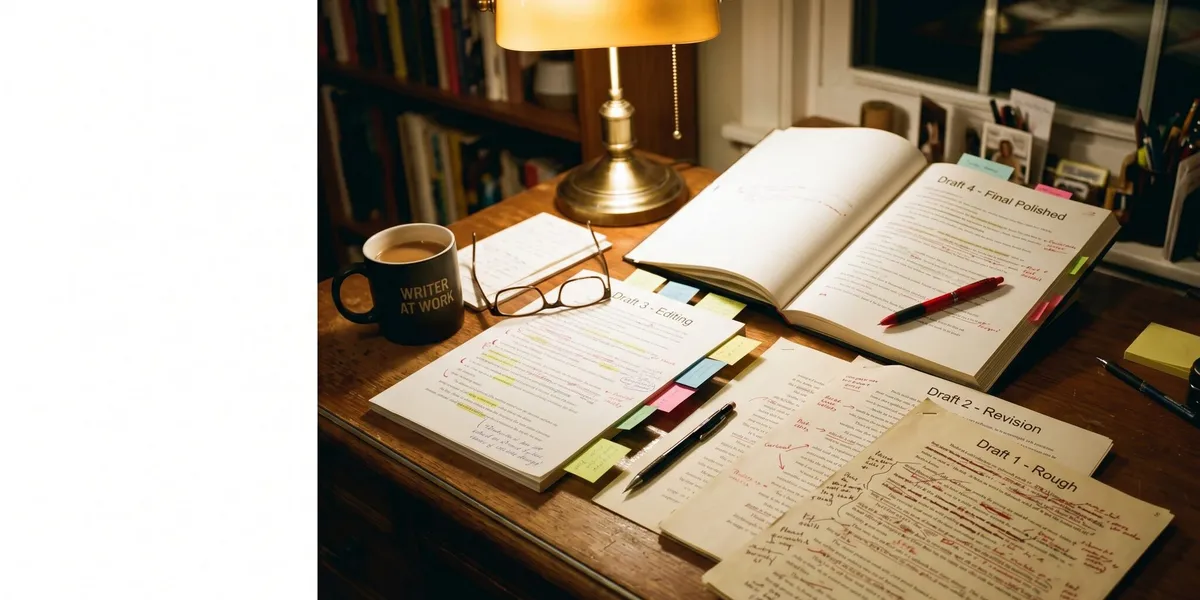
Most books go through 3 to 7 drafts before they are ready to publish. The exact number depends on your genre, experience level, and whether you are working with an editor or revising on your own.
In this guide, you’ll learn:
- What each draft is for and what to focus on during each pass
- How famous authors approach their own revision process
- When your manuscript is actually “done” (and how to stop over-editing)
- How to cut your draft count without cutting quality
Here is how the drafting process works from first draft to final manuscript.
How Many Drafts Does the Average Book Need?
The average book needs 3 to 7 drafts before it is ready for publication. That range covers everything from a fast-moving nonfiction guide to a layered literary novel.
A survey of published authors by Writer’s Edit found that most completed novels went through roughly six drafts. There is even an old publishing axiom — “seven drafts to final” — that literary agents have passed around for decades.
But that number is not a rule. It is a pattern. Some books need three drafts. Some need twelve. Ernest Hemingway famously rewrote the ending of A Farewell to Arms thirty-nine times. The point is not to hit a magic number — it is to understand what each draft accomplishes so you know when your book is genuinely finished.
Draft count by genre
| Genre | Typical Draft Count | Why |
|---|---|---|
| Literary fiction | 5-10+ | Complex prose, layered themes, voice-driven |
| Commercial fiction | 3-6 | Plot-driven, cleaner structure |
| Memoir | 4-8 | Emotional honesty takes multiple passes |
| Self-help / how-to | 3-5 | Clarity and structure over style |
| Business nonfiction | 3-4 | Information-dense, less stylistic revision |
| Poetry collection | 6-12+ | Every word carries weight |
Fiction writers typically need more drafts than nonfiction writers because fiction demands attention to voice, pacing, character arcs, and subtext — layers that reveal themselves only through repeated reading.
What Does Each Draft Focus On?
Each draft in the revision process serves a different purpose. Trying to fix everything in a single pass is the fastest way to burn out and miss critical problems.
Draft 1: The discovery draft
Your first draft exists to get the story or argument onto the page. Nothing more. This is the draft where you figure out what you are actually writing about.
For fiction, the first draft reveals your characters, plot, and voice. For nonfiction, it reveals your thesis and the structure of your argument. Either way, the first draft is raw material — not a finished product.
Do not edit while you write the first draft. Get to the end. You cannot revise a blank page.
Draft 2: The structural revision
The second draft is where you fix the big problems. In fiction, that means developmental editing — checking plot holes, character consistency, pacing, and arc structure. In nonfiction, that means reorganizing chapters, cutting tangents, and strengthening your core argument.
This is the draft where chapters get moved, deleted, or rewritten from scratch. It is often the most painful draft because you are killing your darlings.
Draft 3: The scene-level revision
Now you zoom in. Each chapter and scene gets individual attention. Are the transitions smooth? Does every scene advance the plot or argument? Is there unnecessary repetition?
This is also when you check for line editing concerns — sentence rhythm, word choice, dialogue that sounds natural, and prose that flows.
Draft 4: The polish draft
The polish draft is about voice and clarity. You read every sentence out loud. You cut adverbs, tighten phrasing, and make sure the writing sounds like you — not like a rough draft that has been cleaned up.
For nonfiction, this is the draft where you make sure your advice is actionable, your examples are concrete, and your tone is consistent.
Draft 5+: Final cleanup and proofreading
The final drafts handle copy editing — grammar, punctuation, spelling, and formatting consistency. These are the mechanical passes where you catch typos, fix inconsistent character names, and standardize formatting.
Some writers do this in one pass. Others need two or three. If you are self-publishing, this is also where you send the manuscript to a professional proofreader.
How Do Famous Authors Handle Drafts?
You are not alone in rewriting your book multiple times. Some of the most celebrated authors in history were prolific revisers.
Ernest Hemingway rewrote the ending of A Farewell to Arms thirty-nine times. When asked what the problem was, he replied: “Getting the words right.”
Raymond Carver was known for writing ten to thirty drafts of a single short story. His editor, Gordon Lish, would then cut them further.
J.K. Rowling went through multiple drafts of the first Harry Potter chapter, rewriting the opening more than fifteen times before she was satisfied.
Stephen King, on the other hand, writes a first draft quickly, lets it sit for six weeks, then does a single thorough revision. His process shows that draft count matters less than revision quality.
The lesson? There is no “correct” number. What matters is that you address structure, voice, and mechanics before you call your book done.
How Do You Know When Your Book Is Done?
Knowing when to stop revising is one of the hardest skills in writing. Here are four signs your manuscript is ready.
You are making lateral changes, not improvements. If you change a word in draft seven and then change it back in draft eight, you are done. Lateral edits — swapping one equally good option for another — are a sign that the writing has reached its ceiling.
An outside reader confirms it works. Beta readers and critique partners catch problems you cannot see. If your readers come back with minor notes instead of structural concerns, your book is close to finished.
The structure holds under pressure. Read your entire book in one or two sittings. If the beginning sets up what the end delivers, and nothing in the middle sags or confuses you, the structure is solid.
A professional editor validates it. A developmental editor who tells you “this is clean — focus on copy editing” is giving you permission to move to the final stages. If you cannot afford an editor, AI editing tools like Chapter can flag structural issues, pacing problems, and inconsistencies in your draft.
How to Reduce Your Draft Count Without Sacrificing Quality
Fewer drafts does not mean less revision. It means more efficient revision. Here are proven strategies to tighten your process.
Start with a strong outline
A solid book outline prevents structural problems from appearing in the first place. If you outline before you draft, you spend less time rearranging chapters in draft two.
Use AI for faster first drafts
AI writing tools can accelerate the drafting process significantly. Chapter helps you generate structured first drafts that already have logical flow, which means your revision process starts at a higher baseline. Over 10,000 authors have used Chapter to write books — and many of them report cutting their draft count by one to two rounds.
Our Pick — Chapter
Chapter’s AI writing assistant helps you produce structured, coherent first drafts for both fiction and nonfiction. Instead of staring at a blank page, you start revising from a solid foundation.
Best for: Authors who want to spend less time drafting and more time refining Pricing: $97 one time, 2 books included (fiction or nonfiction), 30-day money-back guarantee Why we built it: First drafts should not take months — revision is where the real writing happens.
Separate your editing passes
Trying to fix plot holes and typos in the same pass leads to missing both. Assign each draft a single focus: structure, then scenes, then sentences, then mechanics. Developmental editing first, copy editing last.
Build a consistent writing routine
A regular writing routine keeps your voice consistent across drafts and reduces the “re-entry” time you lose when you step away from a manuscript for weeks. Consistent writers typically need fewer revision passes because the voice stays unified.
Read your draft out loud
Reading out loud catches awkward phrasing, repetitive sentence structures, and dialogue that does not sound natural. This single habit can eliminate an entire draft’s worth of line editing work.
How Long Should You Wait Between Drafts?
Most writing experts recommend 2 to 6 weeks between major drafts. Stephen King suggests six weeks in On Writing. Other authors settle for two.
The goal is to create distance between you and the manuscript so you can read it with fresh eyes. When you have just finished a draft, your brain fills in gaps and smooths over problems automatically. Time breaks that spell.
Shorter breaks (1-2 weeks) work for nonfiction, where the content is more objective. Longer breaks (4-6 weeks) work better for fiction, where voice and emotional pacing need a reader’s perspective rather than the writer’s.
Use your break productively. Start outlining your next project, read books in your genre, or gather beta reader feedback on the draft you just finished.
Does Self-Publishing Require More or Fewer Drafts?
Self-publishing does not change how many drafts you need — but it does change who handles them.
In traditional publishing, your editor at the publishing house will guide you through at least one or two additional revisions after acquisition. That editorial support is built into the process.
When you self-publish, you are responsible for every draft. That means you need to be more disciplined about your revision process, more willing to hire professional editors, and more honest about when the book is ready.
The most common mistake self-published authors make is publishing too early — after two or three drafts when the book needs five. The second most common mistake is never publishing at all — getting trapped in an endless revision loop.
A good middle path: write your drafts, get beta reader feedback, hire a professional editor for at least one pass, then publish. How long the full process takes depends on your genre and schedule, but having a clear draft plan keeps you moving forward.
Common Mistakes in the Drafting Process
Editing while you write the first draft. Your first draft is for generating material. Editing during drafting slows you down and often produces a worse result because you are optimizing individual sentences before the overall structure is set.
Skipping the structural revision. Jumping from first draft to line editing is like painting a house before you check the foundation. Fix the big problems first — plot, structure, argument — before you polish sentences.
Revising without feedback. You cannot see your own blind spots. Every manuscript benefits from at least one outside reader, whether that is a beta reader, a critique partner, or a professional editor.
Refusing to cut material. If a chapter does not serve the book, it does not belong in the book. Strong revision requires deleting good writing that is in the wrong place.
Perfectionism disguised as diligence. If you are on draft twelve and still making changes, ask yourself honestly: are you improving the book, or are you afraid to finish it?
FAQ
How many drafts does a first-time author need?
A first-time author typically needs 5 to 7 drafts before publishing. First books require more drafts because you are learning the revision process while doing it. Each draft teaches you something about structure, voice, and pacing that makes your next book easier to revise.
Can you publish a first draft?
You should never publish a first draft without revision. First drafts contain structural problems, inconsistencies, and rough prose that readers will notice immediately. Even fast writers like Stephen King revise thoroughly before publishing. At minimum, your book needs a structural pass, a line edit, and a proofread.
How many drafts did Harry Potter have?
Harry Potter and the Philosopher’s Stone went through multiple drafts over five years before J.K. Rowling submitted it to publishers. The first chapter alone was rewritten more than fifteen times. After acquisition, the manuscript went through additional editorial revisions before publication.
What is the difference between a draft and a revision?
A draft is a complete version of your manuscript from beginning to end. A revision is the process of improving a draft — which may involve rewriting sections, cutting chapters, or restructuring the entire book. You might make dozens of revisions within a single draft before moving to the next full pass.
How do you keep track of multiple drafts?
Keep track of multiple drafts by saving each version with a clear naming convention — for example, “BookTitle_Draft3_April2026.” Store all versions in a dedicated folder, and keep a revision log noting what you changed in each draft. Cloud storage with version history (Google Drive, Dropbox) also works well for automatic tracking.