A novel is 40,000 to 110,000 words. Most traditionally published novels fall between 70,000 and 90,000 words, which translates to roughly 250 to 350 printed pages.
In this guide, you’ll learn:
- The exact word count ranges for every major genre
- How word count translates to page count
- What agents and publishers expect from debut authors vs. established writers
- Where novellas, novelettes, and epic novels fit on the spectrum
Here’s what the numbers actually look like by genre.
How Many Words Is a Novel? The Quick Answer
A novel is a work of fiction (or narrative nonfiction) that contains at least 40,000 words. This minimum is recognized by the Science Fiction and Fantasy Writers Association (SFWA) for their Nebula Awards and by the Hugo Awards classification system.
Most published novels are significantly longer than the minimum. The industry sweet spot sits between 70,000 and 90,000 words — the range that agents, editors, and publishers consider standard for most genres.
But genre changes everything. A cozy mystery at 75,000 words is perfectly sized. An epic fantasy at 75,000 words would feel incomplete. The table below breaks down what’s expected in each category.
Novel Word Count by Genre
| Genre | Word Count Range | Sweet Spot | What to Know |
|---|---|---|---|
| Literary Fiction | 80,000—100,000 | 85,000 | Shorter debuts (70K) can succeed if the prose is exceptional |
| Mystery / Thriller | 70,000—100,000 | 80,000 | Cozy mysteries run shorter (65K—80K); legal thrillers trend longer |
| Romance | 50,000—100,000 | 80,000 | Category romance (Harlequin) is 50K—70K; single-title romance is 80K—100K |
| Science Fiction | 90,000—120,000 | 100,000 | Hard sci-fi with complex worldbuilding often exceeds 100K |
| Fantasy | 90,000—150,000 | 100,000 | Epic fantasy regularly tops 120K; urban fantasy stays closer to 90K |
| Horror | 70,000—100,000 | 80,000 | Psychological horror skews shorter; cosmic horror trends longer |
| Historical Fiction | 80,000—120,000 | 90,000 | Dual timelines and period detail push counts higher |
| Young Adult (YA) | 55,000—80,000 | 70,000 | YA fantasy pushes to 90K; contemporary YA stays under 75K |
| Middle Grade | 20,000—55,000 | 40,000 | Upper MG (ages 10—12) reaches 50K; lower MG stays near 25K |
| Women’s Fiction | 70,000—100,000 | 85,000 | Similar range to literary fiction |
| Western | 50,000—80,000 | 65,000 | One of the shorter adult fiction genres |
These ranges reflect what traditional publishers and literary agents currently accept. Self-published authors have more flexibility, but reader expectations still align with these numbers.
Word Count to Page Count: How Many Pages Is Your Novel?
Word count only tells part of the story. Here’s how it translates to physical pages using standard book formatting (roughly 250 words per page for a standard 6x9 trim):
| Word Count | Approximate Pages | Example Length |
|---|---|---|
| 40,000 | 160 pages | Short novel or long novella |
| 60,000 | 240 pages | Category romance, short mystery |
| 80,000 | 320 pages | Standard novel in most genres |
| 100,000 | 400 pages | Long novel, typical for sci-fi/fantasy |
| 120,000 | 480 pages | Epic fantasy, historical saga |
| 150,000+ | 600+ pages | Doorstopper territory |
Page count matters for practical reasons. Longer books cost more to print, which affects your profit margins if you’re self-publishing on Amazon. A 120,000-word novel printed in paperback costs significantly more per unit than an 80,000-word book.
For ebook-only publishing, word count has less impact on production costs. But reader expectations still apply — a 40,000-word “novel” priced at $14.99 will generate complaints. A 150,000-word debut from an unknown author may not get picked up by agents at all.
Novel vs. Novella vs. Short Story: Where’s the Line?
The boundaries between fiction formats are well-defined, at least by industry standards:
| Format | Word Count | Approximate Pages |
|---|---|---|
| Flash Fiction | Under 1,000 | 1—4 |
| Short Story | 1,000—7,500 | 4—25 |
| Novelette | 7,500—17,500 | 25—60 |
| Novella | 17,500—40,000 | 60—150 |
| Novel | 40,000—110,000 | 150—400 |
| Epic Novel | 110,000+ | 400+ |
If you’re writing something between 17,500 and 40,000 words, you have a novella, not a novel. That distinction matters for submissions, pricing, and marketing.
The novelette (7,500—17,500 words) is the least-known category. It sits between short stories and novellas and primarily matters for award submissions like the Hugo and Nebula.
What Publishers and Agents Expect
Word count expectations shift depending on whether you’re a debut author or an established name. Here’s what the industry actually looks for:
Debut Authors
Agents and publishers are more cautious with first-time authors. A 150,000-word debut manuscript signals that the writer may not know how to self-edit. The safe range for most debut novels:
- General fiction: 70,000—90,000 words
- Fantasy/sci-fi debuts: 90,000—110,000 words (the genre allows more room)
- YA debuts: 55,000—75,000 words
- Literary fiction debuts: 70,000—95,000 words
Staying within these ranges won’t guarantee representation, but exceeding them gives agents a reason to pass before reading a single page.
Established Authors
Once you’ve built an audience and a track record, word count constraints loosen considerably. Brandon Sanderson regularly publishes novels over 300,000 words. Colleen Hoover’s novels range from 80,000 to over 100,000 words. Diana Gabaldon’s Outlander series entries frequently exceed 300,000 words.
The difference is that established authors have proven they can sustain reader interest at those lengths. As a newer writer, you haven’t yet.
Self-Published Authors
If you’re self-publishing, you set your own rules. But reader expectations still exist. Self-published novels that fall below 50,000 words often receive criticism for being too short, while those above 120,000 words may struggle with production costs and pricing.
The self-publishing sweet spot for most genres sits between 60,000 and 100,000 words.
Are Novels Getting Longer or Shorter?
Novel lengths have shifted in recent years. Data from publishing databases shows notable trends between 2023 and 2024:
- Horror median word counts increased by approximately 11,800 words
- Action & adventure decreased by roughly 16,000 words
- Literary fiction increased by about 6,300 words
- Science fiction decreased by approximately 7,900 words
The overall trend is mixed. Some genres are expanding as readers embrace longer, immersive stories. Others are tightening as attention spans shift and audiobook consumption grows (shorter novels make more accessible listens).
What hasn’t changed: the 70,000—90,000 word range remains the safest bet for most fiction genres. It’s been the standard for decades, and it still is.
How to Hit Your Target Word Count
Knowing the target is one thing. Reaching it — without padding or cutting essential scenes — takes strategy.
If Your Novel Is Too Short
A manuscript that falls below the genre minimum usually has structural issues, not word count issues. Common causes:
- Underdeveloped subplots. Your main plot may be solid, but your secondary characters and storylines need depth.
- Thin worldbuilding. Especially in fantasy and sci-fi, the setting needs to feel real and lived-in.
- Skipped scenes. You may be summarizing moments that deserve full dramatization.
- Missing interiority. Your characters’ internal thoughts and reactions add word count naturally while deepening the story.
The fix is never to add filler paragraphs. It’s to identify what your story is missing and write those scenes.
If Your Novel Is Too Long
A manuscript that exceeds the genre ceiling by 30,000+ words usually suffers from one of these problems:
- Overwriting. Every sentence uses 20 words when 10 would do.
- Redundant scenes. Multiple scenes accomplish the same narrative goal.
- Excessive description. You’re describing rooms, meals, and outfits that don’t advance the plot.
- Too many subplots. Not every idea needs to be in this book.
Start by cutting scenes that don’t move the plot forward or reveal character. Then tighten your prose at the sentence level.
Using AI to Manage Word Count
AI writing tools can help you outline your novel with word count targets built into each chapter. When you know that your 24-chapter fantasy novel needs to hit 100,000 words, you can plan for roughly 4,000 words per chapter.
Our Pick — Chapter
Chapter lets you outline your novel chapter by chapter and generate AI-assisted drafts with specific word count targets. You set the length for each section, and the AI works within those constraints.
Best for: Fiction and nonfiction authors who want structured, chapter-by-chapter AI drafting Why we built it: Managing word count across a full novel is one of the hardest parts of writing. Chapter’s outline-first approach keeps every section on target.
How Many Words Should Each Chapter Be?
If you’ve settled on a total word count, you need to divide it into chapters. The math is straightforward, but chapter length varies by genre and pacing needs.
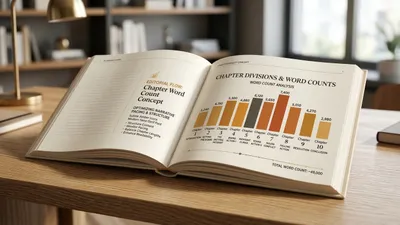
Most chapters run 1,500 to 5,000 words, with 3,000 to 4,000 being the most common range. Here’s how to calculate your chapter length:
Total word count / Number of chapters = Average chapter length
For an 80,000-word mystery with 25 chapters, that’s 3,200 words per chapter. For a 100,000-word fantasy with 30 chapters, that’s about 3,300 words each.
Your chapters don’t all need to be the same length. Thrillers often alternate between short, punchy chapters (1,000—2,000 words) and longer, more detailed ones (4,000—5,000 words). What matters is consistency in pacing, not uniformity in length.
Does Word Count Affect Publishing Success?
Word count alone won’t make or break your book. But hitting the wrong count can create unnecessary obstacles:
- Too short for your genre signals to agents that the story may be underdeveloped.
- Too long for a debut suggests the writer needs more editing experience.
- The right length removes one barrier between your manuscript and the agent’s “yes” pile.
Think of word count as a professional standard, not a creative constraint. A 95,000-word thriller won’t be rejected for hitting 95K instead of 80K. But a 200,000-word debut thriller will raise red flags.
For self-published authors, word count affects pricing, production costs, and reader satisfaction. A book that feels too short for its price generates negative reviews. A book that feels too long for its genre loses readers midway through.
Common Mistakes to Avoid
- Writing to a word count instead of a story. Hit the target naturally. If you’re padding scenes to reach 80K, the reader will feel it.
- Ignoring genre conventions. A 40,000-word epic fantasy won’t satisfy readers. A 150,000-word romance will exhaust them.
- Comparing your word count to outliers. Yes, The Lord of the Rings is 576,000 words. You’re not Tolkien yet. Aim for the genre standard.
- Obsessing over the first draft count. First drafts are rarely the right length. Some writers write short and expand. Others write long and cut. Both approaches work.
- Counting words before finishing the draft. Write the full story first. Adjust the word count during revision.
How Long Does It Take to Write a Novel?
The time to write a novel depends on your daily output and your target word count. At 1,000 words per day, here’s what the timeline looks like:
| Target Word Count | At 500 words/day | At 1,000 words/day | At 2,000 words/day |
|---|---|---|---|
| 60,000 | 4 months | 2 months | 1 month |
| 80,000 | ~5 months | ~3 months | ~6 weeks |
| 100,000 | ~7 months | ~3.5 months | ~2 months |
| 120,000 | 8 months | 4 months | 2 months |
These estimates cover first-draft writing only. Revision, editing, and polishing typically add 2—6 additional months depending on the depth of revision needed.
AI writing assistants like Chapter can accelerate the first-draft phase significantly. Authors using AI-assisted workflows report completing first drafts in a fraction of the typical timeline — while maintaining their voice and creative direction through guided editing.
Can You Write a Novel That Breaks the Rules?
Absolutely. The word count guidelines above are conventions, not laws. Published novels exist at every length:
- Under 40,000 words: The Great Gatsby by F. Scott Fitzgerald is approximately 47,000 words — close to the novella boundary. Animal Farm by George Orwell comes in under 30,000.
- Well over 150,000 words: A Storm of Swords by George R.R. Martin runs approximately 424,000 words. Les Miserables by Victor Hugo exceeds 500,000.
The pattern: shorter outliers are usually literary masterpieces where every word earns its place. Longer outliers are typically from established authors in genres that reward immersive depth.
If your novel naturally falls outside the standard range, don’t force it to conform. But if you’re a debut author seeking traditional publication, know that agents review hundreds of queries per week. A word count outside the expected range gives them an easy reason to move on.
FAQ
How many words is the average novel?
The average novel is 70,000 to 90,000 words, which equals roughly 250 to 350 printed pages. This range applies to most fiction genres including literary fiction, mystery, thriller, and romance. Fantasy and science fiction novels tend to run longer, averaging 90,000 to 120,000 words.
What is the minimum word count for a novel?
The minimum word count for a novel is 40,000 words, according to the Science Fiction and Fantasy Writers Association and the Hugo Awards classification system. Works between 17,500 and 40,000 words are classified as novellas, not novels.
How many pages is a 70,000-word novel?
A 70,000-word novel is approximately 280 pages in a standard printed book using a 6x9 trim size with standard margins and font. Page count varies based on formatting choices, font size, and trim size. Ebooks don’t have fixed page counts since text reflows to fit different devices.
Is 50,000 words enough for a novel?
Yes, 50,000 words qualifies as a novel. It falls within the accepted range for genres like category romance, young adult contemporary fiction, and some mysteries. However, 50,000 words is on the shorter side for most adult fiction genres, where 70,000+ words is the standard expectation.
How many words should a first novel be?
A first novel should be 70,000 to 90,000 words for most genres. Literary agents and publishers prefer debut manuscripts within this range because it demonstrates the author can tell a complete story without excessive padding. Fantasy and sci-fi debuts have more leeway, with 90,000 to 110,000 words being acceptable.