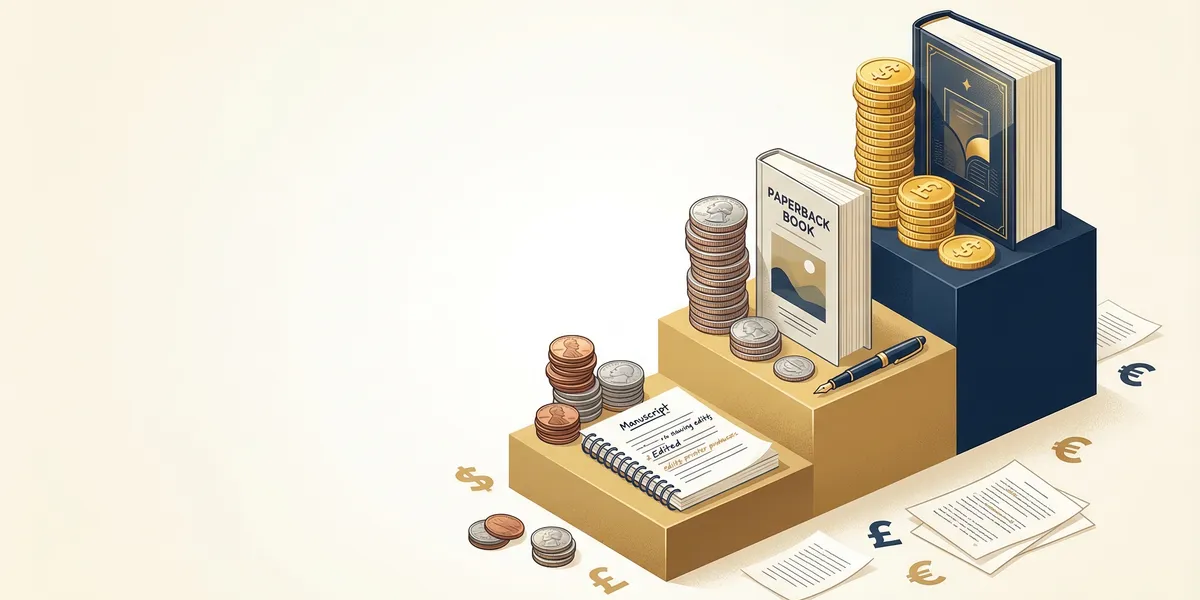
How much to self-publish a book depends entirely on what you’re willing to do yourself versus what you pay professionals to handle. The real range runs from $0 to over $5,000 — and the quality gap between those extremes is smaller than it used to be.
This guide breaks down self-publishing costs at three budget tiers so you can decide exactly where to invest based on your goals, genre, and timeline.
The three budget tiers at a glance
Before we dig into each category, here’s a quick overview of what authors typically spend at each level:
| Expense | Shoestring ($0–$500) | Mid-Range ($500–$2,000) | Premium ($2,000–$5,000+) |
|---|---|---|---|
| Writing | DIY or AI-assisted | DIY or AI-assisted | DIY + developmental feedback |
| Editing | AI tools + beta readers | Freelance copy editor | Dev edit + copy edit + proofread |
| Cover design | Pre-made or AI-generated | Custom from mid-tier designer | Top-tier genre designer |
| Formatting | Free tools or software | Formatting software | Professional formatter |
| ISBN | Free via KDP | Single purchase ($125) | 10-pack ($295) |
| Marketing | Organic only | Small ad budget + email | Full launch strategy |
| Total | $0–$500 | $500–$2,000 | $2,000–$5,000+ |
Now let’s break down what you actually get at each tier — and where the money matters most.
Writing your manuscript
The writing phase is where the budget tiers diverge least. Whether you spend $0 or $5,000, you still need to produce the words.
Shoestring ($0–$100). Write it yourself in Google Docs or use an AI writing tool. Chapter gives you a structured, chapter-by-chapter AI workflow for a one-time $97 investment — and that single purchase covers every book you write from that point forward. Compare that to hiring a ghostwriter at $2,000–$50,000 per manuscript.
Mid-range ($100–$500). Same as above. The writing itself doesn’t cost more at this tier. Some authors invest in a writing course or developmental feedback from a critique partner, but the manuscript production cost stays low.
Premium ($500–$2,000+). Authors at this level might hire a developmental editor to review their outline or first draft before they finish writing. A developmental assessment runs $500–$1,500 and can prevent structural problems that are expensive to fix later.
The takeaway: writing is the one phase where throwing money at the problem doesn’t automatically improve the result. Your ideas, voice, and effort matter more than your budget here.
Editing costs
Editing is where how much it is to self-publish a book varies the most — and where cutting corners hurts the most. According to Reedsy’s marketplace data, professional editing for an 80,000-word book ranges from $2,000 to $4,720 when you include developmental editing, copy editing, and proofreading.
But you don’t have to buy all three at every budget level.
Shoestring ($0–$100). Use AI editing tools like ProWritingAid ($30/month) or Grammarly for grammar, style, and readability checks. Pair that with 3–5 beta readers who read your genre. This won’t catch everything a professional editor would, but it catches the worst problems — and it’s dramatically better than publishing an unedited manuscript.
Mid-range ($300–$1,000). Hire a freelance copy editor through Reedsy or the Editorial Freelancers Association. Copy editing runs $500–$1,500 depending on word count and genre complexity. Use AI tools for the first pass so your editor can focus on the deeper issues. This is the sweet spot for most debut authors.
Premium ($1,500–$4,000+). Full editorial treatment: developmental editing ($1,000–$3,000) to fix structure and argument, copy editing ($500–$1,500) for sentence-level polish, and proofreading ($300–$800) as a final safety net. Fiction with complex worldbuilding and nonfiction with technical content benefit most from this investment.
If you wrote your book with Chapter, the structured chapter-by-chapter process produces cleaner drafts than dumping a single prompt into ChatGPT. That means your editing costs drop because the editor has less structural work to fix.
Cover design costs
Book covers are the number one factor in selling a book, according to the Alliance of Independent Authors. This is not the place to cheap out if you can help it.
Reedsy’s analysis of over 9,600 cover design projects puts the average professional cover at $880, with most landing between $625 and $1,250. Genre matters: fantasy and romance covers run closer to $1,100, while nonfiction covers average around $800.
Shoestring ($0–$200). Pre-made covers from services like 100Covers or GetCovers cost $75–$200. These are designed by professionals who understand genre conventions — a well-chosen pre-made looks significantly better than a DIY Canva cover. AI image generators can also create cover artwork for $20–$30/month, though you’ll want to understand your genre’s visual expectations before going this route. Learn more in our guide to how to design a book cover.
Mid-range ($300–$800). A custom cover from a mid-tier designer who specializes in your genre. This gets you an original design, typography that matches reader expectations, and a cover that doesn’t look like anyone else’s book. Find designers on Reedsy, 99designs, or through genre-specific author communities.
Premium ($800–$2,000+). Top-tier genre designers who study bestseller covers, understand current market trends, and produce covers that compete with traditionally published titles. At this level, you’re paying for market expertise as much as design skill.
Formatting and interior design
Formatting is what makes your book look professional when readers open it — chapter headings, margins, font choice, page numbers, and spacing all need to be right.
Shoestring ($0). Free tools like Reedsy’s Book Editor or Google Docs with a book template can produce a clean interior. The result is functional, if plain. For Kindle-only ebooks, formatting for Kindle is straightforward enough to handle yourself.
Mid-range ($50–$250). Formatting software like Atticus ($147 one-time) or Vellum ($250 one-time, Mac only) pays for itself after your second book. These tools produce both ebook and print-ready files with professional typography and layout. This is the best value in the entire self-publishing costs breakdown.
Premium ($300–$700). Hire a professional formatter for books with complex interior needs — heavy use of images, tables, sidebars, or unusual layouts. Cookbooks, children’s books, and heavily illustrated nonfiction fall into this category.
ISBN and distribution
Shoestring ($0). Amazon KDP provides a free ASIN, and platforms like Draft2Digital offer free ISBNs. You’re limited to those specific platforms, but for many authors starting out, that’s fine.
Mid-range ($125). A single ISBN from Bowker (the only U.S. source) costs $125 and lists you as the publisher. This matters if you want your book in bookstores, libraries, or distributed through IngramSpark.
Premium ($295). A 10-pack from Bowker at $295 covers your ebook, paperback, hardcover, and audiobook formats for multiple titles. If you’re planning a series or publishing career, this is the practical move.
Marketing and launch costs
Marketing is the most variable line item in your self-publish book budget, and it’s the one most debut authors underestimate.
Shoestring ($0–$100). Organic marketing: social media, a basic author website (free via WordPress.com or Carrd), email list building with a free MailerLite plan, and requesting reviews from readers. This approach is slow but costs nothing beyond time. Learn more strategies in our guide on how to market a self-published book.
Mid-range ($200–$1,000). Add a small Amazon Ads budget ($5–$10/day for 30 days = $150–$300), a BookBub Featured Deal submission (free to apply, high impact if selected), and a professionally designed author website. The Written Word Media 2025 survey found that authors with 10+ books see the steepest income ramp — so think of early marketing spend as learning what works for your genre.
Premium ($1,000–$3,000+). Full launch strategy: advance review copies to a curated list, Amazon Ads with professional management, newsletter swaps with established authors, a pre-order campaign, and possibly a publicist for media outreach. A general industry rule is to match your production budget for marketing over the first 12 months.
What most debut authors actually spend
The average self-published book costs about $2,000 to produce and market according to industry surveys. But averages hide a wide range. The ALLi 2025 Indie Author Income Survey found that the median self-published author earns $13,500 per year — outpacing the $6,000–$8,000 median for traditionally published authors.
That means your investment can pay off, but it typically happens over multiple books rather than from a single title. Authors who published 10+ books showed dramatically higher earnings than those with 1–3 titles.
The practical question isn’t “how much to self-publish a book” in isolation. It’s how much per book across a publishing career.
How to get premium quality at shoestring prices
Here’s what the cost breakdown above doesn’t fully capture: AI tools have collapsed the gap between budget and premium tiers in ways that didn’t exist even two years ago.
Our Pick — Chapter
Chapter is an AI book writing platform that handles the most expensive part of publishing — producing the manuscript — for a one-time $97 investment. Over 2,147 authors have used it to create more than 5,000 books, with real results: one author made $60,000 in 48 hours, another landed a $13,200 consulting client, and another scored a speaking gig for 20,000 people.
Best for: Authors who want to write and publish a professional-quality book without spending $2,000–$5,000 before they’ve earned a dollar. Pricing: $97 one-time (nonfiction) Why we built it: Most of the cost in self-publishing comes from producing the manuscript and fixing its problems. Chapter’s structured AI workflow produces cleaner first drafts, which means less editing, faster timelines, and more money left for the things that actually move sales — like a great cover.
Pair Chapter ($97) with a pre-made cover ($100–$200), formatting software like Atticus ($147), and a free KDP account, and you have a professionally produced book for under $500 that competes with books that cost $3,000+ to produce.
Common mistakes to avoid
- Skipping editing entirely. Even at the shoestring level, you need beta readers and AI editing tools at minimum. Unedited books get one-star reviews that tank your visibility permanently.
- Overspending on marketing before your book is ready. Driving traffic to a book with a bad cover or typo-filled sample pages wastes every dollar. Fix the product first.
- Buying a single ISBN when you’ll need more. If you’re publishing in multiple formats or planning a second book, the 10-pack saves money immediately.
- Ignoring genre cover conventions. A beautiful cover that doesn’t match reader expectations for your genre will underperform an average cover that does. Study the top 20 books in your Amazon category before designing.
- Treating marketing as optional. Even the best book doesn’t sell itself. Budget at least your time — and ideally some money — for visibility from day one.
FAQ
Can I self-publish a book for free?
Technically, yes. Amazon KDP charges nothing to publish, and you can write, edit, format, and design a cover yourself. But free almost always means lower quality, which means fewer sales and worse reviews. A more realistic floor is $100–$300 for AI tools and a pre-made cover.
What’s the single most important thing to spend money on?
Your book cover. It’s the first thing readers see, and the Alliance of Independent Authors calls it the number one factor in book sales. If you can only afford one professional service, make it this one.
How much do traditionally published authors spend?
Traditional authors typically pay nothing upfront — the publisher covers editing, design, and distribution. But they give up 85–90% of royalties and most creative control. Self-published authors on Amazon KDP keep up to 70% of royalties while controlling every decision.
Does spending more guarantee more sales?
No. A $5,000 book with no marketing will sell fewer copies than a $500 book with a strong launch strategy. The self-publishing vs traditional comparison shows that what matters most is product-market fit, cover quality, and consistent publishing — not raw production budget.
How much should I budget for my first book?
For most debut authors, $500–$1,500 hits the sweet spot. That covers a professional or pre-made cover ($100–$800), formatting software ($147–$250), and either professional copy editing or AI tools plus beta readers. Add Chapter ($97) for the writing phase and you’re producing a competitive book for well under $2,000.