You can become a working ghostwriter in 2026 — even without a published book under your own name. The global freelance writing market is projected to reach $13.8 billion by 2033, and ghostwriting is one of its fastest-growing segments.
In this guide, you’ll learn:
- How to land your first ghostwriting client (even with zero experience)
- What to charge per word, per project, and per book
- How to structure contracts that protect you and your client
- The niches where ghostwriters earn the most in 2026
Here’s the step-by-step process for building a ghostwriting career from scratch.
What Is a Ghostwriter?
A ghostwriter is a professional writer who creates content on behalf of another person, who then publishes it under their own name. You write the words. They get the credit.
Ghostwriters work on everything from full-length nonfiction books and memoirs to blog posts, speeches, thought leadership articles, and social media content. The Bureau of Labor Statistics reports a median annual wage of $73,690 for writers and authors — but top ghostwriters who specialize in book-length projects earn significantly more.
The difference between ghostwriting and co-authoring is simple: ghostwriters remain anonymous. Your name doesn’t appear on the cover, in the acknowledgments, or anywhere else. That anonymity is what clients pay a premium for.
How to Become a Ghostwriter: 7 Steps
Step 1: Sharpen Your Writing Skills
You don’t need an MFA or a journalism degree. You do need the ability to capture someone else’s voice and turn their ideas into polished prose.
Start by writing consistently — blog posts, essays, short stories, anything that builds your range. Pay special attention to voice mimicry: read a chapter of someone’s existing writing, then try to write the next chapter in their style. This skill separates ghostwriters from regular freelance writers.
Take on free or low-paid projects early to build reps. Write guest posts for industry blogs. Volunteer to help a local nonprofit with their annual report. Every piece you complete is training for the paid work ahead.
Step 2: Choose a Profitable Niche
Generalist ghostwriters compete on price. Specialists compete on expertise — and they charge 50-200% more because they deliver better results faster.
The highest-paying ghostwriting niches in 2026 include:
- Business and leadership books — CEOs and executives pay $25,000-$80,000+ for a business book ghostwriter
- Memoir and autobiography — everyone has a story, and memoir ghostwriting demand keeps growing
- Health and wellness — doctors and practitioners need credentialed writers
- Thought leadership content — LinkedIn posts, newsletters, and articles for busy professionals
- eBook ghostwriting — lower barrier to entry, high volume of clients
Pick a niche where you have genuine interest or background knowledge. A former nurse writing health books will always outperform a generalist trying to fake medical expertise.
Step 3: Build a Portfolio That Proves Your Range
Here’s the ghostwriter’s paradox: your best work has someone else’s name on it. So how do you prove you can write?
Create spec samples. Write a mock memoir chapter, a sample business book introduction, and a thought leadership article. These don’t need to be for real clients — they just need to demonstrate your ability to write in different voices.
Publish under your own name. Start a blog, write for Medium, or contribute guest posts to industry publications. This builds your public writing portfolio while proving you can produce quality content consistently.
Request testimonials, not bylines. When you complete ghostwriting projects, ask clients for testimonials that describe the experience of working with you — without revealing what you wrote. “Working with [your name] was seamless. They captured my voice perfectly and delivered ahead of schedule” is worth more than any byline.
Step 4: Set Your Ghostwriting Rates
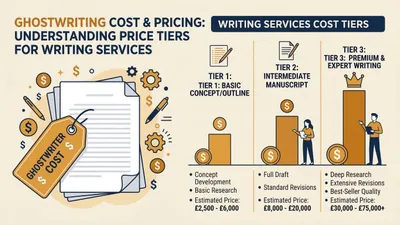
Your rates depend on your experience, niche, and project type. Here’s what the market looks like in 2026 for ghostwriting rates per word:
| Experience Level | Per Word | Per Project (50K-word book) | Hourly |
|---|---|---|---|
| Entry-level | $0.50-$1.00 | $25,000-$50,000 | $30-$75 |
| Intermediate | $1.00-$2.00 | $50,000-$100,000 | $75-$150 |
| Expert/Specialized | $2.50-$5.00 | $125,000-$250,000 | $150-$250+ |
Project-based pricing works best for ghostwriters. Hourly rates punish you for being fast and efficient. Per-word rates undervalue the research, interviews, and revision work that makes up 40-60% of a book project.
Most professional ghostwriting services charge a flat project fee with milestone payments: 25-40% upfront deposit, then payments tied to outline approval, first draft delivery, and final manuscript.
The AI Alternative — Chapter
Not every author needs a human ghostwriter. Chapter’s AI book writing software helps you write a full-length book for a one-time $97 — a fraction of the $25,000+ a traditional ghostwriter charges. You keep full creative control, and AI handles the heavy lifting of drafting and structuring your manuscript.
Best for: Authors who want to write their own book with AI assistance rather than hand the project to someone else entirely.
Step 5: Find Your First Ghostwriting Clients
Landing your first client is the hardest part. After that, referrals and word-of-mouth do most of the work. Here’s where to start:
Freelance platforms. Reedsy, Upwork, and Fiverr have active ghostwriting markets. The rates start lower, but they’re excellent for building your client roster and collecting reviews.
Publishing industry connections. Literary agents, book coaches, and publishers regularly refer clients to ghostwriters. Attend writing conferences, join the Association of Ghostwriters, and network with publishing professionals.
LinkedIn outreach. Executives, coaches, and consultants who want to publish books are all on LinkedIn. Share writing tips, publish articles about the ghostwriting process, and position yourself as an expert. Inbound leads will follow.
Content agencies. Many content and ghostwriting agencies hire freelance ghostwriters for client projects. The per-word rates are lower than direct clients, but the work is steady and you don’t have to find clients yourself.
Your existing network. Tell everyone you know that you’re available for ghostwriting work. The person who hires you might not be someone you expect — it could be a friend’s boss, a neighbor who’s retiring, or a former colleague who just started a consulting firm.
Step 6: Master the Client Interview Process
Great ghostwriting starts with great interviews. Your job is to extract your client’s knowledge, stories, and voice — then organize it into a compelling manuscript.
Before the first interview:
- Research your client’s background, publications, and public speaking
- Prepare 15-20 open-ended questions
- Set up reliable recording equipment (Zoom, Otter.ai, or a dedicated recorder)
During interviews:
- Ask “tell me about a time when…” questions to pull out stories
- Listen for the phrases and cadences your client uses naturally
- Don’t interrupt — let them talk, then follow up on the most interesting threads
After interviews:
- Transcribe everything within 24 hours
- Highlight the strongest stories, quotes, and insights
- Create a chapter-by-chapter outline based on what emerged
Plan for 10-20 hours of interviews for a standard book project. Some ghostwriters front-load all interviews before writing. Others alternate — interview, write a chapter, interview again. Find the rhythm that works for you and your client.
Step 7: Deliver a Manuscript That Exceeds Expectations
The final step is execution. A professional ghostwriter delivers on time, within scope, and in their client’s authentic voice.
Structure your delivery in milestones:
- Detailed outline (client approves before you write a word)
- Sample chapter (proves you’ve nailed the voice)
- First draft (complete manuscript, rough edges included)
- Revised draft (incorporating client feedback)
- Final manuscript (polished, formatted, ready for editing or publishing)
Build in revision rounds at each milestone. Two to three rounds per milestone is standard. Unlimited revisions are a red flag — they signal scope creep and a client who doesn’t know what they want.
Ghostwriting Rates Per Word: What to Charge in 2026
Ghostwriting rates per word range from $0.50 to $5.00+ depending on your experience level, niche, and project complexity. The average rate for a mid-career ghostwriter working on book projects is $1.50-$2.50 per word.
But per-word pricing doesn’t tell the whole story. A 50,000-word business book might require 40 hours of interviews, 10 hours of research, and 15 hours of revisions on top of the actual writing time. Smart ghostwriters price the total project, not just the word count.
Factors that increase your rate:
- Technical or specialized subject matter
- Tight deadlines (rush fees of 25-50% are standard)
- Celebrity or high-profile clients
- Projects requiring extensive research or travel
- Freelance book writing with publishing support included
Factors that decrease your rate:
- You’re building your portfolio (first 2-3 projects)
- The client provides extensive notes, outlines, or recordings
- It’s a repeat client with an established working relationship
- The content is straightforward (blog posts vs. a complex memoir)
Track your hours on your first few projects to calculate your effective hourly rate. If you’re earning less than $50/hour after accounting for all project time, your rates are too low.
Ghostwriting Contract Template: What Every Agreement Needs
A ghostwriting contract protects both you and your client by defining the scope, timeline, payment terms, and ownership of the finished work. Never start a project without one.
Every ghostwriting contract should include these essential elements:
Scope of Work
Define exactly what you’re delivering: word count, number of chapters, revision rounds, and format. A 60,000-word manuscript based on five recorded interviews is a clear scope. “Write a book about leadership” is not.
Payment Schedule
Structure payments around milestones, not calendar dates:
- 25-40% deposit before any work begins
- 25-30% on outline approval
- 25-30% on first draft delivery
- 10-15% on final manuscript acceptance
Ownership and Rights Transfer
The contract must explicitly state that all rights transfer to the client upon final payment. You wrote it, but they own it. This is non-negotiable in ghostwriting.
Confidentiality and NDA
Your ghostwriting contract should include a confidentiality clause that prevents you from disclosing that you wrote the work, sharing the client’s private information, or using excerpts without written permission. A separate NDA may be required for high-profile clients.
Revision Terms
Specify the number of revision rounds included (two to three is standard). Define what constitutes a “revision” versus a “rewrite” — and what additional rewrites cost.
Kill Fee and Termination
If the project falls apart midway, you need a kill fee clause. Standard practice: the client pays for all completed milestones plus 25-50% of the next milestone’s fee.
For a deeper dive into how much ghostwriters cost, check our complete pricing guide.
Ghostwriting vs Co-Authoring: Which Path Is Right for You?
Ghostwriting and co-authoring are two different career paths with different tradeoffs. The right choice depends on whether you value income or recognition more.
| Factor | Ghostwriting | Co-Authoring |
|---|---|---|
| Credit | None — client’s name only | Shared — “with” or “and” on cover |
| Pay | Higher upfront fees | Lower upfront, but possible royalties |
| Creative control | Client has final say | Shared decision-making |
| Portfolio building | Can’t show the work publicly | Can add to your published bibliography |
| Client relationship | Service provider | Creative partner |
Choose ghostwriting if you want maximum income per project, prefer clearly defined client-contractor relationships, and don’t need public credit for your work.
Choose co-authoring if you want to build your published bibliography, are willing to accept lower upfront pay for potential royalties, and enjoy collaborative creative partnerships.
Many successful writing careers blend both. You might ghostwrite business books for income while co-authoring a passion project with a subject matter expert.
How Long Does It Take to Become a Ghostwriter?
You can land your first paid ghostwriting project within 4-8 weeks if you already have strong writing skills. Building a full-time ghostwriting career with consistent income typically takes 6-12 months.
Here’s a realistic timeline:
- Weeks 1-2: Choose your niche, create spec samples, set up your website and LinkedIn
- Weeks 3-4: Start pitching on freelance platforms and networking with industry contacts
- Months 2-3: Complete your first 1-2 projects, collect testimonials
- Months 4-6: Raise your rates, get referrals from satisfied clients
- Months 6-12: Build a steady pipeline of clients and projects
The biggest accelerator is specialization. A generalist ghostwriter competes with thousands of other writers. A ghostwriter who specializes in memoir ghostwriting for retiring executives has a fraction of the competition and can charge premium rates from day one.
Can AI Replace Ghostwriters?
AI writing tools have changed the ghostwriting landscape, but they haven’t replaced human ghostwriters. They’ve created a two-tier market.
For straightforward content — blog posts, articles, standard nonfiction — tools like Chapter’s AI writing platform help authors write their own books without hiring a ghostwriter at all. Over 10,000 authors have used Chapter to create books, and the platform has been featured in USA Today and the New York Times.
For complex, voice-driven projects — celebrity memoirs, thought leadership books, deeply personal stories — human ghostwriters remain irreplaceable. No AI can replicate the interview process, the relationship-building, or the nuanced voice capture that makes great ghostwriting invisible.
Smart ghostwriters in 2026 use AI as a tool, not a competitor. They use AI ghostwriting tools to speed up research, generate rough outlines, and handle first-pass editing — then apply their human skills to the parts that matter most.
Common Mistakes New Ghostwriters Make
Avoid these pitfalls as you build your ghostwriting career:
- Undercharging to win projects. Low rates attract difficult clients and burn you out. Price based on value, not desperation.
- Skipping the contract. Every project needs a written agreement — even work for friends and family. Especially work for friends and family.
- Writing in your voice instead of the client’s. Your job is to disappear. If the finished manuscript sounds like you, you’ve failed.
- Taking on projects outside your expertise. Writing a medical textbook when your background is creative fiction will produce mediocre work and damage your reputation.
- Not setting boundaries on revisions. Without clear revision limits, a single project can drag on for months. Define “done” in your contract.
How Much Do Ghostwriters Make Per Year?
How much ghostwriters make per year depends on their experience, niche, and volume of projects. Full-time ghostwriters in the United States earn between $40,000 and $150,000+ annually, with the top earners specializing in book-length projects for corporate clients.
The Bureau of Labor Statistics reports the median annual wage for writers and authors at $73,690. Ghostwriters who focus on high-ticket book projects — business books, memoirs, thought leadership — often exceed this, completing 2-4 books per year at $25,000-$80,000 each.
Your earning potential increases dramatically with specialization. Ghostwriters who focus on a specific niche and build a reputation within that industry can command premium rates and attract clients through referrals alone.
What Skills Do You Need to Be a Ghostwriter?
The skills you need to be a ghostwriter go beyond basic writing ability. You need to capture another person’s voice, manage complex projects, and maintain confidentiality throughout the process.
Essential ghostwriting skills include:
- Voice mimicry — adapting your writing style to match each client
- Active listening — conducting interviews that extract the best stories and insights
- Research — diving deep into unfamiliar subjects quickly
- Project management — juggling deadlines, milestones, and client communication
- Discretion — keeping your involvement completely confidential
- Thick skin — accepting extensive revisions without taking them personally
You also need strong book writing fundamentals. Understanding narrative structure, pacing, chapter organization, and audience awareness separates professional ghostwriters from amateur writers-for-hire.
FAQ
How much do ghostwriters charge per book?
Ghostwriters charge between $25,000 and $250,000+ per book depending on the project’s complexity, the ghostwriter’s experience level, and the client’s budget. A standard 50,000-word nonfiction book from a mid-level ghostwriter typically costs $25,000-$80,000, including interviews, research, writing, and two to three rounds of revisions. Check our complete ghostwriting rates guide for detailed pricing.
Do you need a degree to become a ghostwriter?
No, you do not need a degree to become a ghostwriter. Most successful ghostwriters build their careers through writing experience, a strong portfolio, and client referrals rather than formal education. While degrees in English, journalism, or creative writing can provide useful skills, clients care about your ability to capture their voice and deliver a polished manuscript — not your academic credentials.
Is ghostwriting legal and ethical?
Yes, ghostwriting is completely legal and ethical when both parties enter a clear contractual agreement. The client pays for the work, the ghostwriter transfers all rights, and both sign a confidentiality agreement. Ghostwriting has been a standard practice in publishing for decades — many bestselling books, speeches, and articles are ghostwritten.
How do ghostwriters find clients?
Ghostwriters find clients through freelance platforms like Reedsy and Upwork, publishing industry networking, LinkedIn outreach, content agencies, and referrals from past clients. The most effective strategy combines active prospecting with building an online presence that attracts inbound inquiries. After your first few successful projects, word-of-mouth referrals often become your primary source of new business.
Can I ghostwrite using AI tools?
Yes, many ghostwriters in 2026 use AI writing tools to streamline research, outlining, and first-draft generation. Tools like Chapter help with structuring manuscripts and generating draft content. However, the core ghostwriting skills — client interviews, voice capture, and editorial judgment — remain human tasks. Using AI responsibly can increase your output without sacrificing quality.