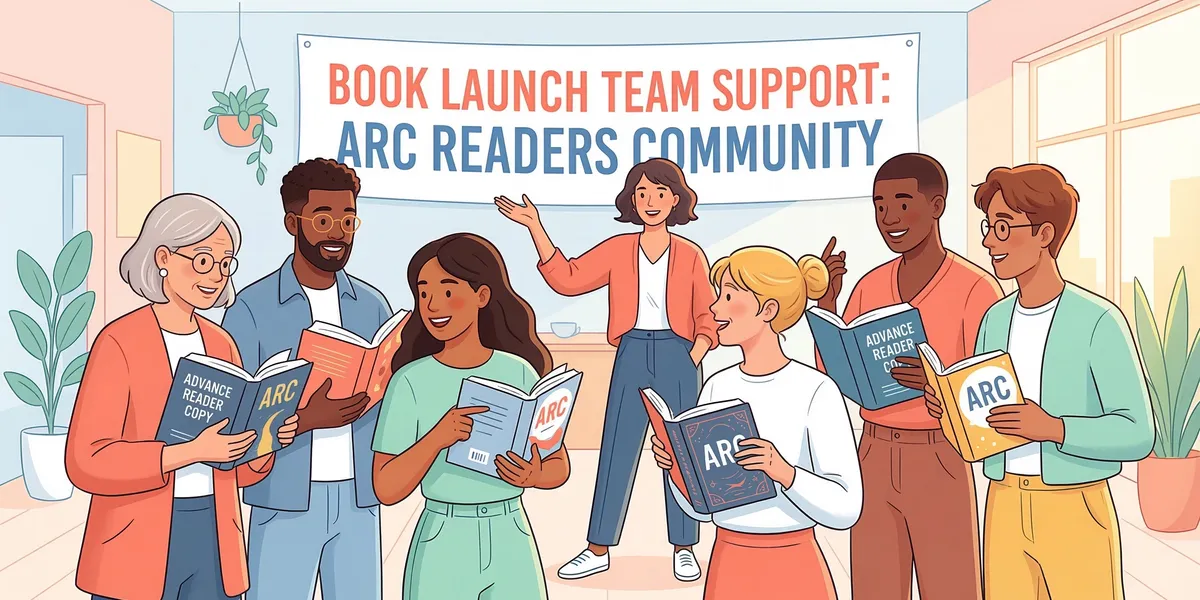
A book launch team is a group of advance readers who receive your book before publication, read it, and post honest reviews during launch week. Those early reviews are the difference between a book that converts browsers into buyers and a book with zero social proof that no one trusts enough to purchase.
This guide covers how to recruit your team, manage the process, and turn launch day into a review-generating engine.
Why launch teams matter
Amazon’s algorithm weighs early sales velocity and review count when deciding where to rank your book. A book that launches with 15 to 25 honest reviews in the first week signals to the algorithm and to browsing readers that this book is worth attention.
According to a Spiegel Research Center study, products with reviews are 270% more likely to be purchased than those without. For books specifically, the first 10 to 25 reviews create a trust threshold that dramatically increases conversion rates on your Amazon listing.
Without a launch team, most self-published authors launch to zero reviews and zero sales, then spend weeks trying to build social proof from a standing start. A launch team solves this problem before your book goes live.
How many people you need
Target: 20 to 50 team members.
Not everyone on your launch team will follow through. Expect a 40 to 60 percent completion rate for reviews. If you recruit 40 people and 50 percent leave reviews, you launch with 20 reviews. That is a strong starting position.
For a first launch with no existing audience, even 10 to 15 committed reviewers is a meaningful advantage over launching with zero.
| Launch Team Size | Expected Reviews (50% completion) | Launch Impact |
|---|---|---|
| 10 members | 5 reviews | Minimal but helpful |
| 25 members | 12-15 reviews | Strong foundation |
| 50 members | 25-30 reviews | Excellent social proof |
| 100+ members | 50+ reviews | Premium launch (established authors) |
How to recruit your launch team
Your email list
Your most reliable source. These are people who already opted in to hear from you. Send a dedicated email explaining what a launch team is, what you are asking (read the book, leave an honest review), and what they get (a free advance copy before anyone else).
If you have been building an author platform and growing a list through a reader magnet, your subscribers are pre-qualified fans of your work.
Social media followers
Post across your platforms asking for launch team volunteers. Be specific about what you need: “I am looking for 30 readers who will read my new [genre] book and post an honest review on Amazon during launch week. You will get a free advance copy 4 weeks before release. Comment ‘I’m in’ if interested.”
The specificity matters. Vague asks get vague responses.
Writing groups and communities
Facebook groups, Reddit communities (r/selfpublish, genre-specific subreddits), and author forums often have members willing to join launch teams, especially in romance, fantasy, and thriller communities.
Be upfront that you are recruiting for your launch team. Most communities have rules about self-promotion, so frame it as an invitation rather than an advertisement.
Friends and family (with a caveat)
Friends and family who actually read your genre can be valuable launch team members. Friends and family who do not read your genre will either not finish the book or leave vague reviews that do not help future buyers.
Be selective. A review from someone who clearly did not read the book (“Great job! So proud of you!”) can hurt credibility more than it helps.
What to give your launch team
The ARC (Advance Reader Copy)
Your ARC is a pre-publication copy of your book. It should be fully edited and formatted, identical to what readers will buy on launch day except for the addition of an “Advance Reader Copy” notice on the copyright page.
Deliver ARCs 4 to 6 weeks before your publication date. This gives readers enough time to finish the book and write a review before launch day.
ARC delivery methods
BookSprout. BookSprout is purpose-built for ARC management. It distributes ARCs in all formats, tracks who has downloaded and reviewed, and sends review reminders. Free for up to 5 team members; paid plans for larger teams.
BookFunnel. BookFunnel delivers ebooks to any device and format. You create a private download page and share the link with your team. It does not track reviews, but it handles delivery seamlessly.
StoryOrigin. StoryOrigin combines ARC delivery with review tracking and cross-promotion tools. It can automatically track whether a team member has left a review.
Direct email. For small teams, attaching an epub or PDF to an email works. This is the simplest approach but offers no tracking.
Clear instructions
When you send the ARC, include a short message covering:
- Thank you for joining the launch team
- The publication date and when you need the review posted
- Where to post the review (Amazon and optionally Goodreads)
- A reminder that you want their honest opinion (Amazon requires this)
- A brief review guide: what to include (what they liked, who should read this book, how the book made them feel) without dictating what to say
Managing your launch team
Create a communication channel
A dedicated space keeps your launch team engaged and makes coordination easier. Options:
- Facebook group (private group for team members only)
- Discord server (works well for authors with engaged online communities)
- Email sequence (if your team is less tech-savvy or smaller)
Use this channel to share behind-the-scenes updates, cover reveals, excerpts, and countdown posts. The more invested your team feels in the process, the more likely they are to follow through.
Send reminders at key milestones
4-6 weeks before launch: Send ARC. Thank them for joining. 2 weeks before launch: Check in. Ask if anyone has questions or feedback. 1 week before launch: Remind them of the publication date and that reviews should go live during launch week. Launch day: Share the Amazon link. Make it easy for them to click and review. 3 days after launch: Follow up with anyone who has not yet posted a review. Keep the tone appreciative, not pushy.
Handle honest negative feedback gracefully
You asked for honest reviews. Some will be less than five stars, and that is actually good. A book with nothing but five-star reviews looks suspicious to readers and to Amazon. A mix of four and five-star reviews with genuine, detailed feedback is more credible and converts better.
If a team member gives you private feedback about issues in the book, thank them and fix the problems before launch day if possible.
Getting reviews on Amazon and Goodreads
Amazon review guidelines
Amazon requires that reviewers have spent at least $50 on their account to leave reviews. Inform your launch team about this requirement so members who have new or lightly used Amazon accounts can prepare.
Amazon also prohibits incentivized reviews. Providing a free ARC in exchange for an honest review is allowed. Providing payment, gifts, or requiring a positive review is not.
Goodreads reviews
Goodreads reviews help discoverability on that platform and add social proof that carries weight with avid readers. Ask your launch team to also post their review on Goodreads, especially if they already have accounts there.
Goodreads allows reviews before a book’s publication date, which means your launch team can post Goodreads reviews while reading and before your Amazon launch.
What makes a helpful review
Coach your team on writing useful reviews without scripting their words. Helpful reviews typically include:
- What the book is about in one or two sentences (without spoilers)
- What the reviewer liked most
- Who would enjoy this book
- An honest assessment of any limitations
- A star rating that matches their overall experience
After launch day
Your launch team’s value does not end after the first week. Treat them well and they become your permanent street team for future releases.
- Thank every team member personally
- Give them first access to your next book
- Recognize their contribution publicly (with their permission)
- Offer them ongoing involvement in cover reveals, title voting, and beta reading
Authors with strong launch teams for their book launch checklist process often find that the team grows organically. Satisfied launch team members recruit friends who read the same genre.
Common mistakes to avoid
- Sending unedited ARCs. Your ARC should be publication-ready. Typos and formatting issues lead to negative reviews about quality rather than content.
- Not giving enough reading time. Four weeks minimum. Rushing your team leads to unread books and no reviews.
- Expecting all five-star reviews. Honest three and four-star reviews are more valuable than suspicious five-star reviews. Embrace the mix.
- Recruiting people who do not read your genre. A thriller reader on your romance launch team will not enjoy the book and either will not review it or will leave an unhelpful review.
- Failing to follow up. People are busy. A gentle reminder during launch week significantly increases review completion rates.
FAQ
Is it against Amazon’s rules to have a launch team?
No. Amazon explicitly allows authors to provide free advance copies in exchange for honest reviews. The key word is “honest.” You cannot require positive reviews, offer compensation for reviews, or dictate what reviewers should write. Amazon’s community guidelines cover this in detail.
How do I handle a team member who leaves a one-star review?
Thank them for their honesty. Do not ask them to change it, delete it, or soften it. Attempting to manipulate reviews violates Amazon’s terms and can get your book removed. A single low review among many positive ones will not significantly impact sales. Readers expect some variation.
Can I use the same launch team for every book?
Yes, and you should build on it. Your core team members from previous launches are your most reliable reviewers for future books. Add new members with each launch to keep the team growing. Many successful authors maintain a permanent “street team” that gets ARCs for every new release.